Sunday, June 29, 2014

In Anno Septimo


Today, June 29th, 2014, is the seventh anniversary of the founding of this blog, which was begun on the Feast of Sts. Peter and Paul in 2007 by Anselm and myself. Even that founding was in a sense a re-founding, as I had originally launched Unam Sanctam Catholicam back in 2004 on the ancient blogger platform with some posts about morality and one about Chesterton. But as I did not have a lot of time and as blogs were fairly new back then, I let it linger for three years until Anselm turned me on to traditionalist Catholic blogs by introducing me to the New Liturgical Movement and Athanasius Contra Mundum. To date, this blog has 972 posts, and the sister site close to 500, which have together been visited 810,000 times. Deo gratias.

The anniversarial posts on this blog are usually occasions for announcing new or upcoming features on the blog and website. To that end, I have two announcements:

The first, I will most likely be in seclusion for the next month or so. I have a lot going on in my personal life and may not get around to blogging as much. Maximus and Noah will no doubt have some posts, but probably  not so much on my end, especially on the website, where posts are of a little bit greater depth. I still have a few things I may throw out that I have been working on, but in general I have to devote some time to my "real" life for the next month and will be on here only sparsely.

Second, and perhaps more exciting: In the introduction to this post, I mentioned the blog of Ryan Grant, Athanasius Contra Mundum, which went defunct in Easter, 2011. This blog was a wonderful resource of scholarly traditionalist thought and was instrumental in persuading me to take up blogging. He actually really established this blog's first readership by linking to an article I did on St. Louis IX; that was the first of many links from traditionalist blogs and sites that helped establish the reputation of USC.

Over time I made the acquaintance of Mr. Grant and he even invited me to contribute to his site, which was a blessing. Several of Ryan's articles have been republished on the USC sister site (see here, here, here and his work on Sedevacantism here). Ryan did not disappear after the closing of ACM; he posted for a time on Distributist Review and briefly surfaced again last summer on the wonderful but short lived experiment in professional traditionalist apologetics, the now defunct Faithful Answers.

I am happy to say that after a three and a half year hiatus, Ryan has returned to the blogosphere with a full relaunch of Athanasius Contra Mundum. The new Athanasius Contra Mundum, available here and this time on a Wordpress platform, retains several stylistic elements of the old site but with the greater versatility offered by Wordpress. I have to warn you, there is not a ton of content on the site yet, but Ryan assures me that things will be moving on quickly.

We rejoice at the return of Ryan Grant to the Catholic blogosphere and look forward to more good things to come from Athanasius Contra Mundum. Special thanks also to Noah, Maximus, John, Thrownback, Anselm and all contributors, as well as Rorate Caeli, Catholic Faith in Light of Tradition, Veneremur Cerui, Popin' Ain't Easy, and Phil Blosser who faithfully link to this site from time to time. Special thanks to our partner in providing audio resources for traditional Catholics, Alleluia Audio Books. Apologies if I am forgetting anyone.

May the good Lord bless us and have mercy on our souls, and may the great Saints Peter and Paul, whose spilling of blood established the double-apostolic origin of the most Holy See of Rome, intercede for us and for Holy Mother Church. Petrus et Paulus, ora pro nobis!

Thursday, June 26, 2014

Christ and Superheroes

Friends,

Superheroes sure have become popular today. Our superheroes today, whether they are mutants, aliens, the ultra-rich, or genetically engineered whatevers, seem to be similar to the Greek gods more and more.

One of the interesting things that many of our modern heroes have are veiled identities. Even though they are the same person, their mask in a way seems to not only amplify their character, but is a source of power to them.  When appearing in public, the mask becomes a remembrance of their past great deeds, as well as a source of fear to their enemies.

Our hearts race with affection and our minds are captivated by the tension introduced between the mask and the wearer.  

I have probably already given away where I am going with this.

Has God prepared the human heart to love something hidden?  I think so.  Let's look at how a real God desires to spend His time amongst men: hidden but present under the appearance of bread and wine.   The Faith in which we see our God in Holy Communion amplifies His character, humility, long suffering, meekness, and perfect charity.  

Are we captivated by the mystery of Him in Holy Communion?  When we see the Corpus, do we remember His great past deeds?

Superheroes fight their enemies, they even occasionally sacrifice themselves to save others from death. Our Lord, however, gave Himself up into the hands of those who hated Him; He suffered and died for us while we were still His enemies. Everyday He continues to offer Himself to His enemies (those priests and laity who receive Him unworthily in Holy Communion) so that He can feed the few faithful.

Is there less fervor because He doesn't sweep in and save like a superhero? There shouldn't be, as He has used His mighty power again and again throughout history.


A priest who was offering the Holy Sacrifice of the Mass in this chapel, during the consecration and elevation of the chalice, permitted himself to doubt the Real Presence of the Blood of Christ. At the same moment the image of the Crucified, which stood before him on the altar, stretched out His arm and took the chalice out of his hand. In fear he started back, repented of his doubt, and the hand of the Crucified gave him back the chalice.  Ancient Eucharistic Miracles

A woman who had lapsed in the same manner desired to open the coffer in which she kept the portion of the consecrated Bread which had been given her in the church. In times of persecution it was customary for the faithful to receive the Holy Sacrament in their hands, in order that they might take it to their houses, and, in the event of sudden capture, be so enabled to strengthen themselves. Now when that woman came to open the coffer a flame of fire issued forth, and drove her away in fear.  An Excerpt from: Ancient Eucharistic Miracles

In both of these instances, our Lord's dramatic action was to save this unfortunate woman and tempted priest from committing horrible sins.  There are more stories in our new audiobook on ancient miracles of the Blessed Sacrament that surpass the power of a superhero.  The difference, though, is this: Our Lord is animated by a desire to save our souls, while the subject of our cinematic heroes most of the time centers around saving our bodies.

I think one story from the new audiobook illustrates this particularly well: one of a priest and his two altar servers.  The altar servers are favored by a mystical visit from the Christ Child regularly whom they share their small lunch with, after several of these visits complain to the priest that the Christ Child never brought food to share.  The Priest upon hearing this tells them to ask the Christ Child if they could all dine with Him at His Father's House.  When the boys relay this request to the Christ Child, Our Lord became very happy and told them the date at which they would all dine together.  Needless to say after celebrating Mass on that day, the three companions while having their heads bowed in prayer, died a most happy and peaceful death.

Superheroes in our movies can perhaps delay our deaths through saving us from disaster, but they do not conquer death like Christ. Perhaps that is why the world loves superheroes so much, because the modern superhero's mission is to of prevent death. Death, the thing that mankind with a guilty conscience fears so much.

You and I, dear reader, have been called to a greater mission than saving the world: to join with Christ in saving souls; we must assist in saving souls from eternal death.  To save our life we must lose it, to become godly heroes we must not embrace ourselves, but Christ.  

Modern superheroes might be more and more resembling demigods, but you and I every day can more and more resemble the true and living God.

O Eucharistic Heart of Jesus, Make Our Hearts Like unto Thine.


Sunday, June 22, 2014

Corpus Christi and the Church of the World


The good ole days

This weekend my mother attended a Corpus Christi procession at a parish that is not her regular parish. She passed on to me the booklet the congregation used for the procession prayers, a composition called the "Litany of Lament for Sins Against the Body of Christ." As I read the prayers, I soon realized that these prayers were of such banal hilarity as to merit being the subject of a post. I should note, this came from a parish that is not known as a particularly progressive or dissenting parish; this is just your typical EWTN-watching, Fr. Barron-loving, Medjugorje-affirming fairly orthodox parish from American Novus Ordo Land.

I have omitted the customary prayers at the beginning of the litany (the "Lord have mercy, Christ have mercy, etc). I present, the "Litany of Lament for Violations Against the Body of Christ", followed afterwards by my comments.

FOR SINS AGAINST THE BODY OF CHRIST IN THE WORLD

For those times when we have failed to welcome the stranger or have been silent about immigration reform, Lord have mercy.

For those times when we have been silent about political issues, especially those that threatened religious liberty, Lord have mercy. [Laughable, because these same priests who are bewailing being silent about political issues would rather walk on hot coals than criticize Obama or say anything even remotely contoversial]

For silence by too many members of the Church while fifty-five million lives wee lost to abortion, Lord have mercy.

For those times in our history when we have not spoken out against slavery, segregation, or persecution, Lord have mercy.

For those times and in those places we have ignored those in prison and the needs of their families, Lord have mercy.

For ignoring genocide in our world - by starvation, by brutal atrocities, and by civil and military actions, Lord have mercy.


FOR SINS AGAINST THE BODY OF CHRIST DUE TO ABUSE

For the sins of Church ministers who sexually abused children, Lord have mercy.

For the failings of those in hierarchy who failed to remove offenders from parish positions, Lord have mercy.

For the irreparable harm caused by victims of abuse, Lord have mercy. [one wonders if the harm is "irreparable", what is the purpose of this prayer of reparation?]

For all those times when any of us has failed to protect children, Lord have mercy.

Let us pray: Lord, we worship you living among us in the sacrament of your Body and Blood. May we offer to our Fathers in heaven our solemn pledge of undivided love. May we offer to our brothers and sisters a life poured out in loving service of that kingdom, where you live with the Father and the Holy Spirit, one God forever and ever. Amen.

FOR OUR SINS AGAINST THE BODY OF CHRIST IS THE DOMESTIC CHURCH

For those times when we have failed to reach out to families who were experiencing difficulties, Lord have mercy.

For too quickly judging divorced and separated spouses, Lord have mercy.

For our failures to reach out and support mothers and fathers considering abortion, Lord have mercy.

For failing to use our resources to help the poor and unemployed, Lord have mercy.

For failing to feed the hungry, clothe the naked, and shelter the homeless, Lord have mercy.

For those times when we have ignored the gifts of our youth and their contributions to the Church, Lord have mercy.

FOR SINS AGAINST THE BODY OF CHRIST

For all those times when we ourselves have failed to be instruments of reconciliation, Lord have mercy.

For not fully utilizing the gifts of women in the Church, Lord have mercy.

For being uncivil in our disagreements about liturgical practices instead of uniting in worship around God's altar, Lord have mercy.

For those times when we have caused other members of the Body of Christ to suffer, Lord have mercy.

For perpetuating historic divisions among Christians, Lord have mercy.

For not recognizing our shared heritage with Orthodox and Protestant believers, Lord have mercy.


For those times when we have been intolerant of non-Christian believers and to those who profess no faith, Lord have mercy.


LITANY FOR THE COMMUNITY

For those who own businesses, may they be good stewards of their gifts, Christ graciously hear us.

For employees, may they reflect the Gospel of Jesus, Christ graciously hear us.

For those who frequent the businesses, may they be bearers of truth, Christ graciously hear us.

For those who visit, may they see the light of Jesus shining all around them, Christ graciously hear us.

For our leaders, may they be filled with justice, prudence, fortitude and temperance, Christ graciously hear us. [Why not faith, hope and charity, also?]

For our public officials, may they act according to the wisdom of God, Christ graciously hear us.

For our utility workers, may they persevere in joyfully serving the community especially in emergencies, Christ graciously hear us.

For all social workers, may know the peace of Christ, Christ graciously hear us.

For all school teachers and principals, may they reach the children they teach emotionally, spiritually, and academically, Christ graciously hear us.
For all hospital personnel...

[Here it goes on and on, mentioning medical workers, police, firemen, EMTs, charitable agencies, those who work with victims of domestic abuse, Salvation Army, postal workers, court workers and judges, prisoners, the "lost and confused", church ministers, senior citizens, foster care workers, those who are suffering from addictions, the depressed and suicidal, and finally, teenagers]


Let us pray: Lord Jesus, on the night you told us to take and eat your Body and Blood, you prayed to the Father that we may all be one as you are one with your Father. We too pray dear Jesus that we may all be one as you are one with the Father. Amen.
...[end]...

Whew. Okay. A few observations-

First and foremost, was there anything in this entire litany about the actual, sacramental Body and Blood of Christ, which is the whole rationale for the feast? No. Never is the presence of Jesus Christ in the Blessed Sacrament mentioned, except for one vague allusion in the prayer "Lord, we worship you living among us in the sacrament of your Body and Blood," and the presence of the phrase "living among us" renders this prayer extremely questionable - as if we cannot worship the sacramental Lord without doing so mediately through the community who receives Him.

Second, I also noted that every intercession, without exception, is entirely worldly, focused on this side of heaven. No prayer for those in the hour of death. No prayer for the conversion of poor sinners. No reparation for offenses against the Sacred Heart or our Eucharistic Lord. No prayers for the poor souls in Purgatory. No prayers for the salvation of the non-believer or for the Church's missionary efforts. Whoever composed these prayers evidently envisions the Church's mission as completely earth-bound, about speaking up for immigration reform.

Third, it should be evident that the presence of Pro-Life sentiments is no longer and indicator of orthodoxy. Perhaps this was once otherwise; maybe back in the 80's and 90's. But the Pro-Life standard has become so ubiquitous within Catholic parish life that it has become kind of disconnected from any larger orthodoxy. This same litany which laments the holocaust of abortion and prays for mothers considering abortion simultaneously prays for greater recognition of the "gifts of women" in the Church (we know what that means), suggests that arguing about liturgical matters is "uncivil", and laments that we are "intolerant" of other faiths. In other words, we have reached a place where Pro-Life sentiments coexist comfortably with progressive theology. Being Pro-Life is no longer an indicator of legitimate Catholicism, and it can be arguable that it never was (related: Profile of a Theological Liberal).

Fourth, the incredible naivete! This "Litany of Lament" bewails the fact that there is not enough influence of women in the Church, that we are too intolerant, that our problem with Protestantism is that we have not sufficiently affirmed it, that we are too judgmental about divorced Catholics. So, women don't have a big enough role in the Church? Maybe whoever wrote this prayer has not seen some of our diocesan publications, or has never Googled "Director of Religious Education" on Google Images,  nor Googled images for "RCIA Director" - or for that matter, "Director of Faith Formation" or "Parish Administrator". Can anyone who has spent one year in a modern Catholic parish and done these basic image searches really be serious that women are not represented enough in the Church today? That the Church has not been sufficiently pro-illegal immigration? That divorced Catholics are treated too harshly? These people are living in fantasy land. But, as has often been pointed out, the solution for the problems caused by liberalism is more liberalism.

Catholics obviously think of the Church as merely an institution for the betterment of society - and when the Bishop of Rome says things like the greatest crisis facing the modern world is youth unemployment and then skips out of Rome's Corpus Christi procession so he can make a pastoral visit to a Calabrian prison, the situation is definitely not made any better. By the way, I also noted the "Litany of Lament" did not include any prayers for the Pope.

We could go on, but why bother? 

"He that is unjust, let him be unjust still: and he which is filthy, let him be filthy still: and he that is righteous, let him be righteous still: and he that is holy, let him be holy still." ~Rev. 22:11

Thursday, June 19, 2014

Again: There is NO Vocations Crisis


Or, to put that more specifically, there is no real vocations crisis. Certainly, there is a shortage of men seeking the priesthood, but the reasons for this are artificial and contrived. Priest shortages occur because Catholicism is being perverted, and when the idea of the Church is perverted, the role of the priest is obscured - and why would anyone want to join the priesthood when its purpose is not understood? This is why the biggest priest shortages are in those dioceses where the liberal cancer is strongest - yep, I'm looking at you, Britain and Austria.

Now, please take a moment and read this article in its entirety. These two tiny little towns have produced 80 nuns and 44 priests - and the two towns combined only have a population of 2,162! Now I know all those vocations happened gradually over the years, but just for giggles, if we do the math and divide the number of vocations by population, an astounding 5% of the population of these two villages enters priesthood or religious life. I know the statistic is not accurate, but you get the point; getting 44 priests out of two dinky towns in the post-Vatican II period is simply amazing. The Diocese of Lincoln has nothing on Fowler and Westphalia!

What is their secret?

"The houses in these two villages eight miles apart in Central Michigan are orderly, with Virgin Mary statues in front yards, American flags on front porches and unlocked front doors. Faith is the center of life, those who live here say: Everyone is Catholic, everyone is related and everyone shows up at Mass. The youth groups are active. Nearly all the students attending the prom in the villages begin the festivities by attending a regularly scheduled 4:30 p.m. Mass, dressed in their party attire. The only grade school in Westphalia is a Catholic one, and the only place of worship is a Catholic church, St. Mary’s, pictured in the city logo alongside the water tower."

Also important is that the parish does more than just give lip service to vocations:


"Most Holy Trinity hosts a weekly prayer hour dedicated to religious vocations and an annual fund-raiser to help cover tuition."

Folks, the vocations crisis is not real and has nothing to do with Catholicism per se. It has to do with a falling away of Catholicism, a rejection of Catholicism. When Catholicism is eagerly embraced and allowed to become part of culture - when it is the center of family and civic life - vocations flourish, as the examples of Fowler and Westphalia show. Imagine if this sort of thing could be reproduced in hundreds of small towns throughout the Catholic world. If we would just live our Faith - and if our leaders and clerics would just embrace the Truth - the vocations crisis would be over instantaneously. 

"Pray to the Lord of the harvest to send out workers into His harvest." The Lord raises up workers for His harvest. When the harvest is no longer His, or when they work for someone other than Him, He will cease to raise up laborers. Return to the Faith, and the Spirit will do His work. "'Return to me and I will return to you,' says the Lord." (Mal 3:7).

Related: Priestless parishes as a fait accompli

Sunday, June 15, 2014

Honor your Father

We can never repay our Fathers enough for their cooperation with God in giving us life.  No matter how we were conceived, or even their shortcomings in raising us, without them we would not exist.  It is a point worth repeating from a previous article on motherhood, that God put the 4th commandment above the 5th for a reason.  In Gods eyes, it is a more hateful thing to have contempt for those who created you, than to kill a man, because without being created you would not even exist to make decisions. 

Throughout history mankind reverence for Fathers even extended beyond just paternal fathers.  In the times of chivalry, a Knight was not allowed to meet in combat the Knight who had trained him (often times this was not the paternal Father as the Father would try to find the most distinguished Knight to train his son in warfare).  Even St John Climacus in the Ladder of Divine Ascent, one of the great ascetical works from the early church, took this point to excess when he said it worst to offend our spiritual father than to offend God (his reasoning was because our spiritual Father made intercession for us before God).  

How does a little boy show love for his Father?  By obeying him, learning from him, following his examples, being courteous to his friends, speaking like him and admiring his various perfections.  An older son carries the name and beliefs passed onto him (in the name of God) and strives to not shame him from departing from the instruction and good example that his Father has given him.  An adult Son seeks his advice, shows him attention, cares for him in his needs and speaks well of him to others and passes down the wisdom that he has received from him to his children.  

That does not mean that the son will be a copy of the father, no Father would want a copy but rather he would want the son to be more excellent and a better man.  In becoming a better man the son gives a great honor and reward to his father for his labors in raising him.

Can we see any departure from this model proposed in our relationship with our heavenly Father? No; rather we see a more excellent version of the same thing. With the notable exception that we can never even equal to God, but even here we are told that we may do yet greater things: “Very truly I tell you, whoever believes in me will do the works I have been doing, and they will do even greater things than these”  John 14:12

Our greatest joy was when onto us a Son was born.  The best example we saw was a Son doing the will of His Father.  Our whole reason for hope in salvation is because of the Love that the Father has for the Son and the Son for the Father.

Can a world that does not love and respect their Fathers, learn to call upon God as a Father and love and respect him, no.  Can a person be saved who does not honor their mother and father, no.  We can say beyond a doubt that a world that does not respect its fathers, does not respect God the father, and is going to hell both literally and figuratively.

But my dearest friends, we are the adopted sons of God.  Who amongst the just is not humbled to call the holy patriarchs, prophets, apostles, saints, our fathers in faith.  But God has called us His Sons.  The confused world holds Gods law and our Fathers confession and service of him to scorn and contempt. These reeds are so shaken in the wind that they even condemn what they said yesterday let alone what our Fathers said even less than 20 years ago.  Is it any wonder that there are so many sad songs, so much rebellious rage mixed with tearing fear.  They have neither a refuge in God, their parents, nor the memories of the days of old, while Christians have a refuge in all three.

It is easy sometime as society continues to grow darker to think that we are isolated and alone.  No society has lasted long that has thrown off the natural law, and when we ignore the stories past unto us, history will repeat itself. Do not be shaken in practicing the faith of our fathers no matter how many brazen impiety, dimwit novelties and stupid theological nuances seek to destroy the faith passed on by our fathers to us.  As God did not condemn our Fathers who were faithful then he will not condemn those who are faithful to what they received.  As God did not leave the Apostles orphans he will not leave us, also his children, orphans. We are in good company when we stand with our fathers before us confessing that Apostolic Faith which has always been and always will be victorious.

Through the prayers of our Holy Fathers, Lord Jesus Christ our God, have mercy upon us and save us.

Wednesday, June 11, 2014

Jewels For Your Crown

I wanted to make you all aware that along with the stock market being at record high’s there also appears to be a rally of sort of available wealth for the kingdom of heaven.  I would have preferred to describe it as a lottery ticket, mainly because lottery winnings are often time quickly squandered away, however winning the lottery is a rare thing, while the opportunity of obtaining this jewel for your crown in the kingdom is most common.

Humanity, especially in the west is moving farther away from Christ, which in consequence means many more souls are being lost.  What is needed to reverse this course? Grace, abundant grace.  How is grace merited? By prayer and penance.  

And what about us, does not the debt we owe to God for our numerous sins grow daily? What shall we do about that?

With so much debt and so many graces needed, we are in need of great amounts of it and fast.

We can obtain this abundant grace, and merit in the kingdom by enduring wrongs patiently. With the abundance of sin today, we must confess there is a greater abundance of grace. My forecast is that the opportunity of obtaining this merit is growing daily, and will continue to grow for the foreseeable future.   Bearing wrongs patiently is probably not the most popular of the spiritual works of mercy, but it is one that all the faithful will have plenty of opportunity to practice.   Let us not squander it like a the winnings of a lotto through impatience and irritation. 

“If then He sends us suffering in this life, it is for our own good: All things work together unto good." Even chastisements come to us, not to crush us, but to make us mend our ways and save our souls:"Let us believe that these scourges of the Lord have happened for our amendment and not for our destruction."  St. Alphonsus Ligouri, Uniformity with Gods Will.

How can we know if we are bearing wrongs patiently?  Are we accepting our trials with peace, joy, longanimity, are we showing goodness to those who make us suffer?  Do we show constancy in our labors for the Church, or do we only really labor when we are stirred up in a passion of anger?

How do these test if we are bearing wrongs patiently?  What I have described are the fruits of the Holy Ghost.  If we are at least striving with our hearts and souls to characterize our actions and thoughts after this manner then we are traveling towards that patience that will fully let us possess our souls. Luke 21, 19


So lets get practical, what amongst the zealous warriors for the Kingdom of heaven can hinder a person's patience when bearing wrongs?

I believe one major cause is the displacement of seeking first the Kingdom of Heaven and the Love of Jesus Christ in ones own life with that of the outward success of the Church.

It is a mark of a saint to be grieved when Holy Mother the Church suffers evil.  A saint should grieve, weep and then rise up and rebuild the walls of the Holy City with a sword in his hand. Nehmiah 4:17

Discouragement, anxiety or even worst sins that result from bad news are signs that we have taken our eyes off of Heaven on put them here on earth.  It will help us keep our patience if we continue to remind ourselves that God is in control of everything and that He Loves us.  

So what can we do?

In this month of June, dedicated to the most Sacred Heart of our Lord Jesus Christ, we can strive manfully to practice the meekness of His Most Sacred Heart.

“" I will tell you my plan. When I see myself inclined to get angry, I pray at once to God to help me, and to make me meek ; then, with a little care and by the grace of God, the passion goes away, and my good humour comes back to me. But if sometimes it does not go away at once, and when I feel it about to burst out in angry words, I immediately stop, keep my lips closed, and do nothing till it is over ; and then, when the tempest is past, I find it easy to speak gently and act kindly.”  St Vincent DePaul, The Catechism in Examples, Fruits of the Holy Spirit, Mildness

Whatever evil afflicts us we should like valiant warriors go to fight the dragon. To bear wrongs patiently is not to run from battle, but to fight bravely with the arms that God has given us: meekness, patience, goodness and all the other Fruits of the Holy Ghost, fighting for His Glory and for the love of our neighbor, even if our neighbor is our enemy.  If we do this we shall have peace in our hearts and jewels in our crown for the kingdom of heaven.

Jesus Meek and Humble of Heart Make our hearts like unto thine

“The Virtue of Patience is the one that most assures us of perfection”.  St Francis De Sales, From the Voice of The Saints, TAN Books 1993

Saturday, June 07, 2014

First Impressions


March 13, 2013 is a day I will never forget. I was at work, but being that I am graced to work with mainly Catholics, we had pretty much ceased all productivity for the afternoon when we saw the white smoke come out of the Sistine chimney. We were all gathered about the office computer watching the bad-resolution live feed and waiting for the appearance of the new Pope on the loggia of St. Peter's. We were all hoping for Burke or Ranjith and predicting what regnal nomen the new pope would take.

Then Cardinal Tauran appeared and announced the new pontiff. I could not understand him, but I made out the words "Francisco" and "Jorge", which I knew meant "George", so for a moment I thought he said Francis George. 

Then Jorge Bergoglio stepped out onto the loggia. Overwhelmed by the applause and the intensity of the moment, he just stared off the balcony with a thin, weak smile, sweat visibly rolling down his cheeks. He awkwardly waved and continued to stare as the commentators attempted to do some hasty research and explain who Jorge Bergoglio was.

I consider myself a Catholic who is fairly well educated about the Church at large, but I had no idea who Bergoglio was. I had never heard of him and certainly did not recognize his face. He was a nobody to me. A complete blank slate. I had no opinions about the man for good or for ill. 

Yet, strangely, when I first saw the new pope, a terrible, ominous feeling came over me. A feeling of...well, not dread, but a deep, heavy and oppressing sense of trouble - foreboding. In fact, my stomach kind of sank and I felt sick. This reaction was a mystery to me then and continues to be so now; I was a college student in 2005 when Ratzinger was elected, and when Ratzinger walked out onto the loggia, I was filled with jubilation and joy - even a supernatural sense of filial devotion and piety which I noticed fill my heart when Benedict XVI was introduced. And at that time I knew very little about Ratzinger, either.

Such a contrast between the two conclaves! I was again expecting 2013 to be a conclave of joy, like 2005 - but I was very disoriented and troubled when Pope Francis was announced. Everything just seemed...under shadow.

I thought this was just my own private reaction, but over the past  year I have heard countless stories of people sharing the same anecdotes. Common phrases to describe that moment are "ominous", "foreboding", "sinking feeling in my stomach", "sick" and so on. I have been honestly shocked at how many people I have run across who explained feeling a similar sensation on the eve of the Holy Father's election. It seems to be something of a phenomenon.

I know feelings don't necessarily mean anything, and I do not want to read more into this than what there is. But I am now curious, did you have a similar experience? How widespread was this premonition of foreboding among traditional Catholics?

Therefore, I ask you:

When Jorge Bergoglio stepped out onto the loggia for the very first time on that drizzly evening in 2013, what was your initial gut reaction? Before you knew who he was - before you Googled his history - before he had time to do anything for good or for ill - before you had time to think about what he was or was not wearing on his gestures or anything else - what was your initial, from-the-belly reaction about the new pope?

I am not asking you to bash Pope Francis or offer commentary on anything that has happened during his papacy; I am merely asking you to think back to March 13, 2013 and recall how you felt when you saw the new Pope for the very first time. Leave your stories in the combox. I don't usually ask this, but in this case, please restrain your comments to answering the question I have posed. If you are old enough, please feel free to add comments about your reactions to other papal elections as well.

"But the anointing which you have received of him abides in you, and you need not that any man teach you: but as the same anointing teaches you of all things, and is truth, and is no lie." ~1 John 2:27

Wednesday, May 28, 2014

Francis Refuses Pius XII Beatification Because "There's Still No Miracle"

The following story is being reported in the AP and the Times of Israel regarding comments made by Pope Francis on the possible beatification of Pope Pius XII.

POPE FRANCIS SAYS PIUS XII'S BEATIFICATION WON'T GO AHEAD
Nicole Winfield 27 May, 2014

ABOARD THE PAPAL PLANE (AP) — Pope Francis remained firm in his refusal to allow the beatification of Pope Pius XII, the World War II-era pope accused by some Jews of not speaking out enough against the Holocaust, because he doesn’t have enough miracles in his record

As he flew from Ben-Gurion International Airport Monday night at the conclusion of two day visit to Israel, Francis spoke of his position on the matter and made it clear that, for the time being, the beatification won’t go ahead.

"There’s still no miracle,” he said. “If there are no miracles, it can’t go forward. It’s blocked there.”

We are refraining from offering any editorial commentary at this point, except to note the point of fact that there has been a reported miracle, as detailed here.

Here is the original story from the Times of Israel.

Kudos to Amateur Brain Surgeon for the tip.

Monday, May 26, 2014

Ecumenism is the Church's Bad Dream


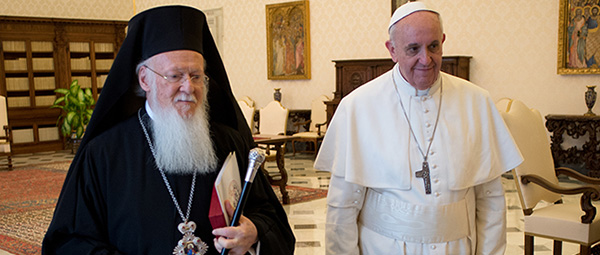
With the pope's much publicized trip to the Holy Land coming to an end, I thought it appropriate to look at the Common Declaration of Pope Francis and the Patriarch Bartholomew. The meeting between the two prelates was, after all, the putative reason for the trip, as it was meant to commemorate the 50th anniversary of the historic meeting between Pope Paul VI and Patriarch Athenagoras. Many pundits are really hyping the importance of this meeting and the Common Declaration as a great step forward in the search for Catholic-Orthodox unity. It is epic! It is historic! A giant leap towards full reunion! The full text of the Common Declaration can found here.

In my opinion, however, this declaration is much ado about nothing.

There are two things to be considered: First, issues raised by the text itself, and second, broader obstacles to Catholic-Orthodox unity that remain unresolved. Let us look first at the text of the Declaration, which begins with the Pope unfortunately lending credibility to a historical farce that the Orthodox have been trying to push for centuries - the lie that the See of Constantinople was founded by the Apostle Andrew:

"Our meeting, another encounter of the Bishops of the Churches of Rome and Constantinople founded respectively by the two Brothers the Apostles Peter and Andrew, is a source of profound spiritual joy for us" [Common Declaration, 1].

The assertion that St. Andrew founded the Church of Constantinople is a historical fabrication that the Orthodox began asserting in the fifth century to contest the claims of the papacy, the thinking being that since Andrew was called before Peter by our Lord, a Church founded by Andrew could have a claim to some sort of preeminence. At any rate the West has never accepted this claim. Nor do early Eastern Fathers know anything about it. Eusebius of Caesarea places Andrew's apostolic activity in Scythia and St. Gregory Nazianzus states it was Epirus. Surely if anyone had a motive for trying to bolster the authority of Constantinople it would be Eusebius, the court historian of Constantine, the builder of the New Rome. Yet Eusebius says nothing of St. Andrew founding the Church at Constantinople for the simple reason that this fable had not been invented yet. It was the translation of the relics of Andrew to Constantinople in 357 that probably occasioned the legend that he in fact founded that Church, something the West has never acknowledged. It is greatly to be regretted that Pope Francis gives credence to this historical fiction - this fiction which every serious historian knows to be a fabrication. It would be as silly as Patriarch Bartholomew affirming the Donation of Constantine - something that would be both historically false and damaging to traditional Orthodox claims.

That's just a pet peeve. Let's really dig in to this. The Declaration continues:

"Our fraternal encounter today is a new and necessary step on the journey towards the unity to which only the Holy Spirit can lead us, that of communion in legitimate diversity...While fully aware of not having reached the goal of full communion, today we confirm our commitment to continue walking together towards the unity for which Christ our Lord prayed to the Father so “that all may be one” [ibid., 2]

We all agree and applaud that talking to the Orthodox for the purpose of bringing about unity is a good thing. But what does this unity look like concretely? How do we get there? Are we closer now than we were fifty years ago when Paul VI met Athenagoras? The appeal of the concept of 'unity' is in its vagueness, but let us recall that unity is not a vague thing - it is a very particular ecclesiological concept that brings forth a concrete canonical reality. As in all these ecumenical meetings, the concept of unity is discussed a lot, but what it looks like or how to get there is never discussed. It is as if we are perpetually standing on the shore talking about sailing somewhere but never getting on the ship - or like one of those bad dreams you have where you know you need to get somewhere in a certain time but can't bring yourself to actually get moving. You know you're supposed to be leaving; you can feel it, you are struggling to get you act together, but somehow you never move - never leave.

Modern ecumenism is like the Catholic Church's bad dream. We will see later what underlies this concept.

"This is no mere theoretical exercise, but an exercise in truth and love that demands an ever deeper knowledge of each other’s traditions in order to understand them and to learn from them. Thus we affirm once again that the theological dialogue does not seek a theological lowest common denominator on which to reach a compromise, but is rather about deepening one’s grasp of the whole truth that Christ has given to his Church, a truth that we never cease to understand better as we follow the Holy Spirit’s promptings. Hence, we affirm together that our faithfulness to the Lord demands fraternal encounter and true dialogue. Such a common pursuit does not lead us away from the truth; rather, through an exchange of gifts, through the guidance of the Holy Spirit, it will lead us into all truth (cf. Jn 16:13)." [ibid., 4]

Indeed, this is "no mere theoretical exercise"; in fact, it is neither "theoretical", nor an "exercise." If it were theoretical, we would be seeing concrete proposals of what unity could look like; of course there's nothing that specific in the Declaration. If it were exercise, we would expect some sort of work or labor towards real reconciliation; but we see neither. These are just platitudes. Indeed, in the modern Church such ecumenical meetings can yield little else; having abandoned the concept of full, formal return to Rome whilst simultaneously denying that we are working towards a mere "lowest common denominator", the Catholic Church is in an awkward spot. All that is left is searching for "an ever deeper knowledge of each other's traditions in order to understand and learn from them." This is what unity means in the modern Church - sharing experiences. 

In case you think we are reading too much into these phrases or jumping to conclusions with our definition of ecumenism with "sharing experiences", consider these comments of the late Cardinal Dulles on the methodology of the modern ecumenical movement:

"[T]o surmount the remaining barriers we need a different method, one that invites a deeper conversion on the part of the churches themselves. I have therefore been urging an ecumenism of mutual enrichment by means of testimony. This proposal corresponds closely, I believe, with John Paul II’s idea of seeking the fullness of truth by means of an “exchange of gifts.”

With this mentality, Catholics would want to hear from the churches of the Reformation the reasons they have for speaking as they do of Christ alone, Scripture alone, grace alone, and faith alone, while Catholics tend to speak of Christ and the Church, Scripture and tradition, grace and cooperation, faith and works. We would want to learn from them how to make better use of the laity as sharers in the priesthood of the whole People of God. We would want to hear from evangelicals about their experience of conversion and from Pentecostals about perceiving the free action of the Holy Spirit in their lives. The Orthodox would have much to tell about liturgical piety, holy tradition, sacred images, and synodical styles of polity (Avery Cardinal Dulles, "Saving Ecumenism from Itself", First Things, Dec., 2007. See also our article, "At the Crossroads of Ecumenism").

In other words, in allowing other non-Catholic Christians to preach to us about their traditions, we approach unity in the context of a mutual enrichment by means of testimony, shifting 'unity' to the subjective plane and making about shared experiences, apparently based on the faulty assumption that understanding will bring us closer together. This is the manner in which Pope Francis and Patriarch Bartholomew understand unity. Sharing experiences.

Of course, sharing experiences will never lead to formal unity, and Francis knows it, as well as Benedict and John Paul II knew it; it is thrown off into the future, as some eschatological reality beyond history. What is left for today then? To work for the good of humanity! Yes, we can find common ground in saving the planet!

"It is our profound conviction that the future of the human family depends also on how we safeguard – both prudently and compassionately, with justice and fairness – the gift of creation that our Creator has entrusted to us. Therefore, we acknowledge in repentance the wrongful mistreatment of our planet, which is tantamount to sin before the eyes of God. We reaffirm our responsibility and obligation to foster a sense of humility and moderation so that all may feel the need to respect creation and to safeguard it with care. Together, we pledge our commitment to raising awareness about the stewardship of creation; we appeal to all people of goodwill to consider ways of living less wastefully and more frugally, manifesting less greed and more generosity for the protection of God’s world and the benefit of His people" [Common Declaration, 6].

Since when did the mistreatment of the planet constitute one of the occasions of the Orthodox schism? This is just sappy, syrupy feel-goody stuff. Totally irrelevant to the divisions within Christianity and unworthy of this historic meeting.

After some pleas for peace in specific regions, the document closes with this comment:

"In an historical context marked by violence, indifference and egoism, many men and women today feel that they have lost their bearings. It is precisely through our common witness to the good news of the Gospel that we may be able to help the people of our time to rediscover the way that leads to truth, justice and peace" [ibid., 9].

"Common witness?" This is wrong on so many levels. There can be no "common witness" between Rome and the Orthodox precisely because we have different understandings of what the "good news of the Gospel" constitutes. The Orthodox reject a very important element of the Gospel - the real primacy entrusted to Peter and his successors by Christ. That is not some extrinsic custom or negotiable point; it is part of the Gospel; Vatican I stated the authority of the Pope to be de fide, which means it cannot be rejected without loss of the faith any more than can be the Trinity or the truths of our Lord's Incarnation. There can be no "common witness to the good news of the Gospel" if an essential element of the Gospel is rejected.

Or can there?

The only way we could have a common witness with the Orthodox if parts of the Gospel are rejected by them is if we only witness in common those points which we share in common - if, in other words, we seek a "common denominator." We may disagree on particulars, but we agree on basic things like the dignity of the human person, sanctity of the family, etc. and therefore we can focus on these broader common denominators - give a joint witness on the commonalities that we do agree upon.

Except Pope Francis specifically says "dialogue does not seek a theological lowest common denominator on which to reach a compromise."...Oh. 

So this Declaration, which some are touting as historic, groundbreaking, "huge", epic, etc. is really more fluff. This sort of thing can never help us towards reunion, and there are several reasons grounded in the broader position of the Catholic Church that make this so.

For one thing, reunion with the Orthodox is impossible and all ecumenical conversations on reunion are farcical until the Vatican formally renounces the 1993 Balamand Agreement. The Balamand Agreement was a declaration of the Joint International Commission for Theological Dialogue which has formed the foundation for the Church's approach to the Orthodox over the past twenty years. Balamand specifically repudiates what it calls the "outdated ecclesiology" of presuming that the Orthodox need to "return" to Rome. The agreement states:

"Pastoral activity in the Catholic Church, Latin as well as Oriental, no longer aims at having the faithful of one Church pass over to the other; that is to say, it no longer aims at proselytizing among the Orthodox. It aims at answering the spiritual needs of its own faithful and it has no desire for expansion at the expense of the Orthodox Church...To pave the way for future relations between the two Churches, passing beyond the out-dated ecclesiology of return to the Catholic Church connected with the problem which is the object of this document, special attention will be given to the preparation of future priests and of all those who, in any way, are involved in an apostolic activity carried on in a place where the other Church traditionally has its roots. Their education should be objectively positive with respect of the other Church" (The Balamand Statement: Uniatism and the Present Search for Full Communion, 22,30).

The concept of reunion understood in terms of return to Rome - a concept that gave the Church such luminaries as Newman and Chesterton and Elizabeth Ann Seton- is repudiated by Balamand. The Balamand document also goes as far as to deny that the Catholic Church is the one true Church:

"[In the past] missionary activity tended to include among its priorities the effort to convert other Christians, individually or in groups, so as "to bring them back" to one's own Church. In order to legitimize this tendency, a source of proselytism, the Catholic Church developed the theological vision according to which she presented herself as the only one to whom salvation was entrusted" [ibid.,10].

Again, let me emphasize, this document forms the backbone of the Catholic Church's understanding of its relation with the Orthodox. And in this document, formal reunion via return to Rome is repudiated. Until the Vatican backs away from these sorts of statements, the sort of meetings that happened this week in the Holy Land can yield nothing substantial. 


Lest we be tempted to think that this is some incidental whim of a non-authoritative committee, let us turn to the weightier opinions of none other than Cardinal Ratzinger, who has written much on the problem of ecumenism and who believes the vision proposed at Balamand is essentially correct.

In the 2003 book God and the World, then Cardinal Ratzinger reveals that the "unity" the modern Church is seeking through the ecumenical movement is radically different from the concept of "returning to Rome" as traditionally understood. In the book, which is in the format of a lengthy interview with journalist Peter Seewald, Seewald poses the question: “The Church prays for Christians to be reunited. But who ought to join up with whom?” Cardinal Ratzinger's reply is revolutionary and flips on its head the traditional understanding of what it means to belong to the Church:

The formula that the great ecumenists have invented is that we go forward together. It’s not a matter of our wanting to achieve certain processes of integration, but we hope that the Lord will awaken people’s faith everywhere in such a way that it overflows from one to the other, and the one Church is there. As Catholics, we are persuaded that the basic shape of this one Church is given us in the Catholic Church, but that she is moving toward the future and will allow herself to be educated and led by the Lord. In that sense we do not picture for ourselves any particular modes of integration, but simply look to march on in faith under the leadership of the Lord – who knows the way.” (God and the World, Ignatius Press, 2003, pp. 452-53)

"We go forward together." Where do we go? Who knows, for "we do not picture for ourselves any particular modes of integration", nor do we even will a formal reunion, because "it's not a matter of our wanting to achieve a certain process of integration." Ratzinger, speaking ten years after Balamand, agrees that formal reintegration is neither fathomable in its mode nor even desirable in the modern Church.

Ratzinger's comment that "the Lord will awaken people’s faith everywhere in such a way that it overflows from one to the other, and the one Church is there" is particularly revolutionary, as it locates the Church not in an objective reality but in an exchange - a relationship. The concept of 'Church' for Ratzinger is more about becoming than being - it is located in the interplay between the various "churches". It is fundamentally a dynamic reality predicated on relationship. 

This novelty is not surprising, given the centrality of change, relation and evolution to Ratzinger's thought (see here). James Larson has also written convincingly on the centrality of the concept of "relationship" in the theology of Joseph Ratzinger.

If Church is found in relationship between various communities, then we have a fundamentally new concept of the Church, something never accounted for in Tradition and which allows for a radical redefinition of what it means to be "in the Church." This is nowhere so evident in Ratzinger's thought as in his comments on Protestantism, which while not referring to the Orthodox problem, help us locate the concept central to the ecumenical movement - a "different mode" of being a church.

We get a lucid summary of Ratzinger's opinion in his 1997 book Salt of the Earth when the Cardinal elaborates on what the Second Vatican Council meant by referring to Protestant groups as "ecclesial communities": 

"The word ‘ecclesial community’ is a term employed by the Second Vatican Council. The Council applied a very simple rule in these matters. A Church in the proper sense, as we understand it, exists where the episcopal office, as the sacramental expression of apostolic succession, is present –which also implies the existence of the Eucharist as a sacrament that is dispensed by the bishop and the priest. If this is not the case, then we are dealing with the emergence of another model, a new way of understanding what a church is, which at Vatican II we designated by the term ‘ecclesiastical community.’ The word was intended to indicate that such communities embody a different mode of being a church. As they themselves insist, it is precisely not the same mode in which the Churches of the great tradition of antiquity are Churches, but is based on a new understanding, according to which a church consists, not in the institution, but in the dynamism of the Word that gathers people into a congregation… (Salt of the Earth, 94-96).

A "different mode of being a church", something based on a "new understanding", located not in a physically identifiable body on this earth, but "in the dynamism of the Word" - the relationship of the people with God. This is the sense in which the concept of "Church" overflows between the various Christian groups, and in the interchange of these groups - what Cardinal Dulles called "an ecumenism of mutual enrichment" - "the one Church is there," to quote Ratzinger. This is the ecumenical thought of the 'Pope of Christian Unity.'

Ratzinger is no fool. He knows that this is a novel concept. Cardinal Dulles recognizes it as well. In the same article quoted above, Dulles paints a sharp contrast between ecumenism pre- and post-Vatican II:

"Vatican II, therefore, represents a sharp turn away from the purely negative evaluation of non-Catholic Christianity that was characteristic of the previous three centuries...Regarding the ecclesial status of non-Catholic Christians, Pius XII had taught as late as 1943 that they could not be true members of the Church because the Body of Christ was identical with the Catholic Church. Such Christians could not belong to the body except by virtue of some implicit desire, which would give them a relation that fell short of true incorporation. From a different point of view, Vatican II taught that every valid baptism incorporates the recipient into the crucified and glorified Christ, and that all baptized Christians were to some extent in communion with the Catholic Church...Relying on the new ecclesiology of communion, Catholic ecumenists now perceived their task as a movement from lesser to greater degrees of communion. All who believed in Christ and were baptized in his name already possessed a certain imperfect communion, which could be recognized, celebrated, and deepened" [Dulles, First Things, Dec. 2007].

The meeting between Francis and Bartholomew is an expression of this "new ecclesiology of communion", which proposes no "particular modes of integration" but simply speaks of moving towards an ill-defined unity grounded in mutual understanding which will somehow result in the Church becoming present in the dynamism of the faith-filled exchange between us. 

It is beyond the scope of this article to offer a traditional critique to this thought; hopefully, most readers of this blog will already see the many problems it poses. But the ultimate purpose of this article is to show that, as long as this concept of a "new ecclesiology of communion" spoken of by Dulles and Ratzinger and epitomized by Balamand is not rejected, there will never be a formal reunion - simply because our Church does not want it. Just like the bad dream where you know you have to leave to go somewhere but keep finding yourself bogged down by various details, so the Church speaks of reunion but never actually moves towards it. It has repudiated the only path towards real reunion - return to Rome, which is now only an "outdated ecclesiology." It is also a little unfair that the faithful continue to vainly hope for a formal reintegration when, as we have seen, the leaders of the Church have no plans for any such integration and do not even will it. This is very troubling.

In Redemptor Hominis, St. John Paul II reminds us that the path forward towards unity is uncertain, and that we have a right to express our uncertainties:

"There are people who in the face of the difficulties or because they consider that the first ecumenical endeavours have brought negative results would have liked to turn back. Some even express the opinion that these efforts are harmful to the cause of the Gospel, are leading to a further rupture in the Church, are causing confusion of ideas in questions of faith and morals and are ending up with a specific indifferentism. It is perhaps a good thing that the spokesmen for these opinions should express their fears" (St. John Paul II, Redemptor Hominis, 6).

Consider my fears expressed.

Tuesday, May 20, 2014

On Perrielo's Fishwrap Piece


Last week, Pat Perrielo published a real piece of tripe at the NCR ("Fishwrap") on communion for the divorced and remarried. Laughably entitled "The Traditionalists are Trying to Regain Control" (as if the "traditionalists" have ever had anything close to "control"), he offers one of the most ignorant and juvenile arguments in favor of relaxing the Church's discipline that I have ever read. I offer his piece in its entirety below, with my glosses in italics.

'The Traditionalists are Trying to Regain Control'
by Pat Perrielo, NCR 15 May 2014

As the time for the Synod on the family draws near, there seems to be an effort by traditionalists to control the process and shift the focus to doctrine rather than serving the pastoral needs of people.

Repeating a progressive canard that 'doctrine' and 'the pastoral needs of the people' are in opposition; that must must choose one or the other, 'law' or 'mercy.' In fact, it is love of God's law that most perfectly fulfills pastoral needs. Remember Psalm 1: 

Blessed is the man who walks not in the counsel of the wicked,
nor stands in the way of sinners,
nor sits in the seat of scoffers;
but his delight is in the law of the Lord,
and on his law he meditates day and night.
He is like a tree
planted by streams of water,
that yields its fruit in its season,
and its leaf does not wither.
In all that he does, he prospers.
(Ps. 1:1-3)

Archbishop Samuel Aquila of the diocese of Denver has reiterated church teaching on marriage and sees the pastoral element as simply doing a better job of explaining traditional Catholic doctrine.

This is true. Archbishop Aquila understands that doctrine and pastoral practice compliment each other and should not be set in a relation of antagonism.

It seems pretty clear that Pope Francis is talking about something else. Francis said, “The question is not that of changing doctrine, but of digging deep and making sure that pastoral care takes into account situations and what it is possible for persons to do.”

Francis is asking the question as to whether it is really possible for many in certain life situations to change their circumstances. Must one wait around for a spouse to die in order to receive Communion? Too many traditionalists seem unable to comprehend what a pastor must take into account to serve the needs of his people. They have a copy of the rule book, but what they may not have is a sensitivity to the people they serve.

I don't think traditional Catholic ethics insists that these people do always have the power to "change their circumstances"; it does insist that they are obliged to do the right thing within the circumstances they find themselves in. "Must one wait for a spouse to die in order to receive Communion?" No. One can always leave one's adulterous 'second marriage', and telling a person otherwise does not "serve the needs of his people" but leads them further into error, making it even less likely that they will "have life, and have it more abundantly" (John 10:10), which is what Jesus desires for everyone. 

What is being examined is not the indissolubility of marriage, but rather the distribution of the Eucharist. In the Scriptures it even appears that Jesus may have shared the Eucharist with Judas at the Last Supper. The Eucharist is meant to nourish the faithful. It is not a reward for the holy. It is not insignificant that most Protestant churches, including Episcopalians, always make clear that all are welcome at the Lord’s Table.

The Eucharist has never been seen as a reward for the holy. Hence, "Domine, non sum dignus..." The Eucharist is the "medicine of immortality", in the words of St. Ignatius of Antioch. And if it is medicine, it is because we are sick. But not all sicknesses are alike; some are sick because, despite our best intentions, we are still weak humans prone to failure. Others are sick because they refuse to amend their lives and obey God's commandments. There is a huge difference between someone who bombs a test because they did not do well and one who bombs because they intentionally left all the answers blank. Just because we are all sinners does not mean there are no standards. All are welcome at the Lord's table, but not on any terms they choose. If you don't like it, take it up with St. Paul and the New Testament, which says, "Wherefore whosoever shall eat this bread, and drink this cup of the Lord, unworthily, shall be guilty of the body and blood of the Lord. (1 Cor. 11:27).

By the way, if the Episcopalians are doing it right, why are Episcopalians in a "death spiral"?

Those having difficulties of any kind have the greatest need for the Eucharist. Yet we pompously walk around picking and choosing who can receive the graces and mercies of a loving Lord. If we want to deny Communion to all who are unworthy we should simply stop giving communion to anyone. None of us are worthy, but all of us are in need. That is why Jesus gave us this wonderful gift.

"Those having difficulties of any kind have the greatest need for the Eucharist." This statement would be true if the clause "of any kind" were removed. Difficulties are not of the same stripe. By long-standing custom, those whose "difficulties" are sins of their own deliberate choosing are not fit to present themselves for Holy Communion precisely because they are not in Holy Communion because deliberate grave sin puts one out of Communion. This is standard sacramental-moral theology, and shows that this is not just a disciplinary problem of who we will give the Eucharist to, but a theological problem. All are in need. Yes. And if we really believe we need Jesus, we must begin by confessing our need to be free of our sins. "Go and sin no more, lest a worse thing come upon you" (John 5:14).

Those opposed to sharing the Eucharist with divorced and remarried Catholics continue to focus on the doctrine of marriage. Yet no one is questioning the doctrine of marriage. Francis and other pastors of the church are simply looking at those who love the Lord and are saying, come, taste and see how good the Lord is.

I beg to differ, Mr. Perrielo. The doctrine of marriage is being questioned. If the divorced and "remarried" are allowed to Communion, it means either (a) second putative marriages are no longer regarded as adultery, or, if they are (b) one can still be in God's grace whilst simultaneously being in a state of adultery, or if not, then (c) Communion can be received in a state of mortal sin with no danger to one's soul, in which case (d) the theological importance of being in or out of a state of grace has been obliterated. As you can see, there are HUGE doctrinal implications from this discussion.

If the Synod fathers buy in to these sorts of lame, ignorant arguments, is there any hope?

Sunday, May 18, 2014

Motherhood, More than a Hobby

Recently, My family attended a company day of recreation where workers were allowed to bring their family and friends. We had our four children under 4 and had our hands full (literally) but we were not short on help being surrounded by friendly people willing to help us out.

In fact a couple of my coworkers also brought their children with them, including their babies. So it made a certain statement made by a guest particularly flummoxing when they referred to having children as an expensive hobby to another person who was kindly pushing a baby stroller for us.

I shot back that a hobby was something unnecessary that we do for pleasure, the person acted as though they did not hear my remark and remained silent after that. Later, when I looked up the definition of a hobby I was pretty close to the mark: “an activity done regularly in one's leisure time for pleasure.”

There are some people who hate mankind, or perhaps wish to see a significant portion of mankind die or not reproduce in the name of population control, but she did not refer to my children as parasites, but hobbies. In the misanthropic view, they are at least something that is powerful, powerful enough to destroy the world, but in this view they are something that is not even necessary.

Even Marxism, which hated the family, still valued the importance of having children, if only to further the revolution. This hit home with more force recently when I was finishing recording a new audio book on the Divine Maternity of Mary, by Abbot Vonier, when I read this:

“True civilization is easily tested by its attitude towards motherhood. There can be no real refinement of human feeling where mans heart is not full of delicacies for the dignity of motherhood; therefore there can be no true civilization where motherhood is either shunned or degraded. If there is anything that belongs to the health of the nations that dwell upon the earth, it is a loving reverence for the burdens of human motherhood. ” An Invocation, The Divine Motherhood of Mary

People forget that the 4th commandment is put above the 5th for a reason. Without parents a person would not exist. It is a tremendous evil to take another persons life, but God put the 4th above the 5th because it is a terrible sin to not show reverence for the parents that bore you, no matter how good or bad parents themselves are. Those who live lives of nihilistic despair, and hate living every day I can imagine hate their parents, the damned in hell hate their parents. Both are full of this hatred because they wish for the suffering that they are enduring to go away, and because it will not they wish they had never been born.

“Christianity’s moral power, Christianity's social contribution to the life of mankind is the sanctity and obligatoriness of the laws that govern the birth of man.” The Divine Motherhood of Mary

To date, Christianity as a whole has failed to make that social contribution since the sexual revolution. When women started bringing home little packages of pills, motherhood itself become compartmentalized, something that people were told could be turned on or off. Motherhood was no longer viewed as a duty of the married women to her God, to her family, to her country but a personal choice that at most might include her husband. To many in the west sex was no longer for procreation but pleasure, and so the begetting of children is now not viewed as a duty but as an optional, expensive, pleasure. In a word a hobby,

Yet, the reality is different even while we live in this age of sexual revolution. Once a mother holds her child and that child and her love one another, that is to say that the women suffers for the well being of the child, any idea that a child is a hobby would be quickly displaced by that reality of sacrificial love. That love of the father to the mother, of the mother to the father leading to a child that loves them both and that came from both of them is one of the most beautiful things our eyes probably will ever be privileged to see in this life, as it is a reflection of the love that exists between the persons of the Most Holy Trinity.

Motherhood is worth fighting for, it is worth suffering for, it is worth dying for, it may not be life itself but without it you and I would not exist.

Holy Mary Mother of God, pray for us.

Friday, May 16, 2014

Marvel's Avengers "Assemble" for Catholic Writer

A renowned English Catholic writer, Stratford Caldecott, is in the last stages of his battle with prostate cancer, which he was diagnosed with in late 2011.

Caldecott, the GK Chesterton Research Fellow at St. Benet's Hall, Oxford, has served prolifically in the Catholic publication industry for decades, both as a writer and editor, serving on the editorial board of the International Theological Journal, Communio, as well as T&T Clark publications, the Catholic Truth Society, as co-editor for Magnificat UK, and also his own literary journal, Second Spring. He received an honorary doctorate in Theology from the JPii Institute in Washington, DC.

I have met him and his family on occasion, and they are quite simply good, faithful Catholics. For this reason, while I was aware of his illness, I was rather amazed to hear of the latest turn of events as they unfolded.

It began, naturally, with a blog post written by his daughter, Sophie:
My father, Stratford Caldecott, was diagnosed with advanced prostate cancer in October 2011... Life since then has been very strange. He has bravely, patiently tried every treatment available to slow down the progress of the cancer, and we have been blessed with some good – almost normal – times together, amongst the bad. 
The doctors now say that dad is into the final stages of the disease, the part where your bones fracture under the slightest impact, and swelling around vital organs starts to happen for no apparent reason. They say that we only have around 12 weeks left. We have to make these 12 weeks count, and I have an idea about how we can do that.
Sophie goes on to speak of her father's love for Marvel comics since boyhood, and more recently, the Marvel films. Apparently, they went to see the last Marvel film in the cinema, but he was too sick to be able to make it to see the latest Captain America film.

This is where Sophie goes to the social media:
We’re going to try and get in touch with Marvel to ask if they can fulfil dad’s dying wish by sending us a copy of the film for him to watch at home. But I think we can go further than that. We’re also going to tweet the Avengers actors and see if they will take a picture of themselves holding a sign saying ‘Captain America/Thor/Iron Man [insert name of character here] for Strat!’ so that we can surprise him with their messages of support and encouragement.
The response has been pretty amazing, both on the side of Marvel, as well as on the side of the actors and other people of good will, as you can see:


Since the doctors estimate Stratford has only 12 weeks to live, the Marvel Studio has confirmed that they will offer an advanced private screening of Captain America: The Winter Soldier in the Caldecott home next week.

As Catholics, we are called to visit the sick and to comfort the afflicted, and, when the time comes, to bury and pray for the dead. I think it really heartening that Hollywood has responded in spades on this one, and, in your charity, I ask that you offer some prayers for Stratford that his suffering might be eased, and, when his time comes, that he has the grace of a good death, fortified by the Sacraments.

UPDATE:

Sophie has compiled a page of pictures of all of your favorite Marvel Characters who have responded all in one place - it is really quite amazing how many have come out in support of one man's battle against cancer.