Wednesday, October 31, 2007
All Hallow's Eve

Tuesday, October 30, 2007
Do vice laws work or not?
Americans are perpetually debating about whether or not the so-called "vice laws" are effective means deterring activities. Let' s define what we mean by a "vice law". A vice law is a law which criminalizes an activity, not so much because it is a crime but because it is a vice. There are two prime examples in American law: the illegality of prostitution and marijuana. Other examples are the so-called "sabbtine laws" that prohibit purchasing liquor on Sundays before noon, old fashioned laws that prohibited spitting or swearing in front of a woman, as well as (now obsolete) military laws forbidding blasphemy. An additional example of a vice law would be (as is in place in several states) laws making sodomy a crime, as well as adultery. I do not know if adultery is still illegal anywhere, but I know this used to be the case in many states and colonies even before the Revolution. Now, from a Catholic perspective, do these laws work to deter the vices they target?Now, what can we say to these charges? Is there a place for vice laws? I would say this: all of the above objections underly a fundamental misunderstanding about what the purpose of a "vice law" is. The question so often revolves around whether or not the vice laws" work," but perhaps people have not stopped to reason whether or not that is really the reason for the law. For example, most places have laws against bestiality. Now, if a man, in the privacy of his own barn, wants to engage in bestial sex with a sheep, how is that harming anybody? And secondly, even if we did outlaw bestiality, how on earth can you enforce it? By criminalizing something so private, you in effect make a law that is impossible to enforce (so proponents of legalized bestiality would say). However, the reason bestiality is illegal is not because we consider it a crime against some other person, but because we recognize that bestiality is a socially damaging behavior in itself; it is unacceptable that one single act of bestiality should in any barn anywhere happen even once. Though we know we cannot positively stop this action, we codify this sensus populorum into law. It is a symbolic action that probably can't be enforced but (if anyone was caught in the act) must be enforced in order to demonstrate and reaffirm society's opprobrium to the behavior. This ought to be the case with homosexuality as well.
Now let's look at the objections. First, I would argue that it is not true that vices targeted by the vice laws do not hurt anybody. Marijuana and prostitution certainly do damage to the persons involved and the persons who get addicted to them through others. Also, it is not the point whether anyone is harmed. The point is that we recognize these behaviors as damaging to society as a whole and thus proscribe them for the sake of the common good.
Second, that the vice laws create more crime than they prevent. This presupposes that people are going to continue doing the behavior no matter what. For example, "If you outlaw abortion, women will just have recourse to illegal and dangerous abortions by untrained hack-doctors." How many times have we heard this? They assume that people will do the action no matter what. First, I don't think this is necessarily true. I'm sure there are a lot of people who do not do drugs because they are illegal that if they were not illegal perhaps would take up the habit. If pornography were illegal, you don't think there would be a huge drop in the amount of people trying to buy porn? Sure, there will always be those die-hard addicts who will try to get their fix whether it is legal or not, but there are vastly more who will say, "It's not worth it," and will give up the addiction or switch to something else. Also, whether or not crime happens as a result of the law is not the point. Sure, making prostitution illegal necessarily brings into existence pimps, who are violent, unsavory individuals. But society is willing to tolerate the existence of a few pimps in exchange for not having to tolerate legal, open prostitution, which would certainly do much more damage to the nation's moral status. It's the principle of double-effect: keeping prostitution illegal is such a common good for the people that the fact that it causes a lesser evil (the existence of pimps) is tolerated but not willed.
Third, the allegation that vice laws legislate morality, which ought never be done. Newsflash: all our laws are attempts to legislate morality. That is why they are laws. Stealing is immoral, and hence, illegal. Same with murder, and so on. We legislate our morals because our morals are timeless and give us insight into the fundamental way society ought to be set up that is not subject to culture, time and place. So to the charge that we are legislating morality, I say, "Yep. So what?" Now, of course, not all of our laws are based on morality, but many of the fundamental ones are.
Fourth, that the laws come from a Christian culture and ought not apply. Well, I would say that you don't have to be a Christian to see that prostitution, marijuana, etc. are bad for society. But I have no problem with legislating specifically "Christian" laws, so long as they do not infringe on the religious practices of others. But Catholics often say that some of these laws, like the one prohibiting alcohol sales before noon on Sundays, reflect a puritan mentality that is not compatible with Catholicism, I would say this: there is absolutely no reason somebody needs to buy liquor on Sunday morning (unless it's the priest getting wine for the Eucharist). If somebody has to buy it that morning, that means they are intending on consuming it that morning (otherwise they could wait), and there is no reason people ought to be getting drunk on the morning that the Lord rose from the dead. I know many of you will disagree with me on this point. I want to look at the substance of the law; I don't care who instituted it. Sure, a chasm of difference divides us from the puritans. But I think this was a good law.
I say, bring back laws forbidding cussing in front of a woman or spitting in front of her. Bring back fines for blasphemy (our Social Security budget crisis would be solved in a week if that ever happened). We have lost sight of a fundamental truth that was understood by all our forefathers, even in the darkest of the dark ages: crimes are crimes exactly because they are vices (ie, vicious deeds) and society deserves to be free from vice.
Am I completely off the wall on this or do I have a good point? Click here to see a related article on legislating morality; in fact, it was the first post ever on this blog, posted on the last day of June, 2007.
Hey, Constantine!
Hey, Constantine!

How many true religions are there?
Thank you Constantine for your simple, straight-forward answer! How did you know that?
Monday, October 29, 2007
Fr. Hardon Archives
Friday, October 26, 2007
Excellent Buchanan Article
St. John Cantius in Detroit, MI.
Today the Detroit News/Free Press did a very sad story about the closing of St. John Cantius parish in Detroit, MI. While this parish is not unique in that it is but one of a number of Archdiocese of Detroit parishes that are being closed or clustered, it is unique because of its great beauty. Below is the Detroit News/Free Press article in its entirety, with my commentary in red (Fr. Z style). This is an excellent article and I want you to notice one theme: the effect of the aesthetic beauty of the Church on the "sense of the sacred" experienced by the faithful (all photos from St. John Cantius parish). Worshippers bid a fond farewell as parish holds last Mass
Mark Hicks / The Detroit News
DETROIT -- At Christmas some six decades ago, the beauty and sanctity of St. John Cantius Catholic Church awed a young Helen Fujawa. During a midnight Mass at the reddish-brown brick mainstay on South Harbaugh, the soprano stood in the choir loft, above rows packed with families, singing a solemn Polish hymn alongside the choir. Before her was an array of arresting images: a decorative manger scene; opulently painted wooden altar statues; and warm candlelight illuminating the pews, accentuating the rich blue, red, emerald and gold hues of soaring stained-glass windows [ isn't this a great point? The "beauty and sanctity" of the old church, the "solemn" hymn, the "opulent" decorations and the candles all served to make the worshipper "awed." This church apparently succeeded in helping the worshipper ascend to the contemplation of the Divine].
"If you ever think of a church, that's the way it would look," [amen] said Fujawa, 75, now of Sterling Heights, who lived a block away and was baptized at the church. "It was always beautiful" [beauty has something that draws people to it]. That's why the past year has been bittersweet for the remaining congregants at the Delray neighborhood parish on Detroit's southwest side. Although it was identified last year for closure, the church was allowed to remain open to celebrate its 105th anniversary on Sunday with a final Mass. It will be the church's last event in a string of countless weddings, baptisms and celebrations.

"You go there for so many years, everything about it you miss," said Roman Matey, a Wyandotte retiree who began attending with his wife more than 50 years ago. "They don't make churches like that anymore" [notice the sadness in this man's statement: "They don't make churches like that anymore." It begs the question: why not?].The closure was forced by declining membership and rising utility costs, said Archdiocese of Detroit spokesman Ned McGrath. St. John Cantius is down to about 200 members from an estimated 2,000 families at its peak, said the Rev. Edward Zaorski, the church's pastor.
"It's very hard to keep a building like that open with just a handful of parishioners," McGrath said. "It's a very pretty church. It's just unfortunate that it can't go on." It's the sixth parish to close under the archdiocese's Together in Faith Plan [isn't it funny that the plans for closing and shrinking Catholic parishes always have these deceptively optimistic names? Just like Ford Motor Company's plan "The Way Forward", which was actually a plan to lay off a ton of people and move to Mexico] launched in 2006, a reorganization reflecting a shifting Catholic population and the loss of priests. Several more churches could close, cluster or merge through 2011. Last fall, the St. John Cantius parish council requested that it remain open to mark its anniversary this month, Zaorski said. "It brought a good closure -- allowed people to recall their contributions. "It's not easy, but we have to move on."

There are no plans to sell the building, Zaorski said, but some relics will be donated to other parishes. Officials also hope to establish an endowment after the building's eventual sale to fund religious education so its "life will continue," Zaorski said.
Although the past year has been dedicated to memories -- tracing the founders' history, delighting in traditions such as an annual Polish festival -- and activities, that only softens the blow of losing a beloved church that shaped, comforted and rejuvenated generations.
"It's in my mind all of the time," said Evelyn Glowiak of Sterling Heights, who was baptized and married there and has visited often this year. "I wanted to see the church as often as I could before it's gone."
The first incarnation of the church -- a wood-frame structure built by some 40 families and established as a Polish parish -- opened in 1902 where the parking lot now stands. A second church was inside the school building that was constructed in 1910. The school, which once enrolled more than 1,000 students, closed in 1969. The twin-steepled Romanesque-style church, which seats about 1,200, was built in 1923 for $160,000 and named for a theologian and a professor at the Catholic college in the old Polish capital of Krakow. Some of the church's ornate stained-glass windows bear the names of founding Polish families, who contributed to construction [if poor Polish émigrés could scrape together enough to build a church like this, don't tell me that wealthy American middle-class Catholics couldn't today! The fact is, they just don't want to].
Drawn by the concord of the forming congregation, Polish émigrés Kanty and Frances Halat saved earnestly to help erect the church and later attended with their nine children. "What they had, they gave," said daughter Loretta Prohownik, 85, of Allen Park, who was baptized and wed there. "It made you feel close to the church." For many who flooded the area early last century, St. John Cantius "was their root -- the main part of the community," said Laurie Gomulka Palazzolo, vice president and executive director of the West Side Detroit Polish American Historical Society. "There was nothing without the church. They knew they couldn't be here without God's help" [this parish was everything a good Catholic parish should be: "the main part of the community"].
The murmurs of multigenerational members filling rows each Mass were a constant for attendees such as Eugene Drabczyk, whose grandparents both attended shortly after emigrating from Poland. His parents were both baptized there, as were he and his brother. Drabczyk and his wife, Patricia, wed in the church on Aug. 21, 1965. Their daughters, still members, were baptized there. So were two grandsons. Reassured by the familiar faces, Polish hymns and other customs, mother Mary Drabczyk insisted on returning years after she moved to Lincoln Park. In late 2004, her funeral was held at the church -- concluding an uninterrupted, nearly 90-year membership. "My mom said she would never go to another church," said Eugene Drabczyk, 71, a retired banker from Southgate. "She liked the church so much. It always drew you there."
Members reminisce about the church school, which was taught by Felician Sisters. There, students learned to volunteer for convent cleaning, respect elders and humbly utter, "Praised be Jesus Christ." The school leaders "really did model good behavior," said Madonna University President Sister Rose Marie Kujawa, the third St. John Cantius member to hold that post. "It did create a spiritual atmosphere an uplifting one. They made you want to come to school" [contrary to the stereotypical portrayal of the mean nun with the ruler]. Kujawa's parents were baptized in the church and once lived across the street. Her mother, Anna, continued attending after leaving Delray to bask in "a family community," Kujawa said. "The church was a spiritual home."
Membership dwindled as the neighborhood -- between West Jefferson and West Ford, near Zug Island -- gave way to industrial expansion. Interstate 75 entered in the 1960s. To comply with the U.S. Clean Water Act the next decade, the city expanded its sewage treatment plant after purchasing and demolishing nearby homes, groceries and other structures. It now surrounds the church on two sides. "It destroyed the neighborhood," Zaorski said. St. John Cantius also was slated to be removed, but parishioners, the then-Rev. Edwin Szczygiel and City Council allies such as Jack Kelley and former Detroit Tiger Billy Rogell prevailed.
Still, the church was affected. As homes vanished and industry sandwiched St. John Cantius between wire fences and train tracks, families relocated to suburbs and other areas. Despite the distance, some continue to return to the church. "They came back to their roots," said Patricia Drabczyk, 68, who with her husband travels some 20 minutes weekly from Southgate for services. "No matter how far we had to travel, it didn't matter. You feel at home."
Edward Pilch, 31, a police officer from White Lake Township, traveled several times yearly to the church where he was baptized. Last month, Pilch celebrated his wedding -- the church's last, more than 50 years after his grandparents. In the darkened church, his bride, Erin, stood flanked by flowers, near sunlight passing through the stained glass in kaleidoscopic streaks. "It was unbelievable the perfect setting," Pilch said [again, aesthetic beauty renders the soul more disposed to contemplate the divine, and thus helps the worshipper to receive more grace ex opere operantis from the sacraments, as this fellow apparently recalls about his wedding].
For organist Steven Frayer, 37, of Westland, crossing the threshold and passing statues instantly imparted a "sense of the sacred," he said. "You really felt like you were in a holy place" [this is the most telling phrase in the whole article: the beauty of the church created a "sense of the sacred" and made you feel that you were in a truly "holy" place. Does our modern church architecture do this?] . Prohownik, a lifetime member of the church, calls the closure "heartbreaking."
"It's all coming to an end," she said. "It's not just losing a church, but losing family."
You can reach Mark Hicks at (313) 222-2117 or mhicks@detnews.com.

This is an excellent article, and I encourage you all to email Mark Hicks and tell him your thoughts on it. Seeing what everybody said about how the great beauty of the Church and all of the wonderful Catholic traditions that were celebrated there helped imbibe people with a sense of sacredness and holiness that kept them devoted to their church in a way few people are today, we must ask the question: they why deviate from a model which has proven so successful in the past? Will any congregants, fifty years from now, recall such fond memories about their whitewashed, ampitheatrical iconoclastic churches they now meet in? I seriously doubt it.
Many liturgists care more about maintaining the validity of their iconoclastic ideology than of assisting the Catholic to better worship God. If they did care about worship of God, they would get the message and pay attention to what the people say, as in this article. They would get the point when the man in the article sadly recalls, "They don't make churches like this anymore." But the fact is, they don't care. They don't care about what is best for the laity. They just care about vindicating the insane liturgical experimentation they have been carrying on for the past forty years. And so for them, perhaps it is better that St. John Cantius does close. It is one less high altar to give them nightmares, and every parish like this that is destroyed or closed is one more link with the past obliterated.
Mount Sinai (Jebel-Musa): Historical Evidence
I thought this would be an interesting question to take up for those of you who, like myself, have an interest in biblical archaeology. Like the Ark of the Covenant (and, to a lesser extent, Noah's Ark), the location of the Mount Sinai of the Scriptures has been a source of controversy for generations. Unlike the Ark of the Covenant, for which many explanations have been formed (see my Ark of the Covenant series on the sidebar), only two real contenders for the Scriptural Mount Sinai have ever been put forward: the traditional site is a mountain in the Egyptian Sinai Peninsula called Jebel-Musa ("mountain of Moses") on which is situated the famous Byzantine monastery of St. Catherine. The other site, put forward as the true location of Sinai on and off in recent centuries, is a mountain called Jebel-al-Lawz in the Hejaz region of what is now Saudi Arabia, just across the sea from the Sinai Peninsula over the Gulf of Aqaba. There are other sites put forward by different people, but these two are the only real contenders.Let me first say, before examining the merits of either of these two positions, that I do not believe that there is any theological import to either. There is no theological, historical or ecclesiological reason why I ought to be in favor or one site over another. It certainly sometimes happens that long-standing Catholic traditions about locations and relics and things of that nature can turn out to be errant (like the "Donation of Constantine"). It is also true that longstanding Catholic archaeological traditions are very often trustworthy; each case is individual. The important thing is that nothing regarding my faith or the powers of the Church is dependent in any way on the location of Mount Sinai. Therefore, I am open to either possibility. To tell you the truth, my mind is not made up on which is really the true location.
In this article, I will look at just the historical evidence for the traditional site, in the Egyptian Sinai at Jebel-Musa. I will go over the historical proofs cited for this location and then critique them. Next time, I will look at the Scriptural evidence for or against the traditional site.
First, what about the establishment of the monastery out there in the Sinai? Why did the first monks choose to settle there, and does this say anything about the historical veracity of the site? Christian monks had been in the Sinai since the earliest monastic periods. It was the Empress St. Helena (c. 330) who decided to establish a monastery on the spot in order to protect the desert monks from raids by local nomads. The reason the present location was chosen was because the local monks pointed out to St. Helena what they believed to be the location of the burning bush, and thus the monastery was erected around that site. This shows that by 330, there was already a tradition that Jebel-Musa was Mt. Sinai. Later polemicists (from about 1750 on) claimed that Constantine used a seer to find the site, but this seems unsubstantiated.
Justinian replaced the monastery-church with a larger, fortified monastery in 550 (it did not take the name St. Catherine's until the 13th century). So it is clear that from the earliest Christian ages, Christian pilgrims and monks believed that Jebel-Musa was Mount Sinai. But between the time of Moses (1400 BC) and the establishment of the church by Helena (330 AD) is a stretch of time almost 1700 years long; is the fact that early Christian hermits thought Jebel-Musa was Mount Sinai any real proof of the fact? Is there any earlier, Jewish evidence that Jebel-Musa is Mount Sinai?
Rabbinic literature of the period 100-200 AD describes Mt. Sinai as being 36 Roman miles from Paran; a later Christian pilgrim Egeria, who visited Jebel-Musa around 381-384, stated in her diary that the distance was 35 Roman miles, almost exactly the same distance as specified by the rabbis. This seems to indicate that well before the Christian monastic period, Jewish sages (at least prior to 100 AD) had identified Jebel-Musa as Mount Sinai. Furthermore, Josephus, writing in the 1st century, says in his work Against Apion that "Moses went up to a mountain that lay between Egypt and Arabia, which was called Sinai...." (Against Apion, 2:2 [2:5]). This demonstrates that in Josephus' time (c. 60 AD), it was a common assertion among learned Jews that Mt. Sinai was located "between Egypt and Arabia," which would seem to indicate the geographic Sinai Peninsula. This does not point to Jebel-Musa specifically, but shows that the site was at least believed to be in the Sinai Peninsula. Furthermore, the fact that Josephus repeats the teaching of the rabbis shows that the belief must go back even earlier than that, since Josephus is repeating what was standard rabbinic belief. Thus, I think we could safely say that the earliest confirmed placement of Mt, Sinai in the Sinai Peninsula in Judaism can be placed sometime between 100 BC - 30 AD (the Pharasaic period).
We know that historically, no other location was proposed for Mount Sinai other than Jebel-Musa until 1845, when another site was put forth by Prussian Egyptologist Karl Richard Lepsius. So, we have no other contenders for the title of Mount Sinai from around 100 BC to 1845 AD, an impressive span of time. But again, even at our earliest confirmed dating of Sinai as Jebel-Musa (c. 100 BC), we still have at least a 1300 gap between the events of the Exodus and the placement of Mount Sinai, a very long period in which the territory of the Sinai was ruled by the Egyptians, the Babylonians, the Persians, the Greeks, the Ptolemies and finally the Romans. Not to mention the fact that it was always home to bands of marauding tribes. That is a long, and confused history, and the possibility exists that place names could have gotten mixed up or lost over the ages.
Map of the traditional Exodus route, Jebel Musa in the south Now, though we have not yet gone into the Scriptural evidence, what can we say about the historical evidence? Let's look at the pro's and con's of the Jebel-Musa site.
Historical Evidence in Favor of Jebel-Musa
1) Earliest site identified with Mount Sinai and no other claimants until 1845.
2) Hallowed by Christian and Jewish tradition.
All the evidence in favor of Jebel-Musa boils down to these two points: tradition, and the fact that there were no other claimans to the title until recently. But do these facts alone establish the veracity of the claim? Let's look at some of the historical evidence against Mount Sinai being Jebel-Musa:
Historical Evidence Against Jebel-Musa
1) Josephus says that Mount Sinai was "the highest of all the mountains thereabout," (Antiquities of the Jews, 2:12) which if true, would point not to Jebel-Musa (7,497 feet), but to a nearby mountain, Mt. Catherine (8,625 feet). It should be pointed out that the monastery of St. Catherine is at the foot of Mt. Catherine, not at the foot of Jebel-Musa, but it is Jebel-Musa that is today held to be the biblical Mount Sinai.
2) Sinai appears to have been part of the Egyptian empire at the time; if this is true, it would not make sense for Moses to flee to the Sinai if it was part of Egypt. The Exodus implies that Moses took the people "out of the land of Egypt," not into an adjacent territory that was still part of Egypt. How would that deliver them? This seems to indicate that Mount Sinai was not in the Sinai Peninsula.
3) Jebel-Musa is situated in the center of a great mass of mountains; there are no plains nearby that would be able to support the massive amounts of people and animals that the Exodus requires.
At best, it seems that the historical evidence in favor of Jebel-Musa is of the weakest kind (an argument from silence) and that the three arguments against it are very weighty. But are they insurmountable? Next time, we will look at the Scriptural evidence regarding Jebel-Musa and see if we can throw any light on the matter.
Thursday, October 25, 2007
"Upon Saint Crispin's Day"

King Henry V of England, after a successful but prolonged seige of Harfleur ending on September 22nd, decided to move his weary army back to Calais to rest and wait out the winter (in the Middle Ages, campaigning season went from April to late September only). The French under Charles d'Albret were in a position to cut the English off from their intended retreat, which they shortly did by positioning themselves between Harfleur and Calais. By doing so, d'Albret hoped to force a confrontation with Henry. The situation looked grim, as Henry's force was weary from 260 miles of marching and was suffering from shortage of food and dysentery, while d'Albret's force was fresh. Henry was not enthusiastic about engaging the French, but his supply lines to Calais had been cut off and he had no other choice.
Estimates of the forces involved vary from 6,000 to 9,000 for the English, and from about 15,000 to about 36,000 for the French. All historians agree that the English were badly outnumbered, at least three to one. The battle was fought in the narrow strip of open land formed between the woods of Tramecourt and Agincourt. The French army was positioned by d'Albret at the northern exit so as to bar the way to Calais. The night of 24 October was spent by the two armies on open ground, and the English had little shelter from the heavy rain. Henry ordered all his men to keep perfectly quiet so that everybody could get a good night's rest; indeed, they were so quiet that the French thought the English had retreated.
The decisive factor in the battle was terrain. The French had chosen the position, a large field that had been freshly plowed and made muddy by the rain of the previous night. The English were not anxious to press the fight, and Henry set up in the traditional English formation of several ranks of men-at-arms wedged in by archers, and the whole line protected by rows of sharpened spikes driven into the ground to ward off cavalry. For the morning of the battle, the armies just stared at each other, neither liking the prospects of charging across the damp field. The rains had left the turned up soil damp and the French knew it would turn to mud under the heavy gallop of the horses and the march of the French men-at-arms.

Finally, Henry forced the battle by moving his line forward and opening fire on the French with his longbowmen. The French made a furious assault on the English lines, but they were hampered by the mud, into which many of them fell to die by drowning, trampling or suffocation. The English longbowmen ultimately repelled them, and French reinforcements were brought up. Unfortunately, the field was too narrow to accomodate all of the French forces and the French were packed so tightly that some could barely use their weapons. The English longbowmen rained down death upon them, then joined the men-at-arms in making a general slaughter of the French. The latter only had to be pushed over into the mud, where they would most likely by trampled or drown from the weight of their armor.
The French had suffered a staggering defeat, both in numbers and in the amount of nobles lost in the battle. The Constable d'Albret, three dukes, five counts and 90 barons were among the dead, and a number of notable prisoners were taken, amongst them the Duke of Orléans and Jean Le Maingre, Marshal of France. English losses were low, somewhere between 150 and 450. But the French losses were immense, somewhere between 7,000 and 10,000 men. Seldom in history had such a one-sided victory been won. The battle that Henry V had been reluctant to fight and only did so in order to get to the coast turned out to be pivotal in the war with France. Henry was able to fulfil all his objectives thereafter. He was recognised by the French in the Treaty of Troyes (1420) as the regent and heir to the French throne. This was cemented by his marriage to Catherine of Valois, the daughter of King Charles VI.
Despite these facts, the war, as we know, did not turn out well for the English in the end. Henry V died suddenly in 1422 from what appeared to be dysentery, and his young son Henry VI by Catherine was then only a few months old. Charles VI of France, whom Henry had hoped to succeed, actually outlived him by several months and was succeeded by his own son, Charles VII (though he was not crowned until 1429). Incidentally, following death of Henry V, his widow Catherine would secretly marry or have an affair with a Welsh courtier, Owen Tudor, and they would be the grandparents of King Henry VII of England.
Furthermore, we know that it was in the reing on Charles VII that St. Joan of Arc was raised up by God to drive the English from France and put and end to the Hundred Years' War. It was Joan's victories that allowed Charles VII to be crowned at Rheims in 1429. Following the defeats of the English under Joan, and the inept rule of England by the young Henry VI, England was plunged into the fratricidal Wars of the Roses that only terminated with the ascension of Henry Tudor (Henry VII) after the Battle of Bosworth Field in 1485. And we all know what good the Tudors did England.
Though Agincourt is not as important for the history of the Catholic Church as other battles like the Milvian Bridge, Tours, Lepanto or Vienna, it certainly is a very interesting and important turning point in European history. And who can talk about Agincourt without remembering the memorable and rousing speech of Henry from Shakespeare's Henry V? We will conclude this article on Agincourt with the speech in its entirety, for your enjoyment:
"If we are mark'd to die, we are now to do our country loss; and if to live,The fewer men, the greater share of honour. God's will! I pray thee, wish not one man more. By Jove, I am not covetous for gold,Nor care I who doth feed upon my cost; It yearns me not if men my garments wear; Such outward things dwell not in my desires.
But if it be a sin to covet honour,I am the most offending soul alive. No, faith, my coz, wish not a man from England. God's peace! I would not lose so great an honour As one man more methinks would share from meFor the best hope I have. O, do not wish one more! Rather proclaim it, Westmoreland, through my host,That he which hath no stomach to this fight,Let him depart; his passport shall be made, And crowns for convoy put into his purse; We would not die in that man's company that fears his fellowship to die with us.
This day is call'd the feast of Crispian. He that outlives this day, and comes safe home,Will stand a tip-toe when this day is nam'd,And rouse him at the name of Crispian. He that shall live this day, and see old age,Will yearly on the vigil feast his neighbours,And say 'To-morrow is Saint Crispian.'Then will he strip his sleeve and show his scars,And say 'These wounds I had on Crispian's day.'Old men forget; yet all shall be forgot, But he'll remember, with advantages,What feats he did that day. Then shall our names, Familiar in his mouth as household words-Harry the King, Bedford and Exeter,Warwick and Talbot, Salisbury and Gloucester-Be in their flowing cups freshly rememb'red.This story shall the good man teach his son.
And Crispin Crispian shall ne'er go by, From this day to the ending of the world,But we in it shall be remembered-We few, we happy few, we band of brothers;For he to-day that sheds his blood with meShall be my brother; be he ne'er so vile,This day shall gentle his condition; And gentlemen in England now-a-bed shall think themselves accurs'd they were not here, And hold their manhoods cheap whiles any speaks that fought with us upon Saint Crispin's day."
Those crazy Mormons
Who searches for the most sex?
Then, surely it must be Europe. With their pornographic channels on the public airwaves and their legalized prostitution in many areas, they are so far down the path of secular humanism and their immorality is so widely known that they probably do the most searching for sex online, right?
Nope. Then it must be Asia, of course. Everybody knows that Asia is the center of some of the world's greatest centers of prostitution and pedophilia. God only knows how many innocent children have passed through the flesh markets of Singapore, Bangkok and Hanoi. Is it Asia? Again, the answer is no.
Then who in the world does do the most searching for sexual material on the Internet? The answer, according to Google, Inc. is the Islamic countries. Google relates that the single country that does the most Google searches for sex is Egypt. This is followed by India, and third place goes to Turkey. It looks like the Islamic countries are not as immune to western decadence as they would have us believe!
Also interesting is that the most Google searches for the word "jihad" came from Morocco, Indonesia and Pakistan.
Click here for the original report by Reuters, along with the rankings for other words like "burrito," and "Tom Cruise."
Wednesday, October 24, 2007
Thoughts on RCIA
Being involved in the RCIA process for several years, I can confidently say that it has its pros and cons, largely depending on who happens to be teaching the classes and what kind of curriculum is being followed. I follow the traditional division: Creed, Sacraments, Commandments, Lord's Prayer (and I also through in some miscellaneus stuff, like Church history, etc). This is the same formula followed by the Catechism of the Catholic Church and is the traditional pedagogy of catechesis, going at least back to Augustine and much earlier.
However, I have often inquired into other parish RCIA programs and found the most arbitrary arrangements of material. One I saw in a parish in southeastern Michigan had a set up that was something like this:
Week 1: First Commandment
Week 2: Second Commandment
Week 3: Baptism
Week 4: Social Justice Issues
Week 5: Social Justice Issues (part 2)
Week 6: Social Justice Issues (part 3)
Week 7: Creation
First of all, is there any pedagogical order to this arrangement? It seems completely arbitrary. Secondly, it is obvious by the insistence on Social Justice (and yes, they really did spend three weeks on this) that this was probably a platform for the RCIA teacher to lecture on her support for illegal immigration, Marxism, etc. Now, if the RCIA teacher is following a good pedgogical form (which is mandated by Catechesi Tradendae) and is presenting the faith in an organic matter, seasoned with solid references to explanations from the Catechism, Scriptures, the Fathers, the Councils, Popes and Saints, then RCIA can be a very positive and formative experience. But it can also be the time where people can come to think the faith is just lame, or be inculcated in false doctrine. I was recently informed that years ago at my parish, a group of women used to burn fires at Advent, throw dirt into the air and pray to the North, South, East and West. Would any Catholic do that if they had proper formation?
Another issue with RCIA is the rites surrounding the acceptance of the catechumens into the Church. I was recently asked by a priest to write a brief article on the history of the Rite of Acceptance. As I began researching this rite, I quickly discovered that it had no history. Sure, it employed a few elements found in the ancient Church, mostly signing catechumens with the sign of the cross, but this is such a common Catholic gesture that it is hard to build a case of continuity on the sign of the cross alone. The manual for the Rite of Christian Initiation for Adults cites only one magisterial document for precedent: the 1965 document Ad Gentes, hardly a distinguished pedigree in Tradition (even Ad Gentes, which the RCIA manual cites, itself cites Lumen Gentium more than any other document, though in fairness it does make mention of several encyclicals of Leo XIII and Pius XI).
The rites surrounding RCIA were completely invented out of thin air. In their case (unlike the case with the Novus Ordo) there was not even an attempt to assert that they were in continuity with an older, established Tradition; they were simply made up. This is not fair to unknowing persons entering the Church who (like myself years ago), believe errantly that they are going through an ancient and hallowed process by going through RCIA. Little did I know that what I thought was an ancient rite was only mandated when I was in 3rd grade!
I understand that RCIA cannot exactly just pick up where the Church left off, since for many centuries there was no established catechumenate, as they had in the ancient Church. But that does not mean the Church had no forms set up for people entering Her. One thing I would like to see changed is for more priests to get involved in RCIA (unless, of course, they are teaching heresy, in which case I'd like them to stay the hell away from it!). I think the period ought to be longer: a few months, even nine, is not enough to saturate a person in Catholic doctrine and spirituality. There ought to be more retreats and less classes on social justice. We should return to the practice of giving these people a ton of exorcisms (still maintained somewhat in the Three Scrutinies).
For so many Catholics, RCIA comes across as a bad experience. I pray that God would send catechists out there who can make RCIA both a period of intense spiritual formation and of great joy.
See here for a related post on how to put together a successful RCIA program.
Late for Mass?
(From Zenit)Q: My parish priest made a regulation that anyone who arrives in Mass after the Gospel is not allowed to take Communion. According to him, the reason is that Jesus is "the Word made flesh." Therefore we must recognize Jesus in the Word before we recognize him in holy Communion. Another priest, who is a professor of liturgy, has another opinion. He said that people who arrive late in Mass with a valid reason (for example, an unusual traffic jam, attending sick children, etc.) should not be denied Communion. Could you please give a clarification on this matter? -- B.E., Kuala Lumpur, Malaysia
We dealt with the question of late arrivals at Mass in one of our first columns, on Nov. 4 and Nov. 18, in 2003.Then as now, I would agree more with the second priest: that someone who arrives late out of no fault of their own should not be denied Communion.
I also consider it unwise to set any barrier point; I continue to insist that the faithful should assist at the whole Mass.It is quite possible that some members of the faithful could begin to see the Gospel as the cutoff moment and feel comfortable in habitually arriving for the second reading, thus assuring that the Mass is "valid."It is true that the Mass is a whole and that we must first recognize Jesus in the Word before we recognize him in the Eucharist. But this would include the entire Liturgy of the Word and not just the Gospel.
Also, while there is some certain logic in choosing the Gospel as such a moment, the reasons given are not sufficiently well grounded from the theological, canonical and moral standpoints to support such a blanket impediment to receiving Communion.The pastor has a duty to direct and inform the consciences of the faithful entrusted to him. And while I disagree with his suggesting the Gospel as a demarcation point for receiving Communion, it is at least clear that he his trying to perform his sacred duty.
Therefore, the onus of the decision whether or not to receive Communion, in this particular case of a late arrival, falls primarily upon the individual Catholic rather than upon the pastor who can hardly be expected to be attentive to every late arrival.
It is therefore incumbent on those arriving late to examine their conscience as to the reason behind their tardiness. If the reason is neglect or laziness, then they would do better attending another full Mass if this is possible. Even those who blamelessly arrive late should prefer to assist at a full Mass although they would be less bound to do so in conscience.
At the same time, there are some objective elements to be taken into account besides the reason for lateness. Someone who arrives after the consecration has not attended Mass, no matter what the reason for his belatedness. Such a person should not receive Communion, and if it is a Sunday, has the obligation to attend another Mass. It is true that Communion may be received outside of Mass, so Mass is not an essential prerequisite for receiving Communion. This would not, however, justify arriving just in time for Communion at a weekday Mass, as all of the rites for receiving Communion outside of Mass include a Liturgy of the Word and one should attend the entire rite.
Tuesday, October 23, 2007
Good Marriage Prep
Feast of St. John Capistrano
Today is the feast of St. John Capistrano (1385-1456), the venerable Franciscan friar (and Cardinal) who expended his life on missions for the papacy and in the service of Christendom. He is best remembered for his role in urging the Hungarian crusade of 1456 which led to the defeat of the Turks and Mehmet II at the Battle of Belgrade in 1456. The stress of preaching the crusade and a sickness which he caught following the battle brought about his death on this day in 1456, only a few months after Janos Hunyadi, military leader of the crusade, succumbed to plague.Monday, October 22, 2007
Nathaniel Hawthorne
This fall I have been reading Nathaniel Hawthorne's Tales, edited by James McIntosh. Being a Traditional Catholic, I was unsure how much I would enjoy this writer of post-Revolutionary America (Hawthorne lived from 1804-1864) whose short stories take place mainly in Puritan New England. However, not only have I been greatly amused and delighted by Hawthorne's tales, but this author of the Romantic school has what one could call a natural affinity for Catholicism and a Catholic world view. This is often true of the Romantics: in opposing themselves to the cold logic of the Rationalists, they oftentimes come out siding with the enemies of those men of Reason, the Catholics. However, Romanticist love of Catholicism has little to do with theological adherence to truth and more to aesthetic sentimentality.
However, more than once this aesthetic respect for the Church has led to actual conversions. Hawthorne himself became very close to the Church towards the end of his life and it is a well known fact that his youngest daughter, Rose Hawthorne (Lathrup), converted to the Faith and became a nun.
Also, though of Puritan New-England stock, Hawthorne is no friend to the grim settlers of Massachussetts Bay and Plymouth. This is evident in such tales as Young Goodmand Brown (1835), the Scarlett Letter (1850) and the Maypole of Merrimount (1837), in the latter of which he says the following about the Puritans of the 1630's:
"Puritans [were] most dismal wretches, who said their prayers before daylight, and then wrought in the forest of cornfield, till evening made it prayer time again. Their weapons were always at hand, to shoot down the straggling savage. When they met in conclave, it was never to keep up the old English mirth, but to hear sermons three hours long, or to proclaim bounties on the heads of wolves and scalps of Indians. Their festivals were fast-days, and their chief pastime the singing of psalms. Woe to the youth or maiden, who did but dream of a dance! The select-man nodded to the constable; and there sat the light-heeled reprobate in the stocks; or if he danced, it was round the whipping-post, which might be termed the Puritan May-Pole."
Despite any religious or cultural undertones, Hawthorne is a truly good writer and his brief stories (usually no more than five pages) are very enjoyable to read. My favorite Hawthorne passage comes from Roger Malvin's Burial (1831); in this passage, Hawthorne attempts to explain the motivations of those who came to the New World to hack out homes for themselves out of the unfriendly wilderness:
"O, who, in the enthusiasm of a daydream, has not wished that he were a wanderer in a world of summer wilderness, with one fair and gentle being hanging lightly on his arm? In youth his free and exulting step would know no barrier but the rolling ocean or the snow-topped mountains; calmer manhood would choose a home where Nature had strewn a double wealth in the vale of some transparent stream; and when hoary age, after long, long years of theat pure life, stole on and found him there, it would find him the father of a race, the patriarch of a people, the founder of a mighty nation yet to be. When death, like the sweet sleep which we welcome after a day of happiness, came over him, his far descendants would mourn over the venerated dust. Enveloped by tradition in mysterious attributes, the men of future generations would call him godlike; and remote posterity would see him standing, dimly glorious, far up the valley of a hundred centuries."
Click here for a brief article on the life and work of Hawthorne's Catholic daughter, Rose Lathrup (Mother Mary Alphonsa Lathrup).
Sunday, October 21, 2007
Why is this awful movie a "Catholic classic?"

The theme is this: Set in the late 1980's, Ukrainian Archbishop Kiril Lakota (Quinn) is set free after two decades as a political prisoner in Siberia. He is brought to Rome by Fr. David Telemond, a troubled young priest who befriends him. Once at the Vatican, he is immediately given an audience with the Pope, who elevates him to Cardinal Priest. The world is on the brink of war due to a Chinese-Soviet feud made worse by a famine caused by trade restrictions brought against China by the U.S. When the Pontiff suddenly dies, Lakota's genuine character and unique experience move the College of Cardinals to elect him as the new Pope. But Pope Kiril I must now deal with his own self-doubt, the struggle of his friend Fr. Telemond who is under scrutiny for his beliefs, and find a solution to the crisis in China.
This film is problematic for several reasons: first and foremost, the Pontiff in this movie, Kiril Lakota (who arrogantly takes his own real name as his pontifical name, becoming "Kiril I"), is portrayed as more of a political diplomat than a priest. Many popes have been diplomats, of course (Pius XII), but they have also been popes. This pope is all diplomat and no pope. He spends the majority of the movie trying to find a political solution between a fictitious quarrel between China and Russia. Besides refusing to take a pontifical name, he refuses to wear his ecclesiastical garments when meeting with the Russians and Chinese Communists (so as not to offend them) and instead wears a suit and tie.
Another problem witht his movie is the character of Fr. Telamond, a priest who befriends Pope Kiril and who advocates evolutionary views of the faith (a "cosmic Christ"). The pope does not understand his teachings, but nevertheless fails to really condemn them. In Fr. Telamond we see a very obvious type of Telihard de Chardin and a tacit support for his heretical teachings on evolutionary theology. The only good part about Fr. Telamond is that he has some kind of brain hemorrhage and dies just over half way through the movie.
Author Morris West wrote the screenplay but was so disappointed by the results that he asked that his name be deleted from that credit, while keeping his novel's source credit onscreen.

Saturday, October 20, 2007
St. John Cantius, Confessor
In view of today's feast of St. John Cantius on the traditional Roman calendar I would like to remind our esteemed readership of the parish in Chicago dedicated to this saint. Saint John Cantius Parish is truly dedicated to the restoration of the sacred. I have heard Mass offered their according to the traditional roman missal, and I can assure you that God was glorified and I was edified. From their home page:
St. John Cantius Parish stands as a unique parish in the Archdiocese of Chicago. It offers the Novus Ordo Mass in both Latin and the vernacular, as well as the Tridentine Mass. Its imposing historic church, solemn liturgies, devotions, treasures of sacred art, and rich program of sacred music has helped many Catholics rediscover a profound sense of the sacred. In addition, throughout the year, St. John Cantius offers a diverse selection of presentations and classes in Latin, Greek, church heritage, catechetics, and Catholic culture... St. John Cantius Church is also the home of the Canons Regular of St. John Cantius, a new religious community of men dedicated to the Restoration of the Sacred...
The Canons Regular of St. John Cantius are also responsible for launching Sancta Missa, the excellent online tutorial on the Latin Mass according to the 1962 Missale Romanum.
St. John Cantius, ora pro nobis!
Friday, October 19, 2007
The North American Martyrs

Muslims have been called "unconvertable." Looking at the example of these martyrs, ought that to prevent us from trying? Suppose every missionary who entered a Muslim country was to be beheaded immediately upon arrival; I say we should still be sending them there in droves. What Tertullian said famously about the blood of the martyrs being the seed of the Church is no less true now than it was in the 2nd century. Who cares if the Muslims don't want us there? When did that ever stop Catholic missionary efforts? The Iroquois did not want us there either; nor the Aztecs, nor the Frisians, nor the Roman imperial bureauacracy. Whether or not the native populace desires our missionaries simply isn't an issue. The problem these days is the Church seems to think it should only undertake missionary activity where it is welcome by the population. If that is our criteria, we might as well just pack up and go home!
Thursday, October 18, 2007
Strongholds of Traditionalism

The Pope-Fire of Poland
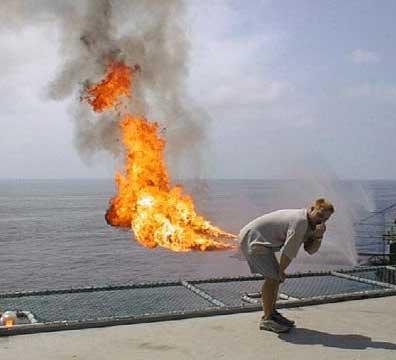
Okay, so if that is not unbelievable enough, the Vatican TV picks up on the photo and does a story on it, complete with a Polish priest endorsing the image as an authentic supernatural manifestation. Jimmy Akin had a pretty good analysis of why this was bad for the Church. He lists three reasons:
"This is the kind of story that Vatican TV really shouldn't do. Even if they ran the story with all kinds of disclaimers, those disclaimers won't make it through into the popular media. The mere fact that Vatican News Service is carrying this story will be taken as indicating that the Vatican supports this interpretation of the bonfire image." People will take this as some sort of "miracle" proving John Paul II is among the blessed when in fact it is no such thing.
"This is bad because it strains credulity enough to have saintly images appearing in tortillas and pieces of toast and on the sides of buildings. Finding one in an image of something as dynamic and as constantly-changing-in-shape as fire is completely beyond the bounds. If you take enough pictures of any bonfire, you'll be able to find such images in it." True. This just makes Catholics look superstitious and stupid.
I think this third and final point by Jimmy Akin really needs to be taken into consideration. He says, "And then there is the fact that fire isn't exactly the most . . . er . . . traditional symbol of what it's like in heaven. I mean, if you want a message that JP2 is in heaven rather than . . . one of the hotter regions . . . is a bonfire the best place for such a message?" Point well taken!
Let's hope this dies away and that people don't start making pilgrimages to this guy's fire pit, just like they did to that fountain dedicated to JPII in Krakow (or it might have been another Polish city). Perhaps people will start claiming this is an authentic miracle because of all the good fruits that will come of it: pilgrimages to the holy fire pit, people saying the rosary there, priests hearing confessions, people weeping. After all, good fruit automatically validates any apparition, right?? It is a weak spirituality that seeks after such tenuous and silly "miracles."
Wednesday, October 17, 2007
St. John Capistrano Triumphant
Speaking of the holy Franciscan St. John Capistrano (see the excellent post below), I was in Vienna earlier this month and come upon this wonderful sight that you see to the left. It is the pulpit from which the good saint preached the crusade for the defense of Christendom against the Turks. Above the pulpit can be seen the holy Franciscan trampling upon a vanquished Turk, while holding the flag of the crusaders and looking to Heaven for divine succor.The Battle of Belgrade: 1456
We all know of the spectacular Catholic victories against the Muslims at Poitiers (732), Jerusalem (1099), Lepanto (1571) and Vienna (1683), as well as the great leaders of those campaingns: Charles Martel, Godfrey de Bouillon, Don Juan of Austria and Jan Sobieski of Poland. But how many of us have ever heard of the no less pivotal Battle of Belgrade in 1456 and the great Catholic Hungarian warlord Janos Hunyadi?After the fall of Constantinople in 1453, the Turkish advance did not simply cease; Mehmet II, the victor of Constantinople, geared up his forces for an invasion of the Catholic Balkans. His immediate goal was to take the Hungarian fortress-town of Belgrade (then called Nandofehervar) on the border of Hungary and the newly possessed Ottoman lands. Hungary was in a precarious situation, as it had no strong centralized kingship at the time and had been torn by baronial rivalries in the years leading up to the battle. The most powerful of these lords was Janos Hunyadi, a Serb and veteran of many wars against the Turks. Seeing the fall of Constantinople and the imminent invasion of the Turks, Hunyadi quickly made peace with his enemies and united the Hungarians against the coming infidel wave. He built up many fortresses and supplied garrisons out of his own revenues. However, no other baron was willing to assist him against the Turks, partly because they thought it a lost cause, and partly because even at this late hour with the Turks at the door, they feared empowering Hunyadi too much at their own expense. Thus Hunyadi stood alone against the Ottomans.
He did have a faithful ally in St. John Capistrano, a Francsican monk who preached a crusade against the Turk so effectively that the peasants and farmers all rose up to join Hunyadi, swelling his forces to about 25,000 men. At the very moment Hunyadi was assembling his peasant force, Mehmet II arrived at Belgrade with a seasoned force of about 70,000 Ottoman warriors, most of them veterans of Constantinople. The siege of Belgrade was commenced on July 4th, 1456. Hunyadi was still a few days away from the city recruiting cavalry for his relief effort.
When Hunyadi heard about the siege, he linked up with St. John Capistrano and made his way for Belgarde, the preaching of the friar having now swollen the Hungarian force to close to 50,000, most of them ill equipped and untrained peasants. Meanwhile, Mehmet II pounded away at the walls of Belgrade with his heavy cannons, the same cannons that had levelled the ancient walls of Constantinople. The defenders waited in fearful expectation. The Turks had set up a naval blockade on the Danube in order to protect against any advance from the south.
Hunyadi arrived at Belgrade on July 14th and destroyed the flotilla of the Turks in a single day, sinking three Turkish galleys and capturing twenty-four ships. Meanwhile, Mehmet's cannons had finally breached the walls of the city, and an all out assault was ordered on the 21st of July. Hunyadi, now within the city, ordered a fierce resistance, and flaming pitch and burning wood were hurled at the defenders. Once, a Turkish soldier managed to plant the Sultan's flag on the pinnacle of the castle, but he was grabbed by a Hungarian soldier, and the Turk, Hungarian and flag all fell from the castle and perished. The Turks were beat back for the day, but only barely.The following day a miracle occured. Apparently by spontaneous impulse, without any orders from Hunyadi or Capistrano, the Christian rabble decided to sally outside of the castle and ravage the Turkish ramparts. The force was soon reinforced by 2,000 Crusaders, and before anybody knew what was going on, the Turks began to take flight. Panic spread throughout the Turkish camp, and the Catholic force of only a few thousand began to rout the conquerors of Constantinople. The Sultan's bodyguard of about 5,000 Janissaries tried desperately to stop the panic and recapture the camp, but by that time Hunyadi's army had also joined the unplanned battle, and the Turkish efforts became hopeless. The Sultan Mehmet II himself advanced into the fight but took an arrow in the thigh and was rendered unconscious. The rout turned into a general panic, and the Catholic army raged upon the Ottoman force with much slaughter; almost all of Mehmet's captains were killed.
When the Sultan regained consciousness, he was so distraught at the disaster that he had to be prevented from killing himself. The wounded were withdrawn in 140 wagons and Mehmet sulked back to Constantinople, the Turkish advance thus halted for the next century. During the siege, Pope Callixtus III ordered the noon bell to call believers to pray for the defenders - but as in many places the news of victory arrived earlier than the order, it transformed into the commemoration of the victory, and the Pope modified his the order to fit this interpretation. Hence the noon bell is still rung to this day for the memory of Hunyadi's victory.
Hunyadi's total force never exceeded 50,000, and the Turkish force was about 70,000, perhaps as high as 100,000. Nevertheless, the Hungarians lost only 10,000 men, and the Turks over 50,000, more than half of their army. But the Hungarians paid dearly for their victory: the carnage caused a plague to break out in the camp, which killed Hunyadi only weeks after the victory. A few weeks after that, Capistrano succumbed as well.
Though Belgrade eventually fell to the Turks in 1521, the Battle of Belgrade and Janos Hunyadi deserve to be remembered along with Don Juan and Jan Sobieski as defenders of Christendom; indeed, as its avenging angel, since it was Hunyadi's forces who killed all the warlords who had taken Constantinople and who wounded the proud Mehmet II and inflicted such disaster on him that he wanted to kill himself.
St. John Capistrano, ora pro nobis!