Showing posts with label Atonement. Show all posts

Monday, March 05, 2012

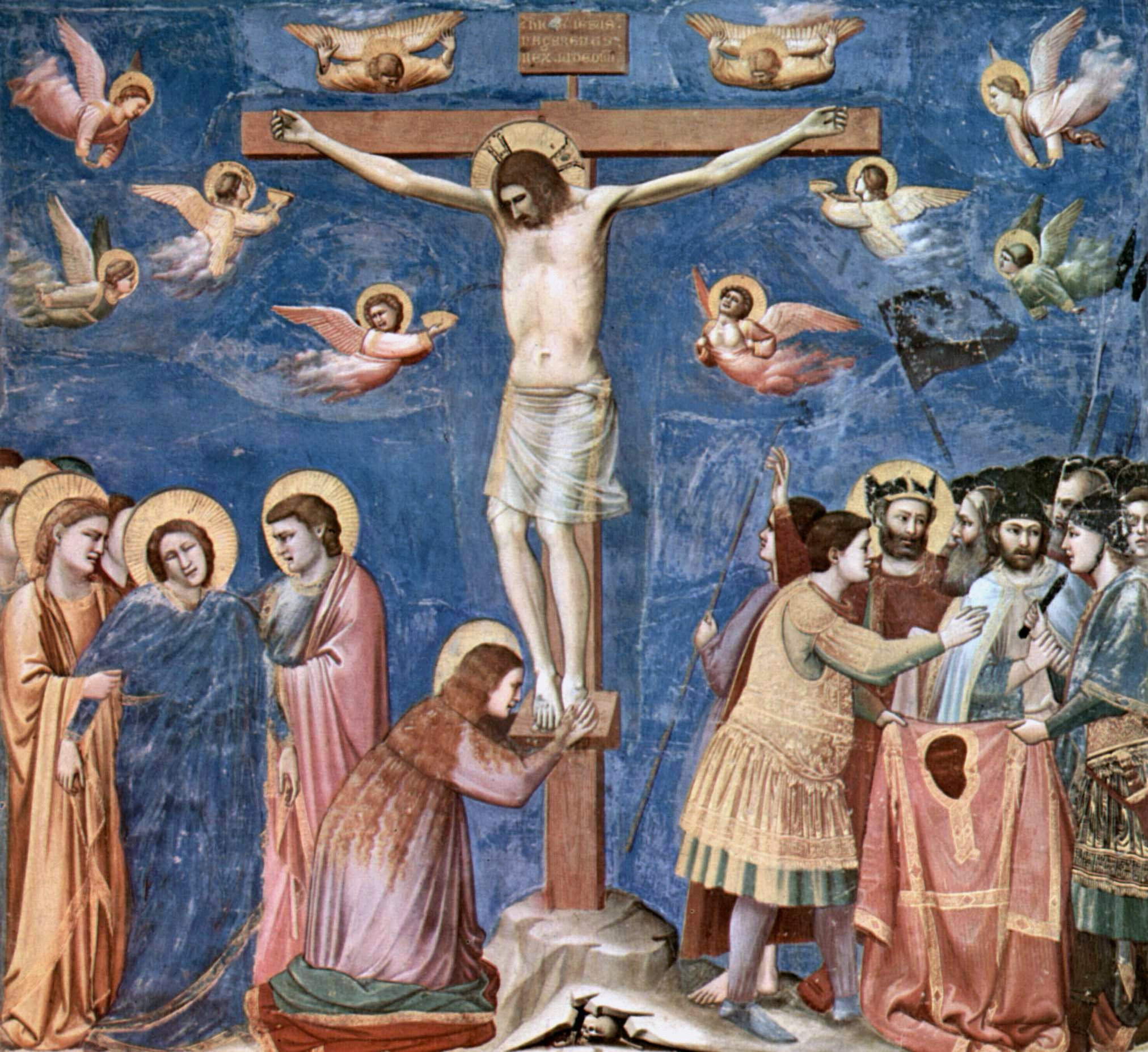
Christ's Cry from the Cross

What is a Catholic to believe about the manner in which Christ has redeemed us by His death? That is, what is a properly Catholic soteriology? Anselm has done a thorough job of refuting the common Protestant error of Penal Substitution elsewhere on this blog (look for "Anselm's Posts on Soteriology" on the sidebar), but what, in a positive sense, is a Catholic left with to believe once we have refuted the errors of those who espouse Penal Substitution?

This is a big question with many facets. There are many ways the conversation can go, but I think the following five issues are the few key points for discussion:

1) The Agent of Christ’s Death
2) The Nature of Christ’s Sufferings
3) What About Christ’s Death Makes it Atoning
4) Interpreting Different Scriptural Texts Dealing with the Atonement
5) How Christians Appropriate the Grace Merited in the Atonement


There is no way to tackle this at once, but I think I would actually like to begin with the fourth point on Scriptural texts dealing with the Atonement, especially Christ’s cry of dereliction (“My God, my God, why have You forsaken Me?” –Matt. 27:46). This verse is usually a proof text for the Protestant claim that Christ is experiencing “abandonment” by God the Father. This abandonment, in the Protestant idea, comes about as a result of Christ literally being “made sin”, that is, loaded with the actual sins of the whole human race in such a way that He assumes the guilt due to us. Because of this, God Himself forsakes Christ and Christ bears the full brunt of the guilt of man’s sin in isolation from God. Thus, the cry from the cross means that Christ is giving voice to this horrendous experience of being forsaken by His Father.

In the first place, I think it is evident that this cannot mean what Protestants think it does. As Anselm has pointed out elsewhere, Christ enjoyed the beatific vision constantly, even during the Crucifixion, and this has been infallibly defined by Pope Pius XII in Mystici Corporis. Christ also specifically references the hour of His passion in contrasting the abandonment of His disciples with the faithfulness of God the Father, who is “always” with Him:

“Behold, the hour cometh, and it is now come, that you shall be scattered every man to his own, and shall leave me alone; and yet I am not alone, because the Father is with me” (John 16:32).

This means that the cry of Christ from the cross cannot mean that His vision or union with God the Father was obscured during the Crucifixion. But the point of this post is not to say what the cry of Christ does not mean, but rather explore what it does mean.

There are many theories as to what Christ’s last, anguished cry means. The Church’s most eminent saints disagree at times, and I might add that not all of their opinions are tenable, in my opinion. St. Ambrose, for example, says:

It was in human voice that he cried: "My God, My God, why have you forsaken me?" As human, therefore, he speaks on the cross, bearing with him our terrors. For amid dangers it is a very human response to think ourself abandoned (Of the Christian Faith, 2.7.56).

Though it may be a human thing to think oneself abandoned, it is not something we can attribute to Christ since, even in his human nature, His intellect was free from positive error, and if we were to say that Christ wrongly believed Himself to be abandoned by God, this would indeed constitute a positive error.

Aquinas states that the difficulty with this passage comes in understanding what it means to be “forsaken” or “given up”, and in typical Aquinas fashion, gives several definitions of the phrase:

As observed above, Christ suffered voluntarily out of obedience to the Father. Hence in three respects God the Father did deliver up Christ to the Passion. In the first way, because by His eternal will He preordained Christ's Passion for the deliverance of the human race, according to the words of Isaias (53:6): "The Lord hath laid on Him the iniquities of us all"; and again (Is. 53:10): "The Lord was pleased to bruise Him in infirmity." Secondly, inasmuch as, by the infusion of charity, He inspired Him with the will to suffer for us; hence we read in the same passage: "He was offered because it was His own will" (Is. 53:7). Thirdly, by not shielding Him from the Passion, but abandoning Him to His persecutors: thus we read (Mat. 27:46) that Christ, while hanging upon the cross, cried out: "My God, My God, why hast Thou forsaken Me?" because, to wit, He left Him to the power of His persecutors, as Augustine says (Ep. cxl). (ST, III, 47, 3).

In my opinion, however, it is St  John Chrysostom who comes closest to the mark here in referring Christ’s cry to Psalm 22 and giving it a prophetic significance. Chrysostom says:

Why does he speak this way, crying out, "Eli, Eli, lama sabach-thani?" That they might see that to his last breath he honors God as his Father and is no adversary of God. He spoke with the voice of Scripture, uttering a cry from the psalm. Thus even to his last hour he is found bearing witness to the sacred text. He offers this prophetic cry in Hebrew, so as to be plain and intelligible to them, and by all things Jesus shows how he is of one mind with the Father who had begotten him
(The Gospel of Matthew, Homily 88.1).

Christ’s cry itself, “My God, my God, why have You forsaken Me” is taken from Psalm 22:1, the same Psalm that prophesies all of the details of the Crucifixion:

~All who see me mock at me, they make mouths at me, they wag their heads; (v. 7)
~Yea, dogs are round about me; a company of evildoers encircle me; they have pierced my hands and feet – (v. 16)
~I can count all my bones --they stare and gloat over me; (v. 17)
~they divide my garments among them, and for my raiment they cast lots. (v. 18)

It is as if, in His final breath, He is saying, “Look, that which is written in the Psalm is coming to pass before your very eyes.” According to Hebrew custom, it is sufficient for our Lord to quote only the first line of the Psalm to bring the whole thing to remembrance, just as it is now when someone says, “The Lord is my shepherd, I shall not want”, “Te Deum”, or “O’ Say Can You See”; the recitation of the first line calls to mind the whole, and everything the whole implies. Therefore, Christ’s cry can be seen as a kind of final appeal to the Scriptures that testify that He is Who He claims.

John Paul II interprets Christ’s cry from the cross as being a sign of continuing communication between the Father and the Son despite the apparent abandonment of the Son by God – and I think we have to keep that word apparent in the forefront of our minds, because to the Pharisees and those who were watching, it did indeed appear as if He had been abandoned. John Paul II says:

"On the Cross, Christ's total forgiveness, even of his executioners, establishes the new justice. Dearest "Brothers and Sisters, the cry of Jesus on the cross (cf. Mt 27,46) is not the anguish of a desperate man, it is the prayer of the Son who offers his life to the Father for the salvation of all mankind. From the cross Jesus shows the conditions which enable us to forgive. To the hatred with which is persecutors nailed him to the Cross, he responds with a prayer for them. He not only forgives them, he continues to love them, to want their good and to intercede for them. His death becomes the full realization of Love" (Message of John Paul II for World Mission Sunday, 19 May 2002).

The only problem here is that the Pope interprets Christ’s words “not as the anguish of a desperate man” but as a “prayer of the Son who offers his life to the Father” but does not explain why the prayer is then phrased awkwardly in the context of God-forsakenness. I do think JPII is close to the truth here, but it needs better explanation.

St. Augustine has a very helpful explanation, connecting the various threads of thought from Chrysostom, Aquinas and John Paul II. He sees the cry as an expression of Christ’s humanity, akin to “If it is possible, let this cup pass from me.” In other words, because Christ was a man, He did not, on a natural level, like the idea of being scourged and crucified. But, because His human will was perfectly in accord with His divine will, He was likewise able to say, “Nevertheless, not my will, but thine be done.” Augustine interprets the cry from the cross similarly:

Out of the voice of the psalmist, which our Lord then transferred to himself, in the voice of this infirmity of ours, he spoke these words: "My God, my God, why have you forsaken me? He is doubtless forsaken in the sense that his plea was not directly granted. Jesus appropriates the psalmist's voice to himself, the voice of human weakness. The benefits of the old covenant had to be refused in order that we might learn to pray and hope for the benefits of the new covenant. Among those goods of the old covenant which belonged to the old Adam there is a special appetite for the prolonging of this temporal life. But this appetite itself is not interminable, for we all know that the day of death will come. Yet all of us, or nearly all, strive to postpone it, even those who believe that their life after death will be a happier one. Such force has the sweet partnership of body and soul (Letters, 140 to Honoratus 6).

In his most compassionate humanity and through his servant form we may now learn what is to be despised in this life and what is to be hoped for in eternity. In that very passion in which his proud enemies seemed most triumphant, he took on the speech of our infirmity, in which "our sinful nature was crucified with him" that the body of sin might be destroyed, and said: "My God, my God, why have you forsaken me?" ... Thus the Psalm begins, which was sung so long ago, in prophecy of his passion and the revelation of the grace which he brought to raise up his faithful and set them free"
(Letters, 140 to Honoratus 5).

Thus, “My God, my God, why have you forsaken me?” means “O’ God, why was it necessary that the sins of man should demand such a price?” with the implied answer, “Into your hands a commend my spirit,” the “Not my will but thine” statement of the Crucifixion. Thus Christ’s cry becomes one not of despair but of absolute abandoning trust. His sufferings are Job-like, and his cry is reminiscent of Job’s response to his own sufferings, “Though He slay me, yet will I trust Him” (Job 13:15).

This interpretation takes some thought to come to, and admittedly I do not like it as much as Chrysostom’s straightforward interpretation of the cry as being in fulfillment of Psalm 22. A lot of this also has to be wrapped in to a more thorough treatment of Catholic soteriology, which I do not have time for at the moment but will hopefully get to in the near futue.

Sunday, February 05, 2012

The Heresies of Balthasar

For the past month, I have been slogging through Alyssa Lyra Pitstick's monumental tome Light in Darkness, subtitled, "Hans Urs von Balthasar and the Catholic Doctrine of Christ's Descent into Hell." It is a massive work, but tremendously thorough and takes on von Balthasar like few in the post-Conciliar Church have been willing to do. Balthasar is most known, of course, for his idea that we may reasonably hope that hell may be empty, but Pitstick takes the fight to the heart of Balthasar's theology: his doctrine that Christ was abandoned by the Father and suffered the pains of hell on Holy Saturday. As Pitstick demonstrates, this theology of the "Descent" is actually central to all of Balthasar's theology and actually serves as the premise upon which he will build his conclusion that we may hope for universal salvation.

I have not finished the book yet, though I am drawing close. Even so, I can say that Miss Pitstick has done us all a tremendous service in putting this work together. I for one an appalled that so many otherwise orthodox individuals in the Church, from theology professors right on up to John Paul II and Benedict XVI, find Balthasar's theology credible. I dismissed his "hope for universal salvation" theory as completely contrary to our tradition about two seconds after somebody explained it to me, and it mystifies me that so many other learned persons continue to dally with it. But Pitstick's book does more than expose the flawed thinking behind Balthasar's empty hell theory - it exposes him as heretical (or at least extremely counter to tradition) in his Christology, soteriology, Trinitarian theology, sacramental theology, ecclesiology and almost every other area across the theological spectrum, leading the reader to the conclusion that, not only is Balthasar mistaken on his empty hell hypothesis, but his entire corpus of theology is extremely questionable and that this man is far from the trustworthy theologian that Ignatius Press and many in the Magisterium would have us believe.

Case in point (and there are many cases to which we could point); Balthasar's concept of sin. The traditional Catholic concept of sin is that sin is understood as a privation, especially with reference to original sin, which is a privation of grace. St. Thomas says that every sin is a kind of privation, either of "form or order or due measure" (De malo, 2:2). St. Thomas affirms Augustine's teaching on sin as a privation of the good:

"Sin is nothing else than a bad human act. Now that an act is a human act is due to its being voluntary, as stated above, whether it be voluntary, as being elicited by the will, e.g. to will or to choose, or as being commanded by the will, e.g. the exterior actions of speech or operation. Again, a human act is evil through lacking conformity with its due measure: and conformity of measure in a thing depends on a rule, from which if that thing depart, it is incommensurate" (STh, I-II, Q. 71, art. 6).

Here we see Thomas stating that sin is an act that falls short of a standard ("due measure"); in other words, it is a lack of the good, a privation of something that ought to be, although Thomas is careful to explain that sin is not a "pure privation" (I-II, Q. 72, art. 1); in other words, to say it is a privation is not to say that sin is "nothing." Sin is "a word, deed, or desire, contrary to the eternal law" (I-II, Q. 71, art. 6),   "an act deprived of its due order"; since all creatures desire the good, truly or mistakenly, sin occurs when a lesser, perceived good is substituted in place of the eternal good. This act falls short, is defective of perfection, but is nevertheless a real act, though an act whose nature is to be sinful by defect. Thus, sin as an act willed by the sinner is certainly a reality, but it has no ontological existence, nor could it, being understood as a privation.

The Catholic Encyclopedia states:

"The act [of sin] is something positive. The sinner intends here and now to act in some determined matter, inordinately electing that particular good in defiance of God's law and the dictates of right reason. The deformity is not directly intended, nor is it involved in the act so far as this is physical, but in the act as coming from the will which has power over its acts and is capable of choosing this or that particular good contained within the scope of its adequate object, i.e. universal good" (source).

The Catechism of the Catholic Church will also use terms that present sin as a privation; it is a "failure", a "wound" (CCC 1849), the latter of which was a popular term in antiquity and the Middle Ages to explain the concept - just as a wound or sickness is the privation of health, so sin is the privation of the good.

Most readers of this blog are familiar enough with the traditional doctrine of sin as a privation that I don't think I need to cite any more sources to establish it. This is an important point, however, because Balthasar will go on to misinterpret the traditional approach taken by St. Augustine and St. Thomas to mean that sin is "nothing." He will state that the idea of sin as a privation does not adequately grasp the reality of sin's horror.

It stands to reason that, since a privation does not have ontological existence, it cannot be objectively separated from the subject in which that privation is found. One cannot have sickness in and of itself apart from a subject who is sick (we may have a cancer cell isolated in a test tube, but that is not sickness. Sickness does not arise until that cancer attacks a human host, who, as a person, becomes sick due to the absence of health brought about by the cancer). Similarly, we cannot isolate sins from the sinner. The way sin must be handled is to be "washed away", "blotted out" or "expiated" in the context of the restoration of the sinner himself. A piece of wood with a hole in it cannot be repaired by trying to remove the hole from the wood; the hole must be filled in the context of the wood, because a hole can only exist in something.

Balthasar's dissatisfaction with the privation theory of sin leads him to posit a real, ontological existence for sin, contrary to Augustine, Thomas, the implications of the Catechism and almost all of ancient and medieval Catholic tradition. Sin becomes an ontological reality by a sort of negative creation, in which man, by the passion and willfulness that he puts into sinning, turns sin into a positive reality. Balthasar says:

"It is possible to distinguish between the sin and the sinner...Because of the energy that man has invested in it, sin is a reality, it is not 'nothing.'" (Theo-Drama, vol. V, pp. 266, 314).

Because sin has this ontological reality, it can be abstracted from the sinner and, consequently, removed to another locus. Here Balthasar's theology of sin crosses into his soteriology. Because sin is a reality that can be separated from the sinner, it is possible to "load" it on to Christ, who literally assumes the sins of every person in His death, but especially in His Descent:

"[Sin] has been isolated from the sinner...separated from the sinner by the work of the Cross" (ibid., 285, 314).

Thus, because sin is able to be loaded onto Christ, Christ literally takes the sins, and the guilt, of every sinner on to Himself, and in His death and Descent, literally becomes sin, in such a real, metaphysical sense that Balthasar makes the shocking statement that the Incarnation is "suspended" while Jesus is in the tomb:

"Holy Saturday is thus a kind of suspension, as it were, of the Incarnation, whose result is given back to the hands of the Father and which the Father will renew and definitively confirm by the Easter Resurrection" ("The Descent into Hell", Spirit and Institution, Explorations in Theology, vol. IV, pp 411-412).

If all sin and all guilt and all punishment for sin has been loaded upon Christ by the Father, who wills to actively "crush" and punish the Son as if He had sinned, then there is no more wrath or punishment left that any sinner could endure eternally. All his sins have been abstracted from him and loaded on to Christ. Conversely, if there is no wrath left for the sinner, there is no real merit left for the saint, at least in the way traditional Catholic theology has understood it. Here, Balthasar sounds downright Lutheran in his understanding of salvation:

"[The sinner's] hope can only cling blindly to the miracle that has already taken place in the Cross of Christ; it takes the entire courage Christian hope for a man to apply this to himself, to trust that, by the power of this miracle, what is damnable in him has been separated from him and thrown out with the unusable residue that is incinerated outside of the gates of the Holy City" (Theo-Drama, vol. V, 321).

The language of the sinner clinging "blindly" to an act that has already taken place reminds one of the Protestant jargon of "resting in God's finished work"; as with Luther, the sin of man is separated from him and placed on Christ, who in turn bestows upon us righteousness. The difference between Balthasar and Luther here is that Balthasar appears to make the operative principle the virtue of hope rather than faith. Balthasar vehemently denied that his soteriological doctrine was Lutheran, because he emphasized charity and hope along with faith and thus technically did not teach "faith alone" (and Balthasar emphasized the redemptive nature of the Descent, something Luther ignored), but in practice, it seems that Luther and Balthasar are very close together here inasmuch as they both agree in sins being abstracted from the sinner, "loaded" upon Christ who is then punished with God's wrath, and the sinner appropriating the righteousness of Christ by faith-hope in a finished work that has already been completed.

There is so much more we could point to with Balthasar, but here I merely wanted to show how he breaks from Catholic Tradition not only in his teaching of an empty hell, but on many other things as well; in this case, the idea of sin having a positive existence that can be abstracted and separated from the man, as opposed to the traditional Catholic idea of sin as a privation.

I highly recommend Pitstick's book. I will also probably do some more stuff on Balthasar in the future on here because his teachings are so pernicious. I knew he was questionable, but until I read Pitstick's book, I did not understand how truly horrific and contrary to Tradition some of his concepts really are.

Saturday, April 23, 2011

Christ's Descent into Hell

Pax tecum! Anselm here. I thought it would be fitting to post an excerpt in honor of Holy Saturday from my work on Christ's act of Satisfaction-Atonement, chapter 8: St. Thomas Aquinas on Christ's Descent into Hell.

Master's Thesis: Poena Satisfactoria: Locating Thomas Aquinas's Doctrine of Vicarious Satisfaction in between Anselmian Satisfaction and Penal Substitution (Trumau, Austria: ITI, 2010).


In his commentary on the Apostles's Creed, Thomas gives four reasons as to "why Christ descended with his soul into hell," the first of which is this:
First, in order to endure the entire punishment of sin, in order thus to expiate the entire fault. But the punishment of man's sin was not only the death of the body, but there was also a punishment in the soul: since the sin also had reference to the soul, the soul itself was also punished by the lack of the divine vision: for the removal of which, satisfaction had not yet been made. And therefore, before the coming of Christ, all men descended to hell after death, even the holy fathers. Christ, therefore, in order to endure the entire punishment due to sinners, willed not only to die, but also to descend according to his soul into hell. Whence Psalm 87:4, "I have been counted with those who have descended into the pit: I have been made as a man without help, free among the dead." For the others were there as slaves, but Christ as free. [Aquinas, In Symbolum Apostolorum, 5]
This text immediately appears to imply that Christ descended into hell in order to suffer there the proper punishment of the damned, namely the loss of the vision of God, as if it were somehow necessary for him to endure this in order to make a full satisfaction for sin.

Such a position would imply that the pœna endured by Christ was a pœna simpliciter, according to which the pain itself is regarded as formal in the act of "satisfaction" (understood here simply as punishment) rather than the good offered in compensation out of charity. In this case divine justice appears unwilling to accept anything less than the full punishment due to unredeemed sinners, namely the damnation to which they would have been subject apart from Christ's sacrifice. This also implies an act of substitution in the Lutheran sense of a literal exchange of places between Christ and sinners, rather than the kind of vicarious representation in which Christ steps into the place of sinners without displacing them, but rather incorporating them into himself. In short, such a position implies a penal substitution in the full sense of the words given to them by the Reformation.

The most important thing to notice in this text, however, is Thomas's concluding statement that Christ was among the dead, ut liber (as free). In the Compendium of Theology, Thomas explains this unique freedom of Christ in a text which is crucial for a proper understanding of his interpretation of Christ's descent into hell and therefore also of his doctrine of satisfaction as a whole:
In truth, on the part of the soul it follows among men from sin after death that they descend into hell not only as regards place, but also as regards punishment. But just as the body of Christ was indeed under the earth according to place, but not according to the common defect of dissolution, so also the soul of Christ descended indeed into hell according to place, not however in order to undergo punishment there, but rather to release from punishment those who were detained there on account of the sin of the first parent, for which he had already fully satisfied by suffering death: whence after his death nothing remained to be suffered, but he descended into hell locally without suffering any punishment, that he might show himself as the liberator of the living and the dead. From this also it is said that he alone was free among the dead, because his soul was not subject to punishment in hell, nor his body to corruption in the tomb. [Aquinas, Compendium theologiae I, cap. 235]
This text makes it very clear that for Thomas there can be no question of Christ suffering any kind of punishment in hell.

The parallelism presented here between tomb and hell is also instructive. In his treatise on the humiliation of Christ in the Summa theologiæ (III, qq. 46-52), Thomas considers his passion (qq. 46-49), and then his death as the state of separation of soul and body (q. 50). This is followed by parallel questions on the burial of his body (q. 51) and the descent of his soul into hell (q. 52). That Christ descended into hell in order to endure the entire punishment of sin means for Thomas that he willed to endure physical death fully, from the suffering which precedes death, through the separation of soul from body in which it is consummated, to its completion in the resting places of soul and body apart from each other. The descent of Christ into hell according to his soul bears the same relation to punishment as the burial of his body: "just as Christ, in order to take upon himself our punishments, willed his body to be placed in the tomb, so also he willed his soul to descend into hell." [Aquinas, Summa theologiae III, q. 52, a. 4] The descent itself, like the burial, is penal only inasmuch as it is the completion of death, but Christ's soul does not suffer in hell any more than his body suffers in the tomb.

Contrary to Balthasar, who holds that Christ had to endure both a natural death (the separation of the soul from the body), and the "second death" spoken of in the Revelation to John (Rev. 2:11; 20:6, 14; 21:8), the spiritual death of the soul (that is, the separation of the soul from God), in order to fully free man from this twofold death, Thomas clearly holds that Christ's one (natural) death is itself more than sufficient for this purpose, as can be seen in the mystical interpretation which he gives to the two nights and one whole day that Christ spent in the tomb (and in hell):
[B]y the death of Christ we have been liberated from a double death, namely from the death of the soul and from the death of the body: and this is signified by the two nights through which Christ remained in the tomb. His death, however, not coming forth from sin, but undertaken from charity, had not the account of night, but of day: and therefore it is signified by the whole day in which Christ was in the tomb. [Aquinas, Summa theologiae III, q. 51, a. 4]
Another important text for an accurate understanding of Thomas's doctrine of the descent of Christ's soul into hell can be found in his commentary on the Sentences of Peter Lombard, his first major work. There he reiterates the principles on the basis of which he excludes any pain or suffering from the soul of Christ in hell. The Incarnation was ordered toward salvation, for the accomplishment of which God had chosen to require satisfaction. In assuming a human nature therefore Christ willed to take upon himself certain defects, according to a twofold criterion: they should be those which were common to all men on account of sin, yet did not imply or even incline toward any defect of grace or virtue. That a soul should descend into hell after death was, before Christ's coming, common to all men on account of original sin, and so Christ also endured this, descending locally into hell. Thomas then considers each possible kind of punishment (pœna), and concludes that Christ cannot have suffered any of them in hell. The pain of loss (pœna damni), which is the lack of the vision of God, would clearly imply a defect of the consummate grace of glory, and hence is excluded. The pain of sense (pœna sensus) could be either satisfactory (pœna satisfactoria), purgative (pœna purgativa), or damnative (pœna damnativa). Now pain cannot be satisfactory after death inasmuch as satisfaction, like merit, belongs to the state of the viator, to this earthly life alone; but purgative pains (after death) are only due on account of impurity and damnative pains on account of mortal sin, either of which would imply a defect of grace. Hence: "It was befitting to Christ to descend into hell insofar as it implies a place, but not insofar as it implies punishment." [Aquinas, In III Sententiarum, d. 22, q. 2, a. 1a]

Conclusion

Although a single text taken out of context can easily give the impression that Thomas holds essentially the same doctrine of penal substitution as Calvin, namely that in order to pay the debt due to sin Christ had to suffer the pain proper to damnation (which consists essentially in the loss of the vision of God), Thomas's parallel texts on the same topic make it abundantly manifest that this is not the case. According to Thomas, Christ descended locally into hell in order to endure death all the way through to the end, but his soul did not suffer there. On the contrary, he came to release from their punishment and from the captivity of the conquered devil the souls of the holy fathers who were detained there on account of original sin, which he accomplished with such a manifestation of power that, although he entered only into the limbo of the fathers according to his essence and freed only them, even the damned felt the power of his presence.

Sunday, March 20, 2011

Is Gandhi in Hell?

No "Saint Gandhi"

This post is really not about Gandhi; rather, it is using Gandhi as an example of a lot of what is wrong in the way a lot of Christians are thinking today regarding the Church's perennial teaching on the reality of hell as well as the abuse of the concept of invincible ignorance.

According to the manner in which the doctrine of invincible ignorance is popularly (and errantly) understood in the Catholic Church, those who are ignorant of the Gospel and Christ's Church in such a way that it is "not their fault" that they have not heard are not guilty of their sins and we can safely presume that will go on to heaven, saved, as it were, by their ignorance. Thus, we need not worry ourselves about Hindus, African bushmen, the natives of the Amazon or the Muslims, because so long as it is "not their fault" that they do not know Christ, we can presume salvation.

This is, of course, an errant interpretation of the concept of invincible ignorance, an idea that is contrary to two thousand years of tradition and something that undermines the missionary impulse of the Church. It leads to things like Mother Teresa's nuns visiting Hindu temples for prayer instead of evangelizing the Hindus, the Columban missionaries having "role playing" sessions with Muslims and teaching that all religions lead to God, and the Trappist monks of Tibhirine, Algeria praying with Sufi Muslims instead of trying to teach them about Christ (they were rewarded for their interest in Islam by being beheaded, by the way). I don't know if in any of these cases the concept of invincible ignorance was cited specifically, but we cannot deny that an ecclesial culture that keeps tossing around this concept is going to breed these sorts of abominations.


As an interesting aside, evangelicals have an interesting answer to the question about what happens to remote natives and persons who never heard of Christ. They basically say, "If anyone of them is open to the truth, God sends them a missionary. If they never hear of Christ and nobody comes to them, it is because God knows they will not listen. Thus, they are without excuse, even if they have never heard."St. Thomas and St. Augustine seem to have opined similarly, though neither taught this as definitive as far as I can tell. I don't know that we can always presume that God will work this way; Ezekiel 33:6 states that when a righteous man fails to warn sinners of their plight and the sinners perish, it is the righteous man who is guilty for not spreading the word: "And if the watchman see the sword coming, and sound not the trumpet: and the people look not to themselves, and the sword come, and cut off a soul from among them: he indeed is taken away in his iniquity, but I will require his blood at the hand of the watchman." Irregardless of whether or not those in true invincible ignorance are saved, Scripture is clear that if they are not reached by the Gospel, it is our fault. I don't think it is responsible to just write them off and say, "Well, if they never heard it is because God knew they wouldn't listen." But this is a digression.

The Catechism says this on invincible ignorance: "Those who, through no fault of their own, do not know the Gospel of Christ or his Church, but who nevertheless seek God with a sincere heart, and, moved by grace, try in their actions to do his will as they know it through the dictates of their conscience - those too may achieve eternal salvation" (CCC 847), quoting Lumen Gentium 16. It must be understood that this is not "another way" to salvation outside of Christ; the Catechism is stating that some may "stumble" into salvation through Christ ignorantly, but just not be cognizant of it, much like the Calormene at the end of C.S. Lewis's The Last Battle. There is only one door, but some may enter through it even if they don't realize it. So the Catechism at least says that salvation is possible for those in invincible ignorance, but does not by any mean state it as a given.

Invincible ignorance is originally a premise in moral theology that has been transplanted to soteriology. The Catechism mentions it in this context in paragraph 1793 regarding culpability for moral actions: "If...the ignorance is invincible, or the moral subject is not responsible for his erroneous judgment, the evil committed by the person cannot be imputed to him. It remains no less an evil, a privation, a disorder. One must therefore work to correct the errors of moral conscience" (CCC 1793).

So, applying this to soteriology, we must first understand that this is not saying that those who have never heard of Christ are absolved of all their sins by this ignorance. According to the principle of invincible ignorance, they may at least be innocent of the sin of unbelief, but invincible ignorance does not negate culpability for sins against natural law (theft, murder, adultery, etc).  The Catechism says this clearly:

"However, no one is presumed to be ignorant of the principles of moral law since these are written on the heart of every man" (CCC 1860).

So one can be innocent of the sin of unbelief but still be guilty of a host of other damnable sins,  first among them idolatry, but also theft, adultery, fornication, lying, etc. Therefore, being invincibly ignorant of salvation does not in any way "secure" salvation - it merely means you can't be imputed with the guilt of the sin of unbelief. It is in this context that Pope Pius IX said, "It is equally certain that, were a man to be invincibly ignorant of the true religion, he would not be held guilty in the sight of God for not professing it" (Pius IX, Allocution of December 9, 1854). He speaks here only of the guilt of not professing the true Faith, not he guilt relating to sins against the natural law.

To see invincible ignorance as somehow being salvific is entirely misleading and destructive to faith. How could ignorance ever be salvific? St. Thomas reminds us that ignorance is a result of sin and remains penal in character. This passage from the Summa wraps up the teaching from the Catechism and Pius IX nicely:

"Unbelief has a double sense. First, it can be taken purely negatively; thus a man is called an unbeliever solely because he does not possess faith. Secondly, by way of opposition to faith; thus when a man refuses to hear of the faith or even condemns it, according to Isaiah, "Who has believed our report?" This is where the full nature of unbelief, properly speaking is found, and where the sin lies. If, however, unbelief be taken just negatively, as in those who have heard nothing about the faith, it bears the character, not of fault, but of penalty, because their ignorance of divine things is the result of the sin of our first parents. Those who are unbelievers in this sense are not condemned for the sin of unbelief, but they are condemned on account of other sins, which cannot be forgiven without faith” (
Summa Theologica II-II, Art. 10 Q. 1).
Ignorance is penal. Furthermore, St. Paul teaches that, even though many of the nations are in ignorance of Christ, God will no longer overlook their ignorance but calls them all to repent:
 
"Since therefore we are the offspring of God, we ought not to think that the divinity is like an image fashioned from gold, silver, or stone by human art and imagination. God has overlooked the times of ignorance, but now he demands that all people everywhere repent because he has established a day on which he will 'judge the world with justice' through a man he has appointed, and he has provided confirmation for all by raising him from the dead" (Acts 17:29-31).
Note that the call to repent is for "all people everywhere." This is totally contradictory to the creeping universalism within the Church which seems to optimistically believe that, not only those who are invincibly ignorant, but even Muslims and Jews will be saved without converting so long as they are "good people."

Gandhi is the most common example of a pagan "righteous man" that is given. Do a Google search on "Gandhi in hell" or "Gandhi in heaven" and you will see that the use of Gandhi as an example in this discussion has become as standard as the use of Socrates in learning logical syllogisms. Does Gandhi in any way fulfill the criteria for someone who was "invincibly ignorant" of the faith? Let's look at a quote from his autobiography:

"It was more than I could believe that Jesus was the only incarnate Son of God, and that only he who believes in Him would have everlasting life. If God could have sons, all of us were His sons. If Jesus was like God, or God Himself, then ...all men were like God and could be God Himself. My reason was not ready to believe literally that Jesus by His death and by His blood redeemed the sins of the world. Metaphorically there might be some truth in it .... I would accept Jesus as a martyr, an embodiment of sacrifice, and a divine teacher, but not as the most perfect man ever born. His death on the cross was a great example to the world, but that there was anything like a mysterious or miraculous virtue in it my heart could not accept" (Mahatma Gandhi, Gandhi An Autobiography: My Experiments with Truth, pp. 170-71).

If anything is clear from this passage, it is that Gandhi was emphatically not in any ignorance about Christianity, Jesus or the central beliefs of the Christian Faith. He knows enough about Christ to paraphrase the Gospel of John at the top of the passage and to understand the Christian concept of Christ being God's "incarnate" Son. He knows Christians believe that "His death and blood redeemed the sins of the world." He understands very well the Christian idea of Jesus' death being unique and atoning. Based on this, we can hardly call Gandhi ignorant, let alone invincibly ignorant. Gandhi knows Jesus' claims to lordship but will not accept them; as a teacher, as a martyr perhaps, but not as Lord. He understands the tenets of Christianity perfectly well and yet consciously chooses to reject them.

Let us remember that the word "invincible" literally means "unconquerable." Gandhi was raised among Christians in British India and his ignorance can hardly be said to be unconquerable. "But," it might be said, "perhaps the example of Christianity he was given was so poor that it spoiled any chance of him ever believing." Well, if we take this line of reasoning then basically every person on the planet is invincibly ignorant unless someone as perfect as Christ Himself comes to preach to them, since we could always cite sins or faults on the part of the one presenting the Gospel. Secondly, Gandhi did not say he rejected Christianity because of Christians (although he was not impressed with the Christians he met), but because he could not accept the message of Christ. It was Christ that Gandhi rejected, and did so quite openly and deliberately.

By the way, even if Gandhi was in "invincible ignorance", it would mean only that he was incuplable for the sin of disbelief, not for any other sins.

Some Catholics assert that it is impossible for those in invincible ignorance to be saved. Following the Catechism and Lumen Gentium, I have to at least admit the possibility, though as opposed to modern, progressive Catholic universalism, I must insist that the criteria for this be understood as narrowly as possible, and that we do no more than admit the possibility without asserting salvation in any specific cases. We should certainly never, ever, ever engage in any of the nonsense like making icons of Gandhi, as we see at the head of this post. In my opinion, those who are in a state of invincible ignorance are few and far between. And even if they are not guilty of unbelief, this does not mean they are not guilty of a host of other sins, much less that they do not need the message of Christ preached to them.

Is Gandhi in hell? Of course, there is no way to know; I can admit the possibility of a hypothetical last-minute, interior conversion known only to God alone. But barring that, and knowing how Gandhi thought about Jesus, I think it is an insult to the Gospel to suggest that such a man could gain heaven just because of his social and political activism while ignoring the insulting things he said about Jesus and the Church.

Monday, February 23, 2009

Christus Victor


An Historical Study of the Three Main Types of the Idea of Atonement

by Gustaf Aulen
translated by A. G. Hebert
Eugene, OR: Wipf & Stock Publishers, 2003
Previously published by SPCK, 1931

Gustaf Aulen attempts in this book to revise the accepted view of the development of doctrine in regards to the Atonement effected by Christ on the Cross. The generally accepted view is that there are basically two types of doctrines of the Atonement: an objective type (e.g. Anselm) wherein Christ's sacrifice satisfies for the sins of the world, and a subjective type (e.g. Abelard) wherein Christ's death on the cross is a demonstration of God's love aimed at persuading men to follow his example (reconcilation of God and a man is effected by the man's conversion in response to the event of the cross). Aulen, however, tries to set a third type of view alongside these two, the view, he maintains, which is common to the New Testament, the Fathers of the Church, and Martin Luther. He calls this the classic view of the Atonement. The three types, as outlined by Aulen, are summarized below, with my conclusions following.


The Classic Idea
A movement of God toward man; continuity in the order of Divine operation, and discontinuity in the order of merit and justice; the Incarnation is seen in close connection to the atonement, as its necessary presupposition; a conflict in God between Love and Justice wherein Love simply triumphs and Justice is left unsatisfied; defies rational systematization.

The Latin Idea
A movement of God toward man, and then man toward God; discontinuity in the order of Divine operation and continuity in the order of merit and justice; the Incarnation is only loosely connected to the work of atonement, because the latter is regarded as done by Christ in the human nature; the conflict in God between mercy and justice is resolved because justice is satisfied leaving mercy free to act; aims at rational explanation.

The Subjective Idea
A movement of man to God; reconciliation between God and men is the result of man's conversion / amendment; Christ is merely the great Exemplar; his work may help God to view men in a new light; sin is regarded as little more than an infirmity; salvation is envisaged in worldly terms; that Christ is God at all is almost entirely left out; there is no more conflict at all between love and wrath, for wrath is left out entirely; aims at rational explanation.

Conclusions
I dismiss the subjective idea entirely; but I'm not convinced that Aulen has satisfactorily demonstrated sufficient distinctions between the Latin and classic ideas of Atonement to warrant the rewriting of history that he intends here.

(Dis-) continuity in the order of divine operation. This is the main distinction that Aulen tries to draw between the Latin and classic ideas of Atonement. However, it is equally present in either case. He makes much of the fact that in the Latin type Christ offers himself on the Cross as man; yet if death and resurrection are the means whereby the devil is overthrown and reconciliaion effect, as the classic idea also holds, then it ought to be indisputable that Christ made atonement as man. For he could hardly have died and risen from the dead as God. In either case, it is equally true that "God was in Christ reconciling the world to himself." In the Latin view as much as in the classic, the atonement is a work of God from first to last, because it is a work executed by the eternal Son in human nature.

In fact, while Aulen claims that the close connection between Incarnation and Atonement is brought out more clearly in his view, I submit that the opposite is the case. Anselm's seminal work is entitled Cur Deus Homo. (Why the God-Man?) His great work on the Atonement is actually intended to be first and foremost a work on the Incarnation. In his understanding, wherein a man must offer the satisfaction for sin since man had sinned, yet only a God would offer an infinite satisfaction to atone for the infinite offense of sin, the close connection of Incarnation and Atonement could not be more obvious: the atonement must be effected by one person existing in two natures, divine and human. The Atonement is the completion of the Incarnation as much as the Incarnation is the presupposition of the Atonement. In Aulen's view of the atonement, on the other hand, it is actually hard to see what the place or role of the human nature of Christ is.

(Dis-) continuity in the order of merit and justice. What Aulen intends as a critique of the Latin type, I take as its particular merit: namely, that it posits an explanation of the atonement which doesn't involve any injustice. That Love and Justice are in conflict within God Himself, and that Love simply overturns Justice, which must remain unsatisfied, is quite unacceptable. Much better is the Anselmian scenario wherein God's Love is creative enough to find a way for justice to be satisfied other than through penal retribution. God is just in His Mercy, and merciful in His Justice.

Reason. Aulen's last critique of the Latin type is that it aims at rational explanation of God's work (Anselm's fides quaerens intellectum), while his view defies rational systematization. Again, I take the opposite position here, viewing rational (not rationalizing) explanation as a good thing, while opining that if something "defies rational systematization" it might just as well be irrational as suprarational.

I will confess that I still regard the Latin type, in its Catholic version (i.e. not penal substitution) as the correct doctrine of the atonement (surprise!). In regards to Aulen's work at distinguishing the doctrine of Luther, the Fathers, and the New Testament, from this view, I will say that I cannot speak to Luther's doctrine from a position of real knowledge, so I will leave that be; the doctrine of the Fathers at large is surely not so developed as that of Anselm, but inasmuch as they all agreed in asserting continuity of divine operation, and none denied the continuity of justice, I take them not to hold a distinct doctrine from Anselm, but an underdeveloped version of the same, as is generally taught by the historians of doctrine; the doctrine of the New Testament, of course, I believe to be completely in line with the Anselmian view, even though not articulated in such a systematic way.

Tuesday, December 18, 2007

New Addition to "My Writings"

The Redemptive Suffering of Christ in the Theology of Joseph Ratzinger by Anselm (2007)

The theology of Joseph Ratzinger has received wide and well deserved attention; ever more so since his election to the chair of St. Peter in April 2005. The purpose of this paper is to draw out some of Ratzinger's key insights into the meaning of Christ’s suffering as an intrinsic part of the work of redemption; what does it mean that "we are healed" by "his stripes" (Is 53:5)?1 After an introductory note on Ratzinger’s soteriological method, we will turn directly to the mystery of Christ's vicarious atonement. We will consider first the vicariousness of Christ's suffering – that mysterious change of place prophesied by Isaiah: "he was wounded for our transgressions, he was bruised for our iniquities" (Is 53:5 [my emphases]). Two of the fundamental questions in this connection must be: how is it possible for Christ to take upon himself the sins of others? And, in what relation does he stand to the sin that he bears?

In the second part of this paper we will then consider the reconciliation between God and mankind effected by Christ’s suffering, looking first at Christ's interior pain of sorrow in light of Ratzinger's words on the nature of forgiveness, and then also at the complete pain of Christ's passion as the expression of a love so pleasing to God that it satisfies God's justice, pacifies his wrath, discharges man's debt of punishment, and merits glory for Christ and salvation for mankind.

Please feel free to read the rest of the paper and post your comments on it here. Enjoy!

Sunday, November 11, 2007

Jesus of Nazareth

Jesus of Nazareth: From the Baptism in the Jordan to the Transfiguration
by Joseph Ratzinger (Pope Benedict XVI)
Trans. Adrian J. Walker
New York: Doubleday, 2007

Last night I finished reading this first book published by Joseph Ratzinger since his elevation to the See of Peter. Because he expressly desired to publish this book as a private theologian rather than as an expression of the Church's magisterium, I will refer to the author as Joseph Ratzinger.

Ratzinger's purpose throughout is to lead his readers to an encounter with Christ, the real historical Christ, as He is presented in the Gospels. There is in fact no distinction between the so-called "Jesus of history" and "Christ of faith." A twofold thread runs throughout the book. Ratzinger stresses the necessity of understanding the figure of Jesus in light of His unique "face-to-face" relationship with the Father and in light of His redemptive mission. These two are in fact intimately linked; the Person and the Work of Jesus cannot be separated from one another.

Of great importance generally speaking, but of less interest to me personally, are Ratzinger's repeated contradictions of (or corrections to) common threads of historico-critical biblical interpretation. While not in the least rejecting this method (in fact, he even accepts, for example, the "fact" that Isaiah 40-66 was written centuries after Isaiah 1-39; this despite the fact the then-magisterial Pontifical Biblical Commission in 1908 gave strong indications to the contrary) Ratzinger points out repeatedly and convincingly the limitations of historico-criticism in theology.

Of more interest to me personlly is Ratzinger's emphasis throughout on the doctrine of the Atonement. A systematic treatment of this topic is, of course, far beyond the scope of this work, but Ratzinger makes one facet of the Redemption in particular a point of emphasis. Namely, what it means for Christ to "bear the burden" of our sins. This emphasis is strongly marked right at the beginning of the book. Speaking of Christ's baptism, Ratzinger writes,

"Looking at the events in light of the Cross and Resurrection, the Christian people realized what happened: Jesus loaded the burden of all mankind's guilt upon his shoulders; he bore it down into the depths of the Jordan. He inaugurated his public activity by stepping into the place of sinners. His inaugural gesture is an anticipation of the Cross" (18).

Again, in chapter 2 on the temptations of Christ, Ratzinger remarks that, "He must recapitulate the whole of history from its beginnings - from Adam on; he must go through, suffer through, the whole of it, in order to transform it" (26). This "suffering through" is an important phrase for Ratzinger. The point seems to be that in order for guilt to really be healed from within (in contrast to two alternatives: retaliation, in which the guilty party is simply punished, and on the other hand, a simple amnesty; although in both cases justice is in a certain sense restored, in neither case has the guilty party really been healed interiorly) the guilty party has to "suffer through" his guilt, that is, he must re-experience his sin from the perspective of love. He must re-live, in a certain sense, his sin, this time seeing it for the evil that it is, stripped of its veneer of goodness. Simply put, we are speaking of contrition - which in its root means being "crushed" by the weight of sin. To return to Christ, then, Ratzinger seems to be saying that He "bears the burden" of our sins, He allows himself to be "crushed" by them, inasmuch as He experiences their wickedness from the perspective of love. In I may put it so, He experiences the "contrition" that we should have felt but are inadequate to feel.

This aspect of the redemption wrought by Christ receives its fullest treatment in Ratzinger's reflections on the fifth petition of the Pater noster - forgive us our trespasses, as we forgive those who trespass against us. Here Ratzinger asks, "What is forgiveness?"

"What is forgiveness, really? What happens when forgiveness takes place? Guilt is a reality, an objective force; it has caused destruction that must be repaired. For this reason, forgiveness must be more than a matter of ignoring, of merely trying to forget. Guilt must be worked through, healed, and thus overcome. Forgiveness exacts a price - first of all from the person who forgives. He must overcome within himself the evil done to him; he must, as it were, burn it interiorly and in so doing renew himself. As a result, he also involves the other, the trespasser, in this process of transformation, of inner purification, and both parties, suffering all the way through and overcoming evil, are made new. At this point, we encounter the mystery of Christ's Cross" (158-59).

We could say that in this book we also encounter the mystery of Christ's Cross; we encounter it and it remains nonetheless mysterious, at least to this poor reader. It is a mystery, however, that I have been assigned to penetrate (term paper topic) to the extent that my frail nature will allow by mid-December! Deus miserere me!

Thursday, November 08, 2007

My God, My God, why hast thou forsaken me?


As I have mentioned in previous posts, it is my firm conviction that many, if not most, Catholics, and I include clergy and laymen, theologian or otherwise, hold to some version of the Protestant notion of penal substitution when it comes to the doctrine of the Atonement wrought by Christ.

The Protestantized notion of the atonement of which I speak might be summed up in the following proposition:

"Christ suffered the full weight of punishment due in justice to all the sins of mankind."

What is wrong with that statement, you ask? Think about it. What is the punishment that sin deserves? Death; not just physical death, though, eternal death; specifically, eternal separation from God. At this point, some one will usually appeal to Christ's cry from the Cross, "My God, My God, why hast thou forsaken me?" Doesn't this mean that Christ did experience separation from God, which is exactly what the punishment of Hell is? In short, No.

In his Summa theologiae St. Thomas Aquinas asks whether the pain of Christ's passion was greater than all other pains. He answers in the affirmative. However, and this must be stressed, in his reply to one of the objections Aquinas makes it clear that Christ's pain is not to be compared to the pain experienced by the damned! He writes,

The pain suffered by a separated soul belongs to a state of future damnation which exceeds every evil in this life, as the glory of the saints exceeds every good of our present existence. When we speak of Christ's pain as being maximal, we exclude all comparisons with the pain endured by a soul in the next life. (ST, III, 46, 6, ad 3).

In fact, Christ's human soul was in possession of the Beatific Vision even during the Passion, so far was it from being experiencing the separation from God which is the punishment of the damned! (ST, III, 46, 8). In the words of Ludwig Ott:

While the immediate knowledge of God, which is absolutely supernatural, is vouchsafed to other men only in the next world (in statu termini), Christ's soul possessed it in this world (in statu viae), and indeed, from the very moment of its union with the Divine Person of the Word, that is, from the Conception. Christ was therefore, as the Schoolmen say, viator simul et comprehensor, that is, at the same time a pilgrim on earth and at the destination of His earthly pilgrimage. It follows from this that He could not possess the theological virtues of faith and hope.

Some of the newer Theologians, such as H. Klee, A. Günther, J. Th. Laurent and H. Schell, denied that Christ possessed the Immediate Vision of God while on earth because they considered it to be contradictory to individual assertions of Holy Writ, and to the fact of the Passion of Christ. The modernists (A. Loisy) denied it also and maintained that the natural sense of Scriptural texts cannot be reconciled with the teaching of theologians concerning the consciousness and infallible knowledge of Christ (D 2032)...

Pope Pius XII, in the Encyclical "Mystici Corporis" (1943) declared: "Also that knowledge which is called vision, He possesses in such fulness that in breadth and clarity it far exceeds the Beatific Vision of all the saints in Heaven" ... "in virtue of the Beatific Vision which he enjoyed from the time when He was received into the womb of the mother of God, He has forever and continuously had present to Him all the members of His mystical Body and embraced them with His saving love" (D 2289).
(Ludwig Ott, Fundamentals of Catholic Dogma, 162-63).

How, then, are we to understand the anguished cry of Christ from the Cross? Allow me to offer without further commentary the interpretations of some of the Church's greatest luminaries, noting especially the absence of any reference to Christ experiencing the separation from God that is the punishment of the damned:

St. Thomas Aquinas
Objection 1: It would seem that the Godhead was separated from the flesh when Christ died. For as Matthew relates (27:46), when our Lord was hanging upon the cross He cried out: "My God, My God, why hast Thou forsaken Me?" which words Ambrose, commenting on Lk. 23:46, explains as follows: "The man cried out when about to expire by being severed from the Godhead; for since the Godhead is immune from death, assuredly death could not be there, except life departed, for the Godhead is life." And so it seems that when Christ died, the Godhead was separated from His flesh.

Reply to Objection 1: Such forsaking is not to be referred to the dissolving of the personal union, but to this, that God the Father gave Him up to the Passion: hence there "to forsake" means simply not to protect from persecutors. or else He says there that He is forsaken, with reference to the prayer He had made: "Father, if it be possible, let this chalice pass away from Me," as Augustine explains it (De Gratia Novi Test.). (ST, III, 50, 2).

Objection 1: It would seem that there was sin in Christ. For it is written (Ps. 21:2): "O God, My God . . . why hast Thou forsaken Me? Far from My salvation are the words of My sins." Now these words are said in the person of Christ Himself, as appears from His having uttered them on the cross. Therefore it would seem that in Christ there were sins.

Reply to Objection 1: As Damascene says (De Fide Orth. iii, 25), things are said of Christ, first, with reference to His natural and hypostatic property, as when it is said that God became man, and that He suffered for us; secondly, with reference to His personal and relative property, when things are said of Him in our person which nowise belong to Him of Himself. Hence, in the seven rules of Tichonius which Augustine quotes in De Doctr. Christ. iii, 31, the first regards "Our Lord and His Body," since "Christ and His Church are taken as one person." And thus Christ, speaking in the person of His members, says (Ps. 21:2): "The words of My sins" - not that there were any sins in the Head. (ST, III, 15, 1).

I answer that, As observed above, Christ suffered voluntarily out of obedience to the Father. Hence in three respects God the Father did deliver up Christ to the Passion. In the first way, because by His eternal will He preordained Christ's Passion for the deliverance of the human race, according to the words of Isaias (53:6): "The Lord hath laid on Him the iniquities of us all"; and again (Is. 53:10): "The Lord was pleased to bruise Him in infirmity." Secondly, inasmuch as, by the infusion of charity, He inspired Him with the will to suffer for us; hence we read in the same passage: "He was offered because it was His own will" (Is. 53:7). Thirdly, by not shielding Him from the Passion, but abandoning Him to His persecutors: thus we read (Mat. 27:46) that Christ, while hanging upon the cross, cried out: "My God, My God, why hast Thou forsaken Me?" because, to wit, He left Him to the power of His persecutors, as Augustine says (Ep. cxl). (ST, III, 47, 3).

St. John Chrysostom
Why does he speak this way, crying out, "Eli, Eli, lama sabach-thani?" That they might see that to his last breath he honors God as his Father and is no adversary of God. He spoke with the voice of Scripture, uttering a cry from the psalm. Thus even to his last hour he is found bearing witness to the sacred text. He offers this prophetic cry in Hebrew, so as to be plain and intelligible to them, and by all things Jesus shows how he is of one mind with the Father who had begotten him (The Gospel of Matthew, Homily 88.1).

St. Ambrose
It was in human voice that he cried: "My God, My God, why have you forsaken me?" As human, therefore, he speaks on the cross, bearing with him our terrors. For amid dangers it is a very human response to think ourself abandoned (Of the Christian Faith, 2.7.56).

St. Augustine
Out of the voice of the psalmist, which our Lord then transferred to himself, in the voice of this infirmity of ours, he spoke these words: "My God, my God, why have you forsaken me? He is doubtless forsaken in the sense that his plea was not directly granted. Jesus appropriates the psalmist's voice to himself, the voice of human weakness. The benefits of the old covenant had to be refused in order that we might learn to pray and hope for the benefits of the new covenant. Among those goods of the old covenant which belonged to the old Adam there is a special appetite for the prolonging of this temporal life. But this appetite itself is not interminable, for we all know that the day of death will come. Yet all of us, or nearly all, strive to postpone it, even those who believe that their life after death will be a happier one. Such force has the sweet partnership of body and soul (Letters, 140 to Honoratus 6).

In his most compassionate humanity and through his servant form we may now learn what is to be despised in this life and what is to be hoped for in eternity. In that very passion in which his proud enemies seemed most triumphant, he took on the speech of our infirmity, in which "our sinful nature was crucified with him" that the body of sin might be destroyed, and said: "My God, my God, why have you forsaken me?" ... Thus the Psalm begins, which was sung so long ago, in prophecy of his passion and the revelation of the grace which he brought to raise up his faithful and set them free (Letters, 140 to Honoratus 5).

See this article for more on Christ's cry from the Cross.

Saturday, July 21, 2007

Why Do So Many Catholics Believe in Penal Substitution?

I am becoming ever more convinced that there is a wide spread lack of understanding amongst Catholics of the nature of the Atonement. St. Anselm, pray for us. I have heard it in homilies, I have read it in books by popular Catholic theologians and apologists, I have heard on Catholic talk radio, I have discovered it in working to prepare 8th graders for confirmation: the Protestant theory of Christ's atonement known as penal substitution. Penal substitution, simply put, is the theory that Christ was punished on the Cross with the punishment with which we deserved to be punished. Here is a great example in a work by a very popular Catholic philosopher and a Jesuit priest:

"It seems impossible for God to solve the dilemma of justice versus mercy, but we know from the Gospel account how he does it. The problem is that he cannot, it seems, do both; he must either exact the just penalty for sin - death - or not. Mercy seems a relaxation of justice, and justice a refusal of mercy. Either you punish or you don't. The laws of logic seem to prevent God from being both just and merciful at the same time... God solves this dilemma on Calvary. Full justice is done: sin is punished with the very punishment of hell itself - being forsaken of God (Mt 27:46). But mercy and forgiveness are also enacted. The trick is to give us the mercy and him the justice" (Handbook of Christian Apologetics by Peter Kreeft and Ronald K. Tacelli, p. 127).

I have seen and heard Christ's atonement described in such ways by Catholics time and time again. There are a number of gaping flaws in this Protestant theory: first, what is just about condemning an innocent man to die in another's place? And what happens to the concept of forgiveness if God does, in fact, exact the full punishment for sin, just from another party? According to this theory, God's righteous anger against us is not withheld but merely redirected. Furthermore, if Christ is supposed to suffer the punishment that we all ought to have suffered on account of sin, simply dying certainly wouldn't cut it, the punishment of sin is eternal separation from God - He would have to accept this. The authors above try to deal with this by pointing to Matthew 27:46 "My God, my God, why have you forsaken me?" as if this points to a real separation between Father and Son. Anyone, however, who is familiar with Trinitarian theology knows this to be absurd. The Persons of the Godhead are certainly inseparable. Even if Matthew 27:46 did indicate a separation of the Son from the Father, the punishment of sin, which He is supposedly accepting, is eternal separation from God, not a three day separation from God. Again, if Christ has actually been punished for all sins committed throughout all time by all men, what is to stop us from sinning freely? God would be unjust to punish both Christ and us for the same sin, and having alreadly punished Christ, He could not punish us. This leads swiftly into one of two places, universalism - the belief that all will be saved, or Calvinist double predestination - wherein Christ only died to save some men. This solves the problem by positing that Christ accepted the punishment only for the elect and therefore God can still punish the damned (this does still leave the elect free to sin without fear).

Why, then, do explanations like Kreeft's and Tacelli's above seem to be so widespread in popular Catholic thinking? And what is the big deal? Here is a hint: there is one more major problem with the Protestant theory of penal substitution. It leaves no room for a perpetual sacrificial propitiation for sins, i.e. the Holy Sacrifice of the Mass. Think about it. If Christ, in dying on the Cross, accepted the punishment then and there of all men, what need is there for a continual sacrifice, the purpose of which is to appease God's anger and assuage His wrath? None. The only sensible purpose of the Mass then would be to provide us an opportunity to receive Him sacramentally in Holy Communion (and I know many Catholics who see this as the primary, indeed the only, purpose of the Holy Mass). This, I think, goes a long way to explaining the inverted emphasis on the meal/communion aspect of the Mass over against the sacrificial aspect of the Mass. When one's understanding of the atonement is so far Protestantized as to think in terms of penal substitution, it is hard to see why the Mass should really be anything more than a Communion service.

If I could be so bold as to add another step into Fr. Z's famous plan to save the world: Understand the Atonement; Save the Liturgy; Save the World! St. Anselm, ora pro nobis!

P.S. I wrote this assuming our esteemed readership to be sufficiently familiar with Catholic theology as to know what the Catholic theory of the Atonemen, admirably explained by St. Anselm, really is. To refresh your memory, see St. Anselm's Cur Deus Homo? and the Catholic Encyclopedia.

Monday, July 02, 2007

CUR DEUS HOMO?


Bishop, Confessor, and Doctor of the Church
St. Anselm, the famous Archbishop of Canterbury, was a Benedictine monk, who fought intrepidly for the faith and liberty of the Church. He is one of the greatest philosophers and mystics of the eleventh century. He died on 21 April in 1109.
As Dr Ludwig Ott summarises it in his Fundamentals of Catholic Dogma:
"St. Anselm of Canterbury in his dialogue: 'Cur Deus Homo' has speculatively penetrated and built up to a systematic theory of Redemption the idea of the vicarious atonement of Christ which is based in Scripture and tradition. While the Fathers, in the explanation of Christ's work of sanctification, proceed more from the contemplation of the consequences of the Redemption, and therefore stress the negative side of the Redemption, namely, the ransoming from the slavery of sin and of the devil, St. Anselm proceeds from the contemplation of the guilt of sin. This, as an insult offered to God, is infinite, and therefore demands an infinite expiation. Such expiation, however, can be achieved by a Divine Person only. To be capable of thus representing mankind, this person must be, at the same time, man and God."
The Catechism of the Council of Trent (The Roman Catechism) has this to say on the doctrine of the atonement:
"The pastor should teach that all these inestimable and divine blessings flow to us from the Passion of Christ. First, indeed, because the satisfaction which Jesus Christ has in an admirable manner made to God the Father for our sins is full and complete. The price which he paid for our ransom was not only adequate and equal to our debts, but far exceeded them. Again, it (the Passion of Christ) was a sacrifice most acceptable to God, for when offered by His Son on the altar of the cross, it entirely appeased the wrath and indignation of the Father."
I have chosen St. Anselm as my patron and (pseudonym) here as it my conviction that a renewed understanding of the Catholic doctrine of the atonement, so admirably ennunciated by St. Anselm, is imperative to regaining a proper understanding of the sacrificial and propitiatory nature of the Mass, which is indeed nothing other than the re-presentation of that self-same atoning sacrifice. I am further convinced, with then-Cardinal Ratzinger, "that the crisis in the Church that we are experiencing today is to a large extent due to the disintegration of the liturgy." In short, understanding the atonement will help us to understand the sacrificial nature of the Mass, which will lead us back to the traditional rite of Mass which so well expressed that sacrificial nature, which in turn will bolster the faith and hence the morals of the Catholic people. Of course there is much more to be said here, especially as regards the assertion that the Traditional Latin Mass will bolster the faith and morals of the Catholic people. But I have gone on long enough for now. Perhaps another post. Sancte Anselme, ora pro nobis!