Friday, July 09, 2010

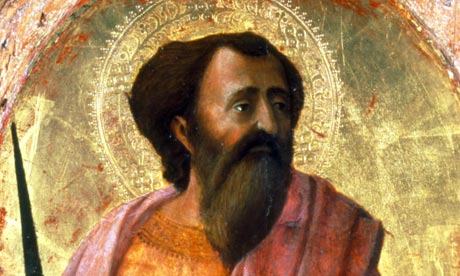
James and Paul on "works of law"

This question came up a while back in a Sacred Scripture class I teach for the local home school co-op:

 In James 2:24, St. James clearly says, “Man is justified by works and not by faith alone" (the only time the phrase "faith alone" appears in the Bible). Yet Protestants will typically turn to St. Paul's discussion of justification in Romans, specifically Romans 3:28, where St. Paul says precisely the opposite of St. James: "We hold that man is justified by faith apart from works of law." What is the solution here?

In looking at the issue of justification, we run the risk of muddying the waters of discussion if we are unable to clear up what, on the surface, appears to be a confusing contradiction.As with most other troublesome issues that come up when reading the Scriptures, the problem here is one of context. In this case, the issue is resolved by looking at what context Paul and James are using the word "works." 

In Romans 3, what is St. Paul referring to when he says that Abraham was not saved by "works of law?" What "works of law" is he referencing? Reading a little further ahead, throughout most of chapter 4, makes it clear that the works Paul is referring to are the ceremonial acts of the Old Testament: the washings, sacrifices, feasts, but especially circumcision:
What does the Scripture say? "Abraham believed God, and it was credited to him as righteousness."  Now when a man works, his wages are not credited to him as a gift, but as an obligation.  However, to the man who does not work but trusts God who justifies the wicked, his faith is credited as righteousness. David says the same thing when he speaks of the blessedness of the man to whom God credits righteousness apart from works:  "Blessed are they whose transgressions are forgiven, whose sins are covered.  Blessed is the man whose sin the LORD will never count against him."  Is this blessedness only for the circumcised, or also for the uncircumcised? We have been saying that Abraham's faith was credited to him as righteousness.  Under what circumstances was it credited? Was it after he was circumcised, or before? It was not after, but before! And he received the sign of circumcision, a seal of the righteousness that he had by faith while he was still uncircumcised. So then, he is the father of all who believe but have not been circumcised, in order that righteousness might be credited to them.  And he is also the father of the circumcised who not only are circumcised but who also walk in the footsteps of the faith that our father Abraham had before he was circumcised. It was not through law that Abraham and his offspring received the promise that he would be heir of the world, but through the righteousness that comes by faith (Rom. 4:3-13).
In the context of Romans, St. Paul is telling the Christians of Rome that the ceremonial precepts of the Jewish law are not efficacious to salvation - that circumcision will not add anything to those who are in Christ, as he states in Galatians 5:6, "For in Christ Jesus neither circumcision nor uncircumcision is of any avail, but faith working through love." The phrase, "works of law," which occurs 74 times in the writings of Paul, is a technical phrase, erga nomou, which is commonly taken to refer to the ceremonial precepts of the Law, not the moral imperative of all men to do good in general.

The context of Romans is clearly that St. Paul is warning the Roman believers that the Judaizing "works of law" are incapable of saving them; he is certainly not making some kind of Lutheran assumption that all of our deeds are valueless and that mankind can in no way cooperate with God's saving grace in a meaningful way.

What then is the context of James 2:24, "For you see that a man is justified by works and not by faith alone"? To what "works" is St. James referring to? In the first place, though the same Greek root word is used for the English "work" (ergon), the familiar Pauline formula "works of law" is absent, suggesting that James is probably not using this word in the same manner. So what "works" is James referring to here?
"What does it profit, my brethren, if someone says he has faith but does not have works? Can faith save him? If a brother or sister is naked and destitute of daily food, and one of you says to them, "Depart in peace, be warmed and filled," but you do not give them the things which are needed for the body, what does it profit? Thus also faith by itself, if it does not have works, is dead. But someone will say, "You have faith, and I have works." Show me your faith without your works, and I will show you my faith by my works. You believe that there is one God. You do well. Even the demons believe; and tremble! But do you want to know, O foolish man, that faith without works is dead? Was not Abraham our father justified by works when he offered Isaac his son on the altar? Do you see that faith was working together with his works, and by works faith was made perfect? And the Scripture was fulfilled which says, "Abraham believed God, and it was accounted to him for righteousness." And he was called the friend of God. You see then that a man is justified by works, and not by faith only. Likewise, was not Rahab the harlot also justified by works when she received the messengers and sent them out another way? For as the body without the spirit is dead, so faith without works is dead also" (James 2:14-26).
Look at the examples James cites of "works": clothing the naked, feeding the hungry, the obedience of Abraham, the faithfulness of Rahab (note that Rahab's faith is a work: compare James 2:25 with Heb. 11:31). These works that James cites as salvific are the proverbial "good works" so derided by classical Protestantism. Here St. James' point is to stress that simple, intellectual adherence to the truths of the Faith is not sufficient for justification; good deeds must follow as well, or else one's faith is in vain. This is the traditional Catholic interpretation of these texts: that while the kind of ceremonial Jewish precepts written against by St. Paul are certainly not salvific or necessary for our salvation, it is absolutely essential to persist in charity and to cooperate with God's grace by doing "good works"; this is, after all, the meaning of our Lord's parable of the talent. Only those who put their master's money (grace) to "work" and reaped a profit were able to enter into their master's happiness. The servant who did nothing was cast out.

Therefore the Catholic need never play St. Paul off against St. James. Both Apostles are correct in their statements, of course. The Church has always reiterated the fact that the ceremonies of the Jewish law are powerless to convey salvation; indeed, for those enlightened by Christian doctrine and educated in the truth, it actually becomes sinful to revert back to the practice of the external forms of Judaism, as taught by the Council of Florence and Pope Eugene IV:
"[The Church] firmly believes, professes, and teaches that the matter pertaining to the law of the Old Testament, of the Mosaic law, which are divided into ceremonies, sacred rites, sacrifices, and sacraments, because they were established to signify something in the future, although they were suited to the divine worship at that time, after our Lord's coming had been signified by them, ceased, and the sacraments of the New Testament began; and that whoever, even after the passion, placed hope in these matters of the law and submitted himself to them as necessary for salvation, as if faith in Christ could not save without them, sinned mortally. Yet it does not deny that after the passion of Christ up to the promulgation of the Gospel they could have been observed until they were believed to be in no way necessary for salvation; but after the promulgation of the Gospel it asserts that they cannot be observed without the loss of eternal salvation.  All, therefore, who after that time observe circumcision and the Sabbath and the other requirements of the law, it declares alien to the Christian faith and not in the least fit to participate in eternal salvation, unless someday they recover from these errors (Pope Eugene IV, Papal Bull Cantate Domino).
 St. Thomas Aquinas affirms this as well:
All ceremonies are professions of faith, in which the interior worship of God consists. Now man can make profession of his inward faith, by deeds as well as by words: and in either profession, if he make a false declaration, he sins mortally. Now, though our faith in Christ is the same as that of the fathers of old; yet, since they came before Christ, whereas we come after Him, the same faith is expressed in different words, by us and by them. For by them was it said: "Behold a virgin shall conceive and bear a son," where the verbs are in the future tense: whereas we express the same by means of verbs in the past tense, and say that she "conceived and bore." In like manner the ceremonies of the Old Law betokened Christ as having yet to be born and to suffer: whereas our sacraments signify Him as already born and having suffered. Consequently, just as it would be a mortal sin now for anyone, in making a profession of faith, to say that Christ is yet to be born, which the fathers of old said devoutly and truthfully; so too it would be a mortal sin now to observe those ceremonies which the fathers of old fulfilled with devotion and fidelity (STh, I-II, Q. 103, Art. 4).

 Furthermore, the Church unhesitatingly affirms the meaning of St. James in asserting that good deeds ("faith working through love") are essential for our salvation, as taught by the Council of Trent and Vatican II:
"Having, therefore, been thus justified and made the friends and domestics of God, advancing from virtue to virtue, they are renewed, as the Apostle says, day by day, that is, mortifying the members of their flesh, and presenting them as instruments of justice unto sanctification, they, through the observance of the commandments of God and of the Church, faith cooperating with good works, increase in that justice received through the grace of Christ and are further justified, as it is written: "He that is just, let him be justified still" and, "Be not afraid to be justified even to death;" and again, "Do you see that by works a man is justified, and not by faith only?" This increase Holy Church asks for when she prays, "Give unto us, O Lord, an increase of faith, hope and charity" (Council of Trent, Session VI, Chapter X).
 From Vatican II:

"He is not saved, however, who, though part of the body of the Church, does not persevere in charity. He remains indeed in the bosom of the Church, but, as it were, only in a "bodily" manner and not "in his heart"(Lumen Gentium 14).


That's the great thing about being Catholic: not having to play Bible verses off against one another to fit certain theological presuppositions, like many Protestants who quote Romans 3:28 verbatim but would like to ignore James 2:24, or who stress a symbolic application of Christ's Hoc est enim corpus meum while conveniently ignoring the Bread of Life discourse in John 6, or who decry the sacrament of confession as clericalism and superstition whilst not having any satisfactory answers for Christ's commission to forgive or retain sins in John 20.


Wednesday, July 07, 2010

Apologia pro Christian Rock: Syncopation & Sexualization (part 4)

After a long delay, it is time for the fourth installment of everybody's least favorite series! This time, I will dealing with the issue of syncopation directly and addressing the claims that syncopated rhythms (a) cause one to become "sexualized", (b) are contrary to natural law and (c) are from the devil. In this post we will only have time to look at question A, whether syncopated beats cause a person to become sexualized.

For many who oppose rock music as intrinsically disordered, the focus is on the syncopated rhythm of the music. Before proceeding any further, we ought to define syncopation, since it can be a difficult concept to grasp for those who do not have a musical background.

Syncopation occurs when a typically unstressed beat is stressed, i.e., an "offbeat." A standard textbook in music theory, the Benward and Saker's Music: In Theory and Practice states that "If a part of the measure that is usually unstressed is accented, the rhythm is considered to be syncopated." Basically, it is the placement of stresses or accents where one wouldn't "normally" occur. If this makes any sense, a traditional rhythm might have the following accent: ONE two ONE two ONE, whereas a syncopated rhythm might go one TWO one TWO one TWO. If we imagine the one's as the bass drum and the two's as a snare drum, then we can see that syncopated rhythms form the "backbeat" to almost all contemporary rock, but also reggae, blues and other forms of music, as we shall see later.

So for the most part, rock music is heavily syncopated. Although, we ought to point out right away that rock music does not consist solely of syncopation - syncopation is one type of rhythm and rock can contain a variety of rhythms. Furthermore, syncopation did not begin with rock. It was used in traditional classical compositions, especially those of a martial nature (march music). Syncopation was used in compositions of the Middle Ages, and such masters as Bach, Mozart, Beethoven and Tchaikovsky have also made extensive use of it (source). So in our discussion of syncopation we ought not to view it as some bizarre novelty invented by the depraved minds of modernity; rather, it is one musical tool among many that composers have always used in assembling their compositions.
|
Now, let's look at these three objections to syncopation in music - that it causes one to become sexualized, that it is intrinsically disordered and contrary to natural law, and that it is from the devil.

The first objection is perhaps the most common, and the point in the argument where objections to syncopation become moral imperatives. If it were true that listening to a certain beat made one sexualized or aroused lust, I suppose it would be morally dangerous to listen to music with that beat, regardless of whether it were a secular rap song or a Christian praise and worship tune. Remember, according to proponents of this theory, the precise style of music or lyrics do not matter - all that matters is the presence of the syncopated rhythm. But does syncopation in fact make one sexualized?

Fr. Basil Nortz of the Opus Sanctorum Angelorum in his talk "Music and Morality" states that (and I paraphrase) syncopated rhythms cause the body to "channel energy" from the upper body down into the pelvic region, giving the listener a desire to thrust or move their hips in sexually suggestive motions. So for Nortz, the connection here is a very physical, biological one: the music actually channels physical energy from the rest of the body to the pelvis, presumably getting one sexually aroused.

Andrew Pudewa, though not making this sweeping of a claim, states that a syncopated rhythm arouses the "lower passions" of man and therefore makes it more likely that the sexual passion or appetite will be awakened by listening to such rhythms. While there is nothing wrong with the sexual appetite, Pudewa states that it is nevertheless dangerous to risk awakening this passion, especially since syncopated rhythms seem to grant it a dominant role in modern music. Pudewa says that rhythm is dominant in modern music based on the fact that "if you turn the volume down very low, the instrument you can still hear is the dominant one." Since in most instances a drum beat can be perceived at much lower amplitudes, therefore music that uses syncopated rhythms is dominated by this beat which sexualizes the listener. This is what Pudewa and Fr. Nortz refer to as rock music's use of "relentless" and "driving" rhythms.

Regarding Fr. Nortz's claims that syncopated beats channel energy to the pelvis, I think we can regard this as pseudo-science. If energy is indeed channeled to the pelvis, then what I want to know is what energy? How is it "channeled"? Does it flow through veins or arteries? Intestines? If you are saying that "energy" is "channeled" then you are making a biological claim about the functioning of the human body and its systems. Unless you can tell me specifically what kind of "energy" this is and how it gets "channeled", then this claim becomes as foolish as the claims of those who say they can "channel energy" from crystals. Therefore, to those who say that a syncopated rhythm channels energy to the pelvis, either explain biologically what exactly it is you are saying gets channeled and how or else refrain from using these meaningless phrases of pseudo-science; it's as worthless as saying that a dog moves by virtue of an "inherent locomotive principle." Frankly, I'm surprised how many people buy this argument about channeling energy, but if you think about it biologically it makes little sense.

What about the argument that rhythm has an especially dominant role in rock music (of whatever variety) and that the dominant place of this rhythm "arouses" the lower appetites?

Again, what is the biological connection between the rhythm and how one gets "aroused" sexually? Do not most of these arguments make use of the unwarranted assumption that a syncopated rhythm arouses one's sexual appetites? Pudewa and Fr. Nortz seem to take this for granted. As a musician of twenty years, I can say this is not the case, but we'll come back to this.

Is rhythm dominant in modern music? Rhythm in fact is dominant in all music, of whatever variety. You cannot have music that is not dominated by rhythm. Classical music is dominated by rhythm. Ancient Greek music is dominated by rhythm. Mozart is dominated by rhythm. So how can Pudewa say that modern rock music is dominated by rhythm? Here we have to make a subtle distinction - when it is said that modern music is dominated by rhythm, what is meant is that modern music makes extensive use of percussive instruments. This is the difference between modern and pre-modern music: while all music is dominated by rhythm (which is just the timing of the music), classical or pre-modern musical forms were written in such a way that the rhythm was not expressed as percussively (note the lack of "drums" in classical compositions, which keep rhythm without them). In modern music, percussive instruments are used for the purpose of keeping rhythm. But in both cases the rhythm dominates the music - it can't be otherwise; without rhythm, there is no music, just minimalism; and however much one dislikes rock music, one cannot accuse it of being minimalist, since most rock music maintains a variety of rhythms, melodies and can be very complex - one might not like the solos of Eddie Van Halen (whose music I can't stand), but one cannot claim that they are minimalist or not complex.

So, it's not rhythm but percussion that allegedly dominates modern music. Andrew Pudewa says that we can prove this by the experiment of turning down the volume when a rock song is playing. If we do this, the last instrument we can still hear as the volume goes down is the drums. This is said to "prove" that the drums dominate the music.

I don't know how scientific this is, but I think what instrument you hear "last" when the volume is turned down has way more to do with tone and pitch that what is "dominant." For example, a lot of classical compositions will have an occasional cymbal crash in them, perhaps only three or four times in the whole piece. Yet, because of the tone and pitch that a cymbal has (as opposed to a violin or cello), you can be sure that if you turned the volume down, you'd hear that cymbal crash above everything else. Does this mean that classical music is dominated by cymbals? No; it simply means that a cymbal is of such a tone that it can be picked up by the human ear with greater ease than a bass. Similarly in rock music, I don't know that we can say that drums "dominate." Obviously, the music has to have rhythm, either with or without drums. I would say that drums don't dominate - they coordinate, as without drums it is very difficult for the guitarists to keep their own rhythm, depending on their degree of expertise.

One more thing to harp on here, and that is the use of this deceptive vocabulary about "relentless" beats and "driving" rhythms. Both Pudewa and Nortz use this language, and I hear it mimicked by many who criticize Christian rock music. What do these adjectives actually mean? Nothing at all. By saying "relentless," isn't this just a more negative way of saying that the beats are constant? Well, so what? Most musical compositions have an instrument that is constantly present. Or when we say that the beat is "driving," don't we really just mean that the beat sets the pace of the music, which is precisely what percussion is supposed to do? These adjectives "relentless" and "driving" are not helpful and are somewhat deceptive- couldn't we just as easily say that compositions by Bach are made up of "relentless piano playing" or that  the 1812 Overture features the use of relentless, driving use of horns; we could even say that Canon in D makes use of that one, "relentless" chord progression. In any of these case the use of the adjectives "relentless" and "driving" would be technically true; yet these adjectives are reserved for reference to rock beats alone because they carry with them obvious, loaded connotation that is negative. Heck, most classical music consists of relentless, driving violins.

But we have strayed from our original question - does any of this have anything to do with people getting sexualized from these beats?

That some music is associated with sexuality is unmistakable, but we have to be clear about what is causing what. For example, rap music and hip hop are more associated with sexuality than most other sorts of music, which is easily proven by a look at their music videos, lyrics and the life-styles engaged in by those who listen to such music. But does the music cause this sexualization? Could the sexuality associated with hip hop and rap perhaps have more to do with culture and socioeconomic status? That is, could not the emphasis of the hip hop "culture" on sex and promiscuity be more about the lack of positive male role models, inverted values that see promiscuous men and loose women as the norm and grinding poverty that leads to a focus on immediate gratification rather than fortitude and temperance? Doesn't this make more sense than saying the beats did it? When we factor in the way this music is marketed and advertised, this reinforces the sexual images associated with the music. The music is marketed using sex, but the rhythms in the music don't cause sexualization. If you remove the cultural background to a lot of this music, I think it is rendered quite innocuous, as in the case of Christian rock music.

And by the way, if the beats really do cause sexualization in hip hop music, then every single person who listens to hip hop should become sexualized and promiscuous, whether they are an African-American youth from Chicago or a dopey, middle-aged white Yuppie professor from Berkley.  Remember, if its about beats then its about beats, and every syncopated rhythm is equally dangerous and sexual - Barry White becomes just as sexual as the Mr. Lunt's "Cheeseburger" song in Veggietales, which is absurd. Yes, syncopation is used in rock n' roll and hip hop, but it also occurs everything from country and blue grass to the Muzak you hear in the department store and the innocent little tunes your kids pick up from Veggietales and Dora the Explorer. Yet sexuality is only associated with a few genres of music, not everything that uses syncopation. Here we have a fallacy of attributing the cultural trappings of a few genres to the whole. That this is a fallacious attribution is easily provable by the fact that (a) it is very easy to separate the musical style from the cultural baggage, and (b) the existence of a vast numbers of musicians and fans of other forms of syncopated music who are not sexual deviants.

I am a musician. I play Christian rock and write Christian rock songs about Jesus but using modern instruments, rock beats and syncopation. If everything was true about syncopation that some assert, then I should be a sexual deviant, not living chastely in a monogamous marriage. It is easy to pick out a few secular rock stars who are sexual deviants, but to focus exclusively on Ozzy Osbourne and the like ignores the throngs upon throngs of other musicians, many Christian but also many secular, who are not deviants, not sexually promiscuous and who are likewise (and most importantly) not famous. Therefore, is it not more plausible that it is the fame and fortune of many rock stars that leads them into immoral lifestyles rather than the type of beats they use in their music? It is a well established fact that fame and wealth corrupt; why invoke syncopated rhythms when we have a much more plausible explanation, especially when there exists a vast number of musicians who are not famous and likewise not living immorally?

Now, it could be argued that syncopation does in fact lead to sexualization by invoking the behavior that goes on at rock concerts. Men and women drunk, scantily clad, sometimes dancing and grinding in a sexual manner, sometimes engaging in unchaste activities right at the show. That this goes on is undeniable, and does it not prove that these beats stimulate the body and cause people to become sexualized?

My answer: absolutely not, and for a simple reason of plain logic. If the argument is made that the beats themselves cause all of these behaviors, and then we bring forward the dissolution that happens at rock concerts as evidence, then it follows that it is necessary to isolate the beats from the concert to prove that the rhythms themselves are responsible for this behavior and not the fact of the large gathering or people, alcohol, loud volume, etc. Basically, if the beats really do cause these behaviors, then they should cause these behaviors under all circumstances, not just when at a rock concert. If we see that syncopation does not produce these behaviors under all conditions, then it is clear that the behaviors described do not derive from the rhythms but arise instead out of the conditions/circumstances in which the music is being performed.

That this is the case is proven by the simple fact that the lewd behaviors described above are associated mainly with rock concerts - i.e., people do not start taking their shirts off and grinding when they are listening to rock music in their car on the way to work in the morning, much less if it is a Christian artist. Nor do they do these things when listening to rock, say, while working in the garage on a Saturday afternoon. In fact, these behaviors seldom occur at all unless in the context of a large gathering of teenagers with plenty of alcohol and loud music. That is definitely a bad combination, but it doesn't have anything to do with beats or rhythms. If you don't believe me, check out the history of opera: opera was banned in the papal states in the 1700s because of the lewd and dissolute behavior that went on at operas. Operas were the rock concerts of the 1700s. And what was the common factor? Certainly not "syncopated rhythms," but the volatile combination of young people, large gatherings at night, alcohol and the latest faddish entertainment.

I apologize for the length of this post - next time I will examine whether syncopation is "against natural law" and whether or not syncopated rhythms are "demonic" in origin.

Friday, July 02, 2010

A miracle for Mother Teresa

 Monica Besra, beneficiary of Mother Teresa's first "miracle"

In this past week's edition of the Michigan Catholic newspaper "The Catholic Times" there was an interesting headline on Mother Teresa's Cause for Canonization. The piece was entitled "Miracle, Anyone?" and was all about how everything was on track for Blessed Mother Teresa's canonization save for the fact that they are "still waiting for one more miracle." The article featured an interview with Fr. Brian Kolodiejchuk, postulator for Mother Teresa's Cause. In his remarks on the need for another miracle, he said, "We get thousands of reports of favors from people praying, but so far, nothing that can be presented as a miracle."

This is interesting, because even the one miracle that Mother Teresa currently has is (in my opinion) not very well attested. Here are the facts on the one miracle recognized by the Vatican in 2002:

This miracle concerns the case of one Monica Besra, a 35-year-old villager from northern India cured of an ovarian tumor. Besra and the Missionaries of Charity claim that the tumor vanished in September 1998 when a medallion with an image of the late Mother Teresa was applied to the site of her pain.

However, Dr. Ranjan Mustafi, chief gynecologist who treated the woman at Balurghat District Hospital in West Bengal, says that it was quite possible that his patient was cured by four anti-TB drugs she was taking at the time, which could have dissolved the tumor. He said he admires Mother Teresa greatly and thinks she should be beatified for her work among the poor. But not for this case. “[Besra] had a medical disease which was cured by medical science, not by any miracle,” he says. His hospital superiors back him up, saying that records show she responded to the treatment steadily. Five doctors in Rome consulted by the Vatican on the case disregarded this scientific probability and hastily agreed there was no medical explanation for the cure. Mustafi said he was never contacted by the Vatican.

Monica Besra, of course, believes in the miracle. But it is interesting to note that her own husband disbelieves in the miracle and attributes the healing to the doctors. He said, "It is much ado about nothing. My wife was cured by the doctors and not by any miracle" (source). Besra does admit that she was receiving medical treatments from the doctors at the state-run Balurghat Hospital at that time., but says, “Those who love Mother will believe." That she loves Mother Teresa there is no doubt. But it is not sentiment that determines the value of a miracle in the normal procedures of the Catholic Church.

Traditionally, miracles were very scrupulously and rigorously investigated. Part of the job of the Advocatus Diaboli was to try to intentionally disprove alleged miracle stories, or if not disprove them, at least suggest scientific or naturalistic explanations for them. The purpose of this, of course, was to ensure that only genuine, bonafide miracles of the undoubtedly supernatural order were proclaimed authentic. With Mother Teresa's one miracle, we do not have to go very far to suggest a possible natural/scientific explanation - the woman happened to be taking medical treatments at the same time as the alleged miracle occurred. In this case, how can anyone distinguish the effects of a possible miraculous cure from the natural effects of medicine? I'm not ruling out the miraculous, but I am thinking that now the waters are sufficiently muddied so as to say that we ought to look for something much more substantial in this second miracle. Hearing that the Vatican never even bothered to contact Besra's doctor to verify the claims is especially troubling.

If we say we believe that the modern world needs saints, we ought not to proclaim them on such tenuous evidence. It is also interesting that Fr. Brian Kolodiejchuk's attitude is "We just need one more miracle" for the Cause to be successful. This is true if we are talking about bare minimums. But what ever happened to saints like St. Vincent Ferrer, who raised nineteen people from the dead during his life, converted 30,000 Jews and Moors (compared to Mother Teresa, who said God wanted to "make Muslims better Muslims") and performed anywhere between 3,000 and 14,000 miracles during his life, not to mention the scores that have happened after his death, 853 alone at his New York Shrine?

True, not all saints are "wonder-workers," but it is something to think about. I think Mother Teresa is either in heaven or on her way there, but for the sake of the  credibility of the Church I want to see he miracles allegedly wrought by her to be scrutinized ruthlessly against any possible other explanation.  Otherwise, we open ourselves up to ridicule by atheists and non-believers, as if already the case with this particular miracle (see here). Granted, atheists will always mock and doubt, but do we need to assist their mocking attacks on the Faith by holding up as miracles stories which are obviously questionable at the very least?

We ought not be afraid to submit or alleged miracle stories to scientific scrutiny. Our faith, which is in truth and not in superstitions and gossip, demands nothing less.

Tuesday, June 29, 2010

Happy Feast of Ss. Peter and Paul

Today is the three year anniversary of the foundation of this blog! Blessed Feast of Ss. Peter and Paul to all of you. I hope your "Year of the Priest" was fruitful for you and all your pastors. It is fitting, on this day  when we commemorate the martyrdoms of the two most glorious apostles, to revisit the famous passage from St. Irenaeus' Against Heresies on the double-apostolic origin of the See of Rome:

It is within the power of all, therefore, in every Church, who may wish to see the truth, to contemplate clearly the tradition of the apostles manifested throughout the whole world; and we are in a position to reckon up those who were by the apostles instituted bishops in the Churches, and [to demonstrate] the succession of these men to our own times; those who neither taught nor knew of anything like what these [heretics] rave about. For if the apostles had known hidden mysteries, which they were in the habit of imparting to "the perfect" apart and privily from the rest, they would have delivered them especially to those to whom they were also committing the Churches themselves. For they were desirous that these men should be very perfect and blameless in all things, whom also they were leaving behind as their successors, delivering up their own place of government to these men; which men, if they discharged their functions honestly, would be a great boon [to the Church], but if they should fall away, the direst calamity.

Since, however, it would be very tedious, in such a volume as this, to reckon up the successions of all the Churches, we do put to confusion all those who, in whatever manner, whether by an evil self-pleasing, by vainglory, or by blindness and perverse opinion, assemble in unauthorized meetings; [we do this, I say,] by indicating that tradition derived from the apostles, of the very great, the very ancient, and universally known Church founded and organized at Rome by the two most glorious apostles, Peter and Paul; as also [by pointing out] the faith preached to men, which comes down to our time by means of the successions of the bishops. For it is a matter of necessity that every Church should agree with this Church, on account of its preeminent authority, that is, the faithful everywhere, inasmuch as the tradition has been preserved continuously by those [faithful men] who exist everywhere.

The blessed apostles, then, having founded and built up the Church, committed into the hands of Linus the office of the episcopate. Of this Linus, Paul makes mention in the Epistles to Timothy. To him succeeded Anacletus; and after him, in the third place from the apostles, Clement was allotted the bishopric. This man, as he had seen the blessed apostles, and had been conversant with them, might be said to have the preaching of the apostles still echoing [in his ears], and their traditions before his eyes. Nor was he alone [in this], for there were many still remaining who had received instructions from the apostles. In the time of this Clement, no small dissension having occurred among the brethren at Corinth, the Church in Rome dispatched a most powerful letter to the Corinthians, exhorting them to peace, renewing their faith, and declaring the tradition which it had lately received from the apostles, proclaiming the one God, omnipotent, the Maker of heaven and earth, the Creator of man, who brought on the deluge, and called Abraham, who led the people from the land of Egypt, spoke with Moses, set forth the law, sent the prophets, and who has prepared fire for the devil and his angels. From this document, whosoever chooses to do so, may learn that He, the Father of our Lord Jesus Christ, was preached by the Churches, and may also understand the tradition of the Church, since this Epistle is of older date than these men who are now propagating falsehood, and who conjure into existence another god beyond the Creator and the Maker of all existing things. To this Clement there succeeded Evaristus. Alexander followed Evaristus; then, sixth from the apostles, Sixtus was appointed; after him, Telephorus, who was gloriously martyred; then Hyginus; after him, Pius; then after him, Anicetus. Soter having succeeded Anicetus, Eleutherius does now, in the twelfth place from the apostles, hold the inheritance of the episcopate. In this order, and by this succession, the ecclesiastical tradition from the apostles, and the preaching of the truth, have come down to us. And this is most abundant proof that there is one and the same vivifying faith, which has been preserved in the Church from the apostles until now, and handed down in truth (St. Irenaeus of Lyons, Contra Haeresies, Book III, Chap. 3, i-iii).

"O God, Who hast made this day holy by the martyrdom of Thine Apostles Peter and Paul: grant that Thy Church may in all things follow the precepts of those through whom she received the beginnings of the Faith" (from the Collect for the Mass of Ss. Peter and Paul).

Friday, June 25, 2010

Sacral Kingship: The Emperor as Pius and Victor (Part 4)


Part 4 of my work on Christian Kingship, looking at the ideologies of power surrounding the first Christian Emperors of Rome. Comments and suggestions are welcome.


The Emperor as Pius and Victor


It did not take long for Constantine to begin to fundamentally alter the way the office of the Roman Emperor was viewed. The office of the Emperor had many pagan connotations that would be unseemly in a Christian context. Constantine may have understood the Christian faith poorly, as most historians assert, but he was prudent enough to realize that if he was to be at all sincere with his conversion that many of the pagan trappings of the imperial authority would have to be done away with. He did not, however, try to abolish hundreds of years of Roman tradition all at once and attempt to substitute something completely novel in its place, like some new Roman Akhenaten. Instead, he modified Roman imperial protocol like a surgeon, skillfully removing parts that had to go, replacing them with well established Christian customs and making the best of the old Roman ideals that remained.

Immediately after his victory at the Milvian Bridge, he offended the aristocracy of Rome by failing to perform the customary victory rites at the temple of Jupiter Capitolinus when entering the city. It had been customary for centuries for every emperor, upon his ascension, to go straight to the temple the first time he entered the city to perform offerings to the state god. This glaring neglect of protocol offended conservative Roman sensibilities.1 He introduced a further novelty by dropping the imperial title Invictus, or “unconquerable,” which had been used as an official epithet of the Roman Emperor as far back as Severus Alexander (222-35) and as an unofficial title as far back as Trajan. It was certainly dropped because of its connotations of sun worship and the cult of Sol Invictus. Constantine replaced it with the more ambiguous title Victor, which implied all of the same images of victory as Invictus but without the pagan trappings. This compromise was acceptable to both Christians and pagans alike.2

His adoption of the new epithet as well as his failure to sacrifice to Jupiter Capitolinus both attest to the military nature of Constantine’s conversion. His initial commitment to Christianity in the years immediately after his victory at the Milvian Bridge “was inextricably bound up in his own understanding of his military success.”3 Constantine viewed his victory as a result of his obedience to the Christian God,4 giving the Christians a modern example of the Old Testament model of the faithful and militarily victorious king. Here was not some ancient David or Hezekiah, centuries removed from common experience, but a living man. For the first time since the Maccabbean era, the Lord God of Israel had granted a military triumph to His chosen one.

This idea obviously had many precedents from Biblical history. Constantine and his circle were quick to apply the ancient ideas of the king as the Lord’s anointed to the Roman Emperor, as was the Church. Thus, it was not long before sincere Christians and shallow sycophants alike began to refer to Constantine’s “Divine Face” and his “Sacred Countenance,” which almost became unofficial epithets of the Emperor.5 Constantine tried very hard to portray his role as the first Christian emperor as an event supreme importance in salvation history, a probably very sincerely believed this. The Emperor and the ecclesiastical writers of the age tried to foster this image by comparing Constantine’s acts to things mentioned in the Scriptures. Thus, Eusebius calls him the “most beloved of God” and compares his victory at the Milvian Bridge to the victory of Moses over the Egyptian chariots and invokes the triumphant hymn of Moses and Miriam as a fitting description of Constantine’s triumph. Conversely, all those who opposed Constantine were “haters of God” and “enemies of religion.”6 When the Emperor finally died, he was buried in the Church of the Twelve Apostles in Constantinople (which he himself had built) amidst statues of the twelve apostles of Christ, even in death identifying himself with the anointed of the Lord. After his death, and even a little during his life, he was referred to as the “Thirteenth Apostle”7 and hoped by his internment in the Church of the Twelve Apostles “that he should thus even after death become the subject, with them, of the devotions which should be performed to their honor in this place.”8

Besides drawing on a rich reservoir of Biblical images, Constantine also drew on the vast heritage of Roman tradition to create his new image. As mentioned above, he substituted the title Invictus, offensive to Christians, with the title of Victor, which placated Christians and pagans alike. A further change came in the redefinition of the classic epithet given to Roman Emperors since the beginning: Pius. To classical Roman thought, the blessing of the gods upon the state was bestowed if the rulers and the people demonstrated the virtue of pietas. Though it is the etymological root of the English word piety, the Roman understanding of it is considerably different. While the word piety in a Christian context denotes a kind of humble devotion, the Latin pietas had a more social connotation and meant fulfilling one’s duty to family, clients, the state and the gods. It invoked the idea of justice, exemplified by a rightly ordered society in which everyone gives their superiors their due: children to parents, parents to family (gens), individual gens to the state and the state to the gods. It was this rightly ordered society that secured the blessing of the gods upon the state, the pax deorum. This peace of the gods consisted solely in material blessings. But it was a societal effort; if any element was missing, whether it be on the state or the familial level, the gods would not bless the nation.

Glaringly absent from the classic idea of pietas to the gods was any notion of obedience to the gods. The idea of Jupiter or Minerva issuing commandments or ordinances like the God of Israel would have seemed strange to an ancient Roman. The gods were not something to be obeyed, but something to be placated. Their worship consisted not in hymns of praise and thanksgiving for the intrinsic goodness of Jupiter, but it a series of sacrifices and liturgies performed according to hallowed custom, where the heart of the individual worshipper was not as important as the insistence that the rites be performed according to meticulous adherence to tradition. They thus took on a kind of magical flavor. With Constantine’s conversion comes the idea, which had always been prevalent in Judaism and Christianity, that a ruler must demonstrate active obedience and allegiance to God, as opposed to the kind of passive placation that characterized most pagan liturgies. “The idea that any sort of day-to-day service or perpetual allegiance was owing to divinity had little currency [among the pagans]…You only made offerings, or promises of offerings, in order to gain favor from powerful beings.”9 This fulfilling of vows, sacrifices and the proper acting out of liturgical rites characterized the pietas that the Romans owed the gods collectively and individually.

Constantine, by his confession of the Christian faith, redefined the concept of pietas, though this transformation seemed to be more of a slow change in thought on the part of the late Roman world than any kind of concerted effort on the part of the Emperor. With his obedience to the heavenly vision to paint the chi rho on his soldiers’ shields and his subsequent victory, the Christian idea of securing God’s blessing on the state implied the idea of obedience to God’s law and to the moral precepts of the Gospel. This image was backed up by the Biblical imagery of the pious king, like David or Asa. The result was that military victory, in terms of which Constantine viewed his immediate conversion, was connected with piety. This was not new in the Empire, but in the novel Christian understanding of the word pius it was something new. Never before had people, much less rulers, been obliged to love and obey the divinity, only placate it. In the post-Constantinian empire, Pius and Victor went hand in hand. 

The Christian emperor had to be pious in his personal and public life, which meant living morally, obeying Church law, governing justly and loving God. The exercise of piety certainly would involve patronizing the Church, and Constantine certainly did this by exempting the clergy from other civil obligations, granting the Church immunity from taxation and building several lavish basilicas. This type of piety brought God’s blessings to his people, which the ancient Christians usually equated with victory over hostile enemies, bountiful harvests, and the spread of the faith. It was especially in the context of military victory that Pius and Victor were connected. 

By the late 4th century, a standard set of characteristics of a good Christian emperor had developed, complete with a court protocol. The Christian writers of the Constantinian period did much to emphasize that the power of the Christian emperor came from God and was not the result of popular acclaim or military might. It was the anointing of God, just as it was with David and Solomon, which made the emperor. The idea of authority to rule coming from heaven was something eastern in origin and originally foreign to the Greco-Roman mind, but by the 4th century years of autocratic rule had gradually accustomed the citizens of the Empire to the idea. Diocletian had begun the process of ritualizing court protocol along eastern lines, and Constantine and his successors continued to do so in a Christian context. Two examples of this protocol help demonstrate this: Constantine’s entry to the Council of Nicaea in 325 and the trip of his son and successor, Constantius II, to Rome in 357.

Constantine had set a remarkable precedent by calling the first ecumenical council at Nicaea in 325, an example that would be followed by future Byzantine emperors seeking to imitate the piety of Constantine. Eusebius’ description of Constantine’s entry into the council chamber in of pivotal importance, for it demonstrates both the exalted image that the emperor tried to portray by his appearance and the ceremony surrounding his entrance, and the first beginnings of an integration of civil and ecclesiastical ceremonies. It is worth quoting at length:

[Constantine entered the chamber] like some heavenly messenger of God, clothed in raiment which glittered as it were with rays of light, reflecting the glowing radiance of a purple robe, and adorned with the brilliant splendor of gold and precious stones….it was evident that he was distinguished by piety and godly fear. This was indicated by his downcast eyes, the blush on his countenance, and his gait….he surpassed all present in height of stature and dignity of form….As soon as he had advanced to the upper end of the seats, at first he remained standing, and when a low chair of wrought gold had been set for him, he waited until the bishops beckoned him, and then sat down, and after him the whole assembly did the same.10
This is far removed from the republican modesty of Augustus! This example demonstrates how clearly ideas about authority and the image of power had changed by the Christian era. Notice that his piety is ascertained by his “downcast eyes” and serious countenance. Christian emperors, as the anointed of God, tried very hard to appear as “other” from the rest of humanity. Out of deference, the bishops remained standing until the Emperor sat down, but lay people who supplicated the Christian emperors of the east usually were required to do more homage, such as prostrations. The idea of one emperor anointed by God fit in well with Christian theology. After all, if there was but “one body and one Spirit…one Lord, one faith, one baptism; one God and Father of all”11 as St. Paul had taught, why not also one emperor ruling earth in God’s name? The concept seemed appropriate to Christian thought. Christian emperors at Constantinople consequently transformed their courts into conscious imitations of the heavenly court, thus proclaiming their piety and displaying their power. Perhaps this was done in imitation of the way the early Christian liturgies were meant to mimic the heavenly liturgy revealed in the Apocalypse. Either way, the message got across. Eusebius himself understood this court symbolism and said of Constantine’s banquet following the opening of Nicaea, “One might have thought that a picture of Christ’s kingdom was thus shadowed forth, and a dream rather than a reality.”12

About half a century later, when Constantine’s son Constantius II visited the city of Rome, the image of the emperor as “other” than the people had been more refined. The imperial procession is described by Ammianus Marcellinus:

[E]scorted by formidable troops…he was conducted, so to speak, in battle array and everyone’s eyes were riveted upon him with fixed gaze….while the standards preceded him on each side, he himself sat alone upon a golden car in the resplendent blaze of shimmering precious stones, whose mingled glitter seemed to form a shifting light….And their marched on either side of him twin lines of infantrymen with shields and crests gleaming with glittering rays, clad in shining mail….Accordingly, being saluted as Augustus with favoring shouts, while hills and shores thundered out the roar, he never stirred…as if his neck were in a vice, he kept the gaze of his eyes straight ahead, and turned his face neither to the right nor to the left, but (as if he were a lay figure) neither did he nod when the wheel jolted nor was he ever seen to spit, or to wipe or rub his face or nose, or to move his hands about. And although this was affectation on his part, yet these and various other features of his more intimate life were tokens of no slight endurance, granted to him alone, as was given to be understood.13
Every motion and expression of the Emperor here is meant to convey the message that he is far removed from the daily lives of his subjects. Everything from the exalted golden throne upon which he sits (which Ammianus assures us that nobody except him was ever permitted to sit on)14, to the image of his stone-faced immobile head, “as if his neck were in a vice”, is meant to display his regal power by exalting the person of the Emperor far above mere mortals. After all, if imperial authority is given by God, why not make certain that everybody knows it? 

Making sure that everybody knew it was the job that court ceremony took on in the Byzantine world. Constantius’ visit to Rome was meticulously choreographed down to the minutest detail in order to convey a message of divine power to his subjects, serving the purpose of a primitive commercial.

This “advertising” of the divine power of the emperors was temperately encouraged by the Church, which was always ready to remind the emperors that their power was derived from God, whether encouraging them to exercise it or to refrain from doing so. St. Ambrose, for example, reminds the western Emperor Eugenius upon his ascension that “as you wish to be held in respect, allow us to respect Him from whom you would like to prove that your authority if derived.” 15 This simple statement alludes to the way in which the divine authority of the emperors could work for or against the imperial image. If the emperors “allow us [the Church] to respect Him [God],” then they prove by their deeds that their authority comes from God and will receive the praise of the Church and the blessing of God. But if they do evil, then they only prove that they abuse God’s authority, and thus incur an even more severe condemnation on themselves by God and the Church. Ambrose seems to be lightly censuring Eugenius here, saying that the emperor would like to prove his authority came from God, and insinuating that perhaps Eugenius was not being as good a steward of God’s authority as Ambrose thought he should have.16

What is the picture we get of Church and State relations at the end of the Roman Empire and the beginning of the Middle Ages? How had the image of the Christian emperor developed from the time of Constantine into the early 5th century? Constantine had made the connection between the faith and the empire a military one. God rewarded the pious emperor for his obedience by blessing him with military victory. This ideal, accompanied by a desire to distance himself from the cult of Sol Invictus, prompted Constantine to adopt the imperial epithet Victor, which he used widely. Indeed, of all the letters and imperial edicts of Constantine recorded for us by Eusebius, all of them are given in the name of “VICTOR CONSTANTINVS.”17 The “victory” was at first military in nature, but afterwards came to symbolize the victory of the Christian empire over the evils of paganism. Victory was ensured by Christian piety, which Constantine redefined, exchanging the pagan idea of pietas as duty done properly for the Christian idea of piety as obedience done out of love. This piety was shown forth by patronizing the Church, repressing heresy (sometimes by calling an ecumenical council), funding Church building programs and defeating pagan barbarians. The truly godly emperor was both Pius and Victor, and the two were inseparably connected.

Taking the idea of themselves as God’s anointed partly from Biblical precedents and partly from trends already latent in the late empire, the Christian emperors made wide use of ceremony to display their power and convey the ideal that their authority was directly from God. This idea was strongest in the Byzantine world, where elaborate rites of court ceremony developed and where emperors were exalted to the point where, like Constantius II on his lofty gold throne, they were portrayed as being utterly “other” than the rest of humanity. Though a Christian emperor, Constantius II might as well have been a pagan statue of some god or goddess being born along his litter in a procession, so stone-like was his countenance. Church leaders called the emperors to task, admonishing them to live up to their public profession of faith and rebuked them sharply if they did not. The rebuke of Ambrose to the emperor Theodosius I when the latter massacred the citizens of Thessalonica is the most widely cited example of this sort of ecclesiastical censure, and by the time of Ambrose and Theodosius (c.388) the Church was well enough established that the Emperor willingly submitted to Ambrose’s censure and did public penance for his sin. This image of an emperor doing penance at the behest of a bishop, along with the later images of Henry IV at Canossa and Henry II at Becket’s tomb, is a prime example of the secular power bowing its knee to ecclesiastical reprimand. A good emperor could not afford to recklessly abuse his power like some Persian potentate, but nor could he afford to haphazardly throw it away to the people, as in the Greek democracies. Rather, he had to wield the sword of temporal authority firmly with the justice of God backing him up, but with an attitude of reasoned temperance and a determination to be a good steward of God’s authority. Beginning in the era of Ambrose, the Church began to take on the role of tempering the edge of the secular sword.


Footnotes
1 Michael McCormick, Eternal Victory, (Cambridge University Press: Cambridge, 1986), 101
2 Ibid., 21, 104-5
3 Ibid., 101
4 The strategic blunder of his foe Maxentius (who abandoned a well fortified position within the city of Rome in order to engage Constantine at the bridge) probably helped Constantine a little bit, too.
5 Michael Grant, History of Rome (Michael Grant Publications: London, 1979), 313
6 Eusebius, Ecclesiastical History, 9.9, 10.9.
7 Grant, 313
8 Eusebius, Life of Constantine, 4.60
9Ramsay MacMullen, Christianizing the Roman Empire: A.D. 100-400, (Yale University Press: New Haven, CT., 1984), 13
10 Eusebius, Life of Constantine, 3.10
11Eph. 4:4-6
12Ibid., 3.15
13Ammianus Marcellinus, Res Gestae, 16.9,4-11
14Ibid.
15 St. Ambrose, Letter 57
16Ambrose invoked the ideal of the pious Christian ruler both to get things done and refrain from getting them done. For example, he calls the piety of Theodosius into question in order to convince the emperor not to force the Church to fund the rebuilding of a burnt synagogue (Letter 40) and in another place uses the same argument to get the same emperor to make amends for his actions in Thessalonica (Letter 51). Thus, an appeal to the emperor’s pietas could get him to do something or refrain from an action.
17Eusebius, Life of Constantine, 3

Tuesday, June 22, 2010

How to run a successful RCIA program.

 Interior of the Merovingian bapistry of St. Jean in Poitiers

As a follow up to my previous post on the horrors that often accompany RCIA programs, I thought I would delve into the positive side of the issue: how to put together and run a successful, educational and faith forming RCIA program, which, believe it or not, can be done. As I said in my prior post, I think the Church should ultimately rethink the entire idea of RCIA. I'm not saying it should be scrapped altogether; teaching the faith in a structured, class setting has certain benefits (of course, the problem is that these days it is seldom a class and seldom structured). What I do think is that RCIA needs to be made but one part of many possible avenues of entry for coming into the Church, so that pastors can respond accordingly to the needs of various individuals. I know several Protestants who I hope will be entering the Church in the next couple of years; while I rejoice at this, I am also deathly afraid that they will have an experience of RCIA like the one I described last time - something which will drive them away from Mater Ecclesia rather than into her bosom.

It is an unjust situation that a Catholic should face this dilemma - wanting their friends to come into the Church but fearful that the very process of making them Catholic will drive them away. This is why RCIA needs to be reevaluated, overhauled and placed as one option among many for people coming into the Church. This is also why I am going to post on how myself and my predecessor and co-blogger Anselm put together a successful RCIA program for out parish.

In the first place, we need to jettison any idea that the RCIA experience is going to be about experience at all; what I mean is that we need to abandon the diocesan-pushed idea of RCIA as a "faith sharing" forum where participants discuss their spiritual journey and their feelings. Rather, RCIA will be academic in nature; a series of classes - lectures. Sure, there will be discussion and interaction, but the sessions will primarily be made up of lecture time in which you (the DRE, director, or whatever) teach and the students listen receptively. This is a very, very important point and is the first step. This step must be taken in your mind before classes ever begin - these are to be truly classes in the traditional, academic sense. Make sure you are prepared to really teach and not just share experiences, and make sure the pastor is on board with this as well.

Now, before classes begin, interview all potential catechumens and candidates. Our classes begin in late August, so usually in July or early August I have private interviews with everybody who has signed up for the classes. They fill out a sheet with all their important info on it, date of baptism if applicable, etc. But the most important reasons for the interview are (1) to assess the potential catechumen/candidate to see if they have good reason for doing what they are doing; i.e., "Why do you want to become Catholic?"  (2) to inform them up front of the nature of the classes and, more importantly, of the commitments they will need to make (3) to see if they will require an annulment; if so, the case is referred to the pastor.

A little more elaboration on the second point regarding commitment: when I am interviewing people, I try to make RCIA sound challenging, maybe a little more so than it actually is. They need to commit to coming to class every single Monday night for the next nine months, showing up at various liturgical events, coming to a few extra-curricular activities (like a trip down to Detroit for a TLM on Palm Sunday, so they can get exposure to the Extraordinary Form), coming to Mass every Sunday and Holy Day of Obligation and (if they are engaged or have a boyfriend/girlfriend) abstaining from all sexual relations. If I get a person who is cohabiting I tell them up front that they will not be received into the Church as long as that state of affairs continues (but I usually refer these cases to the pastor, who makes the final call).

This meeting presents Catholicism as something very challenging - and therefore valuable - and puts them in a disposition to be willing to work and suffer, if need be, for the Faith. It also weeds out people who would not be able to put up with all of the requirements. This is no real loss; it is better to get such people out at the very beginning rather than let them go through the motions and then let them into the Church with sinful habits already formed (like fornication, Mass-skipping, etc.).

Okay, now for the actual curriculum - this is important, and this is where many RCIA classes fail. In the first place, many have no curriculum so to speak of. They have a lot about sharing spiritual experiences, but little concrete in the form of academic instruction/catechesis; this is why, in my previous post, the RCIA director was unable to give the Protestant catechumen any reason why she should become Catholic, saying instead that it was "for her to decide." To avoid this, we will need to come up with a definitive curriculum. Remember, your people are there to receive something from you - what are you going to give them?

Secondly, this curriculum must cover the whole of Catholic faith, morals and spirituality. It must not be narrowly focused on "social justice" issues, heavily bent towards "service projects" or parish involvement. Programs that are weighted down with these elements tend towards the heresy of activism - giving the impression that being Catholic is all about doing a bunch of stuff and making people feel good because they are doing things rather than making them holier by forming their soul. Instead of making your program top-heavy with these sorts of efforts, develop it to be broadly dogmatic; the classes will be about what Catholics believe. Only after understanding what we believe is it proper to discuss how we act on our beliefs.

One other pitfall to avoid - and I can't stress this enough - do not set up your RCIA classes to be based on the liturgical year. I know that a lot of parishes and even diocesan offices recommend this approach, but it is doomed to failure, for two reasons:

(1) While helpful to occasionally discuss liturgical feasts and readings, doing so exclusively gives the impression that the classes are not going anywhere. Remember, the liturgical year is primarily devotional in nature, not catechetical. I've heard many testimonies from disgruntled catechumens who have said, "I didn't get anything out of RCIA at this other parish; all we did was sit around and talk about the readings." Just following the readings and the liturgical year is not pedagogically sufficient for the formation that RCIA requires.

(2) Furthermore (and this is the flip side of the first point) the Catholic Faith can only be fully grasped when it is presented in its integrity, with regard to the hierarchy of truths, and in an organic fashion. Certain truths need to be taught in a certain order, so that student can apprehend higher, more fundamental truths at the outset in order to see how other truths "interlock" with them to form a composite body of doctrine and morality. Basing classes on the liturgical year, even partially, destroys this essential order and obstructs the instructor from presenting topics hierarchically and organically. It gives the impression that the Faith is a jumble of doctrines with little correlation to each other. Since Catholicism is most certainly the most logically consistent religious system in existence, to deprive catechumens of the knowledge of this logical synthesis borders on sacrilege.

Okay, so I've told you what not to do with your curriculum; so what should you do with it?

In our program we use the model laid out in the Catechism of the Catholic Church: first theology, then sacraments, morality, and finally prayer; I've tinkered with this a little bit by adding some apologetics at the outset and some other miscellaneous topics. Here is an outline of what my RCIA year looks like topically (note how they are broken up into larger thematic groupings):

Apologetics

Sept. 14: Proofs for God’s Existence
Sept. 21: The Divinity of Christ

Doctrine

Sept. 28: Scripture & Tradition
Oct. 5: The Blessed Trinity
Oct. 12: Creation, the Fall, Angels & the Devil
Oct. 19: Incarnation of Christ & Crucifixion
Oct. 26: The Church
Nov. 9: The Blessed Virgin Mary
Nov. 16: Purgatory
Nov. 23: Heaven, Hell & Second Coming of Christ

Sacraments I

Nov. 30: Sacraments &  Liturgy
Dec. 7: Baptism & Confirmation
Dec. 14: The Eucharist
Dec. 21: Sin & Confession
Jan. 4: Anointing of the Sick

Morality

Jan. 11: Freedom &  Happiness
Jan. 18: Moral Virtues
Jan. 25: 1st, 2nd, 3rd Commandments
Feb. 1: 4th Commandment
Feb. 8: 5th Commandment
Feb. 15: 6th & 9th Commandments
Feb. 22: 7th & 10th Commandments
Mar. 1: 8th Commandment & Church Precepts

Miscellaneous Topics

Mar. 8: Church History 33 - 1054 AD
Mar. 15: Church History 1054 - 2008 AD
Mar. 22: Saints / Communion of Saints
Mar. 29: The Papacy & Hierarchy

Sacraments II

Apr. 12: The Mass
Apr. 19: Holy Orders
Apr. 26: The Matrimony

Mystagogy (Post-Baptismal Instruction)


May. 3: Introduction to Prayer
May. 10: The Lord’s Prayer
May. 17: Dinner & Reflection (I take them out to a nice restaurant and we just talk about the year)


Note that by moving topically, sometimes the class topics do line up with liturgical feast days - the class on Purgatory just happens to fall close to All Souls Day and the class on the Second Coming falls during the week prior to Advent when the eschatological readings are done. It's nice when this happens, but it's not so desirable that I rearrange classes to make it happen. For me, preserving this order  in the presentation is more important than aligning with the readings.

There is an inner logic to this line-up: Apologetics comes first in order to specifically answer the question "Why am I here in this class?" It is also good because it gets certain objections out of the way that can linger and fester if not dealt with up front. It's not impossible for a man to sit through four months of RCIA but keep questioning whether or not it is all hogwash because he has never had the existence of God sufficiently proven to him; and if he can't even accept God's existence entirely, why would he accept, say, the Church's teaching on contraception? Deal with the big apologetical issues first, which can be summed up in two questions: Why believe in God? Why believe in Christ? Once these are out of the way, you are set to get into theology.

The miscellaneous topics are just important stuff that people need to understand if they are Catholic, and which are greatly misunderstood.

So how are these lessons actually composed? What do they look like? If you click here, you can see a sample of one of my class outlines, in this case, on the papacy and the hierarchy. I will lecture from these notes myself; in addition, I will pass out a copy of this to every person at the beginning of class so they can follow along, take notes, etc. This way, by the time you reach Easter, they have a 200 page booklet of Catholic dogma for future reference.

My lessons all have a few things in common:

They begin with a quote from the Scriptures as well as a quote from a saint for meditation; this gets the tone for the class and grounds the doctrine in the Bible while also cementing it firmly together with Tradition. From the very outset I get them thinking about Divine Revelation in terms of Scripture and Tradition together.

The bulk of the content is based on or quoted from the CCC, which is what my pastor wanted, but which also ensures that you are teaching what the Church considers a "sure norm" for the faith; as much as I love traditionalism, you want to make sure that you are teaching mainstream stuff and not going off onto tangents that might not be immediately relevant to the situation of your catechumens.

Not to say I don't work in Tradition - the lessons are seasoned with quotations from the saints, Aquinas, Church Councils (all of them) and a list of books for additional reading. Furthermore, every lecture draws on examples from Church history to make various dogmatic or pastoral points - the end result is that the catechumens do not walk away with a skewered view of Catholicism (like, there's the "old" Catholicism and then there's the "new", updated Church); instead, they learn to view the Church in its historical fullness as a single, organic entity and to value Tradition as a lens through which to interpret and understand the teachings of the Faith. This appeal to tradition is solidified when I take them to an Extraordinary Form Mass shortly before Easter. If you get it right, they will pick up on traditional issues as you go. For example, if you teach properly on the majesty and reverence owed to God in justice, they will naturally start to ask, "Then why doesn't this parish have the tabernacle more centrally located? Why doesn't everybody receive in the tongue?" and similar questions about decorum and fittingness. Just teaching the Faith makes them orthodox and traditional without them realizing it. You should never have to stand up and say, "Let me give you five reasons why parishes should never be built in the round"; they can deduce these conclusions from the simple truth of the Faith alone if you just give it to them. That's all an RCIA instructor needs to do.

What about RCIA teams? Do we use an RCIA team? Nope. My pastor's opinion is "I pay you to be the DRE. You teach them." This is good enough reason for me; but from a pedagogical viewpoint, it is disorienting to have a string of teachers instead of only one. Can you think of any other field where this is standard? Does a company want a string of managers coming in one after another? Does any school district think it is a good idea to have two or three different teachers take a class within a single year? What does it say about a professional sports team (Detroit Lions?) when they go through a head coach every year and a half for several years? If these examples are all unanimously agreed to be bad for the team/students/employees, why would we adopt such a model to form our catechumens, whose souls are at stake? Just when you get used to one instructor you have to adjust to the eccentricities of another. It also retards true relationships from building between the instructor and the class; at least that's my opinion. Yet despite all these negatives an RCIA "team" is standard for most parishes. That's because most parishes care more about their programs being inclusive, democratic and representative than they do about actual faith formation.

Finally, it might be objected that this academic approach leaves out too much. Some object that being too academic renders the "evangelical" nature of the Faith weaker - that by focusing too much on converting their minds we fail to convert their spirits; after all, Christ is a Person, and they need to be led into relationship with a Person, not just membership in an organization. Can this academic approach lead to heartfelt conversion as well as intellectual formation?

Absolutely. In fact, more so than other approaches that lay the emphasis squarely on experience. Remember, there is no dichotomy between knowledge and relationship. In fact, before we can adequately live God we must know what we are loving. Basic Thomism comes into play here: the essential vision of God is an intellectual vision that transforms the rest of the person in consequence of the intellectual sight of God. Practically speaking, this means that the truth itself is evangelistic. If we simply teach the truth, and teach it with conviction, then its beauty and splendor are evident and compel the will to act on what the intellect has apprehended. I have found, in five years of teaching RCIA in two different programs, that when you simply teach the truth the interior conversions experienced by the participants in the class are more profound and long-lasting. This is because the truth is transformative, and as they grasp the truths of the Church with docility (as opposed to being put on the spot to "share" their feelings), they find themselves transformed in the will and soul even as they learn the truths with the mind. Ironically, if you focus on experience and conversion as primary ends (as opposed to education), they get neither education not conversion; but if you emphasize education, they become converted as well.

I hope this helps. Please feel free to pass this post along to anyone you know who may be involved in RCIA or contact me with any questions. Oh, and don't forget to pray for your catechumens constantly. Very much depends on this and you are accountable for their souls while they are in your care. If you've done everything right, you'll see your former students around the parish for years to come and get feedback like this:

"I most enjoyed [Boniface's] enthusiasm and reverence for the subject matter! He was able to relate each separate piece to every other piece, and to the whole, so that both the intellectual and spiritual Truth and Beauty of God and His Church were made obvious and undeniable. It was the most fulfilling and rewarding journey of my life! As the weeks went by I realized how important it is to truly understand the reasons why Catholicism is what it is, why we do what we do, and especially why knowledge is so important for spiritual growth.”

This from a former atheist of thirty years.

I don't toot my own horn here; it was Anselm who really got this program rolling - I just polished it up. But I bring it up because I firmly believe the key is not in me, or Anselm, or whoever else presents, but in the fundamental approach taken towards the classes - are they for sharing or for education? Will the instructor teach or will the catechumens blab? Will the curriculum be organic and dogmatic or based on the lectionary? These questions determine the success or failure of the program. Here I've laid out my formula for success - employ it at your parish and I think you'll get good results.

Pax.

Sunday, June 20, 2010

Master's Thesis


Dear friends, readers of Boniface's excellent blog, et al. As you may or may not remember, I have posted here occasionally over the past three years while pursuing studies in theology at the ITI in Austria. I am pleased to report that I have successfully completed a Master's degree in Sacred Theology (STM), and graduated Summa cum laude last June 10.

As you might also remember, my primary interest within the field of dogmatic theology is soteriology, the study of how Christ's death on the cross saves us. Working toward a proper understanding of this central point of the Christian creed has been the subject of several posts here, and is also the subject of my recently completed Master's Thesis:

Poena Satisfactoria: Locating Thomas Aquinas's Doctrine of Vicarious Satisfaction in between Anselmian Satisfaction and Penal Substitution.

As you might have guessed, it contains a few criticisms of the Protestant theory of penal substitution. There are even a few criticisms of St. Anselm himself. But the main project of the thesis is to expound the soteriological doctrine of the Angelic Doctor himself, which is substantially the same as that held and taught by the Catholic Church. Placing his doctrine in relation to St. Anselm on the one side and to the Protestant Reformers on the other is thus intended primarily to highlight the unique contours of St. Thomas's position, and only secondarily to criticize their deficiencies and errors.

Those interested in reading the thesis (98 pages) can follow this link to purchase either a soft-cover edition.