Showing posts sorted by relevance for query Bayside. Sort by date Show all posts

Sunday, September 30, 2012

Canards of the Bayside Hoax

A few weeks ago I posted a brief summary of the main reasons why Catholics ought to stay away from the alleged apparitions of Bayside. My exposition was just a summary; only a few of the problematic elements of the apparitions were discussed. Hopefully I will have time to do more in the future.

After posting the article, I received this message from a disgruntled reader who disputes the fact that Bayside is hogwash:

Wow. Lets just pray that Our Lord and Our Lady have mercy on us. True seers have been discredited and disbelieved at every now-approved apparition. I am a good fruit of Bayside. I turned from an immoral life to one of struggling daily to be pious and holy. Our Lady, through her apparitions at Bayside, saved my life-my eternal life, the only one that truly matters- at a time when I least expected it and needed it most. I am not unstable at all. I am a young,attractive, educated, cradle Catholic who had lost my way until I rediscovered the love of God through Our Lady of the Roses. Yes, the prophecies are dramatic, but time will tell ALL. Paying attention to Syria right now?(check the messages). Condemning Bayside followers for quietly living lives of piety and devotion is not good. We should realize that it is better in God's sight to believe humbly and sincerely, even if you are wrong- than to lead others away from the truth, even if outrageous, because of your pride. The messages of Garabandal and Fatima seemed ridiculous at the time and were suppressed by local clergy. I know I can't convince you- that is God's work. I will just keep praying, as I'm sure you are too. As for me,whether anyone else believes it or not, by God's grace I will witness to these messages until my last breath. I am content to suffer ridicule and shame, even from "the elect", for my Queen. After all, she was gracious enough to stoop low and save me from myself.

Where to begin.

First of all, Deo gratias on your return to the practice of the Faith. I am always amazed at the paths that people go down when returning to the Faith. I've run across ex-Mormons, ex-Adventists, ex-Pentecostals, ex-everything who have all returned to the Church through various paths. I myself returned to Catholicism through the means of a schismatic, proto-Catholic body known as the Charismatic Episcopal Church (CEC), which formed the bridge between the pentecostal Protestantism I was familiar with and the Roman Catholic Church I was tending towards.

This commentator had a similar experience. She stated:

I turned from an immoral life to one of struggling daily to be pious and holy. Our Lady, through her apparitions at Bayside, saved my life-my eternal life, the only one that truly matters- at a time when I least expected it and needed it most. I am not unstable at all. I am a young, attractive, educated, cradle Catholic who had lost my way until I rediscovered the love of God through Our Lady of the Roses.

So Bayside was a stepping stone to bringing her into the Church. Well and good. But (and this is the key here), we must not confuse the stepping stones or paths that God uses to bring us home for the destination itself. God used the CEC as a bridge to bring me back to Catholicism, but the fact that He uses such a means does not imply any sort of affirmation of the CEC itself. God often uses secondary causes as motivations for us, "rods" to prod us along or judge us, but the rod itself may be good, neutral, or bad. The fact that God uses the CEC, or Bayside, does not have any bearing on whether either is pleasing in His sight.

In the Bible, God used Assyria as His "rod" to punish Israel, but this did not mean that Assyria was any more righteous than Israel. On the contrary, God warns that he will punish Assyria for its haughtiness:

Woe to the Assyrian, the rod of my anger, in whose hand is the club of my wrath!...Does the ax raise itself above him who swings it, or the saw boast against him who uses it? As if a rod were to wield him who lifts it up, or a club brandish him who is not wood! (Isa. 10: 1,13)

Those who are familiar with my writings on Medjugorje will recognize the next statement. She says:

I am a good fruit of Bayside


First of all, whether one is a good "fruit" is dependent entirely upon whether or not the apparition in question is legitimate, man-made, or from the devil. If an apparition is from the devil, like those of the Army of Mary in Quebec, then it is pointless to talk about good fruits, since the adherence of one to such a sect is not a good fruit but a bad fruit. So whether or not a person is "good fruit" from Bayside is dependent upon whether Bayside is in itself good. A bad tree cannot bear good fruit, and vice versa.

But secondarily, we could point out that good fruits (return to the faith, increased prayer, use of sacraments, etc) does not establish the veracity of an apparition. Good fruits will necessarily accompany every true apparition, but they alone cannot establish it as true. I have already written on this extensively and recommend my article on the "Fruits Argument", which was written in the context of Medjugorje but can be applied to Bayside as well.

True seers have been discredited and disbelieved at every now-approved apparition...The messages of Garabandal and Fatima seemed ridiculous at the time and were suppressed by local clergy.

Well, I don't believe Garabandal either, which is not an approved apparition (it has the status of non constat, which means it has not been ruled a fake, but not been certified as supernatural, either). but that is beside the point. We could do a whole post about this concept - the "persecution complex" developed by those attached to false apparitions.

The thinking seems to be that, since all apparitions, even legitimate ones, are doubted initially (Guadalupe, Lourdes, Fatima), disbelief in an alleged apparition actually becomes a kind of evidence in favor of its authenticity. Bishop Zumarraga doubted St. Juan Diego until the miracle of the roses; Bernadette was doubted until the appearance of the miraculous fountain and the many healings; the three children were thought mad until the Miracle of the Sun. Similarly, we can expect that Bayside will be disbelieved at the outset.

However, note that, in each of the three cases mentioned above, initial disbelief was turned to belief by:

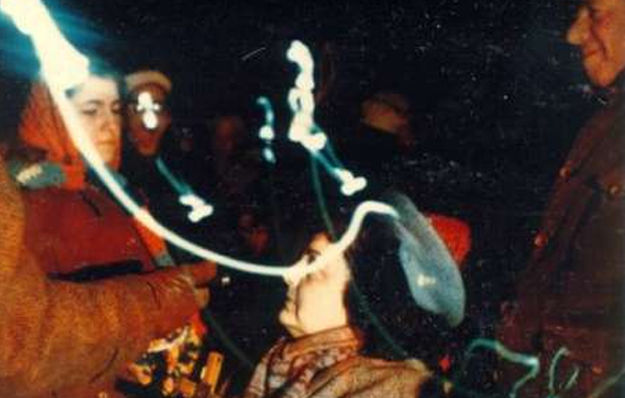
(1) The working of a miracle of sufficient awe to silence criticism (not something banal like unidentified lights or shapes showing up in photographs, see picture at the top of this post).

(2) The doctrinal integrity of the messages and the personal holiness of the seers

(3) The eventual affirmation of the apparitions by the local bishop.

Bayside lacks all of these criteria. The promised miracle, which is supposed to be some kind of comet crashing into the earth (the "Ball of Redemption"), has not happened - and it will not happen, since Veronica prophesied it would happen before the year 2000, a patent falsehood that should be enough to discredit these apparitions on their face.

The messages of Bayside lack any sort of doctrinal integrity and are rife with errors both historical and theological. Bayside teaches that televisions are inherently sinful, that priests are consecrated by priests (not bishops), that the indelible mark of baptism can be lost, believes that Paul VI was replaced by an impostor look-alike pope, and it also affirms the doctrine of the Rapture as understood by Protestants. The apparitions also state that all religions have a place in heaven and tries to make a distinction between the Beatific Vision and the "Mansions" our Lord spoke of in the Gospel:

"For My Father's House, My Son has repeated over and over: remember always that My Father's House-there are many rooms in the Mansion, signifying faiths and creeds. However, the Eternal Father, the Beatific Vision, is reserved for the Roman Catholic following. This it has been deemed by the Eternal Father since the beginning of time." - (Our Lady of the Roses (Blue Book), the “messages” of Bayside, published by Apostles of Our Lady, Inc. Lansing, MI, 1993, p. 81.)

Finally, Bayside has never been approved or endorsed by the local ordinary. Unlike Lourdes, Guadalupe, Fatima, etc., the ordinary has condemned these apparitions unreservedly. In 1986, Bishop Francis Mugavero stated unambiguously:

"No credibility can be given to the so-called "apparitions" reported by Veronica Lueken and her followers...Because of my concern for their spiritual welfare, members of Christ's faithful are hereby directed to refrain from participating in the "vigils" and from disseminating any propaganda related to the "Bayside apparitions." They are also discouraged from reading any such literature. Anyone promoting this devotion in any way, be it by participating in the "vigils," organizing pilgrimages, publishing or disseminating the literature related to it, is contributing to the confusion which is being created in the faith of God's people, as well as encouraging them to act against the determinations made by the legitimate pastor of this particular Church (c.212, para. 1)."

Yes, true apparitions are frequently doubted at first, but this is because doubt is supposed to be the first reaction of a faithful Catholic to any claims of this sort. If the apparition is valid, initial doubts are dispersed by miracles, the doctrinal integrity of the visions, and the support of the local ordinary. Since none of this has happened in the case of Bayside, faithful Catholics are correct in maintaining a disposition of incredulity towards them. As I said above, doubt is supposed to be the default attitude of the faithful towards any alleged supernatural occurrence, even when it happens to us. The reason for this is the great difficulty humans have in discerning the origin of supernatural messages or experiences. If the devil were to appear to you, how would you, without the grace of God, know whether he were himself, your guardian angel, or God Himself? This why the Catholic Encyclopedia, when treating of Private Revelations, makes the following statements:

"Illusions in the matter of revelations often have a serious consequence, as they usually instigate to exterior acts, such as teaching a doctrine, propagating a new devotion, prophesying, launching into an enterprise that entails expense. There would be no evil to fear if these impulses came from God, but it is entirely otherwise when they do not come from God, which is much more frequently the case and is difficult of discernment...“To prove that a revelation is Divine (at least in its general outlines), the method of exclusion is sometimes employed. It consists in proving that neither the demon nor the ecstatic's own ideas have interfered (at least on important points) with God's action, and that no one has retouched the revelation after its occurrence.”

We see here how the Church proposes a very conservative approach to judging these apparitions. This is different from the approach out commentator would have us take. She said:

We should realize that it is better in God's sight to believe humbly and sincerely, even if you are wrong- than to lead others away from the truth, even if outrageous, because of your pride.

Because private revelations come from somewhere other than God "more frequently" than not, incredulity is the proper disposition. The burden is on the seer to disprove out incredulity, not on us to just believe every private apparition out there until we get burned or wounded. She also states:

Condemning Bayside followers for quietly living lives of piety and devotion is not good.

I have never condemned the followers of Bayside. I have simply stated that there are serious doctrinal and historical problems with the apparitions and that they do not deserve out credulity. That is not the same thing as condemning the followers of Bayside, although if one's spirituality is so wrapped up in Bayside that raising doubts about the legitimacy of the visions cannot be perceived as anything other than a personal condemnation, that is problematic and signifies an imbalanced spirituality.

Yes, the prophecies are dramatic, but time will tell ALL. Paying attention to Syria right now?(check the messages).

This is a reference to the fact that the Bayside apparitions point to Syria as the place from which World War III will start, or as the key to peace in the world. To quote the apparitions:

"Syria has the key to the solution of world peace or the Third World War. It will be the destruction of three-quarters of the world. A world aflame, with also the Ball of Redemption." - Our Lady, May 30, 1981

So, obviously, since there is civil unrest in Syria at the moment, we ought to connect this with Bayside and presume that the apparitions are true!

Not so fast. The messages regarding Syria are not for today, or if they are, Our Lady has a weird way of showing it. Check out the following apparition and note the date:

"Wars are a punishment for man's sins. Syria holds the key to peace at this time. However, I place in front of you, My children, a graphic picture for you to understand. It will be a parable for some, and some will turn away not willing to hear what Heaven has to say in these desperate times." -Our Lady, May 28th, 1983.

Syria is said to hold the key to peace, but "at this time" and "in these desperate times." These words were spoken in 1983. If Mary's statement in 1983 that Syria holds the key to peace or World War "at this time" was actually meant to refer to events twenty-nine years later, that would be quite a stretch.

Besides, Bayside certainly does not hold a monopoly on prophecies about Syria relating to the end. There are two famous prophecies found right in the Old Testament that seem to suggest that there will come a time when Syria, or at least Damascus, is destroyed in judgement:
  • "The burden of Damascus. Behold, Damascus is taken away from being a city, and it shall be a ruinous heap...In the time of the evening, behold there shall be trouble: the morning shall come, and he shall not be: this is the portion of them that have wasted us, and the lot of them that spoiled us." (Isa. 17:1, 14).
  • "For three transgressions of Damascus, and for four, I will not turn away [the punishment] thereof..." (Amos 1:3).
Neither of these prophecies have been fulfilled. Even if Damascus were destroyed overnight, it could just as easily be said that this is the fulfillment of a biblical prophesy, not a corroboration of Bayside. What Bayside has done is simply tacked on to its own corpus of messages a prophecy that is legitimately found in the Scriptures and tried to tie the fulfillment of Scriptural prophecy with the legitimacy of its own questionable visions.

I know I can't convince you- that is God's work. I will just keep praying, as I'm sure you are too. As for me,whether anyone else believes it or not, by God's grace I will witness to these messages until my last breath. I am content to suffer ridicule and shame, even from "the elect", for my Queen. After all, she was gracious enough to stoop low and save me from myself.


Okay, again, more with the persecution complex. Nobody is ridiculing you, lady. Nobody is judging you. But you (and all Bayside adherents) need to realize that these messages are highly dubious, requiring an extraordinary stretch of reason to accept (for example, that Paul VI was taken away in 1972 and replaced by a look-alike). As usual in these sorts of arguments, the commentator ignores all of the unfulfilled prophecies relating to Bayside - a "martyrdom" of Paul VI, a comet striking New York City before the year 2000, the successor of John Paul II undoing all the late pontiffs work (Benedict XVI is actually trying to canonize him; odd way of undoing JP2's work!), and much similar nonsense.


Please, for the love of God, exercise some precision in your thinking and abandon your support for this dubious apparition.

Delete

Thursday, June 21, 2012

Are the Bayside Apparitions False? Yes.

I have been having a lot of discussions with a friend of mine lately about the alleged "Bayside Apparitions" of Veronica Lueken (for the background of the Bayside apparitions, see here). I have not done nearly as much research on Bayside as I have on Medjugorje, but from what I have been reading it has some of the same problems - disobedience to the local bishop when he does not condone the visions of the seer, bizarre "warnings" foretold, miracles the whole world will see, and thousands upon thousands of banal messages - in fact, the Bayside messages are even more awkward and banal than those at Medjugorje, if that were possible.

Bayside also has some unique elements to it, such as the insistence that Pope Paul VI was murdered or kidnapped in 1972 and replaced by an actor who had plastic surgery and a coming "Ball of Redemption", a comet that will strike New York City, and belief in the Rapture.

After spending several days mired in these messages, I cannot but conclude that they are complete hogwash. The Bayside Apparitions are a hoax. Here are some reasons why I have come to this conclusion:

All religions have a place in heaven?


"For My Father's House, My Son has repeated over and over: remember always that My Father's House-there are many rooms in the Mansion, signifying faiths and creeds. However, the Eternal Father, the Beatific Vision, is reserved for the Roman Catholic following. This it has been deemed by the Eternal Father since the beginning of time." - (Our Lady of the Roses (Blue Book), the “messages” of Bayside, published by Apostles of Our Lady, Inc. Lansing, MI, 1993, p. 81.)

Here the visions clearly state that, although Catholics have a special place in heaven, other "faiths and creeds" also go to heaven. This is clearly heretical.

False prophecy about the Ball of Redemption


“Our Lady” of Bayside, June 18, 1988: “Do not be affrighted, My child; you must see this, for it is important. Within this century this Ball will be sent upon mankind… It is almost too late… a Ball that is fast hurtling towards earth! It will be here within this century, if not sooner.” (Our Lady of the Roses (Blue Book), p. 108.)

Note the Ball is said to be sent "within this century." This prophecy was given in 1988. Therefore, the fact that by 2000 this had not yet happened proves conclusively that this is false. We should always remember Deuteronomy 18: "When a prophet speaks in the name of the LORD, if the thing follows not, nor comes to pass, that is, the thing which the LORD has not spoken, but the prophet has spoken it presumptuously: you shall not be afraid of him...a prophet who presumes to speak in my name anything I have not commanded him to say, or a prophet who speaks in the name of other gods, must be put to death" (Deut. 18:22, 20).

Televisions are sinful?

“Our Lady” of Bayside, Sept. 27, 1975: “I have, many times, cautioned you, and all My children, against the use of the diabolical machine, your television. There will be no excuses for having these in your presence.” (Our Lady of the Roses (Blue Book), the “messages” of Bayside, published by Apostles of Our Lady, Inc. Lansing, MI, 1993, p. 86.)

This is absurd. Obviously televisions can be used in sinful ways - but are they really diabolical? According to Bayside, we can have absolutely no televisions. There is "no excuse", not even watching pious or faith building movies or programs? Clearly the Bayside people themselves don't believe it since the Our Lady or the Roses website sells Bayside DVDs. This teaching directly contradicts the teaching of the Second Vatican Council document Inter Mirifica on social communication, which states:
"Among the wonderful technological discoveries which men of talent, especially in the present era, have made with God's help, the Church welcomes and promotes with special interest those which have a most direct relation to men's minds and which have uncovered new avenues of communicating most readily news, views and teachings of every sort. The most important of these inventions are those media which, such as the press, movies, radio, television and the like, can, of their very nature, reach and influence, not only individuals, but the very masses and the whole of human society, and thus can rightly be called the media of social communication. The Church recognizes that these media, if properly utilized, can be of great service to mankind, since they greatly contribute to men's entertainment and instruction as well as to the spread and support of the Kingdom of God... support should be given to good radio and television programs, above all those that are suitable for families. Catholic programs should be promoted" (Inter Mirifica, 1-2, 14).

Maybe our Lady did not mean to condemn television absolutely; if not, the words are sloppy and imprecise, as it says there is "no excuse" for ever having a television. Mary here says the television is of diabolical origin; the Church says they were made "with God's help." The messages conflict at worst and are ambiguous at best.

Falsehoods about Paul VI


"Your Father, in the eternal city of Rome, Pope Paul VI, your Holy Father, is a blessed man, for he carries his cross. Your Holy Father is a blessed man, for he shall be martyred." - Our Lady, June 18, 1977

Paul VI was not martyred; he died naturally in 1978. Another false prophecy. This seems to contradict a prophecy made two years earlier which stated that Paul VI had already been replaced by an "impostor" look alike, one of Bayside's most notable and bizarre aspects:

"He is not able to do his mission. They have laid him low, My child. He is ill, he is very ill. Now there is one who is ruling in his place, an impostor, created from the minds of the agents of satan. Plastic surgery, My child--the best of surgeons were used to create this impostor." - Our Lady, September 27, 1975

"The appearance in public is not Paul VI; it is the impostor pope. Medication of evil has dulled the brain of the true pope, Pope Paul VI. They send into his veins poison to dull his reasoning and paralyze his legs. What evil creature have you opened the doors to the Eternal City and admitted?"- Our Lady, September 27, 1975

"In the city of Rome there will be great confusion and trial. Satan, Lucifer in human form, entered into Rome in the year 1972. He cut off the rule, the role of the Holy Father, Pope Paul VI."- Our Lady, September 7, 1978

So was or was not Paul VI replaced by an impostor in 1975? The 1975 apparitions say so, but the 1977 apparition speaks of him as still in power and warns of his impending martyrdom, which did not happen. They could perhaps say that he was secretly murdered or poisoned to get him out of the way, but that would not be a martyrdom. Regardless, this stuff about Paul VI being replaced with an impostor is, in my opinion, nonsense.

Falsehoods about John Paul II

“Our Lady” of Bayside, June 18, 1988: “Please, My children, pray for your Holy Father, the Pope. You must not lose him, for the one who comes after him will destroy if he can – he will attempt to destroy Pope John Paul II.” (Our Lady of the Roses (Blue Book), p. 108.)

Pope Benedict XVI has come after John Paul II. Benedict has not tried to destroy John Paul; on the contrary, he has beatified him and is pressing for his canonization. This prophecy was clearly false.

"Pray for your Vicar (Pope John Paul II). There will be another attempt upon his life. Pray for your Vicar. Do not judge him by the medias, for he is a good man, with a heart that is soft, and often he can be misled. However, he is a good man, and he is one who I keep now under My mantle for his protection. But We need your prayers, My children, your Masses and your sacrifices, if you want him to remain among you." - Our Lady of the Roses, June,30, 1984

In 1984 it was predicted that there would be another assassination attempt on John Paul II. But there wasn't. Nobody every tried to kill John Paul II again after the first 1981 attempt. This is another false, unfulfilled prophecy. Granted, there were other alleged conspiracies to kill John Paul II, but nothing like a real attempt. One could always say that the attempt was thwarted by the prayers of the faithful - but then again, one can always allege that a purported judgment or calamity did not happen because the prayers of the people forestalled it. It is a perpetual out for these people whenever a prophesyed judgment does not materialize.

"When Pope John Paul II is removed, the Church shall be divided among itself. United it will stand, divided it will fall." - Our Lady, March 18, 1983

This simply has not happened. The Church is more united now under Benedict XVI than it was in the 80's under John Paul II. The 80's were the nadir of the Church's unity - things have gotten much better, not worse, since the death of John Paul II.

False rapture doctrine

Most troubling is that the Bayside apparitions promote the false Protestant "rapture" doctrine, which is clearly a heretical teaching that no Catholic ought to hold.

"Remember, without prayers and atonement, the world will become devastated. The Third World War will leave no earth upon the land. There will be no earth, there will be no human beings; but a grouping would have been taken up into Heaven, My child and My children, to await the terrible devastation that falls upon mankind." - Jesus, May 28, 1983

""I give you great grace of heart, My children, to know that many shall be taken from your earth before the great Chastisement.... Many of your news medias shall state that they have been carried off by flying saucers. Oh no, My children! They were carried off into a supernatural realm of the Eternal Father to await the return of My Son upon earth." - Our Lady of the Roses, December 7, 1976

This is the Protestant rapture theory plain and simple - a group of elect taken away from the earth prior to the second coming. And by the way, someone should tell the Virgin Mary that the plural of media is media, not "medias."

Communion in the hand errors

I have to be clear here: I totally am against communion in the hand and have written about this many times. It is a practice that dissolves the boundary between the laity and the clergy and opens th door to too many potential abuses. But it is not an absolute evil. The apparitions say some things about this that cannot be true:

"Pastors, no hands other than those consecrated by a legally-ordained priest shall give the Host to others." Our Lady, August 21, 1975

Okay, first, it is bishops, not priests, who ordain other priests, so Mary really needs to get her ecclesiology straight, but anyhow-

"Communion in the hand has not been, and will not be accepted by Heaven. This is a sacrilege in the eyes of the Eternal Father, and must not be continued, for you only add to your punishment when you continue on in the ways that have been found to be unpleasing to the Eternal Father." - Our Lady, June 30, 1984

Communion in the hand has not been accepted by heaven? That is funny, since it was practiced for centuries in the Early Church. While communion in the hand might not be prudent, it is too much to say it is not accepted by heaven. In the Early Church and for the firsts several centuries of Christianity communion was given in the hand. This was the practice of all the great saints of the Early Church, including the apostles. Over time, the church in the Middle Ages changed the discipline to prevent certain abuses and safeguard the dignity of the sacrament, as it was their right to do. This was the discipline until the modern Church restored the practice.

Now, we might rightfully debate whether or not this was a good idea, but how can our Lady say communion in the hand cannot be accepted by heaven when it was the practice in the universal Church for the first six or seven centuries? We even have a saint, St. Tarcisius, who was layman that was martyred while trying to take communion to someone else - i.e., while holding Holy Communion in his hand.

Also, although restoring communion in the hand in the modern age may not be prudent, none of the accepted rites or disciplines or the Church can be positively harmful or diabolical in and of themselves. They might be bad ideas; they might lend themselves to abuses, but in themselves they cannot be harmful if they are authorized by the Church. Otherwise, the Church would be promoting something that was sinful through its rites, which can never be the case. Otherwise, the role of the Church as the dispenser of God's graces is nullified.


"Loss" of baptismal identity?

Bayside seems to teach that one can lose one's baptismal character and identity as a Roman Catholic:

"I ask you all not to abandon My Church. Do not judge My Church by the priest, for in his human nature he can err. But I assure you I am using him, as a legally ordained priest, to bring you My Body and Blood. Do not go seeking elsewhere, for you will lose your baptismal right, and you will no longer be accepted as a Roman Catholic, and you will not enter into the highest place of Heaven, the Kingdom of Paradise." - Jesus, October 6, 1980

Now, this is kind of ambiguous, I grant. Perhaps it means that by leaving the Church you lose sanctifying grace, and that would be acceptable. But it does not say that. It says leaving the Church causes one to lose their "baptismal right" and no longer be viewed as a Roman Catholic. If taken literally, this would be problematic.

The teaching of the Church is that baptism confers and indelible mark or character that can never be effaced, no matter what sin or apostasy the person commits. Grace may be lost, but the character of baptism may never be lost. Once a Catholic, always a Catholic - perhaps a bad Catholic, perhaps a fallen away Catholic, but always a Catholic. This is another example of the imprecise language rampant in the Bayside apparitions that detracts from their credibility.

Antichrist Pope

In many places, the apparitions suggest that the antichrist will be a pope:

"The Rock has always withstood the test of time. But one will be entered into the House of God, and woe to man when he places him upon the Seat of Peter, for then the Great Day of the Lord shall be at hand." - Our Lady, March 18, 1974

Now I know this is contested and I am not 100% certain on this, but it seems to me that most reputable theologians do not believe the antichrist will be a Pope. It would mean that the promise given to Peter that the Gates of Hell would never prevail against the Church would be compromised; how could it not be if the source of the Church's unity was the antichrist? The antichrist as Christ's vicar? The Fathers of the Church do not ever suggest that this is possible; the antichrist is seen as a false prophet, as a political leader, but never as the pope himself. I would say this teaching is very troubling and will cause the faithful the mistrust and suspect the papacy rather than listen and be taught by it.

Bayside also teaches that the antichrist is currently living and walking around. One of Veronica's messages delivered by our Lady:

“There is not much time left, My child, to gather the sheep. Know that the Antichrist, the Antichrist, My child, is walking upon your earth. He goes and follows wherever there is darkness." -Our Lady to Veronica, Dec. 28th, 1974

He must be getting old - this prophesy was delivered in 1974, thirty-four years ago. So according to Bayside, the antichrist will take the Seat of Peter and was alive and walking around in 1974.

Names of Guardian Angels

In Catholic spirituality, it has traditionally been seen as dangerous to call on the names of angels other than those specifically mentioned in the Bible; simply because our private revelations are not infallible, and you never know who or what you are calling on. Yet Bayside seems to direct Christians to call on mysterious angels that we know nothing about:

"You must ask your guardian angel to ever guide you upon your way. You will also inform Tomdarius that he must keep pure and holy thoughts in his mind. Yes, call upon Tomdarius, My child. You must keep pure and holy thoughts in your mind. My child, this will be a secret for you, Tomdarius, and the soul he guards." - Our Lady, May 15, 1976

This is not heretical as much as reckless and dangerous. No spiritual director would tell you to call out an unknown angel by name like that. Only Michael, Raphael and Gabriel should be addressed by name since they are the only names we know. Who is Tomdarius? Is he an angel? A demon? Should we call out to something when we don't know what it is? There is a good reason that the Church's cultus of saints and angels consists of those who have some sort of formal recognition of being part of the City of God.

"Back in 1970, when Our Lady started Her work here, She assigned special archangels to us.... Every one of the close workers has been given the name of his archangel. And I was assigned one of the highest archangels with Michael--Michael, Raphael, and Gabriel, and his name is Tusazeri. And we've had other archangels that were given to workers.... But we had Sactorius, and of course there's Tomdarius.... It sounds very, very strange: Sactorius, Tomdarius, Razene, Rientre, and I can't remember them all now." - Veronica's commentary, 1974

"There is no reason to fear, My child, for you have Creazuus now with you and Tuzaseri." Veronica - Oh! Creazuus? Creazuus. Oh, Creazuus is the angel guardian given to my son Raymond while he was here on earth. "Our Lady, thank you. Thank you, Blessed Mother." - Our Lady, March 18, 1974

This is all very questionable. Creazuus? Tuzaseri? Who knows what these things are. And if they were revealed to Veronica by heaven, why can't she remember their names, as she says above? I have never heard of legitimate seer or visionary forgetting part of a message from God.

Sometimes, the angels in apparitions behave frivolously:

"Yes. There's Tomdarius, Tusazeri--he is my guardian angel, but he's quite a clown. He likes to circle around. And right now he's turning and spinning again. He always does that when he sees me; he turns and spins. And now also, there's Razene, and Nadina, and many others." - Veronica, October 1, 1988

One of the judgements on whether or not an apparition is true, according to spiritual masters, is "Do we find that the dignity and seriousness which become the Divine Majesty?" What is the purpose of this frivolous description of an angel acting like a clown? When an apparition behaves like this, it suggests it is not legitimate (see here for an earlier post on criteria for judging private apparitions).

Obedience


Another question in evaluating an apparition is: "Have the sovereign pontiffs and the bishops believed this to be so, and have they assisted the progress of the work?" In other words, whether or not a bishop/bishops accept the apparitions is not just a reflection of their personal sentiment, but is actually a judgment of whether the visions are valid at all. In this both Bayside and Medjugorje share something in common, as in both cases the adherents of the vision blatantly disobey their local bishop's requests that the alleged apparitions not be promoted. Bayside's followers profess obedience, but in practice they are being disobedient:

"For to whom much is given, much is expected; and discipline and obedience means suffering and sacrifice. Unquestioning love, unquestioning obedience, that is the only way to Heaven." - Jesus, May 30, 1981

Unquestioning obedience. Yet the local bishop has directed people to stay away from Bayside prayer vigils and events and has asked the faithful not to disseminate the writings or messages of Veronica. From the bishop's directive:
"No credibility can be given to the so-called "apparitions" reported by Veronica Lueken and her followers...Because of my concern for their spiritual welfare, members of Christ's faithful are hereby directed to refrain from participating in the "vigils" and from disseminating any propaganda related to the "Bayside apparitions." They are also discouraged from reading any such literature. Anyone promoting this devotion in any way, be it by participating in the "vigils," organizing pilgrimages, publishing or disseminating the literature related to it, is contributing to the confusion which is being created in the faith of God's people, as well as encouraging them to act against the determinations made by the legitimate pastor of this particular Church (c.212, para. 1)."
Bayside proponents have countered that the process the bishop has used was improper and therefore his decision is invalid. Whether or not this is the case, it does not justify disobedience. If they really have a case that their bishop acted against canon law, the Bayside proponents should appeal to Rome and in the meantime be obedient until directed otherwise. To just state, on one's own authority, that the process the bishop used was flawed and then continue in disobedience is a big warning sign.

When Our Lord said "he who hears you hears Me", He was not instructing his followers to "hear" that which "pleased them" - but to be obedient to lawful authority (even if those in lawful authority were sinners - even mighty sinners) in matters of Faith and Morals, such as alleged apparitions. Bayside is bunk. Medjugorje is bunk. Garabandal is bunk.


Thursday, February 04, 2016

The Bayside Compendium

For the better part of three years now I have been promising a very large expose of the ridiculous Bayside apparitions and their absurd messages.

I honestly almost gave up on this project because it involved reading every single locution from Bayside, which proved to be the biggest waste of my time ever and unbelievably tedious. But, I finally finished and have it linked up below:

CLICK HERE TO READ MY COMPENDIUM OF BAYSIDE ABSURDITIES

Bayside is probably one of the dumbest apparitions in existence and I don't plan to devoting much more time to it (although I think I may have one more article). And the tragic thing is people who are sold on goofy private apparitions really cannot be shaken in their convictions, so I doubt this massive article (so big it needed a Table of Contents) will change anybody's mind; if it only serves to show others how wacky and unworthy of credibility this apparition really is, my purpose will be served.

Tuesday, April 29, 2014

Position on Garabandal


Over my years as a blogger, I have been repeatedly asked to my opinion on the apparitions at Garbandal. This is no doubt because of my writings on other questionable apparitions, such as Medjugorje and Bayside.

Garabandal is a quandary for many traditional minded Catholics. It lacks some of the excesses of Medjugorje (forty thousands plus messages, the charismatic stuff) as well as the absurdities of Bayside (T.V. being an invention of the devil, Pope Paul VI being replaced by an "impostor", etc.). In addition, it promotes traditional morality, calls us to penance, promotes Eucharistic devotion, and its timing from 1961 to 1965 coupled with warnings of an imminent chastisement are very convenient to Catholics who see Vatican II as a fundamental rupture with Tradition. Its condemnation of the contemporary generation of bishops - the Conciliar generation - also plays into the hands of Traditionalists.

It is not my intention to enter into a point-by-point critique of Garabandal, but rather to state my personal opinion on the matter. I do not believe the apparitions at Garabandal are legitimate, nor have I ever thought otherwise. Since I am not offering a refutation but merely stating my thoughts, it suffices to say that my gut has always turned me away from this apparition. Something about it does not seem right. I actually suspect the demonic may be involved. Mary's alleged request to not bring any blessed rosaries before her because she wanted to bless them herself has always given me caution. 

There are other reason as well. But, as always, the biggest evidence against their supernatural character is the continued stand by four successive bishops of Santander against the legitimacy of the apparitions (see here). The seers all at one time or another denied the apparitions upon interrogation, and one, Maria Cruz, continues to do so to this day. Some quotes from Maria Cruz from 1984:

"I've never seen the Virgin at the Pines or any celestial being...[Conchita] suddenly went into ecstasy; that sort of comedy scared us and we thought it would end badly. She put into the heads of the three of us that she had seen the angel." [...] (source Spanish; source English)


In 1992 Maria Cruz further reflected on the pressure the seers were under::

"The people tormented us so that we see the angel and the Virgin, and these fanatics came to write a message, as always happened in other apparitions, like Lourdes or Fatima. [...] Every time I have the occasion, although I don’t look for it, I say it, but they don’t want to hear this truth." I remember perfectly how Conchita, who always used to organize jokes, invented everything. She did it without bad intentions, but the situation became so complicated that we had to go on. [...] Do you believe that the Virgin Mary would do such stupid things? [...] But I'm afraid to be in the papers, because then they make life impossible for my other, who still lives in the village, and it is full of fanatics." [Gabriel Carrión López, El lado oscuro de María, Aguaclara, Alicante, 1992, pp. 106-107])

One last thing: According to Garabandal, the Blessed Virgin Mary has promised that she will one day restore the sight of the blind man Joey Lomangino. This is to happen on the same day as the promised "Great Miracle." Joey Lomangino is now 86 years old. If this man dies without having his sight restored to him, then this is absolute evidence of the falsity of these apparitions. The Garbandal people will probably try to wriggle out of it - say that the promise was of spiritual, not physical sight, or perhaps say that he recovered his sight secretly hours before death or something like that. But if we see that sort of mental legerdemain, it will be a pretty clear sign about Garabandal, though perhaps not the sort its enthusiasts were hoping for.

For these reasons, and many more I will not go into here, I do not believe in the authenticity of the Garabandal apparitions nor do I endorse them in any way.

Tuesday, June 29, 2021

Fourteen Years and an Appeal


Every year on the Feast of St. Peter and Paul it has become custom for me to write an anniversary post commemorating the founding of this blog, which (in its current form) was launched on June 29, 2007. Today I am celebrating fourteen years of Unam Sanctam Catholicam.

But beyond celebrating this enduring blog, I also wanted to give you some news and make an appeal.

First, I want to let you all know I am going to be taking an extended break for awhile. Nothing is wrong in my life or anything, I am just fairly busy and I want to disconnect for a time. I have a lot of books and projects I am involved with, and I also just want to step away from online Traddie-dom for a bit. 

One project I am going to be working on this year is switching over the sister site to a new format. I have been operating www.unamsanctamcatholicam.com since 2012 on a Joomla template that has become woefully clunky and outdated.  I am migrating that site and all its content over to a much sleeker Wordpress-based template that will make it a lot more aesthetically pleasing and easier to navigate. I don't expect this will be done before the end of 2021, but I am going to be spending a lot of time on it.

As I break and revamp the sister site, I'd like to ask you to consider making a financial donation to support the work of Unam Sanctam Catholicam. 

What is this "work" you ask?

Unam Sanctam Catholicam is consistently one of the top-ranked Catholic blogs in the English speaking world. It has been in the top 100 for the past decade and has occasionally been in the top 10. It's content has been 4.3 million times; an average of 38,500 people read our articles every single month. That's 38,500 readers every month being exposed to our articles about the goodness, truth, and beauty of the Catholic faith—articles devoid of clickbait, not beholden to any organization or authority, written in a spirit of patient reflection without pretension. Granted, that means you sometimes have to deal with my own stupidity, but at least there's no commercial angle or institutional gags on my content. I am a fool, but you get to enjoy my foolery without any hook.

My free RCIA notes and outlines have been downloaded 80,000 times and show up first for the Google search "RCIA notes." That's 80,000 people who chose to go with my outlines—full of quotes from the Catechism, Aquinas, the Councils, and the Fathers—instead of any number of the garbage RCIA resources floating around out there.

Countless people have messaged me over the years saying the Bayside article I did back in 2013 had helped them come out of the Bayside hoax. Ditto for my articles over the years on Medjugorje.

I am not a social media influencer. I have never tried to monetize this site by turning into a subscription service, nor have I ever hocked "premium content." I don't make a living from this blog; if I feel like posting I do, and if I don't I don't. 

That being said, a little bit goes a long way. If you've ever been entertained, edified, or educated by Unam Sanctam Catholicam, please consider helping. There’s many ways your contributions can benefit Unam Sanctam Catholicam: 
  • I would like to get my RCIA notes and outlines translated into Spanish and then Arabic. I'd like to be able to pay people for this translating work.

  • As I mentioned above, I am revamping the USC sister site. I would like funds to help pay for the redevelopment and obtain improved design elements of the new site.

  • While I work as a professional writer, I also self-publish works on matters of interest to traditional Catholics. For example, the USC Ebook, Laudato Si: The 40 Concerns of an Exhausted Layman, The Book of Non-Contradiction on harmonizing apparently divergent biblical accounts, and most recently, Power from On High on the history of theocratic monarchy in the Christian west. Your donations allow me to (a) spend more time working on these passion projects instead of grinding away at the corporate stuff, and  (b) help me pay professional copywriters and artists to improve the quality of these self-published works. 

In the meantime, I have a lot on the docket for the rest of 2021. Here are just a few of the articles I have in the works for the next sixth months (hopefully):

  • The legend of St. Maternus
  • Use of ostrich eggs in the traditional liturgy 
  • Various book reviews
  • The Church and autopsies
  • St. Gregory of Narek
  • Cuss words in the Middle Ages
  • Medieval clerical opinions on beards
  • English bishops and the pallium journey to Rome
  • Gemstones in the writings of St. Hildegard
  • Part 3 in my series on the Nephilim (hopefully)

If there is something else you would like to see me write about, please do not hesitate to shoot me an email at uscatholicam[at]gmail.com. Thank you for your patronage over the years. Please use the Paypal button below to make a donation; if you'd like to send a check in the snail mail, message me at uscatholicam[at]gmail.com and I'll let you know how. And as always, follow us on Facebook. May the Lord richly bless you.

CLICK HERE TO MAKE A DONATION TO UNAM SANCTAM VIA PAYPAL

Saturday, May 18, 2024

The Real Apparitions are the Friends You Made Along the Way


Long time readers of this blog will know that I have always been deeply interested in the questions of how the Church evaluates alleged private apparitions. I have written extensively about Medjugorje, Bayside, and many other smaller apparitions. My approach has generally been critical, following the traditional approach wherein an alleged apparition is presumed to be false unless overwhelming evidence suggests otherwise. I have been alarmed and annoyed at the credulousness of those who chase after every spiritual novelty, and disheartened at the sluggish inactivity of the Church in checking their proliferation. 

Sunday, March 10, 2013

St. Malachy: The Case for Authenticity

While we all wait with anticipation for the election of our next Holy Father at the Conclave next Tuesday, let's take a minute to stop and bring some sanity back to the discussion of the prophecies of St. Malachy.

As we get closer to the Conclave, more and more articles on the alleged prophecies of St. Malachy are being posted all over the web, usually from mainstream, conservative Catholics who are bent on drumming into people's heads that the prophecies are forgeries and that serious Catholics should not pay them any credence. The authors usually state that they are writing for the purpose of addressing the St. Malachy/Petrus Romanus "hysteria" that has attended the interregnum, although ironically most of the hysteria I have seen about the prophecies thus is from those bent on debunking them.

As two examples of the sorts of articles I am talking about, take this article by Dr. Donald Prudlo published  on the Truth and Charity Forum at Human Life International, which basically denigrates the prophecies as "papal campaign literature from the 1590's" and says they are "vague utterances that a local horoscope page would be embarrassed to print." Or we could take this one by Gerald Korson from Catholic Online, who feels the need to "debunk" the prophecy and says they are "about as reliable as the Mayan calendar." These are some of the most recent example, but there have been many others as well.

I certainly do not mind engaging in argumentation about the credibility or incredibility of private apparitions or prophecies about which we are permitted to disagree; I myself have done this many times on this blog regarding Medjugorje, Bayside, etc. However, I do take issue with a prophecy uttered by a canonized saint that has been believed by many scholars and even popes for at least four centuries being so summarily dismissed, and with such a cavalier attitude. This has not been the way Malachy's prophecies have traditionally been approached. In the past, the approach to Malachy's prophecies was generally one of reserved skepticism; for example, the 1913 Catholic Encyclopedia mentions the arguments against the authenticity of the prophecy, but it also points out that none of these arguments are conclusive and that the jury is still out. For as long as I can remember, the prophecy has always been approached in this "jury is still out" manner. However, now that we are up to the point where the pontificate of Peter the Roman could begin as soon as a few days from now, the attitude has changed to one of outright hostility and ridicule by people who are horrified any time any Catholic starts thinking seriously about eschatological fulfillments, as if the worst possible thing a Catholic could do would be to think we could be on the verge of a divine chastisement. But like it or hate it, the Malachy prophecies have a very long pedigree in the western Church, and we should not be so quick to mock them or speak derisively about them.

Are there arguments against the prophecy of Malachy? Absolutely there are, and they are strong. But there are also arguments in favor of its authenticity, and regardless which position we take, neither is conclusive, and the strongest arguments against their authenticity are ultimately based on mere speculation, as we shall see. Therefore, since Malachy was in fact a canonized saint, and remembering St. Paul's admonition "Do not despise prophecy", (1 Thess. 5:20), let us take a more objective look at the case for St. Malachy's prophecy.

The Authenticity of the Prophecies of St. Malachy

When discussing whether the prophecies of St. Malachy are "authentic", there are two ways in which we can speak of "authenticity":

(1) Whether or not the prophecies were in fact uttered by Malachy or at least date to the 12th century
(2) Whether or not the prophecies are divinely inspired and can be expected to be fulfilled

Of course, we have no way of conclusively proving the second meaning of authenticity one way or another; no Catholic can have absolute certainty about any private revelation, so this discussion will be confined to looking at the first definition of authenticity: whether or not the prophecies are actually from the 12th century as they purport to be, or whether they are in fact 16th century forgeries.

Malachy the Prophet

Let us remember, first off, that St. Malachy (d. 1148), was a legitimate prophet. The Breviary entry for his feast day notes that he was gifted with prophecy, and St. Malachy is also remembered for a very famous prophecy that Ireland would be oppressed by England for seven centuries, at the end of which time England would suffer a chastisement and Ireland would help restore the Faith to England. Much of this prophecy has come true and has been authenticated, a manuscript of it having been found at Clairvaux dating from the time of Malachy. Thus, if Church tradition records he was a prophet, and if he made other prophecies of events centuries to come, and if these were accurate, why is it implausible that the prophecy of the popes is not similarly authentic?


The Simoncelli Hypothesis: Origins and Problems
In the writings of those bent on disproving the prophecies the Malachy, a standard objection is that the prophecies are probably spurious because the text of the prophecies do not show up until around 1595, over 450 years after their alleged authorship in 1143. In the two articles cited above, Mr. Korson and Dr. Prudlo both state that the late discovery of the text authorship is enough to throw them out as a forgery. Dr. Prudlo considers this to be the strongest argument against them and states that this fact alone is "enough to discount the story even before considering the internal evidence." So, without even considering the content of the prophecy, the fact that they do not enter the historical record until 450 years after their alleged authorship rules out their legitimacy entirely. Prudlo and Korson both use different dates; Dr. Prudlo says they are not mentioned until 1590; Korson says 1595.

These dates are based on the assumption that the prophecies were actually written by the party of one Cardinal Girolamo Simonelli, a cardinal-elector in the conclaves of 1555, 1559, 1566, the two in 1590, 1591 and 1592. The theory is that the prophecies were written to bolster the candidacy of Cardinal Simoncelli (who was a strong papabile in the conclaves of 1590-92) by depicting Simoncelli as a pope prophesied from centuries back.

Korson, Dr. Prudlo and other detractors of the prophesy take the Simoncelli thesis for granted and assume its truth. But where does the Simoncelli hypothesis come from? This theory can be traced back to Fr. Claude-Francois de Menestrier, S.J. (1631-1705) who was an antiquarian and published nine volumes on medieval heraldry and emblems. Menestrier was the first proponent of the Simoncelli hypothesis, which he formulated based on his opinion that the prophecies before 1590 are very specific while those after 1590 are disappointingly vague. He therefore cites the party of Simoncelli as the forgers and even names a specific forger, but regrettably does not furnish us with any evidence whatsoever in support of the opinion, leaving us to understand that his opinion is simply a theory. This is the ultimate origin of theory that the prophecies are a 1590 forgery.

Why 1590? According to Dr. Prudlo, the year 1590 refers to the first publication of the prophecies by Benedictine historian Arnold Wion; the 1595 date cited by Korson is the year Wion republished the prophecies in his book Lignum Vitae. Regarding Wion's book, he was assisted in his translation by the Spanish monk Alfonso Chacon, who was a renowned antiquary and scholar of medieval manuscripts. To Chacon fell the important task of authenticating the manuscript and making sure it was not a forgery, and it is noteworthy that the manuscript did pass the scrutinizing eye of Chacon and was authenticated. It was Chacon who rendered many of the prophecies into the phrases we are familiar with today.


We should note, however, that the 1590 date assigned by Menestrier is misleading, which is unfortunate since this is the date that has been subsequently repeated by commentators who don't know better. The prophecies were not discovered in 1590, but in 1556 by Augustinian historian and antiquary Onofrio Panvinio, who apparently published the first edition of the prophecies in 1557. Wion's inclusion of them in the Lignum Vitae was more well known, but came thirty-three years after the publication by Panvinio. More on Panvinio later, but it is sufficient here to note that the true discovery of the text in 1556 is seriously problematic to the theory that the prophecies were created by Cardinal Simoncelli, who was only thirty-three at the time, had only been a Cardinal for three years and was not considered a papabile until almost three decades later. Fr. Menestrier did not deduce the prophecies as a forgery based on the 1590 date; rather, he started with the assumption the prophecies were false and then hypothesized the 1590 date to justify his theory about Cardinal Simoncelli.

Another edition of the prophecies was published by Girolamo Muzio in 1570. Muzio, likewise, believed in their authenticity. Muzio's 1570 edition of the prophecies was written in Italian and cumbersomely named Il Choro Pontifico Nel Qual Si Leggono Le Vite Del Beatissimo Papa Gregorio& Di XII Altri Santi Vescoui. Thus we have two editions of the prophecies in circulation prior to the 1590 date cited by Prudlo and the 1595 date preferred by Korson.


Even if we grant this, however, we merely exchange one problem for another; instead of a 450 year silence, we have a 413 year silence. Is the 413 year silence about the prophecies problematic? Yes. Is it damning? No. The question really is not whether or not the text was "missing" for 413 years, but whether or not there is a good explanation for it - and whether we accept it or not, there is a traditional explanation. The French Abbe Cucherat in an 1871 work on the prophecies repeats an older tradition that the prophecies were in fact legitimate and were delivered by Malachy to Pope Innocent II in 1143 in order to comfort the Holy Father during a time of discouragement and illness, but that the pope subsequently filed the manuscript away at the Vatican where it remained lost until its discovery in the late 16th century. This would explain the 413 year absence of the manuscript from the historical record; unfortunately, however, Cucherat also gives no evidence for his hypothesis, so it remains as theoretical as that of Menestrier.

Even if Cucherat gives no evidence to back up his assertion, the simple fact that a text allegedly went missing for four centuries is not enough to discount the story prima facie, as Dr. Prudlo would have it. There are multiple well-known examples of texts getting lost at the Vatican for centuries. It is quite common. People tend to forget how voluminous the archives of the Vatican are, where documents have been amassing since the pontificate of Pope St. Damasus I in St. Jerome's day (see the book Vatican Secret Archives by Terzo Natalini for an excellent history of papal record keeping). For example, the oldest extant copy of the Scriptures, the Codex Vaticanus, came to the Vatican sometime in the late 4th century and was lost for over a thousand years, rediscovered only in the early 15th century; if the disappearance of the obscure text of St. Malachy's prophecy for four centuries is problematic, the disappearance of the Codex Vaticanus for a thousand years is immensely more so. Let us not forget the similar stories surrounding the discoveries of the Dead Sea Scrolls and the Codex Sinaiticus, both of which were lost for longer, almost two thousand years each. And, lest we doubt how easy it is to lose stuff in the Vatican, let us not forget that the tomb of St. Peter himself was lost in the Vatican until discovered during the reign of Pius XII (1953) and only positively identified as that of Peter by Paul VI in 1968. If the Church can even lose the tomb of St. Peter for two thousand years, then it is not at all unbelievable that the text of Malachy's prophecy could be lost for 413. This of course does not prove their authenticity, but at the very least, it should allow us to admit that this problem does not at all amount to an ipso facto declaration of invalidity, as Dr. Prudlo would have.

Arguments from Authority

Another argument in favor of authenticity is that two of the greatest scholars and exegetes of the Tridentine period considered the prophecies completely authentic: Cornelius Lapide (1567-1637) and Onofrio Panvinio (1529-1568). As we have seen above, it was Panvinio who first discovered the manuscript and he remained one of the firmest believers in the prophecies. Panvinio was no novice; the chief librarian and editor of the Vatican Library, he authored over 16 major works on history and archaeology and was considered the foremost authority in medieval and ancient Roman history. During his lifetime he was called pater omnis historiae ("father of all history"). Cornelius Lapide was a universally acclaimed student of scripture and prophecy whose works are still being translated today. Lapide studied the prophecies extensively, believed in them, and wrote a tract attempting to establish a chronology attempting to identify the approximate time we could hope to see Peter the Roman.

Other scholars who published, or commented, or otherwise supported the authenticity of the prophecies were Giovannini de Capugnano (d. 1604), Jean Boucher (1623), Chrisostomo Henriquez (1626), Thomas Messignham (1624), Angel Manrique (1659), Michel Gorgeu (1659), Claude Comier (1665), Giovanni Germano (1675), Louis Morerl (1673), John Toland (1718), who fully accepted the prophecies and wrote a treatise on the destruction of Rome during the pontificate of Petrus Romanus; we have already mentioned the Abbe Francois Cucherat (1871), who wrote extensively on the prophecies. It is worth mentioning that despite the assertion of Dr. Prudlo, who claims that the manuscript disappeared in the 16th century, Abbe Cucherat reports having seen the original manuscript in the Vatican in the 1860's, though this is disputed.  All of these men were men of erudition, most of them scholars, historians and antiquarians familiar with medieval heraldry and the procedures of humanist textual criticism. None of them had any doubt about the authenticity of the manuscript. Granted, arguments from authority are not the strongest, but when so many luminaries of Catholic scholarship spanning so many years wholeheartedly accepted the prophecies, we should at least do them the courtesy of not rejecting them out of hand.
Fr. Menestrier (d. 1705) was the first one to suggest the prophecies were a forgery. However, Menestrier apparently never knew of the study of Alfonso Chacon, the expert paleolographer who subjected the manuscript to rigorous scrutiny in the 1590's and proclaimed it an authentic. Chacon's entire vocation consisted in sorting out fraudulent texts from the authentic, and he proclaimed Malachy legitimate. However, as stated above, Menestrier had no knowledge of this study, which is damaging to his thesis.

Evidence of Malachy's Prophecies Before 1556

Even if we were to throw out the testimony of Lapide, Panvinio and all the others, there is also the interesting fact that bits and pieces of Malachy's prophecy of the popes seem to have been circulating around as far back as the 13th century. De Vaticina Summis Pontificibus is a collection of two manuscripts of papal prophecies later joined into one. The first part was written around 1280 and contains 15 papal prophesies beginning from the pontificate of Nicholas III (1277-1280); the second part was composed around 1330 and contains an additional 15 prophecies. Around the time of the Council of Constance (1414), the manuscripts were combined into one for a total of 30 papal prophecies. The prophecies consist of very short Latin phrases using plays on words, puns and allegories, as do the Malachy prophecies, and are strikingly similar in many respects. In the 14th and 15th centuries, these prophecies were even more well-known than the prophecies of St. Malachy would be in the 16th and 17th. It could of course be reasoned that Malachy was inspired by this earlier work, but it could just as easily be asserted that the vignettes of De Vaticina Summis Pontificibus represented hastily copied portions of Malachy that were circulating around and thus provide evidence that the prophecies of Malachy did in fact exist prior to 1556.

It is also interesting that, even before the appearance of the texts published by Panvinio and Wion, badges or medals with enigmatic engravings were circulated during papal conclaves, at least going back to the high Renaissance. These badges were used to influence several conclaves, and these medallions are described briefly in the work of the French author Roger Duguet in his book Around the Tiara (1997). Thus, even if the text of St. Malachy was not published until 1590, the people living at Rome at least several generations earlier were familiar with these sorts of papal "prophecies", which again could be evidence of earlier fragments of Malachy circulating around.

Vagueness of the Malachy Prophecies?

The reason Fr. Menestrier originally settled on 1590 as the date of the prophecies creation was because he opined that the prophecies before 1590 were incredibly accurate while those after 1590 were disappointingly vague. This criticism has been repeated ever since, and appears in both of the current articles of Korson and Dr. Prudlo.

However, a reading of the actual text does not bear this out entirely. Some of the pre-1590 prophecies certainly are specific; for example, Concionator Gallus ("French Preacher"), referring to Pope Innocent V (1276), who was both a Frenchman and a member of the Dominicans - Order of Preachers; likewise, many post-1590 prophecies are vague, for example, Rastrum in Porta (" The Rake of the Door") referring to Innocent XII (1691-1700), of whom no interpreter has found a satisfactory way to link up with the title in Malachy.

But this tendency is not at all universal; many of the pre-1590 prophecies are just as vague as the post-1590 collection, and in addition to this, many of the post-1590 prophecies are remarkably accurate. To give an example in the first case, Ex Ansere Custode ("From the Guardian Goose"), applying to Pope Alexander III (1159-1181), which is horrendously vague and can only be connected to Alexander III by the tortuous argument that the Pope must have been descended from the patricians who saved the Capitoline citadel from Brennus and the Gauls  in 390 BC when a flock of geese sacred to Juno warned the Roman guards of a secret attack. This convoluted interpretation was put forward by Cucherat in 1871 and is the only attempted explanation to date. So clearly not all of the pre-1590 prophecies are recorded with "relative accuracy" (Korson) or are even close to "spot-on accurate" (Prudlo).

Conversely, many of the post-1590 prophecies are strikingly appropriate. This is even noted by the 1913 Catholic Encyclopedia, which was not at all given to superstition or unwarranted credulity. It states:

"Those who have lived and followed the course of events in an intelligent manner during the pontificates of Pius IX, Leo XIII, and Pius X cannot fail to be impressed with the titles given to each by the prophecies of St. Malachy and their wonderful appropriateness: Crux de Cruce (Cross from a Cross) Pius IX; Lumen in caelo (Light in the Sky) Leo XIII; Ignis ardens (Burning Fire) Pius X. There is something more than coincidence in the designations given to these three popes so many hundred years before their time. We need not have recourse either to the family names, armorial bearings or cardinalatial titles, to see the fitness of their designations as given in the prophecies. The afflictions and crosses of Pius IX were more than fell to the lot of his predecessors; and the more aggravating of these crosses were brought on by the House of Savoy whose emblem was a cross. Leo XIII was a veritable luminary of the papacy. The present pope is truly a burning fire of zeal for the restoration of all things to Christ." (source)

The case of Pius IX is particularly striking; Cross from a Cross. In losing the papal states and facing the atheist risorgimento, he suffered greater crosses than any other pope of the modern period. Furthermore, as these sufferings were brought about by the attempts of the House of Savoy to unify Italy, and as the emblem of the House of Savoy was a large white cross emblazoned on a red shield, the title "Cross from a Cross" for Pius IX is beautifully appropriate. Equally accurate is Aquila Rapax, "A Rapacious Eagle", applied to Pius VII (1800-1823), who was actually kidnapped by Napoleon Bonaparte, one of the most rapacious conquerors in all of history, whose emblem was an eagle. The title for Benedict XV (1914-1922) is also amazingly accurate: Religio Depoulata ("Religion Laid Waste"); the pontificate of Benedict XV was overshadowed by the deaths of millions of Christians in World War I, the slaughter of millions more in the Turkish genocide, the outbreak of the Communist revolution in Russia that would lead to millions more dead and the spread of atheism around the world. This prophetic title was fulfilled to the very letter.

Clearly there is not the strict pre/post-1590 division in the quality of the prophecies that Menestrier imagined - and remember, Menestrier died in 1705 and never witnessed the spectacular events of the above mentioned modern pontificates and their marvelous correlation with the titles found in Malachy.

Are the prophecies less precise than we would like? Granted; most of them are two or three words at most. But are the explanations and correlations always as torturous as critics state? Not at all, as we have seen. Let us also remember that vagueness is not necessarily an argument against the authenticity of a prophecy. Many legitimate prophecies from Sacred Scripture are extremely vague. I challenge anyone to go back and read Hosea 11:1 ("out of Egypt I called my son") in context and see how one could possibly deduce the Flight into Egypt from it before the fact; likewise, can anyone honestly say that the election of Matthias to replace Judas in Acts 1 is clearly and evidently found in Psalm 109:8 ("May his days be few, and may another his office take")? Not likely. Yet Divine Revelation tells us they are authentic prophecies nonetheless. These biblical prophecies are vague, even vaguer than the ones found in St. Malachy. Many times vagueness is a trait of genuine prophecy; in fact, extreme specificity is often times a sign that a prophecy is false.

The Inclusion of Antipopes

One problem often brought up with the Malachy prophecies is their inclusion of several anti-popes. Korson sees this as a strong indictment against the legitimacy of the prophecies. He says, "[The] list in itself is erroneous; in several instances, it leaves out legitimate popes in favor of anti-popes, those false claimants to the papacy who surfaced at various troubled moments in the history of the Church." Therefore, the prophecies must not be authentic.

Here we have a case of wanting to have our cake and eat it, too. Remember, if we are asserting that the prophecies were not written in 1143 but sometime around 1590, then we are presuming that the author had the benefit of retrospect; that is, though there frequently were anti-popes during the period of the Western Schism, by 1590 that would have all been resolved, and we could presume our forger in 1590 to have a single, accurate list of legitimate popes at his disposal. The fact that the Malachy prophecy contains anti-popes is actually a point in favor of legitimacy, not against it. Malachy scholar Peter Bander puts it this way:

"I consider those objections quite unreasonable...These antipopes are historical characters, they all held high episcopal offices before claiming the supreme title to the See of St. Peter and, they were, within limits, accepted as real popes by a large section of Catholic followers; the fact that events proved them wrong or even schismatic does not belittle the important function and position they commanded at the time. Giacconius, who in his commentary on Malachy's prophecy lists only canonically elected popes, quarrels with Panvinio for ranking popes and antipopes next to one another. This great schism in the Catholic Church, when popes and antipopes existed side by side, lasted for almost three centuries [reckoned from the time of Celestine II, within Malachy's life, to Felix V, 1449]. St. Antoninus himself comments on this and points out that much is written by different parties in defense of the one or the other ecclesiastical dignitary. All sides were well defended by excellent theologians and canon lawyers, and in the end, the argument was settled by establishing the rightful successor of St. Peter as the one who was canonically elected to the office. St. Antoninus goes further by saying that ordinary people could not possibly partake in such difficult and delicate discussions as they did not understand canon law; they followed the advice of their spiritual fathers and superiors. Personally, I consider the fact that antipopes are included in the list as a point in favor of Malachy" (The Prophecies of St. Malachy, edited by Peter Bander, Tan Books, 1973, pg. 14).

Since the line of succession had long been been clarified by 1590, had the prophecies been forged, there would be no incentive to include anti-popes in the list. However, if at the time of authorship these anti-popes were still to come, it makes perfect sense that their names would have appeared in the prophecy as at least putative holders of the See of Rome. To put it another way: A Englishman in 2013 reciting a list of the kings and queens of his kingdom would not include in the list usurpers such as Lady Jane Grey (d. 1554) and Edgar the Aetheling (d. 1126); they would only recite the officially established succession that had been settled by law over the the course of the centuries, omitting those who aspired, but never managed to retain, the throne. It would make sense that a list written in 2013 would omit these disputed claimants. However, suppose an Englishman living back in 1066 had a vision of all the men and women to sit on the throne of England until the end of time. In his case, it would make perfect sense that usurpers like Jane and disputants like Edgar would appear in the vision, since both claimed the royal authority and were acclaimed as monarch by large segments of the population for a time. Furthermore, if the vision was for a time off, it makes sense that the recipient might not know whether one in the vision was a true monarch or not. Similarly, the presence of anti-popes in the list of St. Malachy is an argument in favor of a 12th century composition, not against it.

But, just to be clear, many of the anti-popes in Malachy are in fact specifically called out as anti-popes, such as Corvus Schimaticus and Schisma Barchinonicum (Nicholas V and Clement VIII), so it is not as if the anti-popes are ranked exactly side by side, as the historian Giacconius opined.

Incorporation by Popes


Finally, we come to what is, in my opinion, one of the most overlooked and strongest pieces of evidence in favor of the authenticity of the prophecies of St. Malachy: the indisputable fact that for hundreds of years the popes themselves have taken the prophecy seriously and have gone out of the way to make sure they fulfilled it.

Carlo Marcora, an Italian historian who did an exhaustive six volume study on the papacy published from 1961 to 1974, noted that many of the maxims of Malachy were applied to specific pontificates with the approval of the popes. Thus Pius VI allowed himself to be referred to as the Peregrinus Apostolicus, Lumen in Caelo was applied to Leo XIII, and Pastor Angelicus to Pius XII; Pastor Angelicus was even the name of the officially sanctioned 1942 biographical documentary of the life of Pius XII and a posthumous book published in 1958. If Pius VI, Leo XIII or Pius XII thought the prophecies of Malachy were forgeries, allowing themselves to be publicly identified with them throughout their pontificates was a strange was to show it.

Many of the popes have also intentionally tried to show that a particular prophecy was fulfilled in them. Take Clement XI (1700-1721), who in Malachi's prophecy is Flores Circumdati ("Surrounded by Flowers"). When no one of the new pope's party could figure out how to connect the phrase with Clement, the pope had a coin struck which bore the motto Flores Circumdati on it. The pope and his circle were clearly trying to show the prophecy was fulfilled, which means they took it seriously. There are many anecdotal tales of popes consulting the prophesy upon their election and choosing their papal coat of arms accordingly in an attempt to fulfill the prophecy. Consider that since 1590, popes Urban VIII, Paul V, Alexander VII, Clement IX, Gregory XVI, and Leo XIII have all apparently incorporated elements of Malachy's prophecies directly into their coat of arms; many more if you include pre-1590 popes.

It can be objected that this sort of thing is self-fulfilling prophecy, but the point is irrelevant. I am not here seeking to prove that the prophecies are true, but that the successive popes have believed or acted as if they were true, which they clearly have right down to our own day. Even Joseph Ratzinger, clearly not ignorant that he was supposed to be Gloria Olivae and knowing the speculation connecting the name with the Benedictines, obliging chose the papal name 'Benedict.' The popes have clearly taken this prophecy seriously over the years and incorporated it into the emblems and symbolism of the papal office. Does this give the prophecy some sort of papal sanction? No. But it should give us pause - modern Catholic pundits blast the prophecies as fraudulent while for centuries pope after pope has given quiet credence to them by going out of their way to make sure they are fulfilled. If the Vicars of Christ on earth take St. Malachy seriously, how do we fare when we recklessly toss them aside and speak so derisively about them?

Conclusion

Do I believe the prophecies are authentic? The jury is still out for me, which I think is the best approach to this question. But clearly the evidence presented above should rule out any sort of automatic dismissal of the prophecies. Many, many scholars, much wiser than myself or the pundits, have spent a long time studying these prophecies and have given them credence. Many of the prophecies have been eerily fulfilled in very literal ways, and the popes themselves have given a nod to them. The prevailing hypothesis that they were forged by someone in the pay of Cardinal Simoncelli at the 1590 conclave is manifestly false, as the manuscript was discovered 34 years before the conclave of 1590 and there is good evidence to suggest that parts of the prophecy were known as early as 1280. While the scholars who fully believed in the authenticity of Malachy were legion, the dismissal of the text as a fraud can be traced to a single Jesuit scholar (Fr. Menestrier) who did not have all the facts at his disposal.

I am not saying the prophecies of St. Malachy are authentic, but the case is by no means closed on them. Fortunately, we are at a point in history where we will not need to wait too long to find out.

Click here for a PDF version of this article.
Click here to follow this blog on Facebook.

Sunday, September 21, 2014

Request Sunday


You would think that after seven years of blogging, I would be running out of material. In fact, the opposite is true; the longer I blog, the more my ideas branch out into seeds for new articles. As of recently, every day two or more ideas has been coming to me and I have so many concepts for articles that I cannot keep them straight or prioritize them.

I also get a lot of requests; the above picture is from the inbox of this blog and website, where I have a backlog of requests for articles going back almost a year.

What do you think I should post on? I guess I'm taking requests; of course, sometimes it takes weeks or months until I get to something, but as long as the request is reasonable, I will put it in the hopper and get to it when I can.

Below you will find a list of subjects that are already in the works to a greater or lesser degree for the next six months; what else would you like to see me post on? 

  • More Heresies of Balthasar: Balthasar insists that Christ possesses the virtue of faith.
  • Modernist thought in the writing of C.S. Lewis [UPDATE: Complete; see here]
  • Catholic Women: Why you can't find a man
  • Comparisons of Old Testament Israelite monarchy to current Church hierarchy
  • Philippians 1 and the Communion of Saints (contra Protestantism)
  • Follow up to this Nephilim article [UPDATE: Complete; see here]
  • Follow up to this article on the theology of the State
  • Hesychasm
  • Satis Cognitum and Sedevacantism
  • Critiquing the "brick by brick" approach to Tradition [UPDATE: Complete; see here]
  • The orientation of early Roman churches [UPDATE: Complete: see here]
  • More stuff on evolution
  • More biblical archaeology stuff [UPDATE: See our Biblical Archaeology articles here]
  • 2 Pet. 2:24 (contra Protestantism)
  • Catholic approach to tithing [UPDATE: Complete: see here]
  • More stuff about Bayside
  • Joachim of Fiore
  • Medieval penances
  • More videos (remember to subscribe to our Unam Sanctam Catholicam channel on Youtube)

Any other ideas? Follow this blog and conversation on Facebook