Sunday, March 28, 2010

The messianic significance of Palm Sunday


The Gospels tell us that today is the day that our Lord Jesus Christ rode triumphantly into Jerusalem on a donkey, in fulfillment of the prophecy that was spoken through the prophet Zechariah:

"Rejoice greatly, O Daughter of Zion! Shout, Daughter of Jerusalem! See, your king comes to you, righteous and having salvation, gentle and riding on a donkey, on a colt, the foal of a donkey. I will take away the chariots from Ephraim and the war-horses from Jerusalem, and the battle bow will be broken. He will proclaim peace to the nations. His rule will extend from sea to sea and from the River to the ends of the earth" (Zech. 9:9-10).

Though we are familiar with the prophecy of Zechariah, it is an interesting question to ask if there is any significance to the use of the donkey itself. Why should the king come riding in on a donkey, as opposed to any other animal? Some have said that this is a sign of our Lord's humility - He comes not as a conquering warlord in chariot or upon a battle steed, but upon the most humble of all pack animals to show forth that the nature of His kingship will be built on charity rather than on conquest. Another theological interpretation is that the mule symbolizes human nature, which our Lord weds Himself to through the Incarnation.

These are appropriate interpretations of our Lord's actions on Palm Sunday, but there is another more immediate reason why He chose a donkey, as prophesied by Zechariah. The donkey is, believe it or not, a messianic creature in the Old Testament associated with the son of David. To find the origin of this association, we need to go back to the book of 1 Kings in the days when King David was on the verge of death and Israel was preparing for a succession crisis based on the claims of two rival sons of David.

David has promised the throne to Solomon, his son by Bathsheba. Yet as he drew near to death, we are told that the throne was claimed by another of David's sons, Adonijah, who had offered sacrifices to God and received the fealty of all the important men of the kingdom while excluding Solomon and his supporters. This was told to King David by Nathan the prophet and Bathsheba; when David heard that Adonijah was claiming the kingship and excluding Solomon, he said:

"Call to me Bathsheba." And when she was come in to the king, and stood before him, The king swore, and said: "As the Lord liveth, who hath delivered my soul out of all distress, Even as I swore to thee, by the Lord, the God of Israel, saying: Solomon thy son, shall reign after me, and he shall sit upon my throne in my stead, so will I do this day." And Bathsheba, bowing with her face to the earth, worshiped the king, saying: "May my lord David live for ever." King David also said: "Call me Zadok, the priest, and Nathan, the prophet, and Benaiah, the son of Joiada. And when they were come in before the king, He said to them: Take with you the servants of your lord, and set my son Solomon upon my mule: and bring him to Gihon: And let Zadok, the priest, and Nathan, the prophet, anoint him there king over Israel: and you shall sound the trumpet, and shall say: 'God save king Solomon.' And you shall come up after him, and he shall come, and shall sit upon my throne, and he shall reign in my stead: and I will appoint him to be ruler over Israel, and over Judah" (1 Kings 1:28-35).

We see that the sitting of Solomon upon the mule of David was to be a sign that Solomon was chosen by the king to rule in place of Adonijah, his brother. Perhaps the mule was chosen because only the legitimate son of David would have access to the king's stables; perhaps it was a sign of humility as opposed to Adonijah's pride; we don't really know. The important point is that it was an identification of the true Son of David, a sign to the peoples that David had chosen Solomon. Furthermore, this choice was ratified by a solemn oath by the king himself. When the people saw Solomon seated on the mule of David and anointed by Zadok, they switched their allegiance from Adonijah to Solomon. The king's mule would have been housed in the king's stables, something only David would have had access to. Therefore, to trot Solomon out on the king's mule demonstrates that David has personally selected him as his successor (as opposed to Adonijah, who has proclaimed himself king but does not show any token of succession or intimacy with the king, such as a mule - in 1 Kings 2 Adonijah will try to establish such a connection by asking for one of David's concubines to be his bride, with disastrous consequences for himself).

What is the messianic connection with our Lord? That our Lord is the new Son of David whose kingship over the earth is contested by the Pharisees and those who deny His identity as the Christ. As He prepares to take possession of His kingdom (through the conquest of His Passion), he rides into the holy city on a donkey to identify himself as the true and rightful king and heir to the throne of David, in memory of what David had ordered done for his son Solomon. The fact that David ratified this with an oath in the Old Testament can be seen as God the Father affirming the claims of Jesus, just as He did on the day of our Lord's baptism and at the Transfiguration.

The response of the people of Jerusalem to our Lord's entry make it plain that they, too, understood this Old Testament reference to the triumph of the son of David by their response. In the first place, they cover the ground with palm fronds, something done in the time of the Maccabees to celebrate the triumph over the pagan Greeks and the cleansing of Jerusalem, as we read in 1 Maccabees 13:51:

"And they entered [Jerusalem] on the three and twentieth day of the second month, in the year one hundred and seventy-one, with thanksgiving, and branches of palm trees, and harps, and cymbals, and psalteries, and hymns, and canticles, because the great enemy was destroyed out of Israel."

As they lay palms before Him, they chant Psalm 118 (117), which is one of the most messianic Psalms of the whole Psalter. Psalm 118 begins with the phrase, "Give praise to the Lord, for he is good: for his mercy endureth for ever" and goes on until we get to verse 26, the verse chanted by the crowds, which says, "Blessed be he that cometh in the name of the Lord." Interestingly enough, the very next verse of this Psalm reads:

"We bless you from the LORD'S house. The Lord is God and has given us light. Join in procession with leafy branches up to the horns of the altar" (v. 27) Coincidence?

One other highly interesting fact is that this Psalm 118 also contains a messianic prophecy that is very frequently quoted in the New Testament:

"The stone which the builders rejected; the same is become the head of the corner. This is the Lord's doing , and it is wonderful in our eyes. This is the day which the Lord hath made: let us be glad and rejoice therein"
(Ps. 118: 22-24).

The point is that everybody there would have understood Jesus' actions in a very messianic way, based on our Lord's fulfillment of the prophecy of Zechariah, his evoking the memory of David's endorsement of Solomon, the cleansing of Jerusalem during the time of the Maccabees and the messianic prophecies of Psalm 118 regarding the Messiah being a stone which the builders reject. Given this last connection with a stone, isn't it also interesting that our Lord's only recorded comment upon his triumphal entry had to do with stones?

"I say to you that if these shall hold their peace, the stones will cry out"
(Luke 21:40).

I'm not sure what the connection is there, but I find it pretty coincidental that our Lord references stones as the people are chanting a Psalm about the cornerstone.

By the way, I know the OT says "mule", but I say close enough since a mule is half-donkey; also, some OT translations call it an "ass" which would make it a donkey. Given the different translations for words between the Hebrew Old Testament, the Septuagint and the New Testament, I think it the theory is still valid despite the OT saying "mule" and the NT saying "donkey."

Well, the point is that there a lot of background to every little statement and action that our Lord says and does and that just a little digging can turn up some pretty amazing connections!

"Week of Salvation"

If anybody is looking for a good read this Holy Week, I highly recommend Week of Salvation: History and Traditions of Holy Week by James Monti. This book focuses largely on the liturgical customs of Holy Week during the first four centuries of the Church. The book goes day by day through Holy Week beginning with Palm Sunday and discusses how the early Church celebrated these most important liturgical rites in different corners of the Roman Empire. Gaul, Spain, Rome, Africa and Jerusalem all receive the most in depth treatment. When reading Monti's book, one cannot help but arrive a deep sense of grief at the incredible liturgical richness connected with Holy Week that has been lost over the centuries. The Holy Week liturgies of days gone by had an extravagant, almost dramatic element to them - they were clearly meant to be the most aesthetically stirring of all the Church's liturgies. Reading about the solemn "entombment" of the crucifix on Good Friday in the early medieval Gallic church, in an actual coffin with all the pomp of a royal funeral, leaves one indignant at the insipid modern novelties that are permitted during Lent and Holy Week, like the leaving of sand or rocks in the holy water fonts. Anyhow, Monti's book is a great read for Holy Week and will certainly help you get into the Traditions of this holiest of all weeks.

Thursday, March 25, 2010

Anglicanorum Coetibus bears more fruit

More great news on the Anglican front as 1,000 Canadian Anglicans seek reunion with Rome. Read the full story here in the Ottawa Citizen. This has been one positive year for true ecumenism!

Sunday, March 21, 2010

Political Authority

In a class on Catholic Social Teaching we have been reading an immensely frustrating piece of work called The Compendium of the Social Doctrine of the Church, penned by the Pontifical Council for Justice and Peace. I don't know precisely what magisterial weight this Council has, but I'm guessing (and hoping) that it's "slim to none".

Last Wednesday we came to paragraphs 393-395, under the heading, "The Foundation of Political Authority."

393. The Church has always considered different ways of understanding authority, taking care to defend and propose a model of authority that is founded on the social nature of the person. "Since God made men social by nature, and since no society can hold together unless some one be over all, directing all to strive earnestly for the common good, every civilized community must have a ruling authority, and this authority, no less than society itself, has its source in nature, and has, consequently, God for its author" [Pope John XXIII, Pacem in terris, 46 (1963).] ....

394. Political authority must guarantee an ordered and upright community life without usurping the free activity of individuals and groups but disciplining and orienting this freedom, by respecting and defending the independence of the individual and social subjects, for the attainment of the common good...

395. The subject of political authority is the people considered in its entirety as those who have sovereignty. In various forms, this people transfers the exercise of sovereignty to those whom it freely elects as its representatives, but it preserves the prerogative to assert this sovereignty in evaluating the work of those charged with governing and also in replacing them when they do not fulfil their functions satisfactorily. Although this right is operative in every State and in every kind of political regime, a democratic form of government, due to its procedures for verification, allows and guarantees its fullest application. [cf. Pope John Paul II, Centesimus annus, 46 (1991).] The mere consent of the people is not, however, sufficient for considering "just" the ways in which political authority is exercised.

My summary: The Compendium asserts that political authority moves like this: God - people - rulers. Now, read Pope St. Pius X's condemnation of Sillonism, in Notre Charge Apostolique (1910):

[Pius X:] The Sillon places public authority primarily in the people, from whom it then flows into the government in such a manner, however, that it continues to reside in the people. But Leo XIII absolutely condemned this doctrine in his Encyclical Diuturnum Illud on political government in which he said:

[Leo XIII:] "Modern writers in great numbers, following in the footsteps of those who called themselves philosophers in the last century, declare that all power comes from the people; consequently those who exercise power in society do not exercise it from their own authority, but from an authority delegated to them by the people and on the condition that it can be revoked by the will of the people from whom they hold it. Quite contrary is the sentiment of Catholics who hold that the right of government derives from God as its natural and necessary principle."

[Pius X:] Admittedly, the Sillon holds that authority - which first places in the people - descends from God, but in such a way: "as to return from below upwards, whilst in the organization of the Church power descends from above downwards." But besides its being abnormal for the delegation of power to ascend, since it is in its nature to descend, Leo XIII refuted in advance this attempt to reconcile Catholic Doctrine with the error of philosophism. For, he continues:

[Leo XIII:] "It is necessary to remark here that those who preside over the government of public affairs may indeed, in certain cases, be chosen by the will and judgment of the multitude without repugnance or opposition to Catholic doctrine. But whilst this choice marks out the ruler, it does not confer upon him the authority to govern; it does not delegate the power, it designates the person who will be invested with it."

[Pius X:] For the rest, if the people remain the holders of power, what becomes of authority? A shadow, a myth; there is no more law properly so-called, no more obedience. The Sillon acknowledges this: indeed, since it demands that threefold political, economic, and intellectual emancipation in the name of human dignity, the Future City in the formation of which it is engaged will have no masters and no servants. All citizens will be free; all comrades, all kings. A command, a precept would be viewed as an attack upon their freedom; subordination to any form of superiority would be a diminishment of the human person, and obedience a disgrace. Is it in this manner, Venerable Brethren, that the traditional doctrine of the Church represents social relations, even in the most perfect society? Has not every community of people, dependent and unequal by nature, need of an authority to direct their activity towards the common good and to enforce its laws? And if perverse individuals are to be found in a community (and there always are), should not authority be all the stronger as the selfishness of the wicked is more threatening? Further, - unless one greatly deceives oneself in the conception of liberty - can it be said with an atom of reason that authority and liberty are incompatible? Can one teach that obedience is contrary to human dignity and that the ideal would be to replace it by "accepted authority"? Did not St. Paul the Apostle foresee human society in all its possible stages of development when he bade the faithful to be subject to every authority? Does obedience to men as the legitimate representatives of God, that is to say in the final analysis, obedience to God, degrade Man and reduce him to a level unworthy of himself? Is the religious life which is based on obedience, contrary to the ideal of human nature? Were the Saints - the most obedient men, just slaves and degenerates? Finally, can you imagine social conditions in which Jesus Christ, if He returned to earth, would not give an example of obedience and, further, would no longer say: "Render to Caesar the things that are Caesar's and to God the things that are God's" ?

My summary: Pius X, citing the doctrine of Leo XIII, condemns the Sillonist assertion that political authority moves like this: God - people - rulers.

Has the Compendium re-introduced the condemned doctrine of the Sillonists? Or am I missing something? If I'm not, then I'd love to know what happens to the asserted superiority of the democratic form of government, since paragraph 395 bases this assertion on the aforesaid condemned doctrine.

Friday, March 19, 2010

A Saint for Modern Times


I do not want to give the impression that because I question the prudence of beatifying John Paul II and have questioned some of the statements of Mother Teresa means that I am opposed to all attempts to canonize modern saints. This is not in any way true. The Church is unfailingly holy, and as holiness is one of the four marks of the Church, we can expect that the means of attaining holiness are and will be present in the Church until the end of time. Consequently, as the Catechism says,

"The Church . . . is held, as a matter of faith, to be unfailingly holy. This is because Christ, the Son of God, who with the Father and the Spirit is hailed as 'alone holy,' loved the Church as his Bride, giving himself up for her so as to sanctify her; he joined her to himself as his body and endowed her with the gift of the Holy Spirit for the glory of God." The Church, then, is "the holy People of God,"and her members are called "saints." By canonizing some of the faithful, i.e., by solemnly proclaiming that they practiced heroic virtue and lived in fidelity to God's grace, the Church recognizes the power of the Spirit of holiness within her and sustains the hope of believers by proposing the saints to them as models and intercessors. "The saints have always been the source and origin of renewal in the most difficult moments in the Church's history." Indeed, "holiness is the hidden sosome of the faithful, i.e., by solemnly proclaiming that they practiced heroic virtue and lived in fidelity to God's grace, the Church recognizes the power of the Spirit of holiness within her and sustains the hope of believers by proposing the saints to them as models and intercessors. The saints have always been the source and origin of renewal in the most difficult moments in the Church's history. Indeed, "holiness is the hidden source and infallible measure of her apostolic activity and missionary zeal" (CCC 823, 828).
I would add that the presence of saints among us also signifies God's fidelity and love for the Church, since they are raised up by His providence for the building up of the Church during certain times in history. The Church has never lacked saints and I do not believe that there will ever be a time when the Church will lack saints.

In this post I would like to point out a man whom I believe is a modern saint and who should definitely be canonized. This is none other than Servant of God John A. Hardon, S.J. (June 18, 1914 – December 30, 2000). For me Fr. Hardon is a local saint, as he lived, worked and died only thirty miles from my home. Many people I have met since returning to the Church in 2002 had the blessing of knowing Fr. Hardon intimately. I do not know the extent of which Fr. Hardon's work is known outside of the Great Lakes area, but here is he already revered as a very holy man.

Fr. Hardon was born in Pennsylvania and came from a very devout Catholic family. His father has been killed at a relatively young age in a scaffold accident, leaving Fr. Hardon's mother to care for the family. The faith was an integral part of the Hardon household, and Fr. John tells us that from an early age he felt a draw to the priesthood:

“The most noticeable event of my childhood was my reception of First Holy Communion at the age of six. Sr. Benedicta, a member of the Sisters of Notre Dame who prepared us for our first Holy Communion, told us, ‘Whatever you ask our Lord on your First Communion day, you will receive.’ When I returned to my pew after Communion, I immediately asked our Lord, ‘Make me a priest.’ I had only the faintest idea what I was saying, but I never forgot what sister had told us to do. When I was ordained twenty-six years later, my first sentiment was to thank our Lord for hearing my prayers.”
Hardon entered the Jesuit novitiate in 1936 and was soon after assigned the task of training future priests. He was sent to Rome for two years to study theology, where he attained a Sacred Theological Doctorate (S.T.D.) from the Gregorian University in 1951, with a dissertation on the supremacy of the Roman Pontiff in teaching Catholic faith. Regarding his time in Rome absorbing the perennial teachings of the Church, and some of the modernist winds blowing in those years, he said:

“The lessons I learned were invaluable. … It taught me that the faith I had so casually learned could be preserved only by the price of a living martyrdom. This faith, I was to find out, is a precious treasure that cannot be preserved except at a heavy price. The price is nothing less than to confess what so many others either openly or covertly denied.”
Fr. Hardon then began an illustrious teaching career, spanning both centuries and continents. He served as an associate professor of Fundamental Theology at West Baden College, Indiana, from 1951-62, and as an associate professor of Religion at Western Michigan University from 1962-67. Hardon was then sent to teach as a professor of Fundamental Theology at Bellarmine School of Theology, in North Aurora, Illinois, and Chicago from 1968-73. In 1973 he became a research professor at the Jesuit School of Theology in North Aurora. From 1974-88, he taught as a professor of Advanced Studies in Catholic doctrine at St. John’s University in Jamaica, New York, and served as a visiting professor of Comparative Religion at St. Paul University, in Ottawa, Canada, from 1968-74. Fr. Hardon also taught as a professor at the Notre Dame Institute, a Pontifical Catechetical Institute, in Virginia, from 1981-1990.

n all of these years, Fr. Hardon never wavered in his orthodoxy and loyalty to the sound teaching of the Magisterium. As he noted about his teaching years in his Spiritual Autobiography:

“All these years of remaining faithful to the Catholic Church in spite of widespread opposition to what I believed, these were the years when I learned clearly and deeply that to remain a bonafide Catholic teacher of Catholic Doctrine was, honestly, the most demanding enterprise of my whole life.”
One of his most ambitious works was his catechetical study program, which later became known as the Marian Catechists. Fr. Hardon developed this program for the Missionaries of Charity after John Paul II asked Bl. Mother Teresa to have her sisters educated as catechists.

Fr. Hardon was a prolific writer. Of his desire to write, he said:

"With God’s grace, I had been motivated since my young years to write for publication. … The single strongest motive in my priestly life has been to put ideas on paper and make them available to potential readers. I can honesty say the underlying motive for doing so much writing has been to reach as many souls as possible.”
Another one of Hardon's ambitious writing projects was the Catholic Catechism (1975), a full exposition of Catholic dogma and morality written at the behest of Paul VI nineteen years before the release of the CCC. Fr. Hardon wrote thousands of articles on everything from demonology to eschatology, metaphysics to mysticism, Communism to education, Mariology to Pro-Life issues. His writings were truly voluminous and stand out for their clear and unambiguous presentation of traditional Catholic truths. For example, when someone wrote to him asking if unity of all Christians could not be achieved without a literal "return" to Rome of Protestants, Hardon shortly but concisely replied:

"Christ wants His followers to be united in faith. But this faith must be founded on the truth. There can be no compromise with the truth. In fact, there can be no real unity which is not based on the truth. The Catholic Church possesses the fullness of God's revealed truth. Christ therefore wants the whole human race to be united in mind and heart. But the mind must possess the truth and the heart must respond to this truth in love. The ecumenical movement is only as authentic as its guiding principles are those taught by the Roman Catholic Church."

Fr. Hardon's views on Traditionalist issues are quite interesting. He seems to have seen radical Traditionalism and the wacky clown Mass as related. The clown Mass causes persons to seek a more reverent liturgy, which can in turn send them to the SSPX. His position was that of many Trads - the SSPX would have no reason to exist if there were not a serious crisis in the identity of the Church.

Regarding the SSPX, it is interesting to note that Fr. Hardon always believed that attending an SSPX Mass did fulfill canonical holy day obligations:

"Now my own opinion which I have been giving now for years. In my judgment, Catholics do fulfill their duty of assisting at Sunday Mass by attending in the Holy Sacrifice a church affiliated with those who are members with a schismatic group like the Lefebvres. But then I also must add the Catholics be sure at those seeing them attending these schismatic Masses are not scandalized into thinking that professed Roman Catholics have given up their fidelity to the Bishop of Rome."
Fr. Hardon reverenced the liturgy and was very sympathetic to the plight of Catholics who were grieved by liturgical abuse:

"[It often happens that] if a Catholic wants to attend a Mass, celebrated with some regard for the lawful norms he would have to drive over a hundred miles to the nearest parish of a neighboring diocese...Not a few Catholics have had to resort to finding a parish somewhere even outside of their own diocese where they can be assured that the Sacrifice of the Mass is offered, hear me, both validly and according to the norms of the Holy See."
Fr. Hardon believed the problem was a Eucharistic problem: that all of the disasters in the modern Catholic Church stemmed from a tragic misunderstanding or willful neglect of the Church's teaching on the Eucharist. Therefore, he devoted a large amount of his preaching and writing to defending and explaining the doctrine of the Real Presence. Indeed, it would not be an understatement to say that the inexpressible reality of the Real Presence was the dominant theme of his preaching and writing:

So many people nowadays are speaking about Eucharistic celebration. So few are ever talking about the Sacrifice of the Mass. In the 16th century when Martin Luther and John Calvin broke with the Catholic Church the first thing they did was to change the Catholic vocabulary. Instead of the Mass it became - this is the 16th century- the liturgy, or Eucharist, or Holy Communion, and that is what is happening today. In other words, there is no substitute for understanding the Holy Eucharist as the Sacrifice of the Mass which is, we believe, a representation of Christ’s sacrifice on Calvary. The Holy Eucharist reserved in the tabernacle, in the plainest language I can use, is Jesus Christ. Once even doubts are raised about the Real Presence is it any wonder that so many Catholic Churches either have no tabernacle in the Church or the tabernacle, as I saw in Louisville, is on a window sill out of sight of the congregation, or in a separate place but not in the Church?
Because of his intense prayer life, the clarity and unambiguity of his theological writings, his fidelity to the Church and his life of selfless zeal, I believe Fr. Hardon should be canonized. Do you know what we do not see in any of Fr. Hardon's writings? We don't find any assertions that pagans can speak to the true God by praying to their false gods; we don't find any statements such as John Paul's famous phrase, "May St. John the Baptist protect Islam!" We don't find him, like Mother Teresa, encouraging Christians to pray in Hindu temples, nor do we find any ambiguity or uncertainty on issues like the inspiration of Scripture, the sacrificial nature of the Mass or the necessity of Jesus Christ for salvation. If he had said any of these sorts of things, I would be more reticent in my praise of him - after all, as a very learned theologian, we can easily say that he should have known better had he said any such questionable things. But fortunately he didn't, and for that reason he is an appropriate role model for today. Granted, Fr. Hardon was not a traditionalist, but he did sympathize with those who wanted a return to Catholic Tradition and he seemed to have thought that the aspirations of those who wanted the Tridentine Mass were valid and deplored the unfair labeling of them as "liturgical reactionaries."

So, I'm certainly not opposed to canonizing modern saints. But if we are going to canonize anyone, let's not canonize people who are mixed bags. No saint is perfect, I know; but some people have less baggage than others, and I would feel much better about canonizing Fr. Hardon than many others who have been proposed recently. With Fr. Hardon, despite the imperfections he did have, there are no scandals or quasi-heretical statements to worry about. If we want to canonize someone, let's start with him.

Click here to see the website for his cause, which was begun by none other than Archbishop Raymond Burke. An online compendium of Fr. Hardon's writings can be found here.

Many quotes in this article were taken from Fr. Hardon's talk "How to Cope with Abuses in the Eucharistic Liturgy", found in the Hardon archives here.

"Gospel" Mass in New Orleans

Don't know what to say about this one.


This is not the first time I have heard of these sorts of bizarre Masses going on in and around New Orleans (see here). Anybody out there from the New Orleans area? If so, how common is this sort of thing?

Wednesday, March 17, 2010

Fire in the bosom

The Pope with Irish Bishops

This St. Patrick's Day is marked by sadness for the Church in Ireland, which is reeling from the ongoing abuse scandal in that country. Fresh scandals are breaking out all across Europe, most recently in Bavaria.

When the scandals broke in America, many conservative Catholic pundits made the claim that our sex-abuse scandal was statistically no worse than the amount of sex-scandals one would expect in any other organization, especially one the size of the Catholic Church. Therefore, although the sex scandals ought to be deplored, we ought not to think that we have a problem any worse that any other denomination or organization. This explanation has always bothered me because:

(1) I don't believe it's true; I believe the Catholic Church does have a larger problem with this proportionate to other organizations/denominations

(2) Even if it were true that our problem was no worse than that of other groups, this should provide us with no consolation since the Church is called to be holy and ought to be an exemplar of sanctity, not another organization where you just say, "Well, only 1% of our priests are pedophiles, and that's about equivalent to what it is in society at large." Since when does the Church mirror society? If society has a 1% pedophilia rate, ours should be much lower. We certainly shouldn't be happy that it's equal!

But the real tragedy is that (my inuition) I don't think it's even equal - I believe it is probably higher. Yes, I know it depends on how you define pedophilia. I know in the U.S. crisis a lot of people were defining as pedophilia what was technically ephebophilia; that is, many of the young persons involved in the abuse were not kids per se but were teenagers or young adults, persons with physically mature bodies who were nevertheless still minors. Still, some of the problem was consensual homosexual sex between priests and adult males, not strict pedophilia.

Well I say whoopty-freakin'-doo. Do any of these mitigating factors alleviate the horror of the situation? Are we more content with ephebophile and homosexual priests than with pedophile priests?

The situation in Ireland is that much more horrible because it involves not just abuse but abuse carried out in orphanages, institutions that are designed specifically to care for needy children. How did the Church in the Isle of St. Patrick come to this? This is a long tale, one that has been told many, many times before. We could cite the lowering of standards to get men into the seminary in order to prop up lagging vocations; we could cite vocational "confusion" of many priests who, trained in the chaotic and misdirected ecclesiological climate of the 60's and 70's, do not really understand why they are priests; we could cite widespread acceptance of homosexuality as a licit lifestyle, even among clergymen; we could cite corrupt bishops seeking only to protect their own rather than face up to real problems.

We could go on and on and on about these causes, but I think the ultimate cause of this scandal is nothing other than a demonic attack to destroy the priesthood, for the priesthood is vital to the life and sanctity of the Church; it is through the ministry of the priesthood that all graces come to us through the sacraments. This is a Satanic plot of destruction pure and simple.

But does that mean that this is a case of "blame it on the devil", as if there is no human responsibility? By no means; if it is a Satanic plot, it is we, the Catholic Church, who have invited him in to do his evil. If Satan is running amok in our seminaries, it is our bishops and seminary directors who have aided and abetted him by turning their head. The seminary, that institution meant to be an impregnable fortress of virtue and a school of ascesis has too often become a romping ground for demonic mischief - and this at the invitations of our own ecclesiastics who think that priestly life is a licit way for homosexuals to "express their desire to serve." No, we cannot simply blame it only on the devil, though he has his part to play; it is we who have courted his devilish influence by dallying around too close with him via modernism, relatavism, etc. Can one dance with the devil and not get singed? "Can a man hide fire in his bosom, and his garments not burn?" (Proverbs 6:27). If we have been burned, it is because the Church has been hiding fire in her bosom.

I think that perhaps the U.S. sex scandal was a warning from God to clean our own house first before the Church tries to clean up the world. Unfortunately, it seems that the European Church did not learn from America's calamity and is now experiencing something that could be profoundly worse, since it seems more widespread in a continent with less practicing Catholics. What is the solution?

We could go on and on about policy changes and disciplinary requirements that need to be kept, but to keep it simple, I propose that the Catholic Church start to take seriously the admonition given by our first pope:

"It is time that judgment should begin at the house of God" (1 Pet. 4:17).

During one of his last Lents on this earth, holy Saint Patrick fasted for forty days upon the top of Croagh Patrick and had a vision in which God promised him that he should watch over the Irish until the end of time and stand in judgment over them at the last day. May St. Patrick, whose inspired preaching and labors converted a nation from darkness to light, again intercede for his people and obtain from God the graces to have a true restoration of the Faith in the Holy Isle and throughout the Church.

Friday, March 12, 2010

Fantasy Magic and the Christian Author


In the course of my work with young people at my parish, not infrequently parents seek my advice on the issue of fantasy fiction, especially when dealing with the existence of "magic," as in the Harry Potter novels. I myself have never read Harry Potter; I know some Catholics are adamantly opposed to the books, while others (such as the contributors of Gilbert magazine) praise the Potter books as being full of Christian virtue. Having never read them, I can't say.

However I can speak to this issue as one who has read a lot of fantasy fiction in my life and who has also written fantasy fiction. Thus I offer my reflections here on the issue of magic in fiction more from the standpoint of an author than as a theologian or a moralist, though my opinions will of course be shot through with Catholic moral and theological thought.

The issue of magic is an sub-category of the subject of fantasy fiction. While magic is not strictly necessary to make a story "fantasy," it is almost ubiquitous in most fantasy fiction today. What role will it play in the fantasy world? How will it be utilized, and will the manner in which it is utilized say anything about the worldview of the creator of that world? This makes the difference between whether the presence of the magic is benign (as in Tolkien) or perhaps malevolent and damaging to the mind of the reader.

There are really only two options when dealing with the issue of magic: either magic is a craft that can be learned and mastered by any person who applies themselves, much like any skill in the natural world, or it is something that must be innate within a being, something one is born with, not unlike the concept of the Jedi in Star Wars. Wizards are either made or born. Is any one of these options more appropriate to the writer trying to incorporate magic into his world in a way not harmful to Christian morality?

J.R.R. Tolkien adopted the latter model, that of magic being innate. The elves possess magical powers by virtue of their nature, which they understand not as magic but as part of who they are - "magic" is what the human peoples of Middle Earth refer to it, a reflection of their lack of understanding of the powers and nature of the elves. The wizards also use magic, but as any Tolkien fan knows, Gandalf and Saruman are not truly men; rather, they are powerful angelic beings called istari who only appear in the forms of men, and their powers are as natural to them as angelic powers are to the angels. The Dunedain possess a kind of magic, but only by virtue of the elven blood in their veins. Thus, there is really no opportunity on Middle Earth for any one to "become" a wizard if they choose: magic is the prerogative of the elves and the Maiar exclusively.

The Dragonlance Chroncles of Margaret Weis and Tracy Hickman adopted the former route of magic being learned: anyone who wanted to become a wizard was able to, provided they passed the training, which included a rigorous life or death struggle in a sort of magical "academy" called the Tower of Wayreth. Thus the popular book The Soulforge, which tells of the endeavors of Raistlin Majere to overcome his weakness and become a mage. Having not read Potter, I'm not sure which category Harry falls into, but I think it is a mixture of the two: wizards are born, and once identified, are taken to Hogwarts to train and hone their skills, not unlike the situation of Professor X's school in X-Men.

While I don't think that either approach is strictly moral or immoral, I do think that from a Christian perspective, the concept of magic as learned is more problematic than magic as innate. Christians accept the existence of angelic beings, and therefore also the existence of angelic powers. If we believe and angel can disguise himself as a human, and in that form use the powers natural to him (either for good or ill), then it is no ideological jump to posit some like beings in another universe that operate in a similar manner, which may or may not be called "magic" by the uninformed human populace. In Middle-Earth we see this in the elves, who are superior beings from beyond the sea that have extraordinary powers which mere mortals would call magical or even godlike. I can see nothing objectionable in this form of "magic."

The other approach, treating magic as a skill to be mastered, is a little bit more difficult for a Christian to deal with. A Christian acknowledges that there is only one God, and that all supernatural power must come ultimately either from that one God, or from His nemesis, the devil, who is a very powerful fallen angel. Now, God dictates that mankind not attempt to contact or harness magical abilities, which leaves us in the real world with no other option than that all magic, both black and alleged "white" magic, are diabolical in origin. Christianity does not deny that magic can be mastered, but asserts that all magic is from the evil one. This means that it is intrinsically evil; there is never a time, place or situation in the real world when it is licit for a person to attempt to use magic.

All fine and good within the real world, but how does this transfer into a fantasy world?

This is a dilemma, for once we acknowledge that in the real world magic must always be viewed as an intrinsic evil, this puts the Christian fantasy author in the dilemma of possibly taking something intrinsically evil and making it neutral or even a positive good within the context of the fantasy world (here's a parallel - imagine a fantasy world where adultery was a positive good). There really is no conflict if we retain acquired magic but reduce its use to evil mages (for evil men may in a fantasy world attempt to harness magical powers just as much as evil men in the real world); but the true difficulty arises when a character that is supposed to be a hero or morally upright person is required to acquire or use magic. Can this ever be licit? One could see in it the equivalence of making an otherwise "good" character commit adultery or theft and present it as justifiable. To present an intrinsic evil as justifiable, even in a fantasy book, is sinful, mortally so if it leads the reader to conclude that those evil acts are permissible based on what he reads.


Ursula K. LeGuin in her famous "Earthsea" novels came to a middle position, in which magic was able to be acquired but which consisted not in developing or harnessing any powers from within the agent, but in expanding knowledge of the "names" of all things, which represented their underlying reality as opposed to their external phenomenon. Thus, one became a magician by learning the true names of all things and gaining authority over reality, to manipulate it according to one's will. This gets us past the difficulty of communing with an evil power, but it does so at the expense of presenting a very eastern, almost Buddhist worldview, in which the present world is somewhat illusory and can be overcome by contact with the "real" underlying reality, which is unity as opposed to the multiplicity of the world, and can be manipulated according to the will of the wizard. Though this is an interesting approach, I do not see it as any more consonant with Christianity than the other approaches.

I think there is some mitigating factors depending on the role of magic in the fantasy realm. For example, in our real world, magic is proscribed precisely because it goes outside the boundaries of what God has decreed for mankind. But if magic is an acceptable and normative part of the fantasy world, this position would likewise change. Another parallel - we may not agree with the worship of Athena or Zeus, but once we read the classics and accept thematically the existence of a world and culture in which Zeus and Athena are presented as real, then we must not be surprised nor appalled if consequences follow thematically from this accepted premise. I don't think most intelligent readers (and I leave a large gap here for those outside the category "most") read fantasy and decide to try to practice real magic because of it, anymore than we go off looking for real elves and dragons after reading Tolkien. The real question regarding magic is a contextual one: "What is the origin of the magic in the novel, and how does it conform (or not) with the context of its place in the larger fantasy world? Is this overall context one that is edifying or damaging to faith?"

The best thing to do, from a Christian standpoint, is to avoid the difficulty by not creating any magician protagonists. In fact, it is best to avoid the problem of magic by minimizing its importance; I do not have a taste for these modern fantasy stories whose whole plot revolves around magic or its uses. From a purely stylistic point, too much magic ruins the "fanastical" mood; we are more excited to see a world where magic is possible than where it is normal. If magic is made the norm, it is no longer magic, but simply the way things are. This may be permissible thematically, but it is not as exciting to read. But morally speaking, if one chooses to adopt a world where acquired magic is possible, I think I have come up with two solutions to minimize the negative impact of such an approach to the point of making it acceptable to the Christian reader (and soothe the conscience of the Christian author!).

First, if magic is used, make it about effects over process. What I mean is that the focus of the magic should be on effects of the magic in the plot instead of a preoccupation with the process of bringing it about. It is enough, when I write about a mage, to say that he "cast a spell" and that as a result of this, a fireball came shooting out of this hand and consumed a party of goblins. The reason for using the magic is to come up with the fireball. Now, instead of saying that the mage cast the spell, suppose I say he sat down inside a magic circle, got out a ritual bowl, started mixing ingredients and chanting mystical words; suppose I even translate some of those words into the book and describe the gestures that the mage goes through before finally consummating his spell and casting the fireball. Well, I still get my fireball, but now with a more (in my opinion) unhealthy focus on the process of casting the spell. I can seldom think of a reason why an author would need to include details about the procedure (unless the character was evil and this was a method of bringing out his evilness), and the procedure is what kids who are attracted to magic will want to emulate. If you just say that the character "waved his hand and shot a lightning bolt," you detract attention from the process and focus it where it should be, on the effect of the magic in the story.

Second, use of magic should be sparse and mages should seldom be used as protagonists. Morally, this protects against the implicit notion that magic is a normative means of getting out of difficulties or obtaining what one wants (contrast this with the Harry Potter books where magic is the normative means of operating in the world). This is more a question of emphasis - less magic means less attention drawn to magic. But it is thematic, too; a single, well-placed and well thought out placement of magic in the story might create more of a mystique or fantastical quality about the story than a ton of episodes of wizards shooting lightning at each other until it is as commonplace as an Indian shooting an arrow or a bat in a cave.

These two methods render the concept of acquired magic more acceptable. By refusing to go into the procedures for becoming a wizard or casting a spell, you deprive the audience of anything to possibly mimic and draw the reader's mind to what is important: the furtherance of the plot. By making the use of magic rare but strategically placed, you reinforce the idea that magic is something "fantastical"; i.e., doesn't exist in the real world and can happen only in a fantasy world, which is where it belongs. Both methods allow for a broad literary use of magic while minimizing the possibility that it will "bleed" into the real world. Taking into account also the simple overarching context that in a fantasy world, many things can happen that are not necessarily affirmed about the real world (for example, a fantasy world can have a differing but really existing set of "gods" without the author personally affirming the existence of any such beings in the real world), I think we can affirm a moderate and acceptable way to incorporate acquired magic, if it is necessary.

I don't know if this helps, but it is interesting to ponder. If you want some good, non-standard fantasy in the epic tradition, please check out my book, available here.

Monday, March 08, 2010

Anglican Personal Ordinariates


On Wednesday, the House of Bishops of the Anglican Church in America announced that they met in Orlando with Reverend Christopher Phillips of the 'Anglican Use' Parish of Our Lady of the Atonement (San Antonio, Texas). The purpose of the meeting the decision was made formally to request the implementation of the provisions of the Apostolic Constitution 'Anglicanorum Coetibus' in the United States of America by the Congregation for the Doctrine of the Faith." The Anglican Church in America, which I guess is currently not part of the Anglican Communion, consists of about 5,200 members in 100 parishes. As far as I know, this will be the first chunk of Anglicans to make use of the provisions laid down in Anglicanorum Coetibus, which was promulgated November 9th, 2009.

In that document, the Pope proposes bringing Anglicans into full union with Rome by offering them a personal ordinariate. While many are comparing the proposed personal ordinariates with the personal prelature status of Opus Dei, my understanding is that the two are a little different, though both are "personal" as opposed to territorial organizations (such as a diocese). The main differences are that the single personal prelature of Opus Dei is worldwide with no recognized boundaries, and that Opus Dei is formally composed of only priests and deacons, while obviously the Anglican ordinariates will be composed of laity as well.

The Vatican itself has said a comparison to Military Ordinariates is more appropriate, though there are still differences here: there is only one military ordinariate per country, but Anglicanorum Coetibus foresees the possibility of multiple Anglican ordinariates within a single country, which will be established " as needed, in consultation with local Conferences of Bishops." Furthermore, the Anglican ordinariates sound like they will have a little bit more structure to them, with institutions such as a "governing council" that are lacking in the military ordinariates.

They are also different from the structures of the varying Eastern Catholic Churches, who are autonomous ("particular") churches, not part of the Latin rite. By contrast, the Anglican ordinariates would not be their own distinct rites; they would be part of the Latin rite but would have permission to adopt an "Anglican Use" liturgy, which I understand to be the Ordinary Form of the Mass modified to accommodate some elements of Anglican liturgical tradition.

The point is that these Anglican ordinariates will be a novel experiment, at least in the specific manner they will be implemented. I do not think there is anything wrong with this sort of novelty. Ecumenical relations is not something like the liturgy where novelty must always be viewed with suspicion. The reasons why various Christian communities are out of communion with Rome are based on specific, historical circumstances and biases that cannot always be overcome with a single, blanket solution. What worked for bringing about the Union of Brest in 1595 with the Ruthenians would not necessarily work with other groups, just as the 33 Articles of Union that came out of the Brest agreements could not just be transferred to other groups. Throughout her history, the Church has always dealt with groups returning to the Church on an ad hoc basis with various agreements, concords and terms of union specific to each group and its particular historical situation. Sometimes, as we see with Anglicanorum Coetibus, this may take the form of a novel canonical structure.

Therefore, I don't see any reason for Trads to get bent out of shape about this novel canonical structure. Nor do I know anybody who is bent out of shape about it; every Trad I have spoken with agrees that Anglicanorum Coetibus is an exceptional leap towards true ecumenism, an ecumenism of return rather than an ecumenism of endless dialogue. Rather than just talk about the need for unity, Benedict lays out a specific path and says, "If you are serious about unity, follow this road." Now we are seeing some Anglicans in America are beginning to walk down the path marked by Benedict. One reason this experiment has been successful is because Benedict is pursuing ecumenism in a manner consistent with the Church's tradition; instead of saying, "Let's get together and talk about the shared riches of our ecclesial traditions, as some eminent clergymen have suggested, Benedict follows the path laid down in the Church's history and says, "If you want to come back, do x, y and z and we'll do such-and-such to accommodate you."

Since these personal ordinariates are novelties, it will be quite interesting to see how they work; some are already saying that this could be a means of restoring the SSPX to union and even the Orthodox. I would say this is much more probable with the SSPX than the Orthodox, who have much more than twenty-two years of schism to overcome. Wherever this goes with regards to the SSPX or the Orthodox, it is at least already bearing good fruit with the Anglicans for whom it was created.

Nevertheless, I can see some potential difficulties with the state of affairs envisioned by Anglicanorum Coetibus.

In the first place, we must remember that the Anglicans are not in the same boat as the Eastern Orthodox, nor have they ever been regarded as such by the Church. The fact that they lost their ordination back in the time of Edward VI and the Protestantizing effects of centuries of "Low Church" influence have so altered the Anglican liturgy that it is a stretch in my opinion to treat it as if it were just like the liturgy of the Greeks or the Russians, who have valid Holy Orders, valid apostolic succession and liturgies that sometimes stretch back to the first centuries. The Anglican Church was deliberately built up by stripping their liturgy of everything Catholic, even changing the form of the sacraments so as to lose their validity. This liturgical "tradition" should not be treated as on par with the legitimate liturgies of the east.

But is this not the message we are sending when we allow returning Anglicans to enter into communion with Rome but maintain an 'Anglican Use' liturgy? I don't know enough about the Anglican liturgy to pretend to know exactly what the Anglican Use consists of or how different it is from the Ordinary Form of the Roman Rite, but I cannot help but wonder if it is a little insulting to martyrs such as St. Edmund Campion and St. Oliver Plunkett who suffered martyrdom rather than accept the Anglican liturgy that is now going to be given a special place within the Catholic Church? While I can see there being good grounds for accepting as is a rite or liturgy that has valid sacraments and an ancient apostolic pedigree, I have a difficult time making the same case for a liturgy that was crafted by men who hated the Church and wanted to suppress Catholic doctrines.

I suppose the answer to this depends on exactly what the 'Anglican Use' consists of; I am certain Rome would not permit this liturgical expression to contain anything positively harmful to the faith. It could very well be that the 'Anglican Use' liturgies might be Anglican liturgies that are more heavily Catholicized and much more acceptable. Nor do I know if the 'Anglican Use' that members of the Anglicans in America group want to use is similar to the Anglican Use permitted by John Paul II in 1980 in a minority of parishes in the United States. It is quite possible that this Anglican Use contains many very traditional elements that Trads would be comfortable with. Yet if this Anglican Use does contain elements more associated with the origins of Anglicanism (such as a omission of prayers for the dead and references to sacrifice), then I could see there being good grounds for saying the Church of 2010 is being inconsistent with the Church of 1555. But again, it depends on what this Anglican Use consists of, which I don't profess to know anything about. If anybody knows, please enlighten me.

In the second place, while personal ordinariates seem to be ideal for incorporating entire groups into the Church without making thousands of people go through the rigmarole of taking RCIA classes, I wonder if there is not something lost in that the returning Anglicans now no longer need to make a real return? Will returning Anglicans get a real experience of the catholicity of the Church if they are allowed their own separate structures, complete with governing councils an ex-Anglican bishops? Would they not be better integrated as Catholics by being dumped into the mainstream Catholic population and fanning out into our dioceses and territorial parishes? In short, have they really made a return, or has Rome just decided to take them where they stand?

This might be a moot point, for one could easily make the argument that even those within the diocesan structure seldom get an true experience of the Church's catholicity. The confusion of the liberal crisis, decades of limp-wristed liturgies and rampant anti-Romanism ensure that the vast majority of Catholics in the mainstream Church in America do not get a deep experience of the Church's catholicity or her tradition. These Anglicans might not appreciate the mainstream Church in America anyway; after all, these are people who are leaving their church precisely because it is too liberal. How will they find the climate in most American parishes? It may be paradoxically true to say that they will get a greater exposure to the Church's catholicity by remaining in their personal ordinariates, much the same way that one who frequents an FSSP chapel gets a greater dose of the Church's catholicity than one who goes to the local new age territorial parish in the Diocese of Albequerque.

This is a shame, because we could truly use these people in our mainstream, territorial parishes. But I think that this whole situation is balanced on a fulcrum - as long as the Church in America as a whole is perceived as too compromising with the world, too hostile to tradition and too out of sync with the Holy Father, then I predict we will continually see the most disciplined, educated and traditionally minded persons filling up the ranks of independent chapels, these personal ordinariates, as well as more Latins "defecting" to the Byzantine Catholic rites; it's a kind of brain drain. On the other hand, when the Church at large begins to swing back to a more orthodox, traditional position, and this is commonly perceived by the laity, only then will you have these stalwart defenders of orthodoxy (like seminarians who currently get diverted into the FSSP) willing to join the mainstream Church and the territorial parishes.

It will be very interesting to see how events unfold. I give thanks to God for the 5,200 Anglicans returning home due to Anglicanorum Coetibus. I pray that these new personal ordinariates do serve as a helpful model upon which to base future ecumenical agreements. And I thank God for our Pope who is a true pope of ecumenism.

Sts. Edmund Campion and Oliver Plunkett, orate pro nobis!

Monday, March 01, 2010

Happy St. David's Day!


If you are Welsh, then today (March 1st) is the feast of your nation's patron saint, David of Wales (Degui, Dewi). The Catholic tradition of Wales is very ancient and beautiful, though unfortunately little known outside of that corner of Britain. This is a true shame, for these old saints were an integral part of the local devotional life of Catholics in the Middle Ages; for the average Welshman of the 11th century, St. David would have been a much more familiar name than St. Augustine or St. Ambrose. Medieval Catholicism, like everything else medieval, was colored by localism. Modern approaches to Catholic saints tend to focus on the lives of the "great ones" with a bird's eye view of how they changed or edified the Church Universal; for the medieval, how a saint changed or edified the Universal Church was not as interesting as the preaching and holy deeds that they did at this specific hill, that particular well or this certain bend in the road. Piety was tied to localism that was vivified by the memory of what this or that saint did at certain hallowed sites.

I think the memory of a lot of these older, more "local" saints of Britain is obscured for three main reasons (1) Their suppression following the Norman conquest and, later, the advent of Anglicanism (2) Their being overshadowed by the more "sensational" and universal saints of the High Middle Ages such as Francis, Dominic and Bernard (3) The simple passing of centuries that "like an ever rolling stream bears all her sons away", along with their memories. Last year I had a series of posts called "Obscure Anglo-Saxon Saints" that I did on saints of England prior to the Norman Conquest. I think that, starting with this post, I am going to continue this series but expand it beyond Anglo-Saxon saints to any of the great old saints of Scotland, Ireland or Wales, these marvelous, wonderworking saints who flourished prior to the year 1000.

Saint David was conceived through rape, and some sources suggest that his mother was a nun (although it is also possible that this is a corruption of a proper name, "Nonna" or "Nonnita"); his father was a lord of the house of the king of Ceredigion, though the records are ambiguous as to whether the father was the king himself, the king's brother or one of the king's sons.

The various Lives of St. David suggest that even his birth was miraculous: St. Patrick is reputed to have had a prophecy of David's birth thirty years before the fact, and at the saint's baptism (c. 500) a blind man was cured. The young David was sent to learn at the feet of of St. Illtyd (along with other Welsh saints such as Samson of Dol and Gildas) and then studied Scripture under St. Paulinus of Whitland for ten years.

The young David was sent out as a missionary priest among the British and found or restored twelve monasteries. The greatest of these was undoubtedly Glastonbury, which in the Norman era became the wealthiest monastery in the kingdom. Glastonbury is also remembered for its connections with the Holy Grail and the Arthurian legends (Arthur and Guinivere are purported to be buried there) as well as for the famous Glastonbury Thorn, a species of Hawthorne which bloomed only twice per year, once in May and once on Christmas. The original Glastonbury Thorn was cut down and burned by Cromwell's troops as a remnant of medieval superstition; another incarnation of the thorn existed until 1991. The sapphire altar of Glastonbury was one of the items plundered when Henry VIII seized the assets of the monastery during the Dissolution.

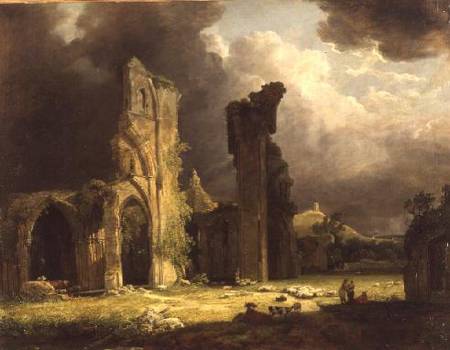
Glastonbury Abbey by George Arnald (c. 1840)

The Rule that David established in the monasteries was austere: monks had to pull the plough themselves without draught animals; to drink only water; to eat only bread with salt and herbs; and to spend the evenings in prayer, reading and writing. No personal possessions were allowed: to say "my book" was an offence. He lived simply and practiced rigorous acseticism , teaching his followers to refrain from eating meat or drinking beer.

His austere measures provoked anger by many monks, and like St. Benedict he was victim of some unsavory attempts at removing him. This perhaps led to his pilgrimage to Jerusalem where he received episcopal consecration by the hands of the Patriarch (possibly Peter or Macarics II). He was quickly recalled to Wales, however, to deal with the Pelagian heresy which was then raging throughout Britain. The Synod of Brevi was convened around 550; so eloquently did David preach that he was soon after appointed to the highest see in Wales, the Archbishopric of Caerleon. This Synod was also the occasion of his most famous miracle, in which the earth rose up beneath his feet as he preached, forming a small hill so as to better amplify his voice. The hill still exists today and his venerated in the village of Llanddewi Brefi, which means "Church of David on the [River] Brefi."

According to St. David's chronicler Rhygyfarch, David obtained the permission of King Arthur to remove his see from Caerleon to Menevia, from whence he governed the British Church for many years with great holiness and wisdom. He died at the great age of 147, on the day predicted by himself a week earlier. It is interesting that despite the fanciful age given at the time of David's death (147), various chronicles all agree that he lived to an extreme old age (at least 100) and all agree that he passed on Tuesday, March 1st. The traditional year of his death is 589.

Some of David's words to his brethren as he passed have gone on to become a well known phrase in Wales: According to Rhygyfarch, David's last words were, "Be joyful, and keep your faith and your creed. Do the little things that you have seen me do and heard about. I will walk the path that our fathers have trod before us.' 'Do the little things in life' ('Gwnewch y pethau bychain mewn bywyd') is today a very well-known phrase in Welsh. In the later struggles of Wales against the English, St. David was invoked before battle in a prophetic phrase which looked forward to the day when the saint would deliver the Welsh from the hand of their oppressors: "A lluman glân Dewi a ddyrchafant" (And they will raise the pure banner of Dewi) became a battle cry.

St. David's relics were transferred to Glastonbury in the 10th century. St. David is depicted with a dove on his shoulder, usually holding a leek, which is derived from a story in which the Welsh and Saxons were about to go to battle found they could not distinguish themselves from one another; therefore, David counseled the Welsh to wear leeks in their hats.

Friday, February 26, 2010

"Saved through childbearing"

Some time ago I received a question by a reader, which I apologize for taking so long to get to. This reader asked:

Boniface, I have a scriptural difficulty that I hope you'll address: what exactly does St. Paul mean when he says: "But women will be saved through childbearing—if they continue in faith, love and holiness with propriety" (1 Tim. 2:15, NIV). How does the Church understand this verse?

Great question. I confess that one of the reasons it took me so long to post on this was that, though I started reading on it right away, so much has been written on this obtuse passage that it is difficult to give a clear interpretation. First, let's look at the entire verse in context:


I will therefore that men pray in every place, lifting up pure hands, without anger and contention.volo ergo viros orare in omni loco levantes puras manus sine ira et disceptatione
29 In like manner, women also in decent apparel: adorning themselves with modesty and sobriety, not with plaited hair, or gold, or pearls, or costly attire:similiter et mulieres in habitu ornato cum verecundia et sobrietate ornantes se non in tortis crinibus aut auro aut margaritis vel veste pretiosa
210 But, as it becometh women professing godliness, with good works.sed quod decet mulieres promittentes pietatem per opera bona
211 Let the woman learn in silence with all subjection.mulier in silentio discat cum omni subiectione
212 But I suffer not a woman to teach, nor to use authority over the man: but to be in silence.docere autem mulieri non permitto neque dominari in virum sed esse in silentio
213 For Adam was first formed; then Eve.Adam enim primus formatus est deinde Eva
214 And Adam was not seduced; but the woman, being seduced, was in the transgression.et Adam non est seductus mulier autem seducta in praevaricatione fuit
215 Yet she shall be saved through child bearing; if she continue in faith and love and sanctification with sobriety.salvabitur autem per filiorum generationem si permanserint in fide et dilectione et sanctificatione cum sobrietate

Rather than me give my own exegesis of this passage, I thought I might rather just state what many other authorities have said on the matter, for as far as I know the exact nature of this passages has never been defined and there is still disagreement on what St. Paul means. That being the case, it is also true that there has been some consensus on the matter, even among Protestants and Catholics.

First, let's state what this verse obviously cannot mean - that the act of bearing children guarantees a woman a place in heaven. This would be so far out of keeping with everything else taught in Scripture that I'm not going to waste time refuting it (though of course, I have met Protestants who assert this).

Some Protestants put a more "faith healing" spin on the verse that I think is equally inadmissible from a Catholic viewpoint. Here's one I found randomly online:

The primary meaning of save in Greek is to be kept safe and sound, to save someone from injury, to restore someone to health, and to keep someone from perishing. This interpretation is consistent with Paul’s theology, that if we trust the Lord, He will keep us safe when we go through calamities. Paul’s concept of salvation is much broader than ours—we tend to think of Jesus saving us from hellfire and leaving us alone to fight office politics, natural disasters, health problems, and other difficulties by ourselves. But Paul saw Jesus as saving us through all things, even if they cause our death.... Paul is instructing Timothy to reassure the women in his congregation who are anxious about the prospect of giving birth. This interpretation is completely consistent with Paul’s theology and his pastoral technique of reassuring people. So I think we have to go with this one. Paul says that a woman who trusts Jesus will be kept safe through the perils of childbirth.

This, too, is inadmissible from a Catholic viewpoint and many Protestants would also disagree - we all know mothers who had faith and virtue but still had painful or very complicated labors. Our faith must always be in God, not in how we think God will or will not act in any given circumstance; faith healers tend to misplace their faith and put it on faith itself - their faith is in their faith.

Let us turn to some Catholic commentaries. The NAB commentary on the verse (for what it's worth) says, "As long as women perform their role as wives and mothers in faith and love, their salvation is assured." This seems to be too broad a statement to be very helpful, however.

Going to something a little more reliable, the 1859 Haydock Commentary states:

She shall be saved by bearing children, &c. and performing other duties of a wife, with a due submission to her husband, taking care to serve God, and bring up her children in the faith of Christ, in piety, &c. --- This would perhaps be more properly rendered, from the Greek, by the bringing up of her children in faith, charity, and holiness. This is the duty of the woman; upon the faithful discharge or neglect of which she must expect her salvation, or reprobation, to hang. Thus repairing the evil which the first of all women brought upon man, by seducing him to evil.

This is what I believe to be the most generally accepted view on the verse - that a woman attains holiness by charitably and faithfully fulfilling the obligations proper to her state in life as a mother. We find this opinion in some ancient commentaries as well. For example, St. John Chrysostom:

As all died through one, because that one sinned, so the whole female race transgressed, because the woman was in the transgression. Let her not however grieve. God has given her no small consolation, that of childbearing. And if it be said that this is of , so is that also of nature; for not only that which is of nature has been granted, but also the bringing up of children. If they continue in faith and charity and holiness with sobriety; that is, if after childbearing, they keep them in charity and purity. By these means they will have no small reward on their account, because they have trained up wrestlers for the service of Christ. By holiness he means good life, modesty, and sobriety (Homilies on First Timothy, 9).

Even Origen interprets this verse to refer to the faithful Christian mother bringing up godly sons as a meritorious service to the Lord:

"Such sons, therefore, the Church produces, and such it brings forth. For "he who sows in the flesh of the flesh also shall reap corruption." (Gal. 6:8) Now the sons of the Spirit are those about whom the apostle also says "The woman shall be saved through childbearing, if they continue in faith and purity." (Homilies in Genesis, 6:3)

Basically, the consensus of most commentators (including many Protestants) is as follows: This verse of St. Paul to Timothy has reference to the original Fall of mankind, especially since pain in childbearing was cited by God as one of curses incurred by sin, just as labor "by the sweat of the brow" was the curse for the man (Gen. 3:16,19). Shall man and woman despair of their salvation then? By no means, for just as in the case of men, manual labor is transformed in Christ from a punishment into a means by which we can attain sanctification, so too with woman. For as the rigors of childbirth was originally a punishment for sin, now in Christ those very same rigors can be an occasion of holiness - not in the physical act of bringing forth children alone, but in the raising up of those children as "trained wrestlers for the service of Christ," which a mother does by providing an example in her perseverance in virtue and holiness.

There other other Catholic interpretations, however. Another fascinating opinion, though one in the minority, is put forward by the editors of the Navarre Bible who speculate that Paul may here be giving an answer to certain Gnostic heretics. It is certainly the case that Paul warns against Gnostic doctrines in many other places, even within First Timothy, where he warns about some heretics who "Forbidding to marry, to abstain from meats, which God hath created to be received with thanksgiving by the faithful and by them that have known the truth" (1 Tim 4:3). Because of their disdain for the flesh, Gnostics treated marriage with contempt, especially the bringing forth of children, which was seen as simply the imprisonment of new souls.

According to Gnostic doctrine, to bring forth children would have actually been sinful, and therefore a woman who had children would be seen as "carnal" and her motherhood as evidence that she had not yet attained perfection. Perhaps St. Paul wrote to reaffirm Christian doctrine to mothers against the teaching of the Gnostics - the Gnostics say, "If you bring forth children, you are not following the secret teaching and will not be saved," to which St. Paul replies in 1 Timothy, "On the contrary, you can be saved and bear children, and this salvation is rendered more secure if you continue in holiness and raise these children up in virtue." According to this theory, 1 Timothy 2:15 should be see as an answer St. Paul gave to an question we do not know.

At any rate, there is no single agreed upon interpretation as far as I can see. Whenever I have come across a Father who commented on this verse they were usually in agreement with Chrysostom and Haydock, although I think the thesis put forward by the Navarre editors has merit as well.

I hope this helps!

Wednesday, February 24, 2010

Apologia pro Christian rock: Rock music and the brain (part 3)

In this third installment we will be looking at some of the experiments cited by Andrew Pudewa in his talk "The Profound Effect of Music on Life," in which he asserts that rock music is harmful to the human person due to the presence of syncopated rhythms, which he says have a negative effect on the human body. It is important to note that Pudewa, like Fr. Nortz and many who make these arguments, state that the problem with rock music is in the beat of the music itself; thus rock music is universally condemned, even if it is Christian rock music written for the purpose of praising God.

Overall, though Mr. Pudewa is not a scientist, his talk is much more scientific and reliable than the pseudo-science and unwarranted assumptions put forward by Fr. Basil Nortz, and overall Mr. Pudewa is very responsible and restrained in his statements. I also have to say that I have tremendous respect for Mr. Pudewa due to his work with getting kids to excel at writing and in the support he has given to the homeschooling movement. Be that as it may, I still think Mr. Pudewa's argument on the disordered nature of rock music fails in several important aspects. In this post, I will discuss the import of some tests done on rodents and their exposure to rock music, drawing on sources that Mr. Pudewa cites in his own presentation, as well as adding some from my own research. My purpose is to show that the arguments drawn from these experiments are inconclusive at best, false and fallacious at worst.

Pudewa cites seven different studies in his talk. Unfortunately, one of his "studies" cited is the Dorothy Retallack experiment, which we have seen from last time to be unscientific, unrepeated and contradicted by mainstream scientists and by average persons who have attempted to repeat the experiment. In my previous post, botanist Dr. Ross Koning told me that the wilting of the Retallack plants, judging from the pictures, was most likely due to insufficient watering or excessive heat; in any case, "the conclusions drawn are not justified by the quality of information gathered," said Dr. Koning. In my opinion, we can reject the Retallack experiment out of hand.

Next we have the Rauscher and Shaw experiment, in which we find that college students temporarily improved spatial-temporal IQ scores by 8-10 points after listening to Mozart, when compared with relaxation music and no music. This is followed up by a second Rauscher and Shaw experiment, in which we find that preschool children given six months of keyboard instruction increased spatial-temporal IQ scores by an average of 46% over other supplemental instruction (singing, computer, free play).

These experiments are fascinating, but in my opinion, do not help Pudewa's case in the larger sense. Pudewa himself says that these cases are only cited as evidence that music, and musical training, have an effect on the brain. He cites these experiments at the beginning of his talk to make the point that music affects the human body, which I don't think anybody has ever disagreed with.

The tests have no import on the question of rock music, however. In the first test, we see only that listening to Mozart can increase spatial-temporal IQ scores (compared to relaxation and no music). This proves only that Mozart is helpful to listen to, not that rock is positively damaging.

In the second case, that of children who increased IQ scores by learning keyboard, we learn only that the cognitive functions involved in learning a musical instrument are helpful in developing a child's overall mental capacity, which again, nobody ever doubted. Everybody knows that it is beneficial to learn an instrument, but it says nothing about rock music or rock beats.

This is not unlike the egg cooking story from Bob Larson cited by Fr. Nortz - even if the egg cooking story were true, it would only prove what everybody already knows: that standing close to extraordinarily loud noises is bad. These Rauscher and Shaw experiments only prove that classical music and the act of learning and instrument are helpful for a child's development, which is not in dispute. It would be as if we were to make the argument that slang English is bad and then go on to prove it by citing studies on how the study of foreign language improves IQ. It may be true, but it hasn't proved that slang is bad, only that study of foreign language is good.

But again, Pudewa knows this and uses these experiments only to demonstrate that music effects living things, so I won't go on and on about this. For his argument to really take hold, he needs to show an experiment that demonstrates positive IQ drops or reversals in humans who have been exposed to rock (i.e., that show that rock makes you "dumber").; he needs an experiment that measures people's temporal-spatial IQ before listening to rock, and then a corresponding measurement that shows an appreciable drop afterward. Does he produce any such experiments? If any such experiments existed, they would add incalculable weight to the thesis that rock music beats are intrinsically bad.

Unfortunately, Pudewa does not bring forward any such studies - instead he devolves to studies on non-human organisms. First, the Retallack plant experiment, which we have already seen does not hold water; second, he brings forward three studies done on rodents. The experiments are:

“Neural plasticity of mus musculus in response to disharmonic sound” (Gervasia Schreckenberg & Harvey H. Bird) Bulletin of the New Jersey Academy of Science, Volume 32, No. 2, pp. 77-86, Fall, 1987

“Improved maze learning through early music exposure in rats” (Rauscher, Robinson, Jens)
Neurological Research, Volume 20, No. 5, 1998

Music, Mice & Mazes: “The Classic/Rock Run” ( 1996, David Merrell, Virginia State Science Fair) Music, Mice & Mazes: “Changes Through the Ages” (1997, David Merrell, Nansemond River High School, Suffolk, VA) [Notice that this one is from a High School Science Fair]

Here are the basic results of the tests, as summarized on Pudewa's website:

Mice exposed to Strauss waltzes showed increased and orderly neuron development, while those exposed to “disharmonic” non-synchronized drum beats showed erratic and pathological growth of neurons.

Rats exposed to Mozart music from before birth to 60 days old were able to learn mazes over twice as fast as those with no music, whereas rats exposed to repetitive “minimalist” music were unable to navigate mazes at all.

Mice exposed for 3 weeks to Mozart were able to run mazes significantly faster than mice with no music, and mice exposed to other forms of music--70’s, 50’s, 90’s and “heavy metal” all performed worse than the control group.

I think these experiments merely confirm what we have already acknowledged - that classical music is the most mentally stimulating than less complex forms of music (and, in case you are wondering, it is the complexity inherent in classical music that makes it so stimulating to the brain. Theoretically, non-classical forms of music that featured similar types of complexity could be as stimulating). But does this prove that rock music is positively harmful, let alone Christian rock?

In my opinion, this is a very subtle bait and switch, because as irrational creatures, rodents do not have an IQ per se. What we can measure is behavior, not real intelligence. Since the Rauscher and Shaw studies dealt with IQ, by switching to the rodent experiments, the implication is made that we are still dealing with the same issue: classical music makes kids smarter, now let's see how rodents are effected by rock music - with the implication that the rodents are "dumber" because of it. But these rodent experiments are looking at behavior, not IQ.

Very well then, so it is behavior, but what accounts for the poor behavior of the heavy metal group of mice? I think it is another bait and switch, and I'll tell you why. In the Merrill experiment the rodents exposed to the heavy metal music did poorly - in fact, they actually killed each other - but this is irrelevant, because nobody is saying that heavy metal music is healthy. Nobody is talking about heavy metal music. I am defending Christian rock music, so I don't see how it is relevant to bring in secular heavy metal.

One other fact that is much more important - in these experiments, the mice were exposed for 10 hours per day to their respective musical styles for weeks. Who listens to music ten hours a day? Of course anybody might feel like killing someone if locked in a cage and forced to listen to heavy metal for ten hours straight, but even I might feel murderous after listening to anything for ten hours, even Pachebel's Canon, the 1812 Overture or Mozart's Turkish March. I recall when watching Morgan Spurlock's documentary Supersize Me, I thought, "Interesting, but nobody really eats only McDonalds for thirty days straight, so this loses some of its import." Similarly, nobody really listens to music of any sort in lab conditions for ten hours a day over sixty days; if any person did do that I think they would go insane. While these experiments are interesting, and do say something about how music affects the behavior of irrational animals, I think it is a leap to say that human beings are so Pavlovian as to be so adversely affected by something as rudimentary as rhythm, which is ultimately nothing more than the timing of two objects banging together. Are we really that delicate?

Interestingly enough, there is one study Pudewa cites where there was data collected on the effects of music on human moods. This was the McCraty experiment, “The effects of different types of music on mood, tension and mental clarity” (McCraty, Barrios-Choplin, Atkinson, Tomassino) Alternative Therapies, Volume 4, No. 1, January 1998. Here is a synopsis of the study from an extract found on the Alternative Therapies website archives:

A total of 144 subjects completed a psychological profile before and after listening for 15 minutes to four types of music (grunge rock, classical, New Age, and designer). With grunge rock music, significant increases were found in hostility, sadness, tension, and fatigue, and significant reductions were observed in caring, relaxation, mental clarity, and vigor. (source)

Aside from wondering how an observer can measure a "significant reduction" in something as immaterial as "caring", I immediately note that the results for classical music are not that much better; indeed, they are "inconclusive", according to the report. The report actually suggests that not classical, but "designer music" is best for "increasing positive feelings and decreasing negative feelings." In case you didn't know, designer music is music artificially designed to specifically produce certain emotions - think elevator music, various mood music CD's, selectively chosen Muzak compositions. According to the study, this music is best as producing positive feelings - and much of it contains syncopated rhythms. Now, if designer music has syncopated rhythms and ranked best, and "grunge", also including syncopated rhythms, ranked worst, could it be that something other than syncopation is to account for these discrepancies?

At this point you are probably thinking, "Boniface, you are grasping for straws here. You have just acknowledged that the study says that rock music significantly increases hostility and depression, as well as another one in which mice exposed to rock did significantly worse than other mice. Even if we can't say that rock music is equivalently harmful to human beings, surely these studies suggest that it is in some degree harmful?"

The only problem I have with that is there are other studies contradicting that supposition. In a 2003 study from Penn State (note, not a high school science fair), researchers Valerie Statton and Annette Zalonowski set out to study the effects of music on mood, but very quickly realized that many previous studies on the subject were defective. They say:

'We've been looking at music and behavior for quite a few years, and it finally struck us that most of the things we were doing, and most of the things that other people were doing, were within lab settings. There was really very little out there that looked at how people listened to music in their daily lives.' (source)

This was one of my beefs with all the mice experiments - people don't listen to music like that, in isolated lab settings. Music is something that people listen to while doing something else by and large, like driving, cooking, working, etc. The Penn State experiment thus sought to examine the effects of music on mood in the real world settings where music is actually listened to. So the researchers recruited 47 college students, including 25 music majors, and asked them to keep a diary for 14 days, noting the kinds of music they listened to. They were also asked to pick various moods from a list, showing their moods before, during and after listening to the music.

The results were very different from those of the lab experiments with mice or of the McCraty experiment. When done on humans, and in real environments, the Penn State experiment found that the type of music was less important in determining mood than whether or not the listeners really liked whatever they were listening to; i.e., if the students like jazz, jazz made them feel relaxed and peaceful; if they were fans of rock or country, these genres had similar effects. The style of music was irrelevant. One form of music did very well across the board, however: rock. Rock, the music of choice, made just about all the students "optimistic, joyful, friendly, relaxed and calm," according to the findings.

This study clearly contradicts the McCraty experiment and the mice experiments. Another fascinating experiment was done by Virgil Griffiths on band tastes and intelligence, measured by SAT scores. This experiment was more of a broad survey than a real experiment done according to scientific method; here's how Griffiths worked it out (from his website):
  1. Got colleagues to download, using Facebook, the ten most frequent "favorite music" at every college via that college's Network Statistics page on Facebook. These ten "favorite musics" are perhaps indicative of the overall intellectual milieu of that college.
  2. Download the average SAT/ACT score (from CollegeBoard) for students attending every college.
  3. Presto! We have a correlation between musical tastes and dumbitude (smartitude too)!

    Music <=> Colleges <=> Average SAT Scores
  4. Plot the average SAT of each "favorite music", discarding those with too few samples to have a reliable average.
Though not very scientific, Griffith's experiment has the import of a broad poll - the results are interesting. Below you will see the graph plotting Griffith's results. The X axis is the SAT scores, which get higher as you go to the right. The Y axis does not mean anything, but the colors of the bands denote musical style (a key is at the bottom). Notice the following as you scroll down (if you can read it because it's so small):

1) Beethoven is way out in front, which is not too surprising (I know you can't see it because I couldn't fit the whole graph in the post - you can see the full size chart here). But, the next highest after Beethoven is the Christian-inspired Indie Rocker Sufjan Stephens, whose alternative and Indie rock most definitely make use of syncopation and have even been described as "electronica" and "minimalist."

2) Note that at the bottom of the SATs, furthest left along the X axis, we have Lil Wayne, Ludicris, T.I. and Jay-Z, all in the rap/hip-hop category, associated with the urban African American culture.

3) Beethoven is far out in the lead, by far the most musical groups that come closest to him are not classical but rock: Counting Crows, Radiohead, Guster, Ben Folds, The Shins, Phish, Norah Jones, The Killers, Death Cab For Cutie, etc. These are all rock bands that are considered somewhat independent and would be listened to by the nerdy college intelligensia.


After looking at this chart, and noticing that (a) indie rock is at the front just behind Beethoven, and (b) rap is at the bottom, with (c) contemporary/classic rock in the middle, that perhaps this has more to do with culture, socio-economic status and one's peer groups than it does with what objectively makes you smarter or dumber?

To wrap up this necessarily long post, let me summarize my arguments:

While it is evident that classical music, due to its complexity, is the most stimulating to the brain, and that mental processes are even more stimulated by learning an instrument, it does not therefore follow that the results of the tests in which rock music is blared to rodents ten hours a day for three weeks straight (in the rigorous scientific atmosphere a high school science fair, mind you) are transferable to humans. When similar experiments are carried out in real-life situations, with music being listened to casually as people really do, we find that the music that makes people the most optimistic is whatever style they happen to like the most. Furthermore, what style a person finds aesthetically pleasing has a lot to do with socio-economic status, culture and what peer group one identifies with. Therefore, those arguments which claim on the basis of the rodent studies to make any claim that rock music (Christian or otherwise) is always a positive evil irresponsibly oversimplify the case.

I'm sorry to my normal readers if you find this topic horribly boring, but it is something I've been dealing with for a long time and I do think that somebody needs to try to clear it up. Next time I come back to this I am going to talk about syncopation itself and why the argument that syncopated rhythms in rock music are disordered or dangerous is fallacious and errant.