Showing posts with label Novus Ordo. Show all posts

Wednesday, November 25, 2020

Utilitarian Arguments Against Lay Lectors


One of the most notable characteristics of the Novus Ordo Missae is the utilization of members of the congregation in roles that were formerly filled by clerics in Minor Orders. This change was brought about due to a misguided understanding of "active participation", a phrase whose pre-Vatican II definition had meant something more akin to "full engagement of mind and heart" but which in the post-Conciliar regime came to mean "everybody moving around doing stuff." There is an excellent little exegesis on the pedigree of the phrase participatio actuosa in Dr. Peter Kwasniewski's book Reclaiming Our Roman Catholic Birthright (which I will be reviewing in the near future, Lord willing). For those of you who don't have the book, I recommend this article from Dr. Kwasniewski at New Liturgical Movement.

While there are many examples of congregants being substituted for clerics in the new Mass, here I'd like to focus on the role of the lector in the Novus Ordo, specifically in utilitarian terms. That is, there are many good arguments that it is more uniquely fitting for clergy to lector; here I am going to present an argument for the same based on the fact that congregants are generally bad at doing the readings.

Before we examine this, I want to reference from the Rule of St. Benedict, Chapter 45, on mistakes made when doing the readings. St. Benedict wrote:

Should anyone make a mistake in a psalm, responsory, refrain or reading, he must make satisfaction there before all. If he does not use this occasion to humble himself, he will be subjected to more severe punishment for failing to correct by humility the wrong committed through negligence. Children, however, are to be whipped for such a fault.

Granted, this passage is not directly applicable. Benedict is referring specifically to monastic life, and the passage refers not to the celebration of the liturgy but to the readings done in the Oratory or during mealtime in the Refectory.  Still, even if the particulars are not directly applicable, it is still relevant on principle―the Sacred Scriptures are the very words of God, the public recitation of which demands skill, attentiveness, and excellence. To treat the public recitation of the Word of God as something common place profoundly devalues the place of the Scriptures in the economy of salvation. We are blameworthy if we do so, and hence the Rule of St. Benedict proscribes a penalty for anyone who errs when readings, whether through neglect or honest accident. The recitation of the Word of God in the liturgy deserves the highest attentiveness and formal excellence on the part of the lector.

Given this basic principle, let us consider how the readings are often done in the Novus Ordo. 

In the first place, it is evident that the lay lectors are often unfamiliar with the specific biblical text they are reading. This is evidenced in the endemic mispronuncation of biblical names. Even relatively simple names like Jezreel or Bartimaeus give many a lector pause. Some names are morphed into others, like when the text says Simeon but the lector lazily says Simon, or Mattathias becomes Matthias. The lector fumbles to say Nebuchadnezzar or Melchizedek. And if a word like Mahershalhashbaz or Zaphnathpaaneah comes up, it's game over. 

The quality of the delivery is often shoddy as well. Pitch is monotone, cadence indiscernible, and punctuation in the text is slurred over because the lector doesn't understand how all the subordinate clauses run together. There's no particular emphasis on any aspect of the text―or conversely, if there is, it is often melodramatic and cringy. In other words, it's exactly what you'd expect when people who are uaccustomed to reading publicly are asked to read publicly. It oftens seems like the first time a lector sees the text he or she is reading is when they step up to the ambo.

Furthermore, it frequently happens that a lector is chosen who honestly does not have sufficient eyesight or audio-verbal coordination to be reading publicly. I am reminded of a Mass I attended where an elderly gentleman lector consistently said "the Godfather" instead of "God the Father." Whether the problem was age, dyselxia, or some other cause, the fact was somewhere in the cognitive process the words were getting jumbled, resulting in calling the First Person of the Trinity "The Godfather", and other similar embarassing errors.  

And all of these problems are compounded when a parish decides to also let children lector, which is unfortunately common.

Finally, we must also note the problem of lay lectors approaching the ambo in clothes that are much too casual for the office they are fulfilling, especially in the case of daily Masses where the lector is likely to be wearing jeans or other street clothes. The solemn proclamation of the Word of God in casual attire creates a cognitive dissonance between what is supposed to be happening and the reality we are seeing. Although to be honest, even if the lector is impeccably dressed, he is still not vested for the specifically liturgical function he or she is ultimately performing, which is a whole other discussion.

I grant that these objections are anecdotal. One's experience with a lector is going to vary depending on the particular lector. And some Novus Ordo parishes do a good job vetting their lectors, and these lectors are attentive to reviewing and meditating on the text prior to taking the ambo. So this is not meant to disparage those of you who may be serving as lay lectors and putting a lot of attentiveness and work into the reading. Nevertheless, anecdotes are anecdotes for a reason, and the fact that some lectors do a good job in the Novus Ordo is no argument against the ubiquity of the problems I have described above.

One reason for the subpar lectoring in the Novus Ordo is that, once you admit the principle that the readings should be done by a layperson, you must now find a constant supply of laypeople to do this for every set of readings: day after day, week after week, year after year. Even assuming one lector is going to read multiple times during a month, this is still a tall order. To keep the assembly line of lay lectors flowing uninterrupted, a pastor cannot afford to be choosy with whom he admits to the ambo. Even though canonically the pastor has total discretion over who can fulfill this function, in practice any warm body who wants to lector is going to be permitted.

The problems I enunciated above are all non-issues in the Traditional Latin Mass. Granted, it is still possible that a cleric may stumble over a word like Merodachbaladan or Tigleth-pileser. But really, who is less likely to mispronounce Bible names: a cleric who studied the Scriptures for years prior to ordination, preaches on them daily, and meditates on them privately multiple times of day in the Office...or a lay person whose only interaction with the Bible may be on Sunday? Obviously a cleric is much less likely fumble just based on his training and manner of life. Even someone in Minor Orders is going to be far better equipped to deal with a reading than a lay person. Yes, lay people can study Scriptures and be very biblically literate, but like everything else in the Novus Ordo, this is entirely dependent upon the particular lector. Should the quality of our readings be held hostage to the skill of a particular individual every week?

Furthermore, a priest or deacon who preaches regularly, essentially speaking in public for a living, is going to have a better quality of delivery. Pitch, cadence, emphasis, timbre, and all of it is going to be superior to your average lay lector who probably never has to read publicly. A priest who encounters the Scriptures on a daily basis in public liturgy and private study is also a lot less likely to juxtapose phrases or commit an error like "The Godfather" example mentioned above. Someone who has studied the Scriptures for years is going to be intimately familiar with the texts in a way that gives them a certain comfort or naturalness about reading them aloud. 

And obviously a cleric is going to be properly vested for the office he is performing, which eliminates the cognitive dissonance I mentioned above when a layperson saunters up in their street clothes to proclaim the divine revelation of the Word of God. Furthermore, reserving the readings to the few clergy associated with a parish solves the problem of needing to find an unending supply of laypersons to lector.

In critique all this, I can anticipate the rebuttal that God does not care about our education level, or how eloquently we speak, or whether we stumble over a word. God only cares about the heart! After all, "When I came to you, brethren, I did not come proclaiming to you the word of God in eloquence or human wisdom. For I decided to know nothing among you except Jesus Christ and him crucified" (1 Cor. 2:1), and "If I speak in the tongues of men and of angels, but have not love, I am a noisy gong or a clanging cymbal" (1 Cor. 13:1). To insist on some kind of external, formal excellence in how one reads is Pharisaical. Didn't Jesus come for the poor and uneducated? 

In the first place, the verses above do not pertain to the liturgy specifically. In liturgical worship, externals do matter very much given that it is the public worship of the Church. General Christian precepts about personal prayer often do not apply to the liturgy, which has its own standards. For example, Jesus clearly says "But thou, when thou prayest, enter into thy closet, and when thou hast shut thy door, pray to thy Father which is in secret" (Matt. 6:6). Yet, clearly this does not apply to the liturgy, which by definition is public worship. If we applied Jesus' dictum to pray in secret to our liturgy, we wouldn't even be able to have a Mass. It is sloppy, lazy scholarship to take biblical passages that were never meant to apply to the liturgy and derive liturgical norms from them. That's how you end up with people going barefoot at Mass because God once told Moses to take his shoes off, or parishioners dancing in the sanctuary because David danced before the ark

And even though many of us might struggle to pronounce Mahershalalhashbaz or Chushanrishathaim when we come across them in our private reading, our private reading is not the public proclamation of the Word of God in the liturgy. I might also read the Bible privately while sitting comfortably in my pajamas but it would be absurd to say that the same standard applies to the liturgy. The excessive focus on "Aw, but his heart is in the right place" and "C'mon, she's doing her best" reveals the degree to which the Novus Ordo approach to liturgy is so anthropocentric it cannot even fathom the idea of the Mass being God-directed.

But more to the point: granted that by every objectively measurable criterion a cleric is better suited to do the readings than a layperson, what counter-argument is there for preferring lay lectors despite all the defects we mentioned? What principle is weighty enough to override the avalanche of problems that come with lay lectoring? What can be so important that we accept the standard of mediocrity? The only plausible answer is that it is all worth it in order to include laypeople in the liturgy. And thus we see that, again, the true North Star of the Novus Ordo is the flawed principle of active participation. It's a kind of liturgical affirmative action: a cleric can objectively "do the job" better, but a less qualified person is chosen, not based on their ability, but solely on their identity. The fittingness of the liturgical celebration comes second; attending to lay "representation" in the ritual is first. It is a perfect example of the schizophrenia of the Novus Ordo mentality―to prefer a watered-down, banal experience that is objectively slipshod and detrimental to faith so long as people can feel like they are "doing something."

In conclusion, it seems evident that the public worship of the Church demands the highest level of excellence possible for the proclamation of the Word of God. The reliance on lay lectors in the Novus Ordo completly subverts this standard by prioritizing the physical involvement of laypersons―regardless of their capabilities―over the objective quality of the liturgy. It is the total inversion of the principle we saw enunciated in the Rule of St. Benedict and which has always been at the heart of the Church's public worship.

For another take on this same problem please see "How Typical Lector Praxis Transmits a Protestant and Pelagian Message" from New Liturgical Movement (Jan. 2018)

Sunday, July 10, 2016

Memorizing the Readings

This weekend I was traveling out of state and went to Mass in a beautiful historic church from the late 19th century. It has preserved all of its original neo-Gothic decor; of course, a little table altar had been added in front of the high altar, but at least nothing had been positively destroyed.

The liturgy was novus ordo but was done very well as NO liturgies go. The priest in charge evidently cared a great deal about having things done "decently and in order" (1 Cor. 14:40). But during the readings something happened I had never encountered before. The lector who was doing the first readings had apparently memorized the entire reading. This allowed him to not look at the lectionary the entire time; he maintained a steady eye-contact with the congregation and projected his voice in a commanding tone. It was like he was reciting lines, not reading from the lectionary.

For a moment I really did not know what to think about this. In terms of objective quality of the delivery, sure it was better - he had all the emphasis at the right points, was more engaging to listen to, and delivered the reading in an objectively better manner than I have heard most lectors who are just kind of stumbling along over the words in the book. Obviously, taking the care to memorize the reading gave him a much greater familiarity with the text than if he were merely reading it, and it showed in the way he delivered the lines with confidence and depth.

But, it also bothered me some. Regardless of the objective quality of the "delivery", it felt like he ought to be reading out of the book. I thought to myself, "How would I feel if the priest had memorized the Canon of the Mass and delivered it without any reference to the Missal?" And that idea ruffled me greatly; it seems that the book, lectionary or Missal, is not simply there as an aid to help the priest or lector remember what he is supposed to be saying. The book is not like an incidental accoutrement to the liturgy; it is not a kind of glorified cue card that is there to remind the priest or lector of the words but can be dispensed with if they have their "lines" memorized.

Rather, the lectionary and Missal are the tangible representations of the Tradition. When the lector reads from the lectionary and the priest prays from the Missal, he is demonstrating that he is receiving what has been handed on. It is a kind of reverence towards the Tradition. And if I recall, Klaus Gamber makes this same argument in The Reform of the Roman Liturgy.

However well a priest or lector might memorize the words, it ultimately becomes a performance. That's why I noticed that this lector's reading had a certain sort of theatrical affectation to it that I found distracting.Ultimately I felt it was not something I liked. I would prefer the person reading drably rather than someone delivering memorized "lines" with great gusto. It seems like a more proper way of acknowledging that what you are doing is not your own creation- it's something you have received and are handing on.

Sunday, June 22, 2014

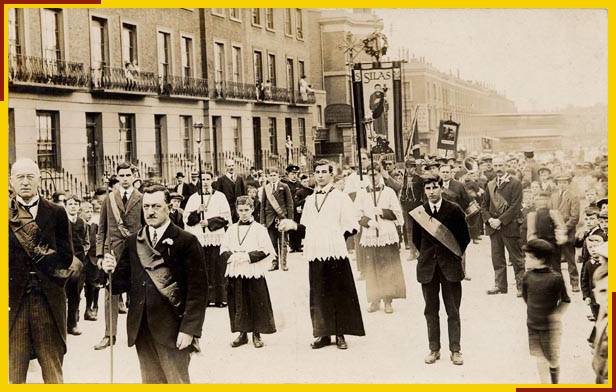
Corpus Christi and the Church of the World


The good ole days

This weekend my mother attended a Corpus Christi procession at a parish that is not her regular parish. She passed on to me the booklet the congregation used for the procession prayers, a composition called the "Litany of Lament for Sins Against the Body of Christ." As I read the prayers, I soon realized that these prayers were of such banal hilarity as to merit being the subject of a post. I should note, this came from a parish that is not known as a particularly progressive or dissenting parish; this is just your typical EWTN-watching, Fr. Barron-loving, Medjugorje-affirming fairly orthodox parish from American Novus Ordo Land.

I have omitted the customary prayers at the beginning of the litany (the "Lord have mercy, Christ have mercy, etc). I present, the "Litany of Lament for Violations Against the Body of Christ", followed afterwards by my comments.

FOR SINS AGAINST THE BODY OF CHRIST IN THE WORLD

For those times when we have failed to welcome the stranger or have been silent about immigration reform, Lord have mercy.

For those times when we have been silent about political issues, especially those that threatened religious liberty, Lord have mercy. [Laughable, because these same priests who are bewailing being silent about political issues would rather walk on hot coals than criticize Obama or say anything even remotely contoversial]

For silence by too many members of the Church while fifty-five million lives wee lost to abortion, Lord have mercy.

For those times in our history when we have not spoken out against slavery, segregation, or persecution, Lord have mercy.

For those times and in those places we have ignored those in prison and the needs of their families, Lord have mercy.

For ignoring genocide in our world - by starvation, by brutal atrocities, and by civil and military actions, Lord have mercy.


FOR SINS AGAINST THE BODY OF CHRIST DUE TO ABUSE

For the sins of Church ministers who sexually abused children, Lord have mercy.

For the failings of those in hierarchy who failed to remove offenders from parish positions, Lord have mercy.

For the irreparable harm caused by victims of abuse, Lord have mercy. [one wonders if the harm is "irreparable", what is the purpose of this prayer of reparation?]

For all those times when any of us has failed to protect children, Lord have mercy.

Let us pray: Lord, we worship you living among us in the sacrament of your Body and Blood. May we offer to our Fathers in heaven our solemn pledge of undivided love. May we offer to our brothers and sisters a life poured out in loving service of that kingdom, where you live with the Father and the Holy Spirit, one God forever and ever. Amen.

FOR OUR SINS AGAINST THE BODY OF CHRIST IS THE DOMESTIC CHURCH

For those times when we have failed to reach out to families who were experiencing difficulties, Lord have mercy.

For too quickly judging divorced and separated spouses, Lord have mercy.

For our failures to reach out and support mothers and fathers considering abortion, Lord have mercy.

For failing to use our resources to help the poor and unemployed, Lord have mercy.

For failing to feed the hungry, clothe the naked, and shelter the homeless, Lord have mercy.

For those times when we have ignored the gifts of our youth and their contributions to the Church, Lord have mercy.

FOR SINS AGAINST THE BODY OF CHRIST

For all those times when we ourselves have failed to be instruments of reconciliation, Lord have mercy.

For not fully utilizing the gifts of women in the Church, Lord have mercy.

For being uncivil in our disagreements about liturgical practices instead of uniting in worship around God's altar, Lord have mercy.

For those times when we have caused other members of the Body of Christ to suffer, Lord have mercy.

For perpetuating historic divisions among Christians, Lord have mercy.

For not recognizing our shared heritage with Orthodox and Protestant believers, Lord have mercy.


For those times when we have been intolerant of non-Christian believers and to those who profess no faith, Lord have mercy.


LITANY FOR THE COMMUNITY

For those who own businesses, may they be good stewards of their gifts, Christ graciously hear us.

For employees, may they reflect the Gospel of Jesus, Christ graciously hear us.

For those who frequent the businesses, may they be bearers of truth, Christ graciously hear us.

For those who visit, may they see the light of Jesus shining all around them, Christ graciously hear us.

For our leaders, may they be filled with justice, prudence, fortitude and temperance, Christ graciously hear us. [Why not faith, hope and charity, also?]

For our public officials, may they act according to the wisdom of God, Christ graciously hear us.

For our utility workers, may they persevere in joyfully serving the community especially in emergencies, Christ graciously hear us.

For all social workers, may know the peace of Christ, Christ graciously hear us.

For all school teachers and principals, may they reach the children they teach emotionally, spiritually, and academically, Christ graciously hear us.
For all hospital personnel...

[Here it goes on and on, mentioning medical workers, police, firemen, EMTs, charitable agencies, those who work with victims of domestic abuse, Salvation Army, postal workers, court workers and judges, prisoners, the "lost and confused", church ministers, senior citizens, foster care workers, those who are suffering from addictions, the depressed and suicidal, and finally, teenagers]


Let us pray: Lord Jesus, on the night you told us to take and eat your Body and Blood, you prayed to the Father that we may all be one as you are one with your Father. We too pray dear Jesus that we may all be one as you are one with the Father. Amen.
...[end]...

Whew. Okay. A few observations-

First and foremost, was there anything in this entire litany about the actual, sacramental Body and Blood of Christ, which is the whole rationale for the feast? No. Never is the presence of Jesus Christ in the Blessed Sacrament mentioned, except for one vague allusion in the prayer "Lord, we worship you living among us in the sacrament of your Body and Blood," and the presence of the phrase "living among us" renders this prayer extremely questionable - as if we cannot worship the sacramental Lord without doing so mediately through the community who receives Him.

Second, I also noted that every intercession, without exception, is entirely worldly, focused on this side of heaven. No prayer for those in the hour of death. No prayer for the conversion of poor sinners. No reparation for offenses against the Sacred Heart or our Eucharistic Lord. No prayers for the poor souls in Purgatory. No prayers for the salvation of the non-believer or for the Church's missionary efforts. Whoever composed these prayers evidently envisions the Church's mission as completely earth-bound, about speaking up for immigration reform.

Third, it should be evident that the presence of Pro-Life sentiments is no longer and indicator of orthodoxy. Perhaps this was once otherwise; maybe back in the 80's and 90's. But the Pro-Life standard has become so ubiquitous within Catholic parish life that it has become kind of disconnected from any larger orthodoxy. This same litany which laments the holocaust of abortion and prays for mothers considering abortion simultaneously prays for greater recognition of the "gifts of women" in the Church (we know what that means), suggests that arguing about liturgical matters is "uncivil", and laments that we are "intolerant" of other faiths. In other words, we have reached a place where Pro-Life sentiments coexist comfortably with progressive theology. Being Pro-Life is no longer an indicator of legitimate Catholicism, and it can be arguable that it never was (related: Profile of a Theological Liberal).

Fourth, the incredible naivete! This "Litany of Lament" bewails the fact that there is not enough influence of women in the Church, that we are too intolerant, that our problem with Protestantism is that we have not sufficiently affirmed it, that we are too judgmental about divorced Catholics. So, women don't have a big enough role in the Church? Maybe whoever wrote this prayer has not seen some of our diocesan publications, or has never Googled "Director of Religious Education" on Google Images,  nor Googled images for "RCIA Director" - or for that matter, "Director of Faith Formation" or "Parish Administrator". Can anyone who has spent one year in a modern Catholic parish and done these basic image searches really be serious that women are not represented enough in the Church today? That the Church has not been sufficiently pro-illegal immigration? That divorced Catholics are treated too harshly? These people are living in fantasy land. But, as has often been pointed out, the solution for the problems caused by liberalism is more liberalism.

Catholics obviously think of the Church as merely an institution for the betterment of society - and when the Bishop of Rome says things like the greatest crisis facing the modern world is youth unemployment and then skips out of Rome's Corpus Christi procession so he can make a pastoral visit to a Calabrian prison, the situation is definitely not made any better. By the way, I also noted the "Litany of Lament" did not include any prayers for the Pope.

We could go on, but why bother? 

"He that is unjust, let him be unjust still: and he which is filthy, let him be filthy still: and he that is righteous, let him be righteous still: and he that is holy, let him be holy still." ~Rev. 22:11

Friday, March 28, 2014

Is the Novus Ordo a New Rite of the Church?

The term Novus Ordo is often used by “traditionalist” Catholics as a sort of pejorative, but it is most interesting to note that Paul VI himself referred to his new Mass as the “Novus Ordo”. [1] In light of this fact, I think we can charitably make use of the term as a means of distinction. But is the Novus Ordo a new rite of the Church?

The Vetus and the Novus, as Pope Emeritus Benedict has said, are “two expressions of the Church’s Lex orandi” [Law of praying]. Benedict sees that, while there is one law of prayer, it finds two expressions in the one Roman Rite. He says that their relationship is such that it “will in no way lead to a division in the Church’s Lex credendi [Law of believing]. They are, in fact two uses of the one Roman rite.” [2]

From this quote, it seems the question posed is all but answered. And yet, how can Paul VI be correct and Benedict XVI also be correct? Is it a new rite, as Paul VI has said, or is it merely another form of the same rite, as Benedict has said? The two seem to be in contradiction on the matter. Perhaps in order to resolve the conflict we should look more deeply at what a "rite" in fact is.

For Catholics in the West, to speak of the Roman Rite and the Latin Church is synonymous. However, it is important to note that in the East, a “church” refers to a particular people who are legally autonomous, and so they refer to a “church sui juris” (of one’s own right). There are multiple churches sui juris that share a common rite. It may be easier to see in terms of genus (rite) and species (church) - Under the genus, “Byzantine”, there are the species of Ukranian, Melkite, Ruthenian, Romanian, etc., all of whom, while sharing a common liturgical patrimony, are in fact legally autonomous from each other. In addition to the churches of the Byzantine Rite, there are also other rites, such as the Alexandrian, Antiochene, or Chaldean rites, and which are composed of various autonomous churches.

The Eastern Code of Canon Law defines a rite as thus: “A rite is the liturgical, theological, spiritual and disciplinary heritage, distinguished according to peoples' culture and historical circumstances, that finds expression in each autonomous church's way of living the faith.” [3]

In the West, we have used the word “ritus” to mean something different. Historically, we have referred to the one Latin church sui juris (whose Patriarch is the Bishop of Rome), with many “rites”, or liturgies, attached to it. So, we find that there was once not only the Roman Rite, but the Gallican Rite, or the Carmelite Rite, or the Sarum Rite - in effect, rite and church have the opposite hierarchical structure in the West from what is found in the East! We also use the word to speak of particular liturgical ceremonies, such as the "rite of baptism" or the "rite of communion", etc. The Old Catholic Encyclopedia treats of “rite” in this manner, defining it as “comprising the manner of performing all services for the worship of God and the sanctification of men” - in effect, a particular type of liturgy. [4]

If we take rite to be used in the Western sense, as defined by the Old Catholic Encyclopedia, we would have to say that Paul VI is entirely correct in calling the Novus Ordo a "new rite" of the Church. From this, can we conclude that Benedict in Summorum Pontificum was simply in error on this distinction - that the Novus and the Vetus should most properly be referred to as two rites, and not one? There are many canon lawyers and Bishops, who, following the Pauline definition of ritus, would say that Benedict was simply not a good canonist, that there are manifold problems surrounding the legislation Summorum Pontificum, and use this in order to prevent its implementation. However, to simply do this is not only incorrect, it is to miss the real genius behind the motu proprio given to us by Benedict. Let's take a closer look.

Returning to the definition for the word given in the Eastern Code of Canon Law, we find that in order to refer to something as a rite, we not only have to evaluate the liturgical patrimony, but also the “theological, spiritual and disciplinary heritage, distinguished according to peoples' culture and historical circumstances” in order to make a determination on the issue.

In light of the greater qualifications necessary for the constitution of a rite as laid down by the Code, we should perhaps endeavor not to speak equivocally of the word “rite”, and try to harmonize these two different definitions in order to see that, in fact, Paul VI and Benedict XVI are speaking of the same reality, albeit with different things being signified by the word "rite". In harmonizing the two, Benedict gives us a different word, “use”, as the more proper term pertaining to the various liturgies of the West, since he understands "rite" as having a more broad scope. As “particular liturgical usages” of the Roman Rite, the Vetus and the Novus should witness to the same “lex orandi” of the one Roman Rite. This distinction which Benedict is making between the two forms of the Mass has great implications, far beyond the liberation of the traditional missal, although they may not at first be apparent. These implications, I think, lie in the other qualifications of the constitution of a rite (as given in the Eastern Code), and bear greatly on our question, "is the Novus Ordo a new rite of the Church?"

Dear friends, I don’t think that I have the space in order to adequately explicate and argue one way or the other for the answer to this question - perhaps we are still too close in history to the Council to be able to judge such a thing. However, please allow me to make a few observations. After the Council, we were given a new liturgy, formed, not organically, but by a committee of “experts”. The substantial difference between the Tridentine Missal and the Missal of the post-Vatican II reform is sufficient enough for nearly all to agree that the Novus Ordo is in fact a formally new, albeit perhaps materially similar, usage of the Roman Rite.

But not only were we given a new liturgy, we were also given a new Code of Canon Law, adopting the legal language of modern political theory. Furthermore, the seminaries almost universally dropped St. Thomas from their formation programs in favor of modern philosophy and a “new theology” based upon the foundation of these modern philosophies.

In the implementation of all of these changes, an euphoric “spirit” of the Council was adopted as the new path to holiness in the modern world, throwing off the shackles of a “repressive” spirituality obsessed with peoples’ sins and medieval devotions while replacing it with an “all you need is love” sort of spirituality - one which could be summed up by the phrase “who am I to judge” as the modus vivendi for the Church in the modern world.

Fifty years after the Council, we are at a critical time in the history of the modern era of the Church. The answer to the question, “Is the Novus Ordo a new rite?”, I fear, is still very much an open one, and while the friction may rear its head most heatedly in the discussion of the Tridentine Mass versus the Mass of Paul VI, we should take care to have greater reference to the theological, spiritual, and disciplinary traditions in order to resolve the question. Benedict saw that, while a new rite could never be created de jure in the Church, [5] if things did not change dramatically, the West was well on its way to celebrating a new rite de facto.

This, I think, is the real mens behind the legislation Summorum Pontificum, and the particular genius of a Pope who, by his taking part in the reforms of the Council saw the dangers that accompany the adoption of a doctrine of progress. It is for this reason that we need Catholics who are not only devoted to the traditional liturgy, but also to the theological tradition accompanying the liturgy - to do anything less is to live a sort of duality within one’s own soul that will ultimately sow utter confusion and discord.

Benedict proposes that we must understand these new theologies, liturgies, and disciplines in the light of a hermeneutic of continuity. This, of course, is true - it is the only way to maintain the integrity of the one Roman Rite; and with regard to the Mass, it is the only way in which "These two expressions of the Church's Lex orandi will in not any way lead to a division in the Church's 'Lex credendi'". But especially with regard to those things which do not bear the charism of infallibility, perhaps the surest and most direct path to continuity with the patrimony of the Roman Rite that is given to us in the tradition is to be begin to discern which of those branches of the vine have not born the fruit that had been hoped for, and begin the pruning process, so that the whole vine might begin to bear good fruit once again.

The particular legislative genius of Summorum Pontificum has not yet been fully realized or appreciated - the recent unprecedented moves on traditional religious orders and academic institutions witnesses to this fact. I think that, in light of the particular reality that the Latin Church has found itself in at the beginning of this new millennium, Pope Benedict has shown us that the only way to stave off the natural schism (a “hermeneutic of rupture”) that occurs from two fundamentally opposed philosophical foundations is to be found in forming an intentional relation, a hermeneutic of continuity, between the Vetus Ordo and the Novus Ordo (and their accompanying theologies) as two forms of one rite.

The "auctoritas" [6] that the usus antiquior possesses will become the anchor for authentic liturgical renewal and reform, and, in turn, since lex credendi follows on lex orandi, the renewal of Catholic theology and life will continue to be enriched - proportionally, I would say - by the regularization of the particular theological and spiritual patrimony of the Vetus Ordo into the life of the Church as a whole.

The answer to the original question, “Is the Novus Ordo a new rite?” should be a simple one: “no, of course not!” The means of making this answer true lies in the work ahead, moving forward in faith, hope, and charity, and using the blueprint given to us by Benedict in his theology, his pastoral praxis, and in what will be perhaps the legacy of his pontificate, Summorum Pontificum.


[1.] Address of Paul VI at the Consistory for the naming of Cardinals, 24 May 1976.
[2.] Summorum Pontificum, a. 1.
[3.] CCEO 27
[4.] Griffin, Patrick. "Rites." The Catholic Encyclopedia. Vol. 13. New York: Robert Appleton Company, 1912. 21 Jan. 2014 <http://www.newadvent.org/cathen/13064b.htm>.
[5.] The rites all have their origin in apostolic foundations, and thus, a truly new rite could never legitimately be erected.
[6.] Pope Benedict refers to the “auctoritas” possessed by the Vetus Ordo when he says “What was sacred for prior generations, remains sacred and great for us as well, and cannot be suddenly prohibited altogether or even judged harmful.” The question of what “auctoritas” the Novus Ordo might possess could be a fruitful subject for future reflection.