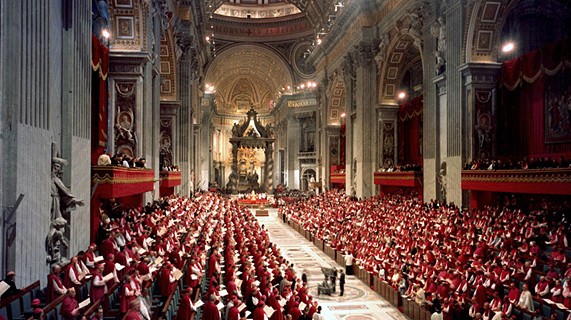
Showing posts with label Vatican II. Show all posts

Monday, October 16, 2023

A 1971 Proposal for a New Form of First Confession for Children

Bishop Pieter Jan Antoon Moors of Roermond, who in 1964 became one of the first bishops to revise how the Sacrament of Penance was administered to children.

[Oct. 15, 2023] Franz Heggen (b. 1930) is a Dutch theologian who was a peritus for Bishop Pieter Jan Antoon Moors of the Diocese of Roermond, Netherlands. Before the Second Vatican Council had even ended, Bishop Moors (1964) issued directives in his diocese for a reevaluation of how penance was administered, asking priests to consider preparing children for confession in stages through prayer and song rather than traditional catechesis (1). Franz Heggen was a part of these discussions and an advocate for a restructuring of the sacrament in such a way that absolution was conferred collectively in order to stress the communal character of the sacrament.

Saturday, July 15, 2023

The Cardinalate's 80-Year Rule—A Critique


[July 15, 2023] Most Catholics are familiar with the rule that cardinals lose their right to vote in papal conclaves if they turn 80 before the papal throne falls vacant. [1] This rule comes from Paul VI's 1970 motu proprio Ingravascentem Aetatemwhich stated that cardinals "lose the right to elect the Roman Pontiff and therefore also the right to enter the Conclave" upon the completion of their eightieth year. [2] According to the motu proprio, this rule was instituted because—

Sunday, October 09, 2022

The Most Fruitless Search


There is a moment of epiphany on the road to Traddie-dom that occurs when you realize that the progressive junta that controls the Church does not actually care what Vatican II taught. 

I remember my mindset before this earthshaking revelation! I recall arguing that what we needed was fidelity to the conciliar documents, getting back to "what Vatican II really taught." I used to post essays exegeting the conciliar documents in an attempt to show "what they really mean." I was fully aboard the Weigelian Express, hoping, ever vainly, for a "real implementation of the Council." I thought patient explanation of the "real meaning" of these documents was a sufficient response to the Modernist crisis; that the reason priests and bishops allowed nonsense unchecked throughout their churches was because they honestly didn't know that Sacrosanctum concilium called for the preservation of Latin and chant, or sincerely didn't understand the real meaning of participatio actuosa.

But how many years can one exhaust themselves in such pursuits? How long can you beat your head on the wall? To be sure, it is important to understand the documents from a theological perspective; but it is another thing if we think that patiently explaining the documents in hopes that the "real Council" will emerge is anything other than chasing an elusive will-o-the-wisp. 

At a certain point I realized—as many of us have—that the progressives don't care what Vatican II said. They don't view the Council as a series of teachings; rather, they view it as an event. And not just any event, but an event whose nature is meta-historical. It is not merely another step in the long path of historical development; it is a paradigm shattering upheaval that breaks the fourth wall of history, purporting not just to change the historical trajectory of the Church, but to remove the Church entirely from the bounds of history and tradition. What do people with such lofty vision, such grandiose pretensions, care about the precise definition of participatio actuosa, the rubrics of the GIRM, or any other considerations that are merely textual?

Six years ago I was invited to the home of a mainstream Catholic apologist to deliver a talk on the role of Catholic Tradition (you can find the lecture on YouTube). Therein I argued—as I still argue today—that treating the Council like a collection of texts while failing to understand it as a historical event is the principal reason why "conservatives" make no headway against the progressive revolution. After the talk, one of the attendees, a notable hyperpapalist theologian, just kept shaking his head in disagreement, saying, "No, no, the documents matter!" as if it were a mantra. This fellow has been rightly lambasted in traditional Catholic outlets recently for ridiculous attempts to square the circle concerning Traditionis custodes. Six years later and he's still shaking his head and repeating the mantra.

When speaking of Sacred Scripture, St. Thomas Aquinas says we can have a meaningful disputation with an opponent only if they at least admit at least some of the truths of revelation. "Against those who deny one article of faith," he says, "we can argue from another." But what if the opponent does not grant any of the articles of divine revelation? Then argument becomes impossible, as there is no common ground, for, he continues, "if our opponent believes nothing of divine revelation, there is no longer any means of proving the articles of faith by reasoning, but only of answering his objections" (STh I, Q. 1, art 8).

Similarly, if it has become clear that progressive don't grant any authority to the texts of Vatican II, then upon what common ground can we stand? Upon what foundation do we plant our feet when we presume to uncover "what the Council really said" when our opponents do not care? We are not dealing with two different hermeneutical approaches to conciliar documents, but two different paradigms of the Council itself, between which there is a vast chasm fixed, that those who would pass from one to the other might not be able.

I can hear some objecting, "Trads don't grant authority to the texts of Vatican II either!" It is true that we do not grant it infallible authority, but this is hardly novel; it is nothing beyond what Paul VI himself taught, when he said:

"There are those who ask what authority, what theological qualification, the Council intended to give to its teachings, knowing that it avoided issuing solemn dogmatic definitions backed by the Church's infallible teaching authority. The answer is known by those who remember the conciliar declaration of March 6, 1964, repeated on November 16, 1964. In view of the pastoral nature of the Council, it avoided proclaiming in an extraordinary manner any dogmata carrying the mark of infallibility." (Pope Paul VI, General Audience of January 12, 1966)

Traditional Catholics are in fact the only segment of the Church attempting to construct an accurate interpretation of Vatican II, both in terms of the documents' meaning and authority. While understanding the documents were only part of the phenomenon known as Vatican II, we still affirm they have an objective content that should at least be understood. 

This is totally contrary to the progressive manner of utilizing the documents. The examples are legion, but to take one recent occasion, we could turn to this article from America magazine where a Jesuit cardinal waxes eloquent about the Amazon's newly approved "ecclesial conferences" that will replace the regional episcopal conference. These new conferences will incorporate lay people—men and women—in the governance of the Church. The cardinal says this arrangement "stems from the Second Vatican Council" and cites Lumen Gentium in justification. Lumen Gentium says nothing about lay people governing the Church; it specifically says that the bishops rule the Church by divine decree, and that lay people participate in the work of God through their secular work and family life. I do not want to revisit the whole matter here, but if you want my take I recently recorded a video breaking down this ridiculous article, which you can view here on the Unam Sanctam YouTube channel (apologies for the blurred video at some parts; blame my sketchy rural internet). The cardinal doesn't care what Vatican II teaches. "Vatican II" becomes a meaningless label assigned to any and every novelty.

If you do watch, you will see that the ridiculous novelties the Vatican is churning out faster than the Fed churns out USD are more likely to elicit my laughter than my consternation these days. To be sure, I am deeply saddened and appalled at the state of my Holy Mother Church, but there is only so much a person can stand up to before their battle-worn face cracks into a smile, then breaks forth into laughter at the nonsense of it all. It is a strange but proper human response to absurdity, especially in situations where the severity has escalated to the point of ridiculousness. Saddle me with a ten thousand dollar debt and I will be concerned; saddle me with a ten million dollar debt and I am more likely to laugh in your face. 

There is no more useless endeavor than to search for "the real Vatican II." One has better chances finding the Fountain of Youth or the Ark of the Covenant. That's because there is no "real Vatican II" that can be found by documentary analysis alone, and it is a most fruitless search to think otherwise. Vatican II can't be found solely in the documents any more than the French Revolution can be found by reading the Declaration of the Rights of Man.

And so, I no longer engage in intellectual hand-wringing over the "real meaning" of Vatican II. I certainly acknowledge an objective meaning of the documents, and I am even capable of extrapolating upon it if I've had enough to drink. But I have long since jumped off the Weigelian Express, preferring rather to walk in "the ancient paths where the good way is" (Jer. 6:16), even if I move at a snail's pace, for I prefer the exile of the desert to the plunge off the precipice of irrelevance that the "real council" railcar is heading for.


Sunday, July 31, 2022

How Goodwill Was Squandered


This week our eyes were graced with the scandalous spectacle of Father Mattia Bernasconi, vicar of the pastoral care for young people of the parish of San Luigi Gonzaga in Milan, celebrating Mass on an air mattress in the water at the beach at Alfieri in Italy's Crotone region—for no reason save that "it was hot." The source for the story can be found here.

I do not draw attention to this for the purposes of making another tired old "Look how bad the Novus Ordo is" post. We all know how bad the Novus Ordo can be. And besides, if the source is to believed, this Mass was in the Ambrosian Rite, not the Novus Ordo. 

The purpose, rather, is to call this episode as witness to why traditional Catholics do not trust the modern hierarchy when it comes to safeguarding the integrity of the liturgy—of any liturgy. This Mass is the reason why nobody believes Pope Francis when he asked bishops "to be vigilant in ensuring that every liturgy be celebrated with decorum and fidelity to the liturgical books promulgated after Vatican Council II, without the eccentricities that can easily degenerate into abuses." This is why Pope Benedict's statements that the liturgy "cannot be created or amended by the individual community or by experts, but must be faithful to the forms of the universal Church" elicited only yawns, or why his post-synodal exhortation that priest demonstrate "attentiveness and fidelity to the specific structure of the rite" was a dead letter; why nothing changed after John Paul II called liturgical abuse "a source of suffering for many" and argued forcefully that "liturgy is never anyone's private property, be it of the celebrant or of the community in which the mysteries are celebrated...No one is permitted to undervalue the mystery entrusted to our hands: it is too great for anyone to feel free to treat it lightly and with disregard for its sacredness and its universality." It is why, despite the CDW's prohibition of liturgical dance back in 1975, it continues to this day.

The reason is, no matter what is said about the dignity of the liturgy, nothing ever changes. Nobody in the Church is actually going to do anything about the abuses endemic throughout the Novus Ordo. Nobody reprimanded Cardinal Schönborn—editor of the Catechism—for having an irreverent balloon Mass in Vienna. Nobody disciplined the Detroit priest who had a Detroit Red Wings logo stitched onto his vestments and intoned the scores of a hockey game during Mass. The priests who handed out Holy Communion in sandwich bags for people to take home during Covid will not be disciplined. Nobody from any Vatican dicastery or diocesan office will ever lift a finger to stop the guitars, the balloons, the banners, and all the other clown-world abominations found throughout the Latin rite. All the talk about liturgical decorum and fidelity is about as vacuous as an American politician talking about balancing the budget. 

As a thought experiment, suppose this history had all unfolded differently. Suppose that the Novus Ordo was still implemented in 1970, but imagine the Church authorities were as rigorous in enforcing its rubrics as they are in suppressing the Latin Mass. Imagine they punished liturgical abusers, quashed innovations like communion in the hand, altar girls, etc.; imagine episcopal conferences reaffirming ad orientem worship and mandating the study and use of Latin, as Vatican II specifically ordered. Imagine diocesan training offered in Gregorian Chant and a broad prohibition of secular styles and instruments as envisioned by Pius X in Tra le sollecitudine. Imagine communion kneeling on the tongue was the norm throughout the west. In short, imagine that the elusive "reverent Novus Ordo" was, in fact, the status quo instead of the unicorn it now is. 

In such circumstances, the loss of the Traditional Latin Mass would still be tragic. There would still be a traditional movement advocating for the TLM and arguing for its restoration. But—and I think this is the essential difference—there would be a lot more goodwill between traditional Catholics and the hierarchy, simply because we would all know the authorities were serious when they spoke of correcting liturgical abuses and trying to maintain a sense of reverence. The dynamic between the TLM and NO could have been very different if Benedict XVI and John Paul II had taken substantial action to correct abuses. 

Of course, that is a pipe dream. The fact is, the leadership in the Church does not care about reverent liturgy or suppressing abuse; they only care about suppressing the Traditional Latin Mass. So whenever an attack on the traditional Mass is accompanied by panegyrics about the importance of preserving decorum in Novus Ordo as well, nobody believes it. The hypocrisy is palpable. Fr. Mattia Bernasconi is not going to be disciplined; or, if he is, it will be a slap on the wrist (although, I have heard this priest actually got in trouble with the civil authorities for offending religious sensibilities; what a strange world!) 

Once again, if traditionalists are skeptical about the goodwill of the hierarchy, it is not because we are simply mean or nasty; it is because the ecclesiastical authorities have systematically dismantled that goodwill over the last fifty years and continue to do so to this day.

Friday, May 06, 2016

The Phantasm of Fiat Continuity


Back at the Second Vatican Council, the Declaration on Religious Liberty Dignitatis Humanae made a very interesting statement. The opening paragraph of the declaration states that the document "leaves untouched traditional Catholic doctrine on the moral duty of men and societies toward the true religion and toward the one Church of Christ" - and immediately after stating that traditional Catholic doctrine remains "untouched", goes on over fifteen chapters to propose things that had never before been expressed in any official organ of Catholic teaching. Theologians have been muddled ever since trying to figure out how such a novel document can be reconciled with tradition - how such a document can leave Catholic doctrine "untouched" while seemingly overturning it in every paragraph.

Not everybody is bothered by this. Many people will simply take the Declaration's statement that traditional doctrine is "untouched" as establishing the fact, as if there mere statement of continuity is all that matters. 

One recent example is Pope Francis' off the cuff statements on intercommunion between Lutherans and Catholics. After seemingly suggesting that Lutherans could receive Communion in the Catholic Church if their conscience was clear about it, Cardinal Gerhard Müller stepped in to do damage control. But rather than explain how the pope's comments could be reconciled with Catholic doctrine, he merely declared that they were in line with Catholic doctrine and said other inferences were "misunderstandings" - all the while never addressing the pope's actual comments. Please see our article here for a more thorough review of this problem

But who cares? Müller declared continuity so continuity is established.

A more recent example is the hubbub over Amoris Laetitia. Full disclosure: I did not read Amoris Laetitia. Maybe I will someday. I have better things to do with my time, honestly. But I have taken a look at some of the questionable passages, including the controversial footnote 351. And I have read a lot of commentary on it. From what I can see, my raw opinions on the document's controversial passages are fairly in line with what Ed Peters wrote on his blog a month ago. Peters is certainly no traditionalist, but he points out real, substantial problems with the document in terms of some of its assumptions and inherent confusions. Other critics have made further assumptions about the implications of the document (that it allows wiggle room for communion for adulterers, that it implicitly adopts a moral theology of gradualism, that downgrades the obligations of Christian marriage to the level of an ideal, etc).

I am not asserting any of these things, especially as I have not read the document. But others have, such as Athanasius Schneider, who said the document was vulnerable to misinterpretation and needed clarification. 

Now, not every statement of the Magisterium needs a full apologetic for every sentence. But I would also add that they do need them occasionally, especially in eras of great confusion. If there is considerable confusion of how a document is in continuity with tradition, the Magisterium ought to explain how it is in continuity.

But the party line so often is to simply state the document is in continuity without bothering to give us the details - without explaining how. Following the precedent set by Dignitatis Humanae, it's like they think that merely asserting continuity establishes the fact. Sometime over the years they stopped identifying the elements of continuity and restricted themselves to merely proclaiming it. Never mind how. Never mind that educated theologians, canonists and bishops still can't understand in what sense the documents have continuity. Continuity has been declared, ergo it exists by Magisterial fiat.

Thus with Amoris Laetitia. Cardinal Müller comes out and states that Amoris Laetitia is in perfect continuity with tradition. He states that Francis did not mean to call the teaching of his predecessors into question. Fine. But what about those passages that do seem to contradict Familiaris Consortio and Sacramentum Caritatis, like, you know, footnote 351? The cardinal says footnore 351 is only making some very general observations and that's about all we should take away from it, “Without going into detail." Without going into detail? Detail is what we need at this point, sir.

He then simply restates the traditional teaching and says that Amoris Laetitia "does not touch on the former discipline.” His only other comment on the footnote is that if the pope thought it was so important, he wouldn't have included it as merely a footnote.

None of this actually parses what the pope said or explains how it is in continuity; after all, Müller wanted to discuss it "without going into detail." But who cares? Continuity has been declared. The fact is established.

Cardinal Raymond Burke is another example. His essay on the Amoris Laetitia states that "the task of pastors and other teachers of the faith is to present it within the context of the Church’s teaching and discipline." I agree wholeheartedly. But when we don't understand how to reconcile certain statements with the Church's teaching and discipline, you need to tell us how, sir. 

While he admirably addressed the false assertion that Christian marriage is merely an ideal, Burke likewise fails to offer us any way to reconcile the Pope's meanings with tradition. He states: 

"The Church’s official doctrine, in fact, provides the irreplaceable interpretative key to the post-synodal apostolic exhortation, so that it may truly serve the good of all the faithful, uniting them ever more closely to Christ, who alone is our salvation. There can be no opposition or contradiction between the Church’s doctrine and her pastoral practice."

Yes! There can be no opposition between doctrine and practice. Now please explain how the document does not create such an opposition. Merely stating there isn't one does not establish anything.

You can't create continuity just by saying it exists. You can't tell us the traditional teaching is untouched when the context of the words seems to suggest otherwise - and if we are wrong, then please explain how. Please explain how things are not in discontinuity. You cannot create continuity by fiat decree. You cannot substitute a phantasm for substance.


Saturday, October 11, 2014

Critiques of the "Brick by Brick" Mentality


Brick by brick. Remember that? "Brick by brick" was quite the thing during the previous pontificate. I remember one popular priest-blogger was extremely fond of the saying and kind of popularized it among traditional minded Catholics. I must confess, I haven't heard so much about "brick by brick" lately, though...

How shall we define the "brick by brick" mentality? "Brick by brick" is an interpretive paradigm used to ostensibly find positive trends in the bleak world of post-Conciliar NuChurch. It is not a particular set of principles so much as a way of looking at things, a kind of hermeneutical schema for making sense of current events in such a way that is favorable to Catholic Tradition. Essentially, though we see the forces of chaos and dissolution raging everywhere about us, we can discern a certain thread of continuity in the actions of the hierarchy and the sovereign pontiffs which should give traditionalists consolation. Yes, brick by brick acknowledges that we are in dire straits, but there is grounds for good hope because the fallen building is being slowly restored. "Bricks" are being put back into place - in the form of a decent episcopal appointment here, a promising statement friendly to tradition there; a quality snippet from a homily or document on this side, a few photos of cardinal so-and-so wearing traditional vestments on that side. These charming little nuggets are strewn out on the table and assembled to form a coherent trajectory of action that is supposed to exemplify some hidden "strategy" of the Pope and Magisterium to restore the Church to sanity. Granted, we never really hear what this strategy consists of in its entirety, but we are to confidently assume that the Princes of the Church have her best interest at heart and ever so slowly, brick by brick, the edifice is being raised up. Therefore, we can be fundamentally optimistic about the way things are going; we are certainly not there, but we are at least on the way.

This, as far as I can tell, is the crux of the "brick by brick" approach to the modern Church. It is not a terrible position to take; in fact, many priests and laity I respect tremendously see things this way. It is good to have a healthy optimism, and inasmuch as is possible, we should think well before thinking ill. Even so, optimism does not mean we shut our eyes to evident problems, and while "brick by brick" is not a not series of propositions as much as a frame of thought, as mentioned above, certain default assumptions do flow from it. I have reflected on "brick by brick" for seven years now, and it is precisely the assumptions it takes for granted that I have come to question.

Therefore, I present my five critiques of the "brick by brick" mentality.

I. MISPLACED GRADUALISM. In the first place, "brick by brick" tends to incorrectly assume that we can licitly move from evil to good along a gradualist spectrum. There are many things wrong with the Church. Duh. Some of them are just a matter of lesser goods being preferred to superior goods, like when a priest uses Eucharistic Prayer 2 instead of the Roman Canon. Many problems, however, are a matter of positive evils and abuses being preferred over any good whatsoever. In this category would be theologians clamoring for recognition of same-sex unions, bishops giving a pass to Pro-Abort politicians, lay people standing up around the altar at the consecration or lay-homilies, retreat centers promoting New Age practices with the blessing of the local bishop and so on - you know, all the abuses the existence of which probably turned most of you reading this into Traditionalists.

Now, brick by brick would not deny these things are problematic; it would, however, insist that we should be patient with these sorts of problems because this is a complicated matter and change comes slowly. The important thing is that we are moving in the right trajectory. I mean, look! The pope mentioned the devil twice in his homily. That's good news, right? And here's some beautiful photographs of an FSSP Mass is Portsmouth. Isn't that gorgeous? And lo! There is Bishop So-and-So using the Benedictine altar arrangement. There is still a lot of work to be done, but we don't want to spoil the whole thing by coming off too whiny. We should be thankful we are on the right path and give these other things time.

So, aside from the question of whether "time" will heal these wrongs (see Section II below), this approach seems to forget that while it is licit to move from a lesser good to a higher good on a gradualist spectrum, it is never licit to propose a gradualist time frame for moving from evils to goods. Evils need to stop immediately. If we truly believe in the evil of many of these abuses, anything less than an immediate cessation is unacceptable. I would rather have the New Age retreat house shut down and forego the Benedictine altar arrangement; I would rather the Pro-Abort politician be denied communion or excommunicated and forego seeing pictures of the beautiful FSSP Mass; I would gladly never read or hear another homily from the pope if we could get the progressive theologians dealt with. That would be the right way to handle this. Unfortunately, we just get token gestures while the real abuses go unchecked year after year, decade after decade.

II. TIME EQUIVALENT TO PROGRESS. Next, I cannot help but thinking that perhaps "brick by brick" assumes a modernist conception of time as equivalent with progress? That if we just allow enough time to pass, things will automatically get better? After all, the problem was not created overnight and it will not be recitifed overnight. One brick at a time, here a little, there a little. But never fear! There is a grand plan, and ultimately the Church is in the process of restoration. Just. Need. More. Time. 

But is it true that time will make true reform more feasible? I don't think that's the case. Reform is brought about by persons, persons who are connected with the Tradition of the Church. Every day that goes by without authentic reform, the gap between the present and the authentic Traditional praxis of the Church grows wider and wider. Right now the gap is about 45 years; how much demand for reform will there be when that gap is 60, 80, or 120 years? In the Anglican revolution, there was a powerful movement to return to Catholicism in the years immediately after Henry's innovations; the Pilgrimage of Grace in 1536 and the Prayer Book Rebellion of 1549 are two prime examples. But how much a demand was there to return to Catholicism in 1605? In 1689? What about in 1715? By this time, Catholicism was but a distant and despised memory and everybody had gotten used to Anglicanism. If reform does not happen soon, the Church's Tradition will be a distant historical memory. Sure, groups like the FSSP, The Institute of Christ the King Sovereign Priest and the SSPX will keep Tradition alive - as well as the multitude of parishes that celebrate the Traditional Mass - but as more and more time elapses between the present and the era when the Tradition was universally accepted, it will have less and less relevance to new generations, just as Catholicism had very little relevance to an Englishman living around 1715.

Was there a better chance of reunion with the Protestants in 1525 or today after five centuries has elapsed?

I know us trads like to console ourselves by thinking time is on our side; the same priest who popularized brick by brick was also fond of saying that in time the "biological solution" would solve the problem of our older, liberal bishops. But is putting more time between ourselves and the pre-Conciliar era really an ultimate boon for our side? I mean, really? I'm not so sure it is. Therefore, I call into question whether or not time is on our side in this struggle.

III. TAKE IT SLOW? Brick by brick pretty much assumes that we have to take the reform slowly in order to do it right. If we don't, we could confuse people, offend people, and the whole thing could backfire on us, and that is  bad, mkay?

But who says? When did we all agree to that premise? I would simply ask, "Where was the moderation and careful approach when the original reforms were instituted after the Council?" Did the liberal reformers care about offending people or confusing the faithful when they ripped out the High Altars, removed the sacred images and relegated the Tabernacles of the world to closets? It was that quick; Friday the High Altar was there, and Monday it was gone. The 24th Sunday after Pentecost of 1970 Mass was said in the Missal of 1962; First Sunday of Advent seven days later and everyone's on the Novus Ordo. Bam. Done.

It can be objected that the quick implementation of these reforms is what caused so much mischief to begin with. Well, that's a cop-out because it dodges the question of the nature of the reforms altogether, placing blame instead on their pace. But what we all tend to forget is that the progressive reforms of the post-Conciliar era - for all the chaos they caused - were ultimately successful. The progressives wanted a horizontalized liturgy, and they got it. They wanted a democratized Church, and they got it. They wanted an end to papal centralization, and they got it. They wanted inculturation, and they got it. They got everything they wanted because they knew what they were after and were bold enough to reach out and take it.

If reforms can be brought about that quick in an errant cause, there is no reason it cannot be brought back that quickly in a righteous one. I understand that is is always easier to break down than to build up, but still...if the Magisterium were in earnest about fixing anything, it should not take forty-five years to undo the damage of ten.

Would there be disorders? Could such a swift restoration 'backfire'? Sure it could. And ultimately, there is no thoroughgoing "top-down" solution to our difficulties (see here). Yet we'd be foolish to disregard the restoration of Tradition because of fear of a hypothetical 'backfire' after Tradition is already restored. If we have to have problems either way, I'll take problems with Tradition than problems without it.

IV. DISREGARDS CONTRARY TRENDS. Suppose the tenuous connections between the positive nuggets strewn out on the table the way a person assembles a jig-saw puzzle are not completely arbitrary; suppose the brick by brickers are correct in their identification of a thread of positive movement in the modern Church. Even if this were true, the thread of positive movement is so thin, so small, and so inconsiderable compared to the massive contrary movement towards apostasy and liberalism that it is intellectually dishonest to make any claims about the trajectory of the Church as a whole based on it.

If you want to know which way traffic is moving, you judge this by the direction most cars are driving. You certainly do not look at the one or two cars here and there that are driving off the main road against the flow and make a judgment based on them. That would be not only foolish, but inaccurate. You judge direction by the trajectory of the majority. Similarly, you cannot latch on to positive developments within the tiny traditionalist community and use them to make sweeping generalizations about the Church whilst ignoring massive trends to the contrary.

V. THE TERRIFYING CRUX OF THE MATTER. Finally, what in my opinion is the strongest criticism of the brick by brick mentality is that it assumes that the Supreme Pontiffs have some 'grand plan' to restore the Church. It necessitates that we believe in some sort of supreme insight the popes have into the current crisis, some lofty vision of how to solve our current problems that we mere mortals are not privy to. Remember Benedict XVI's "Marshall Plan" for restoring the Church? Remember how we were supposed to find coherence in the gibberish of our current Holy Father by "reading Francis through Benedict"?

This is really the terrifying crux of the matter - my dear friends, believe me, there is no plan. There never was a plan. John Paul II did not have a plan. Benedict XVI did not have a plan. Francis sure as hell does not have a plan.

Did JP2 and BXVI occasionally do wonderful things? Of course. Does Francis occasionally say something orthodox? I admit it seems to have happened. But to the extent that John Paul or Benedict or even Paul VI made some truly good moves, it was absolutely not because they had some sort of "master plan" of how to fix the crisis; rather, the opposite was in fact true. Have you ever noticed that the good things about JPII and BXVI were always erratic and mixed in with many negatives as well? In the past I have called John Paul II a "mixed bag"; all the post-Vatican II popes have been mixed bags. This is because John Paul II and Benedict were sincerely conflicted men, torn between a strong, pious pre-Conciliar tradition they cherished nostalgically, but also committed intellectually to the post-Vatican II reforms.

After the Council, when the Church was in free-fall, neither pontiff really knew what to do. They had no plan to solve the crisis they both helped create. Neither seemed to be able to reconcile their pre-Conciliar formation with their post-Conciliar experience. At the best, they seemed to have believed in some sort of vague synthesis of the traditional thesis with the progressive antithesis. Thus occasionally they did something friendly to tradition while other times working to undo it; occasionally they threw traditional Catholics a bone and other times tossed a bone to liberals; sometimes they displayed great care for Catholic Tradition while other times their disregard for it was appalling and devastating to faithful Catholics. I don't think they ever knew how it was going to work out. John Paul II knew that the liturgy of the Eucharist had to be celebrated with reverence, but he had also committed himself to a particular form of evangelism which required things like the scandalous World Youth Day masses, the animist masses in Togo, etc. Benedict XVI, author of Dominus Iesus, certainly understood the salvific uniqueness of Jesus Christ, yet he also remained committed to a program of interreligious dialogue that brought about Assisi III and gave implicit recognition to Assisi I and II, again scandalizing the faithful.

While the conservatives bent over backwards trying to explain how all these actions were coherently orthodox and the sedevecantists coherently heretical, the fact of the matter is that there was no coherence to these actions at all. The reason Catholics disagree so vehemently about reconciling these contradictory actions is because the pontiffs themselves did not know how to reconcile them. At most they seemed to have shared a vague optimism that tradition and novelty existing side by side would somehow reconcile themselves over time. Remember the "mutual enrichment" of the two forms of the Roman rite? The brick by brickers latched on to the part about the Traditional Latin Mass enriching the Novus Ordo, but recall, the enrichment Benedict envisioned was mutual; it was meant to run the other way, too...

We are discussing brick by brick. Laying brick upon brick presupposes you are working towards constructing a final structure - that you have some sort of blueprint or plan or telos for your actions. My friends, Benedict XVI had no plan. John Paul II had no plan. There is no blue print and there never has been a blue print. The previous two popes acted erratically because their sentiments were erratic. They served two masters and had no idea how to satisfactorily reconcile their conflicting loyalties. Ironically, this is one sense in which Francis is refreshing: having never been formed in the Old Rite, Francis is purely a pope of the post-Conciliar period. Whatever you think about Francis, what you see is what you get. He displays none of the wrestling between novelty and tradition displayed by Benedict and John Paul. Francis is not hampered in his actions by a nostalgia for a period that never meant anything to him.

VI. CONCLUSION. Please do not misunderstand this as an attack on anyone who has held to or promoted the brick by brick mentality. As I said above, I have nothing against brick by brickers. I love brick by brickers. Some of my best friends are brick by brickers. I read the blogs of brick by brickers. But I have come to see that this paradigm is intellectually dishonest and ultimately insufficient for making sense of what's going on in the Church, especially in light of the current pontificate. 

Friday, March 28, 2014

Is the Novus Ordo a New Rite of the Church?

The term Novus Ordo is often used by “traditionalist” Catholics as a sort of pejorative, but it is most interesting to note that Paul VI himself referred to his new Mass as the “Novus Ordo”. [1] In light of this fact, I think we can charitably make use of the term as a means of distinction. But is the Novus Ordo a new rite of the Church?

The Vetus and the Novus, as Pope Emeritus Benedict has said, are “two expressions of the Church’s Lex orandi” [Law of praying]. Benedict sees that, while there is one law of prayer, it finds two expressions in the one Roman Rite. He says that their relationship is such that it “will in no way lead to a division in the Church’s Lex credendi [Law of believing]. They are, in fact two uses of the one Roman rite.” [2]

From this quote, it seems the question posed is all but answered. And yet, how can Paul VI be correct and Benedict XVI also be correct? Is it a new rite, as Paul VI has said, or is it merely another form of the same rite, as Benedict has said? The two seem to be in contradiction on the matter. Perhaps in order to resolve the conflict we should look more deeply at what a "rite" in fact is.

For Catholics in the West, to speak of the Roman Rite and the Latin Church is synonymous. However, it is important to note that in the East, a “church” refers to a particular people who are legally autonomous, and so they refer to a “church sui juris” (of one’s own right). There are multiple churches sui juris that share a common rite. It may be easier to see in terms of genus (rite) and species (church) - Under the genus, “Byzantine”, there are the species of Ukranian, Melkite, Ruthenian, Romanian, etc., all of whom, while sharing a common liturgical patrimony, are in fact legally autonomous from each other. In addition to the churches of the Byzantine Rite, there are also other rites, such as the Alexandrian, Antiochene, or Chaldean rites, and which are composed of various autonomous churches.

The Eastern Code of Canon Law defines a rite as thus: “A rite is the liturgical, theological, spiritual and disciplinary heritage, distinguished according to peoples' culture and historical circumstances, that finds expression in each autonomous church's way of living the faith.” [3]

In the West, we have used the word “ritus” to mean something different. Historically, we have referred to the one Latin church sui juris (whose Patriarch is the Bishop of Rome), with many “rites”, or liturgies, attached to it. So, we find that there was once not only the Roman Rite, but the Gallican Rite, or the Carmelite Rite, or the Sarum Rite - in effect, rite and church have the opposite hierarchical structure in the West from what is found in the East! We also use the word to speak of particular liturgical ceremonies, such as the "rite of baptism" or the "rite of communion", etc. The Old Catholic Encyclopedia treats of “rite” in this manner, defining it as “comprising the manner of performing all services for the worship of God and the sanctification of men” - in effect, a particular type of liturgy. [4]

If we take rite to be used in the Western sense, as defined by the Old Catholic Encyclopedia, we would have to say that Paul VI is entirely correct in calling the Novus Ordo a "new rite" of the Church. From this, can we conclude that Benedict in Summorum Pontificum was simply in error on this distinction - that the Novus and the Vetus should most properly be referred to as two rites, and not one? There are many canon lawyers and Bishops, who, following the Pauline definition of ritus, would say that Benedict was simply not a good canonist, that there are manifold problems surrounding the legislation Summorum Pontificum, and use this in order to prevent its implementation. However, to simply do this is not only incorrect, it is to miss the real genius behind the motu proprio given to us by Benedict. Let's take a closer look.

Returning to the definition for the word given in the Eastern Code of Canon Law, we find that in order to refer to something as a rite, we not only have to evaluate the liturgical patrimony, but also the “theological, spiritual and disciplinary heritage, distinguished according to peoples' culture and historical circumstances” in order to make a determination on the issue.

In light of the greater qualifications necessary for the constitution of a rite as laid down by the Code, we should perhaps endeavor not to speak equivocally of the word “rite”, and try to harmonize these two different definitions in order to see that, in fact, Paul VI and Benedict XVI are speaking of the same reality, albeit with different things being signified by the word "rite". In harmonizing the two, Benedict gives us a different word, “use”, as the more proper term pertaining to the various liturgies of the West, since he understands "rite" as having a more broad scope. As “particular liturgical usages” of the Roman Rite, the Vetus and the Novus should witness to the same “lex orandi” of the one Roman Rite. This distinction which Benedict is making between the two forms of the Mass has great implications, far beyond the liberation of the traditional missal, although they may not at first be apparent. These implications, I think, lie in the other qualifications of the constitution of a rite (as given in the Eastern Code), and bear greatly on our question, "is the Novus Ordo a new rite of the Church?"

Dear friends, I don’t think that I have the space in order to adequately explicate and argue one way or the other for the answer to this question - perhaps we are still too close in history to the Council to be able to judge such a thing. However, please allow me to make a few observations. After the Council, we were given a new liturgy, formed, not organically, but by a committee of “experts”. The substantial difference between the Tridentine Missal and the Missal of the post-Vatican II reform is sufficient enough for nearly all to agree that the Novus Ordo is in fact a formally new, albeit perhaps materially similar, usage of the Roman Rite.

But not only were we given a new liturgy, we were also given a new Code of Canon Law, adopting the legal language of modern political theory. Furthermore, the seminaries almost universally dropped St. Thomas from their formation programs in favor of modern philosophy and a “new theology” based upon the foundation of these modern philosophies.

In the implementation of all of these changes, an euphoric “spirit” of the Council was adopted as the new path to holiness in the modern world, throwing off the shackles of a “repressive” spirituality obsessed with peoples’ sins and medieval devotions while replacing it with an “all you need is love” sort of spirituality - one which could be summed up by the phrase “who am I to judge” as the modus vivendi for the Church in the modern world.

Fifty years after the Council, we are at a critical time in the history of the modern era of the Church. The answer to the question, “Is the Novus Ordo a new rite?”, I fear, is still very much an open one, and while the friction may rear its head most heatedly in the discussion of the Tridentine Mass versus the Mass of Paul VI, we should take care to have greater reference to the theological, spiritual, and disciplinary traditions in order to resolve the question. Benedict saw that, while a new rite could never be created de jure in the Church, [5] if things did not change dramatically, the West was well on its way to celebrating a new rite de facto.

This, I think, is the real mens behind the legislation Summorum Pontificum, and the particular genius of a Pope who, by his taking part in the reforms of the Council saw the dangers that accompany the adoption of a doctrine of progress. It is for this reason that we need Catholics who are not only devoted to the traditional liturgy, but also to the theological tradition accompanying the liturgy - to do anything less is to live a sort of duality within one’s own soul that will ultimately sow utter confusion and discord.

Benedict proposes that we must understand these new theologies, liturgies, and disciplines in the light of a hermeneutic of continuity. This, of course, is true - it is the only way to maintain the integrity of the one Roman Rite; and with regard to the Mass, it is the only way in which "These two expressions of the Church's Lex orandi will in not any way lead to a division in the Church's 'Lex credendi'". But especially with regard to those things which do not bear the charism of infallibility, perhaps the surest and most direct path to continuity with the patrimony of the Roman Rite that is given to us in the tradition is to be begin to discern which of those branches of the vine have not born the fruit that had been hoped for, and begin the pruning process, so that the whole vine might begin to bear good fruit once again.

The particular legislative genius of Summorum Pontificum has not yet been fully realized or appreciated - the recent unprecedented moves on traditional religious orders and academic institutions witnesses to this fact. I think that, in light of the particular reality that the Latin Church has found itself in at the beginning of this new millennium, Pope Benedict has shown us that the only way to stave off the natural schism (a “hermeneutic of rupture”) that occurs from two fundamentally opposed philosophical foundations is to be found in forming an intentional relation, a hermeneutic of continuity, between the Vetus Ordo and the Novus Ordo (and their accompanying theologies) as two forms of one rite.

The "auctoritas" [6] that the usus antiquior possesses will become the anchor for authentic liturgical renewal and reform, and, in turn, since lex credendi follows on lex orandi, the renewal of Catholic theology and life will continue to be enriched - proportionally, I would say - by the regularization of the particular theological and spiritual patrimony of the Vetus Ordo into the life of the Church as a whole.

The answer to the original question, “Is the Novus Ordo a new rite?” should be a simple one: “no, of course not!” The means of making this answer true lies in the work ahead, moving forward in faith, hope, and charity, and using the blueprint given to us by Benedict in his theology, his pastoral praxis, and in what will be perhaps the legacy of his pontificate, Summorum Pontificum.


[1.] Address of Paul VI at the Consistory for the naming of Cardinals, 24 May 1976.
[2.] Summorum Pontificum, a. 1.
[3.] CCEO 27
[4.] Griffin, Patrick. "Rites." The Catholic Encyclopedia. Vol. 13. New York: Robert Appleton Company, 1912. 21 Jan. 2014 <http://www.newadvent.org/cathen/13064b.htm>.
[5.] The rites all have their origin in apostolic foundations, and thus, a truly new rite could never legitimately be erected.
[6.] Pope Benedict refers to the “auctoritas” possessed by the Vetus Ordo when he says “What was sacred for prior generations, remains sacred and great for us as well, and cannot be suddenly prohibited altogether or even judged harmful.” The question of what “auctoritas” the Novus Ordo might possess could be a fruitful subject for future reflection.

Sunday, September 01, 2013

What is the hermeneutic of continuity?

Ever since the pontificate of Benedict XVI, the term "hermeneutic continuity" has been proposed as descriptive of an interpretation of the Second Vatican Council that stresses continuity between pre and post-Conciliar teachings. This "hermeneutic of continuity" is generally opposed to a "hermeneutic of rupture", which sees Vatican II in terms of a break or rupture with tradition. Progressive are generally "rupturists", while conservative, orthodox Catholics favor the hermeneutic of continuity proposed by Benedict XVI and enthusiastically embraced by those advocating a reform of the reform.

But what exactly is the hermeneutic of continuity? Is it as self-evident as the simple definition I gave above would lead us to believe? In fact it is not, and while I support the concept of the hermeneutic of continuity, I must firmly insist that we begin by understanding what the hermeneutic of continuity is exactly - and what it implies.

To say that the hermeneutic of continuity stresses continuity between pre and post-Conciliar teaching is not sufficient, because there is two ways one can interpret what this means, and as we shall see, much is riding on which approach one prefers.

Two ways of interpreting "hermeneutic of continuity":

1) The teaching of the Second Vatican Council is already in perfect continuity with Tradition, and in proposing a hermeneutic of continuity, we are being asking to realize and appropriate this truth. The hermeneutic of continuity is simply recognizing what the Council "really taught" as opposed to what liberals drew out of it. In this interpretation, discontinuity is a myth that must be dispelled by proper catechesis.

2) The teaching of the Second Vatican Council presents a departure from Catholic Tradition, and in proposing for a hermeneutic of continuity, we are being asked to look for a way to reconcile Conciliar teaching with pre-Conciliar teaching. The hermeneutic of continuity consists in new statements or actions on the part of the Magisterium, bishops and priests to bring the Vatican II documents into synthesis with prior Magisterial teaching. In this interpretation, discontinuity is a fact that must be rectified.

Look at these for a moment and notice how different the two approaches are. While both call for an interpretive schema that stresses continuity, the former denies the existence of objective discontinuity while the latter actually takes it for granted. It might be objected that the latter interpretation actually puts one in the camp of the rupturists, since it presumes that there is a true divergence between Conciliar teaching and Catholic tradition - an objective rupture. But it is important to point out that a true rupturist interpretation not only acknowledges the rupture, but celebrates it and works to further it. We, on the other hand, acknowledge the fact of a rupture, but work to rectify it, to close the gap, to bring all things into harmony inasmuch as is possible.

It is in the second sense that I, too, believe a hermeneutic of continuity is vitally important for restoration. But this does not consist of simply returning to the documents, uncovering the "riches" of the Council, or stressing what the Council "actually taught" as opposed to how it was "implemented." I have written elsewhere on how the Council Fathers noted many problems with the Conciliar documents from the outset; I have also demonstrated that the theory of a council "hijacked" by the media and other outside interests is not tenable. We need, desperately need, a hermeneutic of continuity, but it does not simply consist in rediscovering the documents or returning to what the Council "really taught." These are dead ends.

It would be worth asking: if there really is an objective discontinuity, a real rupture of sorts, what's the use in trying to "bring it into harmony" with tradition? Discontinuity, by definition, means there is no continuity, and if so, how can we speak of "reconciling" or synthesizing it?

In acknowledging an objective discontinuity, I do not mean to say that the break is so grave, the chasm so wide, that it cannot be crossed. The majority of the Council Fathers, even men of unimpeachable orthodoxy like Marcel Lefebvre, ultimately signed off on the Council documents, which indicates that they must have believed that the documents were compatible with Tradition in some sense, even if only "with great difficulty." Vocabulary was novel, the manner of speech was different from prior Councils, different angles or aspects of questions were explored which previously had not been, the ends of the Council were pastoral rather than dogmatic, and the very "mood" of the Council was profoundly different from previous Councils. All of these things taken together signify an objective "change of direction" in the Church's understanding of itself - but, as Vatican II itself and Paul VI himself noted, this orientation was fundamentally pastoral, which ultimately means discretionary. If the Church wanted to, they could go back to its pre-Conciliar orientation or even adopt a new one without any change in teaching. So, when we speak of harmonizing or bridging the gap, we mean not the attempt to put a square peg into a round hole, but rather effecting a true metanoia, a change of direction, within the Church, such that her fundamental orientation is realigned with Tradition.

But this means we must confess that the orientation is currently not aligned. In calling for a hermeneutic, we are implicitly acknowledging that there is a discontinuity that needs to be addressed. Or, as Chris Ferrara put it recently, "What kind of Council needs a 'hermeneutic' just to understand Catholic teaching?" If the hermeneutic of continuity is more than just "rediscovering the riches" of the Council, then it is in fact something extrinsic that needs to be applied. It is something akin to a syllabus, or an explanatory note followed up by a rigorous campaign of implementation - a dedicated, intentional effort on the part of the Magisterium to impose continuity on the Council by stating definitively how the documents are to be interpreted and bringing them into harmony with Tradition.

Can this be done? A recent statement of the SSPX opined that the Council could only be brought into harmony "with great difficulty." But to counter that with Cardinal Newman, "ten thousand difficulties do not make one doubt." So, yes, we need a hermeneutic of continuity, but paradoxically, this hermeneutic of continuity must begin from the premise of acknowledging an objective discontinuity. Only if you acknowledge where you are can you even begin to think about where you ought to be going.


Thursday, August 22, 2013

Book Review: Second Vatican Council: An Unwritten Story

For the past two weeks, I have been immersed in what I am convinced is the definitive biography of the Vatican II, The Second Vatican Council: An Unwritten Story, by Italian author Roberto de Mattei. Dr. Mattei is no meager polemicist, and though his book supports many of the ideas proposed by Catholic traditionalists, his book is by no means a traddy diatribe. Mattei's curriculum vitae is impressive; he is Professor of Modern History at the Faculty of Arts of the University of Cassino and is currently Professor of Modern History and History of Christianity at the European University in Rome. This scholarly background shows through in his work, which is probably the most academic and dispassionate treatment of the Second Vatican Council ever written.

Even so, The Second Vatican Council: An Unwritten Story is a total vindication of the traditionalist critique of the Council and its relation to the current state of the Church. Using only documentary evidence - including records of Council proceedings, texts of interventions by the Council Fathers, personal correspondences of John XXIII and Paul VI, and personal diaries of the periti - Dr. Mattei reconstructs the tumultuous days leading up the Council and thoroughly documents the thoughts and aspirations of the Council Fathers as the event that was Vatican II exploded on the world stage.

This is where Mattei's book has its greatest value: in revealing the intentions, thoughts and opinions of the participants in the Council. Reading the words of the actual Fathers on this subject demolishes a lot of canards about the Council. For example, it is often asserted that the ambiguity of the Council documents is an accusation made by Traditionalists who seek to blame the Council itself for the Church's problems; however, the comments of the Council Fathers themselves reveal that even while the Council was in session, ambiguity and vagueness were serious concerns for many of the participants in the Council (see here).

Another example: it is commonly asserted that the Council itself was carried out in perfect continuity with previous ecumenical councils and the problems came only with a hijacking of its implementation. However, Mattei's book reveals that the participants in the Council viewed it even then as something revolutionary, from the first meetings of the first session when the Fathers revolted to throw out the documents prepared by the Theological Commission, to their replacement of the heads of all the commissions with liberals, to their setting up of a permanent body of four Cardinals that effectively served as a meta-commission to organize all the other commissions and push them towards liberal ends. We learn that it was not a liberal who first proposed interpreting the Council in light of its "spirit", but Paul VI himself who first referred to the "spirit of Vatican II" in his opening address of the Fourth Session in September of 1965; it was not dissenting bishops who did away with Latin, but Paul VI who first celebrated Masses in the Italian vernacular in 1965 and urged his bishops to imitate him. It was a dominant clique of the Council Fathers themselves who asked for vernacular, versus populum Masses, cultural Masses, and many other deviations. Yes, this book demolishes the argument that the problems did not come until implementation; the problems were present at the outset.

Also of note is the manner in which several theologians come off as not just questionable but as total heretics. Sure, we already knew about Kung and Rahner, but even some of the more "respectable" theologians are outed for the heretics they were. For example, Yves Congar, whom Scott Hahn has praised many times and often cites as a source, comes off as a radical heretic in his desire to undermine papal primacy and redefine the nature of the Church, even invoking Martin Luther at the tomb of St. Paul, "who had wanted to reaffirm the Gospel for which Paul had struggled" (pg.487). I was appalled at some of the statements from Congar's diary quoted in the book. Jean Danielou and Henri de Lubac also are revealed as hypocrites, dissenters and heretics - and this not by any insinuations of slander by the author, but by the words of these theologians themselves. Mattei as an author does not need to make any argument; he allows these periti to hang themselves by simply citing their own words.

We also see that the controversial issues today were not necessarily the controversial issues then. While post-Conciliar critiques have focused on the liturgy, there was really not that much debate at the Council about liturgical matters. The most controversial subject was undoubtedly the Council's teaching on "collegiality", which many conservative bishops believed was in flat contradiction of Vatican I and was plainly invented in 1962. More debate was held on this question than any other, with the concept of religious liberty as expounded in Dignitatis Humanae coming in second (a tidbit I found awesome was that Karol Wojtyla found grave problems with the religious liberty schema and thought the concept of truth found therein was too disassociated with Christ, who is truth). Communism also looms large in the debates, with the vast majority of the Council Fathers asking for a condemnation of communism and Paul VI categorically refusing it.

One of the fundamental themes of Mattei's work is the teachings of the Second Vatican Council as theology versus the Second Vatican Council interpreted as an event. Mattei argues that the failure of the conservative/traditional bishops to halt the liberal onslaught was due to the fundamental inability of the conservative bishops to understand that Vatican II as an historical event, a defining occurrence in the history of the Church that was widely viewed as the beginning of a new epoch. The conservative Council Fathers, naturally interpreting Vatican II in continuity with previous Councils, focused excessively on the strict theological meaning of the wording of various documents, ultimately making noble and profound objections to the ambiguities of the texts, but never fully grasping the nature of the revolution that the Council unleashed. They did not understand the manner in which the liberals wanted to use the Council, at least not until it was too late. And why would they? No Council in the Church's history had ever been used in such a way - what Benedict XVI referred to as a "meta-council." Paradoxically, the conservative bishop's view of the Council in continuity with tradition rendered them incapable of perceiving the vastness of the looming threat.

What we have is ultimately the fact that, while Vatican II may not be a total doctrinal rupture, it certainly was a historical rupture, and many of the liberal Council Fathers were content to maintain the semblance of doctrinal continuity if they could have historical discontinuity; discontinuity of fact was always the end game, even if we do not have a total discontinuity of teaching. Discontinuity de facto has been the golden apple, the liberal wet-dream, the "promised land of the Council", as Congar referred to Gaudium et Spes; conservatives can reconcile the documents and claim continuity of teaching till the cows come home - continuity de jure is an on paper reality, while the monstrous discontinuity de facto continues unabated.

Thus, the modern movement towards continuity cannot be content with merely proving it on paper or getting it authenticated in some document; there is no purely legal solution to the problem. The horses are out, and shutting the proverbial barn door now will do little good. To restore the Church, we must not only restore continuity on paper, but restore it in fact, in practice, in our lives. We must understand the Council as an historical event as well, and seek to reconcile not only documents, but lives and praxis.

This is why the book is both enlightening and depressing; it will make you mad as hell to see how things really went down, how Cardinal Ottaviani was blacklisted by the liberal elite, how the four Cardinals who dominated the Council (Frings, Konig, Dopfner and Suenens, the arch-villain) intentionally tried to dismantle the whole Catholic edifice, how the Council Fathers got us to exchange our heroes for ghosts and hot ashes for trees, in the words of Roger Waters. But it is enlightening as well, because it helps to bring into focus, glaringly, where the exact problems lie, and in doing so make the path to restoration seem more clear.

We all know there is a liberal narrative of the Council, what Benedict called the "Council of the Media"; but there is also a conservative narrative, one which tries to absolve the Council itself of all possible wrongdoing and place the blame squarely on post-Conciliar innovations. That narrative is no longer plausible after reading this book. I highly recommend it for any student of the Council, and I want to emphasize again that this book is not a polemic, not some Traditionalist attack - everything I said above is deduced simply from the speeches and writings of the Council Fathers, which this book reproduces en masse and hence becomes an indispensable resource for this important period in ecclesiastical history. It is not inexpensive, but it is certainly worth the money. When I finished the book, I was sorry it was over.  It was that good.

I also want to thank the blogger "I am not Spartacus" who brought the book to my attention and graciously sent a hard copy of it in the mail to me for my perusal. Blessings, my friend.

Click here to purchase Roberto de Mattei's The Second Vatican Council: An Unwritten Story

Saturday, July 13, 2013

Athanasius Schneider: Clarification of Vatican II Needed

The Most Reverend Athanasius Schneider of Kazakhstan has become the most recent bishop to speak up on ambiguities and problematic texts in the documents of Vatican II and speak up in favor of an authoritative interpretation or clarification of these documents in continuity with Catholic Tradition.

His comments came in the context of a lengthy interview with Michael Voris of Church Militant TV, who caught the Bishop in Rome and somehow got a 34 minute interview out of him. Click here to check out Michael Voris' interview with Bishop Athanasius Schneider; it is long, but well worth it if you have the time.

This is not the first time Schneider has made such comments; in 2010 he called for a "Syllabus of Errors in Interpretations of Vatican II" (see here); but in his comments to Voris he goes further and explains what he specifically objects to in some of the Council documents and what sorts of clarifications are needed.

Bishop Schneider begins by stating that the biggest error relating to the Council is a basic approach to the Council itself that sees it as a rupture with Tradition. In this, he echoes the words of Benedict XVI, who popularized the phrase "hermeneutic of rupture" in his now famous 2005 homily. Schneider notes that this presumption of rupture can be "liberal or traditional", though as his subsequent comments explain, he sees the liberal rupture as much more grave than any potential traditionalist rupture. His proposition for remedying this is a formal declaration that the Council should be interpreted in continuity with Tradition and that the Council Fathers had not no intention to make a break with the past.

Like Cardinal Kasper, Schneider notes that it is not simply a problem with interpretation of the Council, what Benedict XVI called the "council of the media", but with the some of the documents themselves. He states that "majority of the texts of the Council are very rich and traditional", but some are "controversial or ambiguous" and suffer from a "lack of precision." Some of these documents are "open to different interpretations" (what Kasper called "compromise formulas"). Thus, following Kasper, he admits an ambiguity in the documents.

During the interview he is asked about Kasper's comments, and far from denying or contradicting them, he states that Kasper's comments are correct and need to be officially stated by the Magisterium. He calls for an official clarification of the documents of Vatican II, a sort of authoritative interpretative key to ensure that the documents are understood in continuity with Tradition. He states that the Church needs to offer "some clarifications or some indications of the misinterpretations...because we have to be very, very concrete" and suggests perhaps an explanatory note, as Paul VI offered for Lumen Gentium.

By the way, I had proposed a similar concept a few weeks back - that an authoritative interpretation of Vatican II was needed.

Whereas Schneider does not follow Kasper in discussing the intentionality of these ambiguities, he does discuss some very concrete examples of specific passages he finds problematic and asks for the Magisterium to "give us clear, very clear, interpretations of some very specific subjects." He suggests that this clarification should come from the Pope himself.

So, what ambiguities does the Most Reverend Athanasius Schneider find problematic?

His first example is the doctrine of collegiality found in Lumen Gentium. Without citing any passages in particular, he opines that the document teaches the headship of the Pope in an "insufficient" way and that the document can be read to mean that the Pope is a first among equals who has only a of primacy of honor, ignoring or downplaying his actual jurisdiction and role as episcopus episcoporum. Schneider does not cite a text directly so I will not comment any further except to say that the view of collegiality that Schneider finds "insufficient" is very common manner.

Staying in Lumen Gentium, he spends quite a bit of time with Lumen Gentium 16, which he forcefully says  "needs and explanation." The problematic passage he cites is the sentence which states that "the plan of salvation also includes those who acknowledge the Creator. In the first place amongst these there are the Muslims, who, professing to hold the faith of Abraham, along with us adore the one and merciful God." His specific problem is which the last sentence, which states that Muslims and Catholics together adore the one God. Schneider says that this statement is extremely clumsy and admits of  "two substantial different levels" of interpretation. He goes on to make a phenomenally important distinction between belief in one God according to natural reason and the supernatural virtue of faith, which alone is pleasing to God:

"We adore God always as a Trinity...our adoration is an adoration of supernatural faith. To worship God as Creator only or one God only, there is no need of faith. The use of your reason is sufficient. This is a dogma of the First Vatican Council, that every human person is able only by his reason, natural light of reason, without the light of faith, to recognize the existence of one God as Creator. Consequently, to worship Him according to his knowledge of natural reason. These are the Muslims - they have no supernatural faith and therefore they have no supernatural act of worship. Even the Jews who rejected Jesus as God, as Trinity, they rejected Him they have no faith. Therefore their worship is also natural, not supernatural."

The Muslim worship of Allah is not the same as the supernatural worship of the Trinity, which alone is pleasing to God. Thus, even if they claim to worship the same God based on a certain historic pedigree, their worship is fundamentally different from Catholic worship and cannot be pleasing to God because they lack the supernatural virtue of faith. When Voris mentions that Cardinal Timothy Dolan recently encouraged Muslims to keep their faith and said that we worship the same God, Schneider dryly says, "The Cardinal was referring to this expression of the council. Now you observe why it is necessary to strengthen this essential distinction."

Also on Schneider's naughty list is Gaudium et Spes 12, which begins with the statement "all things on earth should be related to man as their center and crown" (finis et culmin). In his analysis of this passage, :

"I think this expression is very ambiguous. It is not correct because all the things which exist on earth have their finality in God and have to glorify God as their summit...all things that exist are created for the glory of God and for Christ, through Him and for Him. Christ is the end of all created things. The aim of this expression was that God created all non-rational things for the service of man, and that man is the ruler or king of this creation because God gave man such a dignity. But I think we cannot say this in this manner. We have to stress, even so, the created things on earth are created for man, but not ultimately for man...so we have to explain this also, otherwise it is an anthropocentrism, and this is all part of the crisis of this past fifty years, this anthropocentric vision. And not only vision, but practice, also, Christian life, liturgy and theology. Very anthropocentric. And this is the biggest danger of humanity, for the Church to be anthropocentric, because this was the first sin of Adam and Eve. This is very dangerous, and such expression of our Council texts can be used for such things and therefore need more explanation."

When it comes to ecumenism, Schneider has a strong criticism of the tone of the document Unitatis Redintegratio. The document on ecumenism teaches that God can use even the non-Catholic communities as means of salvation. Schneider opines:

"This could also be interpreted in a wrong manner, in a way of the Anglican Branch theory that there are several branches of Christianity who are all means of salvation. Therefore we also have to clarify this expression. We have to say perhaps, nevertheless, God can use other Christians, but individually because they are baptized...Remember what St. Augustine said, what the non-Catholics have, they took from the Church. He even said they have stolen it from our house. What they have, this is Catholic, not theirs. Therefore, we have to explain this. Otherwise, it could be understood wrongly."

In other words, individual non-Catholic Christians, by virtue of the valid baptism they share, can certainly be means of grace; it was a Protestant who first shared the Gospel with me when I was a pagan teenager, and this became a means of grace that was the first step in my whole conversion. But Schneider points out that we cannot attribute this to sects or denominations collectively, as if God wishes to utilize groups in material heresy as some kind of "sub-churches" alongside the Catholic Church. Whatever good individuals do or bring to the table, they bring it by virtue of what they retain from Catholicism. These denominations, on the other hand, owe their very existence to the fact that they reject Catholicism. So the fact that an individual Protestant may be a blessing or be instrumental as a grace-bearer does not legitimize Protestantism as such.

There is much more and I encourage you all to watch the full interview if you have time. But it is important to note that Schneider is the latest voice added to a growing trend: clerics who are admitting that the documents of Vatican II themselves have ambiguities and problems that ought to be rectified. Benedict XVI himself was perhaps the first to raise these objections when he noted some Council documents were "dense" and "weak" (see here) and rectified the subsistit in problem of Lumen Gentium by issuing an interpretive document; more recently we had Kasper's candid admission on intentional ambiguities in the conciliar texts. Now we have these refreshingly honest comments by Schneider about some legitimate problems with several key Conciliar documents.

As we move further from 1965, it is becoming increasingly acceptable to note the existence of ambiguities and problems in the Council documents, and that this can be done without calling into question the legitimacy of the Council. This is a significant shift, as in previous years there were only two possible positions on the Council: the documents were perfect, the Springtime of the Church had to be affirmed unhesitatingly, and any problems were due not to ambiguities in the documents but to liberals who were twisting the documents, hijacking them, as it were. Or, if you denied any of these assertions, the only alternative was that you were a schismatic who was questioning the legitimacy of the Council and dissenting from the Magisterium. The comments of Benedict, Kasper and Schneider demonstrate clearly that it is possible to have an intelligent conversation about the documents that admits of their weaknesses without in any way being unfaithful to the Church. Indeed, the most recent comments of Schneider show us that this sort of discussion is not only possible, but necessary.

Sunday, April 14, 2013

Kasper Admits Intentional Ambiguity

Cardinal Walter Kasper made a stunning statement in the pages of L'Osservatore Romano this past Friday. In offering some reflections on the challenges facing the Church and the continued (perpetual) problem of the "true implementation of Vatican II", Kasper, speaking with reference to the documents of the Council, stated:

"In many places, [the Council Fathers] had to find compromise formulas, in which, often, the positions of the majority are located immediately next to those of the minority, designed to delimit them. Thus, the conciliar texts themselves have a huge potential for conflict, open the door to a selective reception in either direction." (Cardinal Walter Kasper,  L'Osservatore Romano, April 12, 2013)

In the Cardinal's statements, we basically have an affirmation of a fundamental thesis of Michael Davies and most Traditionalists: that the Council documents themselves have ambiguities in them and are subject to a multitude of interpretations. This concept of Conciliar ambiguity has been denied by many conservative/pop apologists, who insist that the Council documents are plain as day and it is only the malice of dissenters pushing a false implementation that is responsible for our current confusion.

Traditionalists, however, and ironically, Kasper, too, have insisted, however, that the destruction that followed the Council can be read back into the documents themselves. Even if the Council Fathers did not intend for the disaster that followed the Council (and most agree they did not), the documents themselves were constructed in such a way as to permit progressive interpretations when put into the hands of progressive theologians or bishops. Contra the conservative mantra of "perfect documents - imperfect implementation", Kasper affirms the Traditionalist critique of "imperfect documents lead to imperfect implementation." Benedict XVI had made the same point. There is an intimate connection between the documents and their implementation.

But Kasper does more than just admit that "the conciliar texts themselves have a huge potential for conflict"; he goes on to state that these ambiguities, these potential conflicts, were part of an intentional program. He does not simply say the texts will bear various interpretations, but that these ambiguous passages were "compromise formulas" brought forth to placate two opposing sides, in such a way that they can be interpreted in an orthodox manner, but just as easily can be twisted by the progressives to lend seeming support to their mischief.

These are what the late Michael Davies called the "timebombs" in the conciliar texts. Davies wrote, "These 'timebombs' were ambiguous passages inserted into the official documents by the liberal periti or experts - passages which would be interpreted in an untraditional, progressivist sense after the Council closed." (Michael Davies, Liturgical Timebombs, Rockford, Ill: Tan Books, 2004, pg. 23). Davies borrowed the phrase "timebombs" from Archbishop Lefebvre's book A Bishop Speaks, which had basically put forward the same argument. In Kasper's interview, we have nothing less than an admission that there were not only timebombs, but that they were placed there intentionally, and in this he and Lefebvre are in agreement. This is a stunning admission.

Kasper made many other interesting statements that undermine other aspects of the conservative narrative of the Council. For example:

For most Catholics, the developments put in motion by the council are part of the church’s daily life. But what they are experiencing is not the great new beginning nor the springtime of the church, which were expected at that time, but rather a church that has a wintery look, and shows clear signs of crisis.

This is contra to the prevailing mantra from the JPII era that we are experiencing a 'new springtime" and a candid admission that there is in fact a crisis, despite the fact that some, such as Cardinal Timothy Dolan, continue to deny this plain truth. This simple admission of fact, that the Church is in crisis and is not experiencing the promised post-conciliar springtime, is of considerable importance in moving forward, and whatever else we may think of Kasper, I appreciate his sincerity here.

Speaking of the confusion that ensued after the Council, Kasper said:

"For those who know the story of the twenty councils recognized as ecumenical, this [the state of confusion] will not be a surprise. The post-conciliar times were almost always turbulent. The [Second] Vatican, however, is a special case."

This important admission, which I have also stated elsewhere, really debunks the conservative Catholic talking-point that what we are experiencing in the modern Church is normal, since there is 'always confusion after a Council.' That may be true, but Kasper notes that the confusion that followed Vatican II is "a special case", different from the turbulence of previous periods. This, too, is a point that is often made by Traditionalists, who see in the Second Vatican Council not just another ecclesial event with the standard level of confusion after the fact, but rather a new kind of ecclesial event that cannot be so easily classed alongside the Councils of the past.

Cardinal Kasper affirms the positions of Michael Davies, Lefebvre and the Traditionalists? These are strange times, indeed.

There is a paraphrase of Kasper's comments here, or you can read the original through Google translate at this blog. As of yet, the L'Osservatore Romano Englsih site has not posted the articles from the previous week, but I will link it up when it becomes available.

Like this article? Please follow us on Facebook or consider subscribing to this blog!