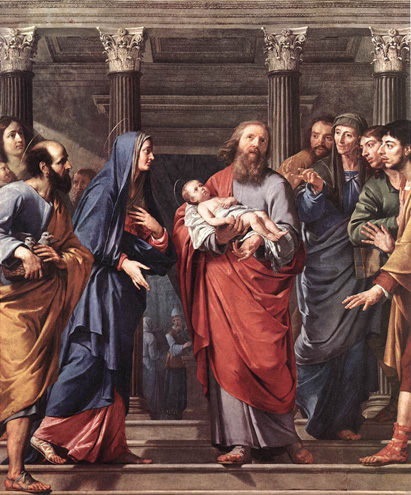
Showing posts with label Mariology. Show all posts

Sunday, November 23, 2025

The Co-Redemptive Suffering of St. Thérèse of Lisieux

This month I have been working through the classic 1957 book The Sanctifier by Luis M. Martinez, Archbishop of Mexico. The Sanctifier is one of the great modern texts on the Holy Spirit, an incredibly rich work that I recommend for anybody seeking deeper insight into the way the Holy Spirit effects our sanctification.

Sunday, December 31, 2017

Rosary To The Interior: For the Purification of the Church


Greetings friends! While I am still technically on vacation, my friend James Larson asked me to post the following article to promote the prayer of the Rosary on February 2, the Feast of the Purification of the Blessed Virgin Mary, for the intention of the purification of the Church.

                                                                                  *  *  *  *

On February 2, 2018, which is the day celebrating the double Feast of the Presentation of Jesus in the Temple and the Purification of the Blessed Virgin Mary, there will occur throughout the United States the gathering of faithful in their parish churches to pray the Rosary for the intention of the Purification of the Church, and the Triumph of the Light of Christ over all sin and error.

While being inspired by the Rosary on the Borders in Poland, this Rosary event – titled Rosary To The Interior: For the Purification of the Church – does indeed have a different and very specific intention. Recognizing that the Catholic Church alone in this world was blessed and commissioned with the Light of Christ necessary for triumph over the Darkness of sin and error, and that this Light has now been severely obscured by the sin and errors of its own members, this Rosary asks us to turn our eyes inward in order to effect that interior purification which alone can once again make Christ’s Light manifest in its fullness to the world.

A website has now been established, which offers a more complete explanation of both the nature and structure of this event; it also a Comment forum for communication between those who are participating.  It is found here:

www.rosarytotheinterior.com

Friday, September 04, 2015

My First Attempt at Catholic Writing


I was a cradle Catholic in the sense that I was baptized as a baby. But I never was taken to Mass, never made a First Communion as a child...in fact, I never even knew I was Catholic until I was an adult.

I had a powerful conversion to evangelical Protestantism in 1999, when I was 19 year old, but almost immediately saw the flaws in it and began exploring Catholicism in 2000. I was converted solely through historical and theological reading and was received into the Church on October 4, 2002, the Feast of St. Francis of Assisi.

From the very beginning of my conversion, I was filled with a zeal to share the good news I had received with others, especially Protestants I knew who loved the Lord Jesus but did not know about the fullness of faith in the Holy Catholic Church. 

Last night when I was cleaning out some old boxes, I cam across an essay on the Blessed Virgin Mary I wrote in June, 2002, which was actually before I was even received into full communion. The essay was supposed to be part of a longer "book" meant to explain Mary to Protestants. The particular essay was entitled "The Role of the Woman in God's Salvific Plan." It was, essentially, my first foray into writing to defend the faith, though three years before I'd ever heard of blogging.

It is a rambling essay, and very theologically unsound; in fact it contains some serious errors. But the language is flowery and it has a charming style that is pleasant to read. I thought it would be fun to scan it and post it here; you can see my edits in several places where I'd planned on making revisions. It is 12 pages long. It's just funny for me to see how I was writing when I was 22.


Monday, December 08, 2014

The Sweetest Impossibility

There is a wonderful story in the life of St. Louis de Montforte about his encounter with a rich affluent couple while visiting a friend who was staying with them.  At first the woman tried to tease and frustrate him with childish behavior.  However, through his pleasant disposition and patience, he greatly impressed her, and as a result he wound up being invited for dinner.

Despite having charmed the wife, her husband remained unimpressed until “At the dinner table Louis produced a small statue of the Virgin, this he placed in front of Mr. d’Orville, asking him if he did not love her very much, this lady who had been so good to him and his!

“The host was embarrassed. He had never been devout to Mary or God.  He had never paid homage to anyone save the King…. but something mysterious happens when Louis continued to talk about Our Lady.  He listened with profound attention.  And before he bade his guest adieu, he had promised to say the Rosary every day” Wisdoms Fool, Eddie Doherty.

If you have ever observed a relationship between a loving mother and unruly children, or between a virtuous wife and a boorish husband, you may have felt: pity for the poor woman, admiration at her dedication, indignation at how she is treated, or perhaps even perplexed at such devotion in spite of such ingratitude. When we consider the benefits and loving tenderness of our Blessed Mother (the numerous miracles and graces obtained through her intercession, her assurance of protection and final perseverance to those who wear the brown scapular, the number of times where she has hid us under her mantle when we have felt the overwhelming shame of our sins, and so many others benefits, so numerous that the Saints of God will never be able to write them all down even till the end of world) at best we can conclude that we have not loved the Virgin Mary as she ought to be loved.

Yet, if we were to love her with all of our love, would that be enough? No.   What if we were able to offer all the love of the Saints and the praise of the Angels? No, it is still not enough.  What if she allowed us to borrow her love for us?  Not even then.  The only way we can love Mary as she ought to be loved, is with the love of the All-Holy Trinity.  The Immaculate Conception of our Blessed Lady reminds us that God has loved her with a special love from the moment of her very creation. It is with this love that we must love her.  The only way to love the Virgin Mary as she ought to be loved is with the full measure of the love of God for His own Mother.  Let us not forget what she has done for us, and no matter which devotions we practice (the scapulars we wear, consecrations - daily or total - pictures we have, and so on) we never love Mary as she ought to be loved; nevertheless, let us strive to do so.

How does one try to accomplish the impossible? With heavenly aid, for all things are possible to God.  Should we ask God to love his Mother as we ought? I believe humility demands that, before approaching His Majesty with such a petition, we examine ourselves with fear and trembling.

Let us first examine if the devotions that we do in Our Lady’s honor can be improved, our Rosaries said with more attention, our scapulars more attentively worn, her songs more devoutly sung.  Let us not presume to ask God for such a great grace, if we sloppily attend to the graces He has bestowed on us to have such devotions.  Do we make sacrifices in her honor in preparation for her feasts? Do we teach our children to love her and pray to her?

Perhaps upon examining ourselves we realize that we fall short of the devotion of the Saints to Mary we have read about, perhaps our imagination has supplemented our devotion and made us think we are good servants while with a little self-scrutiny we shall the reality of our neglectfulness towards her. Have we spoken better about the Rosary than we have devoutly prayed it, or advised others to call on her when we neglect to do so?  

Such an examination is not to discourage, but rather what we need in order to make a serious prayer for help, full of humility and contrition, that God might make us more pious and devout in the service of His Blessed Mother.  More piety, more devotion, more grace, to love the Blessed Virgin as she ought to be loved, even if only gradually more, more even if it is hard.

Let us, dear reader, for our Blessed Mother’s sake, who has suffered so much for us, strive to love her more than we do. Let us humbly approach God and ask that we love her more than we do now.  If we do as much, we are heading in the right direction, towards accomplishing that sweetest of all impossibilities, to love our Blessed Mother as she ought to be loved, to love her as God Himself loves her.

We are taught by grace to love Her, but let us not forget to not stop calling upon her, and follow her to the  harbor of happiness with Our Lord Jesus Christ in heaven.  

“If you begin to sink in the gulf of melancholy and despair, think on Mary. In dangers, in distress, in perplexities, think on Mary, call on Mary. Let her not depart from your lips, let her not depart from your heart, and, that you may win the suffrage of her prayers, never depart from the example of her life. Following her, you will never go astray.” St Bernard of Clairvaux, Advent Homilies of St Bernard

Tuesday, April 29, 2014

Position on Garabandal


Over my years as a blogger, I have been repeatedly asked to my opinion on the apparitions at Garbandal. This is no doubt because of my writings on other questionable apparitions, such as Medjugorje and Bayside.

Garabandal is a quandary for many traditional minded Catholics. It lacks some of the excesses of Medjugorje (forty thousands plus messages, the charismatic stuff) as well as the absurdities of Bayside (T.V. being an invention of the devil, Pope Paul VI being replaced by an "impostor", etc.). In addition, it promotes traditional morality, calls us to penance, promotes Eucharistic devotion, and its timing from 1961 to 1965 coupled with warnings of an imminent chastisement are very convenient to Catholics who see Vatican II as a fundamental rupture with Tradition. Its condemnation of the contemporary generation of bishops - the Conciliar generation - also plays into the hands of Traditionalists.

It is not my intention to enter into a point-by-point critique of Garabandal, but rather to state my personal opinion on the matter. I do not believe the apparitions at Garabandal are legitimate, nor have I ever thought otherwise. Since I am not offering a refutation but merely stating my thoughts, it suffices to say that my gut has always turned me away from this apparition. Something about it does not seem right. I actually suspect the demonic may be involved. Mary's alleged request to not bring any blessed rosaries before her because she wanted to bless them herself has always given me caution. 

There are other reason as well. But, as always, the biggest evidence against their supernatural character is the continued stand by four successive bishops of Santander against the legitimacy of the apparitions (see here). The seers all at one time or another denied the apparitions upon interrogation, and one, Maria Cruz, continues to do so to this day. Some quotes from Maria Cruz from 1984:

"I've never seen the Virgin at the Pines or any celestial being...[Conchita] suddenly went into ecstasy; that sort of comedy scared us and we thought it would end badly. She put into the heads of the three of us that she had seen the angel." [...] (source Spanish; source English)


In 1992 Maria Cruz further reflected on the pressure the seers were under::

"The people tormented us so that we see the angel and the Virgin, and these fanatics came to write a message, as always happened in other apparitions, like Lourdes or Fatima. [...] Every time I have the occasion, although I don’t look for it, I say it, but they don’t want to hear this truth." I remember perfectly how Conchita, who always used to organize jokes, invented everything. She did it without bad intentions, but the situation became so complicated that we had to go on. [...] Do you believe that the Virgin Mary would do such stupid things? [...] But I'm afraid to be in the papers, because then they make life impossible for my other, who still lives in the village, and it is full of fanatics." [Gabriel Carrión López, El lado oscuro de María, Aguaclara, Alicante, 1992, pp. 106-107])

One last thing: According to Garabandal, the Blessed Virgin Mary has promised that she will one day restore the sight of the blind man Joey Lomangino. This is to happen on the same day as the promised "Great Miracle." Joey Lomangino is now 86 years old. If this man dies without having his sight restored to him, then this is absolute evidence of the falsity of these apparitions. The Garbandal people will probably try to wriggle out of it - say that the promise was of spiritual, not physical sight, or perhaps say that he recovered his sight secretly hours before death or something like that. But if we see that sort of mental legerdemain, it will be a pretty clear sign about Garabandal, though perhaps not the sort its enthusiasts were hoping for.

For these reasons, and many more I will not go into here, I do not believe in the authenticity of the Garabandal apparitions nor do I endorse them in any way.

Friday, October 11, 2013

Consecration of "the World" this Weekend


This Sunday our Holy Father Pope Francis will consecrate the world to the Immaculate Heart of Mary. Of course, there are no plans to mention Russia specifically, and the bishops of the world have not been asked to participate. It looks as if our current pontiff will be continuing in the trajectory set by previous pontiffs of performing generic world consecrations that do not fulfill Our Lady's request at Fatima.

This is a profoundly disappointing development, especially since with Francis' current popularity, such a consecration of Russia specifically, and in union with the bishops, would most likely be well received by the faithful and the hierarchy, the former of whom have expressed on more than one occasion their willingness to participate in a consecration of Russia when and if the Holy Father should wish to do it.

And what is the point of a consecration of "the world"? To consecrate something means to set it apart, dedicated to the service of God. Now, "the world" is really everything. How can you set apart everything? What is it being set apart from? Perhaps I am being a little simplistic here, and I will willingly receive correction on this point, but to consecrate the whole world seems like playing a game where everybody wins. And if everybody wins, then nobody does; if everything is consecrated, is anything consecrated? And if the entire planet is to be consecrated, why the necessity of repeating this consecration again and again over the past sixty years? Each subsequent consecration suggests and imperfection in the previous one; unless we take the position that consecrations periodically need to be renewed.

Who knows. The consistent failure of the last several popes to consecrate Russia to the Immaculate Heart is one of the most disappointing aspects of modern Catholicism, and it does not look like it is going to happen anytime soon, although our Lady did state that it would finally happen, but "late." I am not one of those people who attributes every single ill in the world and the Church to the failure of the popes to consecrate Russia, but the way things are going, it is very difficult to not see a correlation between the darkness the Church suffers through and the ongoing failure to make the consecration.

On a positive note, I do know through several reliable sources that Fr. Gruner is in the Vatican this week, and that allegedly he will be meeting with Pope Francis prior to the consecration. It is known that Pope Francis, as Cardinal Bergoglio, had written to Fr. Gruner in the past. I do not know the nature of their meeting this week, but I pray it will be fruitful.

These are very strange times, my friends.

Wednesday, December 19, 2012

Within the Great Stream of Tradition

This week I had a follow up meeting with my Protestant acquaintances that I blogged about last time. We spent several hours at the local Big Boy drinking shakes, eating seasoned fries and talking about different issues in theology. As last time, we wandered in a disorderly manner over many topics, starting with the atonement and moving on to the concept of tradition and finally ending with Nominalism and the influence of Occam and the Nominalists upon the proto-Reformers like Wycliffe.

In speaking about Tradition and the break with Catholic Tradition that came out of the Protestant Revolt, one of my companions asked a very decent question. He said, "You speak of different dogmas developing over the centuries; not everything the Catholic Church teaches is found explicitly in the apostolic age" (which is true)...he continued, "so, if you can admit a development of dogma in the Church, why can't it be said that the theological doctrines that came out of the Reformation were themselves developments of Christian dogma?"

The question was raised in the context of Lutheran-Calvinist soteriology. Since there had been much disagreement before as to how the atonement actually works (the Fathers favored the Ransom Theory, Anselm had his Satisfaction Theory, St. Thomas the modified Satisfactory Punishment Theory, etc), why could the historic Christian traditio accommodate all of these diverse theories but find no place for Penal Substitution as a legitimate development? Could it not just be seen as the next step in Christian soteriological development, a development that had already been going on since the days of the Fathers?

The late Fundamentalist Bible teacher J. Vernon McGee (d. 1988)  made a similar point when speaking of eschatology. When it was pointed out to this proponent of the novel Rapture doctrine that the concept of the Rapture was not held by the historic Church, he countered by arguing that, just as the great Christological disputes of theology were worked out in the fifth century, so the Church's eschatological disputes were being worked out in the 20th. Therefore, the "emergence" of the Rapture doctrine so late in the history of Christianity is just the latest step in the development of dogma; Christians ought to be no more wary of the emergence of the Rapture doctrine in the 19th century than of the Trinity in the 4th, the Hypostatic Union in the 5th or any other development.

This does of course beg the question of what is a legitimate development and what isn't. No doubt Dr. McGee would not sanction the devotion to Mary or the saints that grew out of the patristic period or the Scholastic teaching on the nature and efficacy of the Sacraments to be legitimate developments of doctrine but rather deviations. In other words, Dr. McGee would sanction only those developments, like the Rapture, that already conformed to his theology.

But couldn't a Protestant jump back and make the same accusation? The Church only rejects Calvinist soteriology because it is contrary to its teaching while accepting Aquinas' because his conforms. Isn't this the same argument?

Yes. As a matter of fact it is. The only difference is the Catholic has a right to make the argument while the Protestant does not.

Of course the reason why an innovation like the Rapture or Penal Substitution would be rejected as not in keeping with the Tradition for the very reason that they contradict Church teaching, because Church teaching is nothing other than the Tradition. That which is in the stream of Tradition is part of the Church's teaching and that which is not is not proposed by the Church for belief. The Church, the Magisterium in particular, is the custodian of Tradition and is responsible for handing that Tradition on intact to each subsequent generation - this is done by explaining the True Faith, but also by excluding and condemning propositions that are against the Faith. This what the Church does and what it has always done. If the Church is a credal, confessing, historic Church (i.e., One, Holy, Catholic and Apostolic) then such a conclusion is self-evident and entirely in keeping with the nature of the Church and Christian dogma as understood by Catholicism.

But, if one rejects this ecclesiological concept of a credal, historic Church, as Dr. McGee does, then by what right does one accept one dogma and reject another, especially if adherents of both sides use the Bible to justify themselves? We know that Protestant sects can argue from the Bible all day long and get nowhere; this is one of the inherent flaws in Protestantism - a lack of a Magisterium to authoritatively resolve conflicts.  The whole Protestant movement was based on the premise that the Church could, and indeed had, erred on several fundamental points of doctrine for several centuries. If Protestants accept Luther's premise that Catholicism had erred in its teachings on justification, the Eucharist, devotion to the saints, etc., then why can't any other Protestant teacher make the similar assertion that Protestantism has erred in its teaching on anything from soteriology to eschatology to the eternality of hell? There is no reason why not, unless you appeal to a universal Tradition.

But if we appeal to that Tradition, we cannot do so haphazardly. That is, if we use the Tradition to support belief in, say, the Trinity or the divinity of Christ, we cannot reject it when it tells us that Mary is sinless or the Eucharist is the Body and Blood of Christ. A Protestant might respond that we can only accept those aspects of Tradition that are in keeping with the Bible, but if we say that we are arguing in a circle - we use the Tradition to interpret arguments about the meaning of Scripture but deferring to the "plain meaning of Scripture" when interpreting the Tradition. Either the Tradition is authoritative or it is not; if it is, then the Catholic Church is the Church of Christ; if it is not, then there can be no appeal to Tradition to solve any theological dilemma. We are left solely with every man to his own sect and each sect its own interpretation and the Baptists and the Presbyterians are no more right or wrong than the Adventists or the Unitarians.

But to go back to the original question of why every development can't be accepted within the larger stream of Tradition - the answer is that Tradition is not to be understood as simply "whatever happens", in such a way that each and every thing that crops up is said to be part of the Tradition just by virtue of existing. Tradition means "that which was handed on", and something within the stream of Tradition must have evidence of being handed on in some way. In other words, that which is truly in the "stream" of Tradition must go "with the stream" and not against it; it must be clearly deducible from principles which came before and one must be able to discern the later development from the seeds of earlier teaching. This is one of the principles Cardinal Newman lays down in his Essay on the Development of Christian Doctrine.

Let's use two examples: Mary's Immaculate Conception and the Protestant assertion that the Eucharist is not the real Body and Blood of Christ. First, the Immaculate Conception. The Immaculate Conception, formally defined in 1854, is according to one of my Protestant friends, the prime example of a doctrine "invented out of thin air." But if we look at the Tradition, we can see that it is not the case.

  • First of all, the data of Scripture itself that calls Mary "full of grace" can be said to at least suggest the concept of sinlessness, since to be full of grace is to be without sin, depending on how we understand grace.

  • In St. Irenaeus' writings (c. 180), Mary is described as "undoing the knot of Eve's disobedience" through her own obedience, so Mary is contrasted with Eve and her fiat is given an important place in the Redemption of Man.
  • Fathers of the third century continue to contrast Mary with Eve, using Mary as an antitype, contrasting not only Eve's disobedience with Mary's obedience, but Eve's sinfulness with Mary's purity.
  • By the fourth century, this has crystallized into a language of Mary being "all holy" and "without stain of sin." This is found in the writers of the west, like St. Ambrose, as well as in the east, like in the case of St. Ephrem the Syrian, who wrote poems in honor of Mary's purity. As the devotion to the saints and martyrs evolved, devotion to Mary uniquely as the first and holiest of the saints (hyperdulia) emerged.

  • In the early fifth century, St. Jerome and St. Augustine treat Mary's sinlessness as a given, something all Christians assume rather than argue about. Liturgical feasts also are first recorded here honoring things like Mary's Dormition and her Immaculate Conception, though that language is not yet used. Mary's sinlessness is assumed by all Christians; the Council of Ephesus in 431 declares Mary theotokos.
  • Marian devotion in general spreads throughout the early Middle Ages and all Christians agree that Mary is sinless. Bernard of Clairvaux composes hymns and orations on her purity. In the 12th and 13th centuries, the Scholastics ruminate on how exactly Mary is sinless; since actual sin proceeds from original sin, if Mary was free of actual sin or from any stain of sin, it means she was free from original sin. But since original sin is part of human nature, she must have been rendered free from it at her very conception. There are arguments over how this happened, when a human is really "conceived" and so forth, but there is a general agreement that Mary is not only free of actual sin, but free of original sin, and this from her conception. This is the natural conclusion that flows from the patristic consensus on her sinlessness.
  • Marian devotion continues to spread with the promulgation of the Rosary devotion by the Dominicans and the rise of humanistic Christian devotion in the late medieval period that focuses more on the humanity of Christ, in which the Virgin finds a prominent place as an object of veneration, as well as the art of the Renaissance. Liturgical feasts celebrating the Immaculate Conception are celebrated all over Christendom.
Okay, pause. So, we have a clear linear development of Marian theology from the apostolic age to the Renaissance, both in the special place Mary is accorded in the devotional life of the Church, and in the doctrine of her sinlessness and Immaculate Conception, which is either clearly taught by the Fathers or easily deduced by principles the Fathers espoused. There is a solid and unambiguous line connecting the Fathers with the Scholastics and the later medievals, creating a clear line of development. Thus, when Pius IX proclaims the Immaculate Conception ex catherda in 1854, it is evidently clear that this dogma stands firmly within the stream of Tradition. It is clearly handed on, there is a historical continuity of Marian devotion, and the 1854 dogma stands "in the stream" or in the same line of thinking as that of earlier ages. We can, in a sense, anticipate the Immaculate Conception definition from the teachings that came before. This teaching is a legitimate development of Tradition.

Now compare this with the denial of Transubstantiation by the Reformers. Let's look at the Eucharistic Tradition up to the time of the Protestant Revolt:
  • Scripture has Christ refer to the sacrament as His "Body and Blood", there are string Eucharistic allusions in John 6 suggesting that eating and drinking the flesh of the Son of God is somehow necessary in order to be incorporated into Him; St. Paul in 1 Corinthians 11 states that he who profanes the Lord's supper will be judged for "not discerning the Body of the Lord."
  • References from the apostolic Fathers and the sub-Apostolic Fathers consistently refer to Holy Communion as the Body of Christ. St. Ignatius of Antioch (d. 110) calls it the "medicine of immortality" and "the flesh of Jesus Christ", a strange phrase to use about a symbol. St. Justin Martyr calls it "the flesh and blood of Jesus who became flesh."
  • Fathers like Tertullian and St. Cyprian make very clear references to belief in Christ's real presence; Cyprian tells stories of curses that have fallen on apostates for receiving the Body of Christ unworthily. The doctrine is firmly established and undeniable by 250 and will only be further confirmed by the writings of fathers like Augustine, Jerome and Ambrose.
  • In the early medieval period (Gregory the Great on), liturgical praxis develops around the assumption that the Eucharist was the true Body and Blood of Christ. Reception on the tongue was prescribed to prevent possible sacrilege; later, the Minor Elevation was added. Belief in Transubstantiation is evidenced by certain Eucharistic miracles that occur throughout the period, like the famous one of Lanciano, c. 700. Note that, even if specific Eucharistic miracle tales can be written off as legendary or of questionable historicity, the fact that such tales were being circulated at the time is proof that the people of the age believed unquestioningly in the Real Presence. Paschasius Radbertus writes an influential treatise affirming Transubstantiation.
  • In the 11th century, the heresiarch Berengarius becomes the first person on record to doubt Trasubstantiation officially. He is controverted by Lanfranc, the most eminent ecclesiastic of his day, as well as the Holy See and several local synods; the Church universally condemns his teaching.

  • In the 13th century, the doctrine of the form and matter of the sacraments is more perfectly worked out and Transubstantiation is defined formally at the Fourth Lateran Council (1215). Eucharistic devotion spreads with the institution of the Feast of Corpus Christi and the rise in the practice of Eucharistic Adoration. This continues throughout the medieval period.
Okay, so again, we have a clear line of development in the direction of affirming the real, true and substantial presence of Christ in the Eucharist. Now insert the Protestant doctrine that the Body and Blood of Christ is not truly present but is merely a symbol. Given the brief history we just sketched, how can this teaching be said to be a development from anything that came before? It does not flow with the stream of Tradition but adamantly opposes it, holds the former popes and saints to be in error, and posits a teaching that the Fathers and Scholastics would not have recognized; a teaching which, in fact, many condemned. Are we supposed to believe that the 16th century Reformers' denial of everything that came before is somehow also a development of what came before? So contradictions can become developments? This is in the same vein as the Protestant idea of "unity in disunity" as an explanation for why Protestant communions still have "unity" despite being fractured into 20,000+ denominations.

There fact is there is no unambiguous line connecting denial of Transubstantiation with anything that came before, no historical continuity, and no one reading the statements of Augustine or Ignatius or Aquinas would anticipate a denial of the Real Presence as a logical development of earlier ideas. The Protestant concept of the Eucharist is not in the same stream as that of the earlier ages, neither in teaching nor liturgy. Therefore, this is not a legitimate development of doctrine but rather a deviation from it. And the same can be said of every major teaching that came out of the Protestant Revolt or subsequent Protestant sects.

The theory that the developments that came out of the Reformation are legitimate developments of doctrine within the stream of historic Christian Tradition is ultimately an attempt to have your cake and eat it too; to maintain professing a single, uninterrupted Christian traditio that has survived intact throughout the ages, but yet a traditio that can also encompass teachings that are in direct contradiction to the direction of the rest of the Tradition. It is a way to maintain the Protestant dissent from Catholic dogma while affirming the appealing Catholic concept of a single Christian Tradition. It is nothing other than the Via Media that enticed Newman for a time until he came to see that it is a contradiction to claim that things directly contrary to the traditio can themselves be part of that traditio. As Newman discovered so many years ago when he came from Anglicanism into the Catholic Church, there is no way to assert the claims of Catholic Tradition with the right hand while insisting one is independent of it with the left.

Let us stand firm with the stream of Tradition, or let us stand alone to the side, casting rocks at the Tradition like Shimei did to King David and accuse the Tradition of being entirely corrupt; but to try to affirm a Tradition while placing things contrary to that Tradition within the stream of the same Tradition is not possible and conflates the concepts of "development" and "change" as if they were the same thing. That kind of broad accommodation is not possible; either Catholicism is totally right, or it is really, really wrong. If you are with the Tradition, you must be within it.

Tuesday, December 11, 2012

Potuit, Decuit ergo Fecit

This week we celebrated the Feast of Our Lady's Immaculate Conception. In his homily on the feast day, our pastor gave an excellent little exegesis on the formula that the Scholastics adopted for explaining the reason behind the Immaculate Conception.

The formula of the Scholastics is potuit, decuit, ergo fecit, which roughly translated means, "He could do it, it was fitting that He do it, therefore, He did it." The phrase of course refers to God and His causing of the Blessed Virgin Mary to be free from the stain of original sin from the first moment of her conception. God had the power to cause Mary to be created sinless; it was fitting that the Mother of God be sinless - and therefore, God did in fact cause her to be so.

Two things are worthy of noting about this formula:

First, the formula does not offer a proof for the Immaculate Conception, but merely an explanation of why God did it, which is different than a proof. A proof is different than an explanation. An explanation of why I went to the store would be that I needed to pick up some eggs and butter. Proof that I went to the store would be the mileage logged on my car, the surveillance cameras showing me in the store at a given time, electronic records of the purchase on my debit card, and the physical presence of the eggs and butter now safely inside my refrigerator. The latter sum of data is proof; the former is just an explanation.

The interesting thing about the Immaculate Conception in Catholic Tradition is that it is so taken for granted in the first millennium and a half that no theologian or father really bothers to write a formal series of proofs on the Immaculate Conception, the way St. Thomas did with his proofs for God's existence. No one disputed the Immaculate Conception. It was taken for granted that Mary was sinless. St. Augustine did not even think the question was worth discussing and refused to speak of it out of "honor for the Lord":

"Having excepted the holy Virgin Mary, concerning whom, on account of the honor of the Lord, I wish to have absolutely no question when treating of sins—for how do we know what abundance of grace for the total overcoming of sin was conferred upon her, who merited to conceive and bear him in whom there was no sin?—so, I say, with the exception of the Virgin, if we could have gathered together all those holy men and women, when they were living here, and had asked them whether they were without sin, what do we suppose would have been their answer?" (Nature and Grace 36:42 [A.D. 415]).

St. Ephraim the Syrian took her absolute purity for granted when he composed his famous hymns in her honor. Notice how he classes Mary in the same category with Jesus, indicating that the gracefulness he envisions in her is more than that which is common to the saints:

"You alone and your Mother are more beautiful than any others, for there is no blemish in you nor any stains upon your Mother. Who of my children can compare in beauty to these?" (Nisibene Hymns 27:8 [A.D. 361]).

Going further back, Tertullian and St. Irenaeus both speak of Mary saving the human race and of humanity being "redeemed by virginal obedience" in contrast to the virginal disobedience of Eve. The analogy is clear: the first Eve, through sin, enslaved humanity; the second Eve, without sin, freed it. It would make no sense to use Mary as an anti-type to Eve if Mary shared sin in common with Eve. The reason Mary and Eve are such a perfect type and anti-type is not because of Mary's similarity to Eve, but because of her dissimilarity. However far back we go in Church Tradition, we see that Mary's sinlessness is never really argued about; it is simply taken for granted; that is, the fact and the rationale are offered, but not the proof. Proofs will come later, but not until the late Scholastic period and the era of the Protestant Revolt when men first started really debating the merits of the teaching.

Second point on this formula: Note that it says the rationale is potuit (He was able) and decuit (it was fitting), but not necessarius erat (it was necessary). The Scholastics were careful to avoid making Mary's Immaculate Conception a matter of strict necessity; they did not teach that Mary had to be free from Original Sin, only that it was within God's power to do it and that it was fitting. The reason for the fittingness of her sinlessness is her unique vocation as the incarnate Mother of the Second Person of the Trinity.

Why did they not argue from necessity? The Scholastics, and most other traditional Catholic theologians, have been very hesitant to say that God "had" to do something this or that way in the economy of salvation. It is very true that, based on what we know and what has been revealed to us, we are unaware of any other way God could have redeemed us other than by the sending of His Son to die a redemptive, atoning death on the cross. But the fact that we are unaware of any other way or that any other potentiality was not revealed to us does not mean that, in His omnipotent eternal wisdom, God could not have chosen another method had He wished. Similarly with the Scriptures, we only know of 73 books that are inspired by God; these and only these books are said to be the Sacred Scriptures breathed by the Holy Spirit. But there is no reason, in God's omnipotent power, that He could not have inspired more or less had He so wished. It is necessary that we hold that there are 73 inspired books, not one more, not one less, for the very purpose that God Himself did in fact inspire 73; but we cannot say that on God's side He could not have done things otherwise had He so wished. To assert so would be to subject God's freedom to act to a kind of necessity or fate that would in fact then be higher than God Himself.

This is why the theologians stop short of saying Mary's Immaculate Conception is necessary and instead focus on the fittingness of the dignity. The official definition of 1854 states that the Immaculate Conception was wrought "by a singular privilege and grace of the Omnipotent God"; it is noteworthy that the word privilege is used, as it gives credence to the teaching that Mary's sinlessness is fundamentally an issue of fittingness, not of necessity. Note also in the official definition the absence of "in order that original sin not be transmitted to Christ" or any such language. The Church does not view the Immaculate Conception as "necessary" to preserve Christ Himself from inheriting Original Sin. Rather, it is a privilege that is fitting given Mary's unique status as Mother of God and receptacle of the Incarnate Word of God.

There are some, deviating from Catholic Tradition and no doubt motivated by pious inclinations, who attempt to fabricate some sort of necessity on the Immaculate Conception, sometimes through reflections on the biological details of the Incarnation (see here, for example).  Nevertheless, necessity is not part of the traditional formula, and I do not think Catholics ought to argue from necessity when proposing the Immaculate Conception to our non-Catholic friends. Even St. Thomas Aquinas, when discussing the question of Mary's Immaculate Conception, defaults to the question of "fittingness" or "worthiness" as the rationale for the singular grace. When discussing Mary, Jeremiah and John the Baptist and the concept of sanctification before birth, St. Thomas says:

"Although it is not possible to assign a reason for God's judgments, for instance, why He bestows such a grace on one and not on another, yet there seems to be a certain fittingness in both of these being sanctified in the womb, by their foreshadowing the sanctification which was to be effected through Christ. (STh, III, q. 27, art. 6).

In my experience, Protestants in particular do not understand the argument from fittingness; they want to know why God had to make Mary sinless, and why if so, He didn't also have to make Mary's parents sinless in order to create Mary Immaculate, and so on ad infinitum; and if He can do that to Mary, why not do this with all humanity and dispense with Christ's atoning death altogether? Perhaps Protestantism,  coming from a tradition of ostensibly rejecting all that is "superfluous", "showy" or smacking of "pomp", can no longer appreciate graces bestowed for purposes of adornment, glorification and beautification apart from strict necessity.

It is good to remember that, as St. Thomas said, "why He bestows such a grace on one and not on another" is not ultimately within the purview of our knowledge. Why doesn't God heal all disease, like He did to the people who encountered Christ during the days of His earthly sojourn? He clearly could if He wanted to. Or for that matter, why did He miraculously and infallibly convert St. Paul on the road to Damascus? If He could do that to St. Paul, why not do that to every single human being and save the Church the effort of having to evangelize? God could do that right this second and every human being would be saved. Who doesn't God grant every sinner the grace to immediately and infallibly see the emptiness and futility of worldly pleasure and cause them to repent, as our history tells us happened to St. Francis of Assisi?

The answer of course is that we do not know why God does one thing and not another. When treating of the Immaculate Conception, let us hold fast to traditional formulation. God in His omnipotence was capable of creating Mary sinless, and given the dignity that was to be hers as the Mother of God, it was eminently fitting that she be thus endowed with the grace of sinlessness. God could do it. It was fitting that He do it. Therefore, He did it. Potuit, decuit ergo fecit.


Wednesday, December 14, 2011

What did the Angel say to Mary?

As we celebrate the birth of our Lord later this month, and as the Feast of the Immaculate Conception was this past week, we have will be hearing a lot of readings at Mass about the Nativity of Jesus Christ.

In the account of the infancy narrative of our Lord as recounted in the Gospel of Luke, the verse when Gabriel comes to visit is subject to an unusual amount of creativity in translation. We all know different versions of the Bible translate words differently, but this one verse has more variety than usual.  In Luke 1:28, we have the angel Gabriel appearing to Mary to announce the conception of our Lord. Look at some translations of this passage:

  • "And coming to her, he said, “Hail, favored one! The Lord is with you." (NAB)
  • "And he came to her and said, "Hail, O favored one, the Lord is with you!"(RSV)"The angel went to her and said, "Greetings, you who are highly favored! The Lord is with you." (NIV)
  • "And the angel came in unto her, and said, Hail, thou that art highly favoured, the Lord is with thee." (KJV)
  • "And having come in, the angel said to her, “Rejoice, highly favored one, the Lord is with you; blessed are you among women (NKJV)
  • "The angel came to her and said, "Greetings, you who are highly favored! The Lord is with you!" (ISV)
  • "And the angel being come in, said unto her: "Hail, full of grace, the Lord is with thee: blessed art thou among women." (Douay-Rheims)
  • "Gabriel appeared to her and said, "Greetings, favored woman! The Lord is with you!"(NLT)
  • "The Angel entered her presence, and he said to her, “Peace to you, full of grace, our Lord is with you; you are blessed among women.” (Aramaic Bible in Plain English, 2010)

While we could dwell on many elements of this passage, such as whether the correct translation is "favored woman", "highly favored one", or "full of grace", I think the initial greeting of the angel is interesting to look at, too. Does Gabriel say "Hail," "Greetings", or "Peace to you?" I have found that Protestants, who typically use either the New King James or the New International Version, prefer the translation "Greetings" or "Rejoice," frowning on the "Hail" of the Douay, old King James and NAB as implying that Mary has some sort of authority or power. After all, "Hail!" is a salute given to a superior. If the angel said "Hail" to Mary, one could make the argument that she is, in some manner, superior to the angel Gabriel.
The literal word in Greek here is chairō. We immediately encounter a problem in that chairō does indeed mean a formal, military salute or hail, but it can also be translated as greeting. Let's look at some other contexts in the New Testament where chairō is used. I tried to use passages where the translation was pretty much agreed upon between the NAB, RSV, NKJV and NIV:

"And forthwith  he came to Jesus, and said, Hail, master; and kissed him" (Matt 26:49). The passage where Judas betrays our Lord. Clearly, the greeting chairō here denotes authority - a disciple greeting his teacher, and in the case of Jesus, more than just a teacher. Thus, "Hail" makes sense as a translation.

And platting a crown of thorns, they put it upon his head, and a reed in his right hand. And bowing the knee before him, they mocked him, saying: "Hail, king of the Jews."  (Matt. 27:29; Mark 15:18; John 19:3) I do not believe I have ever seen this verse translated in any other way than with the word "Hail." Indeed, "Greetings, king of the Jews" would make very little sense. This suggests that, even if this word chairō can be interpreted as "greetings" at times, it is never a casual greeting, but always a kind of greeting that implies an authority. The inference if this authority is what makes the use of the word by the soldiers so mocking. Had they not been mocking the claims about Jesus' authority, their use of the word chairō would not make any sense.

"And behold Jesus met them, saying: "All hail." But they came up and took hold of his feet, and adored him"  (Matt. 28:9). This verse is often translated "All hail!" in older translations, even Protestant ones, but more often as "greetings" in modern editions, Catholic and Protestant alike. This seems to be due to an evolving understanding of apostolic authority - a gradual shift ecclesiology from viewing the apostles as successors of Christ to viewing them as Jesus' "friends", for whom the salute "greetings" would be more appropriate than "hail." I think this change in ecclesiology was reflected in translation.

"Claudius Lysias to the most excellent governor, Felix, greeting." (Acts 23:26) Here is a case where we definitely can see how chairō would imply authority. If the word chairō meant a simple "hello" or good day" or something neutral, it would not be used by a Roman to salute an imperial governor. We know that what Claudius Lysias actually said to Felix (presuming they are speaking Latin and Luke is translating into Greek), is the word ave, which has unanimously been translated as "Hail" from time immemorial.


What conclusions can we draw here? While I think that sometimes the rendering of chairō as "greetings" might be appropriate, it seems that the context of how the word is used always denotes a kind of superiority or authority in the one to whom it is said, as exemplified by the use of the Latin ave ("hail") in translation. The use of chairō by Claudius Lysias to Felix, a superior, as well as the mocking way in which the Roman soldiers use the phrase when they denigrate our Lord reveals that this word carried with it an implication of authority.

So what did the angel say to Mary exactly? When Gabriel said chairō, he was acknowledging that she had an authority, that she was, in a way, his superior - not in the order of nature (where mankind ranks below the angels), but in the order of grace, where mankind is exalted above the angels and even made to sit in judgment over them. This superiority in the order of grace is why the next words of Gabriel after saluting this singular woman are Kecharitomene, literally "you who have been perfected in grace," but which the Vulgate translated as gratia plena, "full of grace" in the Douay-Rheims. But that is another discussion. It suffices to say that Mary is hailed as having authority over the angel because she is exalted above the angels in the order of grace and is truly Queen of the Angels, who form a kind of "honor guard" around her. Thus says a hymn for Morning Prayer in the Armenian Liturgy for the Feast of the Assumption: "O Mother of God, you are born aloft in the triumphal cars of the Cherubim, with Seraphim for your escort and the arrayed army of heaven’s hosts is prostrate before you." From the Ethiopian Missal comes: "O Mary, heart of the whole world, you are greater than the many eyed Cherubim and the six-winged Seraphim, and heaven and earth are utterly full of the glory of your holiness."

Hail, full of grace!

Sunday, August 14, 2011

The Assumption: Not a Question of History

The Church's doctrine on the bodily Assumption of the Blessed Virgin Mary is usually treated with scorn by Protestants, who of course do not acknowledge the unique role of Mary in salvation history. There are many objections: the doctrine is "not biblical"; it was "invented" in 1950; in makes Mary into a rival of Christ for our affection, etc. We are all familiar with these standard canards. Before I came back to the Church, I used to be skeptical of this doctrine; "Assumption? It sure is one giant assumption, since the Bible says nothing about it," I used to say to myself.

When you really dig into it, it is not the concept of an Assumption that is so problematic - Protestants of course acknowledge that both Enoch and Elijah were assumed alive into heaven, as the Scriptures state. The problem is not with the concept of an assumption, as much as whether or not one specific individual - Our Lady - was in fact assumed body and soul into heaven.

This question of fact is where I think the only strong objection to Our Lady's Assumption is found (by strong I only mean that it is the only objection that is really intelligent). This is the fact that, when we look back on evidence for belief in the Assumption in the patristic period, the writings are silent for the first several centuries. St. Epiphanius around 377 suggests the Assumption as a possibility; the first clear references we have to it come from the mid-5th century. There are many apocryphal works purporting to be from the pre-Nicene era, but my understanding is that none of these can be established with certainty before the 5th century, or maybe even the 6th. But if we look to the pre-Nicene era, we find zero references to the doctrine of the Assumption.

This at least is a real objection; it is based upon actual history and the lack of reference to a doctrine that Catholics believe is part of the deposit of faith. How can we believe a doctrine is apostolic if it is not mentioned in the apostolic or pre-Nicene periods? Indeed, even from 400 to 500 references to it are scarce; it is only in the period from around 550 to 700 that the doctrine comes into full light. This begs the question: If Mary truly was assumed bodily into heaven, would not the apostles have known about it and told others? Wouldn't news of such a miraculous occurrence be spread abroad fairly early on throughout all the churches? Wouldn't we have a clear testimony to its historicity, like we do with regards to Peter's martyrdom in Rome? Wouldn't someone before the 5th century have mentioned something about it?

These objections may seem formidable until we call to mind one simple fact that dispels them all: Belief in the Assumption is not based on historical observation; it is not a question of history. Let's look at what I mean by this.

Of course, the act of the Assumption was historical; I wouldn't deny that for a moment. It has been declared as divinely revealed dogma, and this guarantees the historicity of the event. But what we need to understand is that the Church does not believe in the Assumption because of some historical observation that was passed on from generation to generation. In other words, our faith concerning this dogma does not depend upon that somewhere in mid-1st century Palestine or Ephesus, somebody actually saw Mary's body assume into heaven and then went and told others about it. It is not based on any historical witness or observation.

In this sense, it is quite different from the Church's belief in our Lord's Resurrection, which was believed by the early Church because it had in fact been witnessed by many. Our Lord took great pains to make sure that many witnessed His Resurrection because He wanted the faith of the primitive Church to draw its source from this one, clearly historic event that was seen by numerable eyewitnesses. Mary's Assumption, on the other hand, might very well have been witnessed by no one. Suppose she died and was buried, and then her body was taken into heaven - who would have witnessed that? We do have that old story about the twelve apostles coming together to look at Mary's body one last time and upon opening the tomb finding her body gone, but I don't know of any scholar who accepts these Transitus Mariae narratives as historical, though they do reflect the pious beliefs of Christians in the late patristic period, who though they acknowledged that Mary was Assumed into heaven, were unclear on the details. Were Mary assumed into heaven, as the Church believes, it most likely would have been in obscurity and secrecy, unwitnessed by anyone.

Rather than an historical event that was observed and related, the Assumption is related to our belief in  Mary's sinlessness. The doctrine of the Assumption is implied in the doctrine of the Immaculate Conception;  Corruption, of course, is part of the effects of sin, as we are told in Romans 6:23 and in the Psalms, where King David writes, "Therefore my heart hath been glad, and my tongue hath rejoiced: moreover, my flesh also shall rest in hope. Because thou wilt not leave my soul in hell; nor wilt thou give thy holy one to see corruption" (Ps. 16:9-10). This is quoted by St. Paul in Acts 13:34-35 with reference to the Lord's Resurrection, where the Lord's "holy one" who is blameless is justified in His words by being freed from the corruption common to the sons of Adam.

Mary, because of her sinlessness, also shares this prerogative; the fact of the Assumption is implied from the reality of her Immaculate Conception. The two doctrines are linked; the latter leads us to confess the former, just as the justice of the Messiah means His Resurrection, since death and corruption are punishment for sin. Therefore, we do not believe in the Assumption because some dude two thousand years ago witnessed it and ran around the ancient churches saying, "Man, you'll never believe what I just saw over in Ephesus!" No; rather, it is a teaching which logically flows from our belief in the Immaculate Conception - and Mary's freedom from sin is clearly and explicitly taught in the pre-Nicene period. There is no Father who at any time suggests that Mary was a sinner; they all clearly teach her freedom from sin.

Therefore the Assumption is implied in the Immaculate Conception. Just like we say that belief in the Trinity is part of the deposit of faith even though it was not taught explicitly as such by the apostolic fathers, likewise can we assert about the Assumption. The Trinity is inferred by Christ's declaration of equality with the Father in the Gospels (along with many other of His words and actions), and the Assumption is inferred by the primitive belief in Mary's sinlessness.

Pius XII, when defining the dogma in Munificentissimus Deus, after relating different evidences of late patristic liturgies, iconography, and statements of the later Fathers (St. John Damascene, et al), goes on to say that belief in the Assumption is ultimately based on Sacred Scripture: "All these proofs and considerations of the holy Fathers and the theologians are based upon the Sacred Writings as their ultimate foundation" (MD, 38). Of course, Pius XII is here referring to a specifically typological reading of the Bible, though it he admits that sometimes theologians of the past were "rather free in their use of events and expressions taken from Sacred Scripture to explain their belief in the Assumption" (26). This is not a critique, however, but an endorsement of an interpretive method that wedded the mystical to the literal to gain insight into the truth.

The primary reason for belief in the Assumption, according to Pius, is "the filial love" of Christ for His mother (25). Note that it is a theological argument, not a historical one. He goes on to explain this filial love in terms of Mary's close unity with her Son:

"Hence the revered Mother of God, from all eternity joined in a hidden way with Jesus Christ in one and the same decree of predestination, immaculate in her conception, a most perfect virgin in her divine motherhood, the noble associate of the divine Redeemer who has won a complete triumph over sin and its consequences, finally obtained, as the supreme culmination of her privileges, that she should be preserved free from the corruption of the tomb and that, like her own Son, having overcome death, she might be taken up body and soul to the glory of heaven where, as Queen, she sits in splendor at the right hand of her Son, the immortal King of the Ages" (MD, 40).

All of this comes from the data of revelation as found in the Scriptures, and therefore does Pius say the pious beliefs about Mary's Assumption are "based upon the Sacred Writings as their ultimate foundation." Pius XII goes on to explain the importance of the later Fathers and early medieval liturgies as evidence for belief in the doctrine, but the doctrine itself is implied from the sinlessness of our Lady, which is found in the Scriptures and the pre-Nicene Fathers. It is part of divine revelation, albeit implicitly.

Of course, Protestants would not acknowledge this, as they read the Bible differently than we. But is important for us that we understand, and can explain that this doctrine does not depend upon a witness of history, although that does lend credence to a very ancient belief in the Assumption; rather, it exists in seed form along with the doctrine of Mary's sinlessness and is inferred from it. This is true whether or not there were Christians alive in the patristic age who could elaborate on it, and thus the lack of written evidence for the Assumption prior to the late 4th and early 5th centuries is not only not problematic but is actually irrelevant.

Wednesday, December 08, 2010

Our Lady's Perpetual Virginity


Today in Mass my eight year old daughter asked me a very insightful question that, if it were asked by many Protestants, would lead them by its own inner logic to confess that our Blessed Lady did indeed remain a virgin perpetually throughout her life, as the Church has always confessed. The Gospel reading for the Feast of the Immaculate Conception is, of course, the Annunciation  narrative from Luke 1. My daughter noticed something when the priest read verses 34 and 35, where the Gabriel has just finished explaining to Mary that she will conceive the Savior in her womb. Mary responds to Gabriel in the following manner:

And Mary said to the angel, "How shall this be, since I have no husband?" And the angel said to her, "The Holy Spirit will come upon you, and the power of the Most High will overshadow you; therefore the child to be born will be called holy, the Son of God" (Luke 1:34-35). 

My daughter, reflecting on this passage, said, "If Mary knew she was going to get married, why did she wonder how she was going to have a baby?" Interesting. Mary was betrothed to Joseph; therefore, the announcement that she would have a child should have come as a shock to her. So why Mary's astonishment? My daughter's instincts about this question were spot on; this question does not make any sense, if in fact Mary was not a Perpetual Virgin. While non-Catholic commentators tend to brush past this passage in assuming it is a reflection of Mary's incredulity at the possibility of getting pregnant without a husband, we shall see that, upon closer inspection, no such interpretation is possible.

Suppose, for example, that you are a young woman. Suppose you are engaged, like Mary was. Suppose somebody comes up to you and says, "You will bear a child." Now, (assuming you are not contracepting), what would be so revelatory about this? Even though you would not yet be married, there is nothing particularly amazing about the fact that a woman who is going to be married will bear a child. Note that the angel in verse 1:31 mentions only that Mary will conceive and bear a son, saying, "Behold thou shalt conceive in thy womb and shalt bring forth a son: and thou shalt call his name Jesus." At this point, he has said nothing about the miraculous conception by the Holy Ghost. As far as Mary knows (at this point), this will be a normal conception, done according to the natural mode of procreation, since the angel as not yet mentioned the Virginal Conception.

It is this presumed natural conception that Mary expresses astonishment at. "How can this be?" she exclaims, not expressing shock at the idea of a virginal conception (for Gabriel has not announced this part of it yet), but merely at the idea of conceiving a child period. Her initial astonishment is at the suggestion that she will have a child, not that the child will be supernaturally conceived. Since the virginal conception has not yet been announced (and is in fact announced only in response to Mary's astonished questioning), we can't posit any other reason for Mary to be astonished at the suggestion that she would have a child other than that she had assumed she would never bear children; i.e., that she was a perpetual virgin.

This question, "How can this be?" makes no sense at all if Mary is not a perpetual virgin. If she were planning on having children by St. Joseph, when Gabriel said, "You shall bear a son," a more natural response from Mary would have been "Yes, I was assuming I would, since I am getting married in a few months." In other words, Gabriel's message would have been seen solely as a prophetic announcement of an otherwise natural occurrence that had yet to come to pass, rather than as the inauguration of the great miracle of the Incarnation, which according to Tradition, took place at the time of Mary's Fiat.

One issue to clear up here is the sloppy translation of Mary's question as "How can this be, since I have no husband?" The Greek verb that is usually translated as "can" is actually "shall," a form of the verb "to be." Mary is not questioning whether it can be done in the sense of expressing doubt, but is inquiring into the practical "how" of the angel's words; she acknowledges in faith that it shall be done, but wonders how. This must lead us to ask: if Mary was planning on having normal marital relations with St. Joseph in the future, why would she ask how she was to conceive? This, again, suggests that she had no intention of having marital relations with Joseph, which explains her faithful questioning of how this conception was to occur.

There is also a problem in the second clause of Mary's response, the phrase "I have no husband." Here the NAB is being patently unfaithful to the Vulgate, which does not say "I have no husband," but rather virum non cognosco, literally, "I know not man." The Vulgate is faithful to the Greek, as well, which says ἐπεὶ ἄνδρα οὐ γινώσκω, the word ἄνδρα meaning man with reference to sex (to distinguish from woman) and γινώσκω, which means simply "to know" (ginōskō) in the general form, but as we all know is also the Jewish idiom for having sexual intercourse. The Greek and Latin both clearly indicate that what Mary really said was "How shall this be, since I know not man?" If we understand "know" in the Jewish sense of "to have intercourse with," then Mary's statement might be more accurately rendered "How shall this come to pass, since I have no relations with man?" Notice that Mary does not say "I have not yet had relations with a man," but categorically says "I know not man"; i.e., I have not now, nor do I ever plan on "knowing" a man. Hence her astonishment at being told she will conceive.

This is not a new argument in favor of the Perpetual Virginity of our Lady; most of you have heard it before, other apologists more astute than I have written more eloquently about it, and I think it was even mentioned by St. Augustine (though I didn't find this argument in St. Jerome's famous Letter to Helvidius). But I never realized before how plain and simple it is to understand, that even an eight year old girl can recognize that Mary's question to the angel makes no sense unless she is a Perpetual Virgin. 

"Out of the mouths of babes and sucklings thou hast perfected praise" (Matt. 21:16)

Friday, October 09, 2009

Sungenis Responds to Hahn

Here is the latest segment in an unfolding saga. Last time, Dr. Scott Hahn made a thorough and charitable response to me regarding his opinion concerning understanding the Holy Spirit in a feminine sense. I was mostly satisfied with his explanation and no longer intend to question him on the matter or cast doubt on his orthodoxy - I am going to give him the benefit of the doubt and assume that this is meant to be interpreted in the most orthodox manner possible (i.e., as a metaphor). But I still don't necessarily think it is a useful or prudent metaphor. Remember, even if the thesis is entirely orthodox, that does not mean it merits being promoted or applauded. There are propositions called suspecta de hæresi, errore (suspected of heresy or error) which the Catholic Encyclopedia defines as follows:

"Propositions thus noted may be correct in themselves, but owing to various circumstances of time, place, and persons are prudently taken to present a signification which is either heretical or erroneous."

One could therefore say that even if everything Hahn says is entirely valid, there is still a prudential reason for perhaps not going forward with this theory anymore, due not to any internal error with the propositions but with regards to "circumstances of time, place and persons"; i.e., what people at large will think Hahn is saying. Though Hahn has the best of intentions (and because of his over 20 year record of distinguished service to the Church, we ought to assume the best of intentions), his theory would be subject to immediate misinterpretation by many people less well informed and with less pure motives. The Gospel is always subject to misinterpretation, but a proposition that is suspecta de haeresi, errore is a propisition that invites misinterpretation by its very nature.

Furthermore, the encyclical of Pope Paul VI Mysterium Fidei said the following regarding safeguarding theological language:

"Once the integrity of the faith has been safeguarded, then it is time to guard the proper way of expressing it, lest our careless use of words give rise, God forbid, to false opinions regarding faith in the most sublime things" (MF 23).

This is an important point that is seldom brought up in the discussion. Not only is it important to maintain the truths of the Faith, but even the traditional language of the faith that expresses those truths ought to be guarded.

Please understand that this is not about Scott Hahn the man - I am trying to be very charitable and reasoned here, so as to avoid being accused of blasting or criticizing Dr. Hahn. All this is about his thesis, not Scott Hahn the man. I respect Scott Hahn greatly and admire the work he has done for the Church and for how his work has affected my own personal faith.

Another man I greatly respect, Dr. Robert Sungenis, has made a lengthy reply to Dr. Hahn's response, posted on my blog last week. As you read this, please note that it was originally given in a private email and wasn't submitted as an article or post, so please give Dr. Sungenis some leeway before criticizing him - (how would your email conversations fare if subject to critique?) That being said, this is a pretty good response for an email - it was sent to me by a reader, and I'm taking the liberty of assuming that Dr. Sungenis will not mind me posting it [UPDATE: Dr. Sungenis has since given his explicit permission to post the following response].

Dr. Sungenis' response to Dr. Hahn will be in blue (my comments in red):

I think Hahn defended himself about as good as he could, but there still remains some problems, as you will see below. Perhaps it was all a big misunderstanding [Which I think is probably the source of most of the controversy on this topic]. Only Hahn knows for sure, because only he knows what he really believes about this issue. I had always found it difficult to gauge just how much Hahn was attributing by means of metaphors to the Holy Spirit as opposed to how much he was singling out the Holy Spirit as the only person of the Trinity to have these feminine characteristics. In fact, in reading his explanation, I’m still somewhat unclear as to the where he stands.

I think it is easy to grant to Hahn that he is not saying the Holy Spirit is feminine in the sense of having a feminine gender [Right - which is the most important point and what everybody is agreed upon]. I think that goes without saying. But I think he is saying, of all the persons of the Trinity, the Holy Spirit is the one to whom we can attribute feminine characteristics. The problem lies, however, in just how Hahn attributes these feminine characteristics. Is Hahn saying that they are ontologically based in the substance of the Holy Spirit? If so, then it seems that feminine characteristics are part and parcel with the being of the Holy Spirit, even if one claims that the same Holy Spirit is not feminine in regards to gender.

On the other hand, is Hahn merely saying that if we were to see feminine characteristics somewhere in the Trinity then the Holy Spirit would be the best candidate to exhibit them (even though the Father and the Son are sometimes seen in light of feminine characteristics as well)? Again, I’m not sure what he is saying at this point. In what way is the Holy Spirit, in Hahn’s view, distinct from the Father and the Son with regard to feminine characteristics?

If Hahn’s whole thesis is merely saying that the Holy Spirit is preponderantly pictured as having what we normally understand as “feminine” or “motherly” actions toward human beings or toward the other two persons of the Trinity, perhaps there is not much cause for much alarm [I think personally that this is closest to the truth]. But if in some way these feminine aspects of the Holy Spirit that Hahn wants to emphasize are ontologically based wherein the Holy Spirit is now distinguished from the Father and Son because of them, then I believe we have a serious problem, for we are out of the realm of mere metaphors and into the substance of the Godhead.

Hahn’s quote of Cardinal Ratzinger, which states: "Because of the teaching about the Spirit, one can as it were practically have a presentiment of the primordial type of the feminine, in a mysterious, veiled manner, within God himself,” is troublesome for me. First, I don’t know precisely what the cardinal is trying to say, for the language is very obtuse, at least not without some more context to flesh it out.

The use of “as it were” seems to make Ratzinger’s imagery merely a hypothetical suggestion rather than a confirmed teaching. Also, I have a hard time wrapping myself around the clause “a presentiment of the primordial type of the feminine.” A presentiment is a foreboding of something bad, so how that fits with promoting the idea of a “primordial type of the feminine” I don’t know. Perhaps the English translation is bad.

Lastly, when we speak of “primordial” we are commonly talking about the beginning, and more specifically, the prototype to whatever is subsequent. But here again is where one might see a slippage into the ontological, since a “primordial” feminine would have to mean that it came before anything subsequent, existing as such for all eternity [That would present a problem...]. Again, I see a confusion here between ontology and metaphors. All in all, the clause “a presentiment of the primordial type of the feminine…within God himself” is much too vague and ambiguous a sentence to use as support for Hahn’s theory [suspecta de haeresi, errore?]. Hahn needs to first unwrap what Ratzinger is really saying before it can be commandeered as a support.

As for the Catechism at para. 370, I don’t think this offers Hahn much help for the simple fact that it is not singling out the Holy Spirit but is speaking of the Godhead in toto.

The quote from St. Aphrahat is certainly interesting, but not any real support, since Aphrahat is merely expressing in poetical style his affection for the Holy Spirit as his “mother.” Obviously, Aphrahat is not saying the Holy Spirit IS a mother, so it must be metaphorical. If Hahn is going to use Aphrahat as a support for his thesis (whatever that thesis is), he would have to show Aphrahat having a fully thought-out theology of the Holy Spirit in which the “motherly” aspects he writes in devotion can be transferred into a theological understanding of the Holy Spirit as distinguished from the Father and Son. From what I know and have read of Aphrahat, there is no such thought-out theology. Logically, if there is no other statement from Aphrahat that speaks of the Holy Spirit in feminine or motherly characteristics, we may be doing him a disservice by appealing to him as a progenitor of Hahn’s thesis. This is especially true in light of the fact that the Eastern Fathers had a tendency to use rich and flowery language in their theological descriptions, much more than the Western Fathers did. (There is actually a specific word for this type of Eastern writing, but I can’t remember what it is) [Hymnography?]

Hence, it is no surprise to me that all of the ancient witnesses that Hahn can garner to his aid (however minimal they may be), are all Easterners, and all use the same type of ornate imagery common among Easterners. As regards to doctrine, the Easterners wouldn’t be bothered by this ornate language, since, from what I can see, they confined these rich descriptions to their hymns and prayers, not their doctrinal stances. Granted, our motto is lex orendi, lex credendi, but still, prayers have much more of a poetical license than strict doctrinal formulations.

Kolbe’s use of the phrase “uncreated Immaculate Conception” and “quasi-incarnation of the Holy Spirit” in reference to the Blessed Virgin is also troublesome. First, Kolbe was sainted not for his theological knowledge but because of his impeccable life, so he really shouldn’t be esteemed as a “theologian of unimpeachable orthodoxy,” in the sense that whatever Kolbe said in the theological realm is “unimpeachable.” [This is a point that deserves to be weighted carefully - just because someone is a saint, even of unimpeachable orthodoxy, does not mean their teachings are authoritative, especially if we consider why they were sainted. When we consider martyrs like St. Thomas Becket, St. Isaac Jogues or St. Thomas More, we can see their sanctity bound up with their witness for the Faith, but no one goes around citing their writings as the basis for doctrinal claims. Is Kolbe in this category as well?]

Second, the Church has never used such vague and ambiguous language of the Holy Spirit, not even close [Remember Paul VI on guarding traditional language?]. What is a “quasi-incarnation”? Either one is incarnated or one is not. There is no in-between state. This kind of terminology only creates confusion; it doesn’t clear up anything. Likewise, “uncreated Immaculate Conception” is Kolbe’s invention, since it certainly wasn’t used by anyone in Catholic history. If we don’t draw these solid lines around how we describe the Holy Spirit, the whole enterprise becomes a shell game of word meanings and implications [This has been the problem with this whole debate since the beginning - figuring out exactly what is being implied]. This ought not to be. When we speak of the Holy Spirit we must be as precise as humanly possible. Metaphors about feminine and motherly characteristic may be good in prayers and homilies, but certainly not in doctrinal formulations.

For the same reason, the quote from Edith Stein is also troubling. Here we have use of what seems to be an ontological categorization of the Holy Spirit (in distinction to the Father and Son) by her use of “prototype.” She says “Thus we can see the prototype of the feminine being in the Spirit of God.” Once again, if Edith Stein were a noted and decorated pneumatologist for the Catholic Church, we might take pause and give her words some weight, even if they seemed to run counter to traditional descriptions of the Holy Spirit. But Edith Stein, saint or not, was not recognized for her insights on pneumatology, but for her impeccable life in service to God. Thus, she is not an authority on this subject, and certainly not one to support a major thesis such as the one Hahn is promoting. Edith Stein simply had no thought-out theology of the Holy Spirit to even be considered a support for Hahn’s thesis. Proof-texting from Stein, or anyone else for that matter, is simply not enough.

As for Scheeben, he is merely using an analogy when he says "As the mother is the bond of love between father and child, so in God the Holy Spirit is the bond of love between the Father and the Son." Whether Scheeben would want to be categorized as supporting Hahn’s thesis (and again, I’m not sure what that thesis really is), remains to be seen. Hahn is certainly not going to prove that Scheeben is on his side by extracting a mere analogy from his writings.

I also have problem with the use of the quote: "As Eve can, in a figurative sense, be called simply the rib of Adam... St. Methodius goes so far as to assert that the Holy Spirit is the rib of the Word (costa Verbi)." Once again, we have another Easterner (Methodius) using ornate language. Westerners did not use this language, and even many Easterners were cautious about using it, especially those who were the articulators of Catholic doctrine on the Trinity (Athanasius). Moreover, Hahn gives us no context for Methodius’ assertion (e.g., was this a prayer or a doctrinal formulation?), nor does he explain what precisely Methodius means by such a strange mixed metaphor as “rib of the Word.” In a way, Methodius’ phrase is non-sensical, and it certainly has no support from any other patristic writer.

As for “R. Garrigou-Lagrange, OP; L. Bouyer; J. Kentenich; B. Ashley, OP; Cardinal Y. Congar (Tradition & Traditions, pp. 372-75); F.X. Durrwell; A. Feuillet; H.M. Manteau-Bonamy, OP” supporting “this notion,” I don’t know what “notion” Hahn is referring to. If these eminent theologians are supporting Hahn’s thesis, then he would do himself a service, and us as well, to show specifically what they are saying as support. At this point, I don’t know anything in their writings that is supportive. I think it is safe to say that, if there was supporting argumentation that was clear and concise, Hahn would have excerpted quotes from their books just as he did with, say, Kolbe or Methodius [Good point]. At this point in the controversy, Hahn cannot hold up mere source citations as support. He must dig deep into these theologians and draw out the specific evidence. This is his thesis. It behooves him to do the homework.

As for Catherine LaCugna’s objections to accepting feminine traits attached to the Holy Spirit for fear of further subordination of women, Hahn needs to show that this lone opinion is the consensus among Catholic feminists. I haven’t done any research on this particular angle of the argument myself, but I can imagine that there are a significant portion of Catholic feminists who applaud the idea that the Holy Spirit is considered feminine, in distinction to the Father and Son. What more basis can one have for Catholic feminism than the fact that God, in some sense, is feminine? This would make Eve much more than a rib appendage from Adam, for she would be an appendage from the Holy Spirit which only used Adam as the vehicle!


I think these are all fair critiques from Sungenis. Any comment on them? Regardless of what you may think of Sungenis or geocentrism, this seems to be a pretty balanced critique. Basically he seems to be saying that Hahn's explanations still give room for ambiguity and that, even if everything is on the up-and-up, this idea is simply too novel and subject to misinterpretation; i.e., it could be technically true but still confusing and very imprudent to promulgate. Any thoughts?