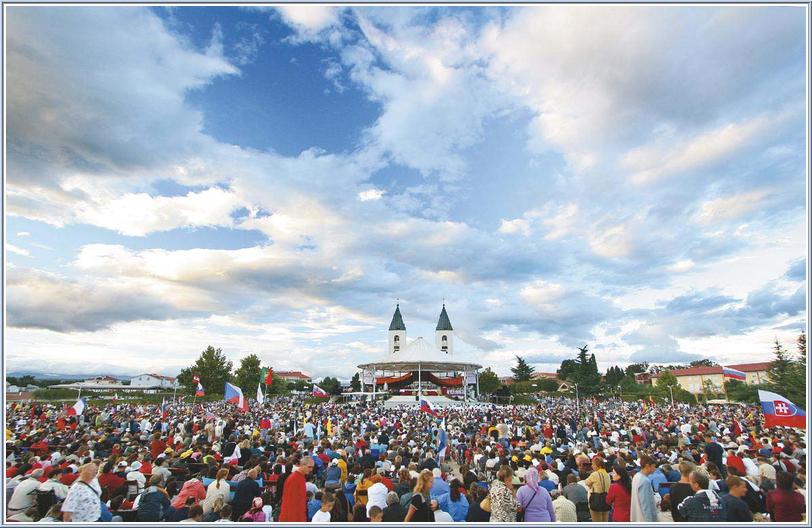
Long time readers of this blog will know that I have always been deeply interested in the questions of how the Church evaluates alleged private apparitions. I have written extensively about Medjugorje, Bayside, and many other smaller apparitions. My approach has generally been critical, following the traditional approach wherein an alleged apparition is presumed to be false unless overwhelming evidence suggests otherwise. I have been alarmed and annoyed at the credulousness of those who chase after every spiritual novelty, and disheartened at the sluggish inactivity of the Church in checking their proliferation.
Showing posts with label Medjugorje. Show all posts
Saturday, May 18, 2024
Thursday, June 25, 2015
Medjugorje: The End is the Beginning
The day has come. It has been announced that the CDF's long-awaited judgment on Medjugorje is negative (source). Of course, Pope Francis has yet to sign off on the judgment, but it is presumed he will.
The judgment on Medjugorje has now come down from the highest authority; no more waffling by Medjugorje adherents; no more ignoring the repeated condemnations of the local ordinaries while maintaining glibly that "the Vatican has not made any ruling." The Vatican has now made a ruling. And it does not bode well for Medjugorje. Medjugorje has been weighed in the balance and found wanting. "The Lord has done this, and it is marvelous in our eyes" (Ps. 118:23).
It will be extraordinarily interesting to see how this plays out. We can only hope for the following:
1) That the Holy Father Pope Francis will sign off on the judgment of the CDF.
2) That Medjugorje devotees will accept the decision with docility and invest their time and efforts into other Marian Messages such as Fatima and Lourdes.
3) That anti-Medjugorje Catholics (such as ourselves) will not gloat...well, maybe a little gloating.
That is the best case scenario. May the Holy Spirit make it so! Yet, there has always been worry that, were Medjogorje ever condemned, the Medjugorje supporters would not adhere to the Church's judgment but rather would continue promoting the alleged apparitions in a state of blatant disobedience or possible schism. The apparition has already been characterized by disobedience to the local ordinary. Anyone who has really studied the history behind Medjugorje cannot fail to see that disobedience and division are the only real "fruits" of this apparition (cf."Understanding the Herzegovina Question", USC).
How likely is an outright schism? I do not see this as extremely likely. Yes, Medjugorje people can be a little eccentric, but the vast majority of them are decent Catholics who would never break with Rome over something like this.
I do not see an out and out schism as likely. But I do not see the confusion abating. In fact, the likelihood of the confusion continuing is exacerbated by a very troubling statement allegedly found in the CDF statement. Catholic Culture reports that the CDF document will:
"...urge recognition of Medjugorje as a special “place of prayer,” in light of the numerous reports of intense spiritual experiences enjoyed by visitors there. Pilgrimages to Medjugorje will not be forbidden, provided that they do not center on the alleged apparitions."
If the CDF has authoritatively decided that there is nothing supernatural going on a Medjugorje, by what rationale ought it to be designated a special "place of prayer", or why anyone would want to make a pilgrimage there if it did not center on the alleged apparitions? The CDF reportedly says the rationale is that it recognizes Medjugorje as a "special place of prayer" not based on on the credibility of any apparitions, but "in light of the numerous reports of intense spiritual experiences enjoyed by visitors there."
We do not know if this is the language the document will use, but if so, it is gravely troubling. To suggest any location can be designated as a "special place of prayer" and even pilgrimage based not on any objective reality but only on the "intense spiritual experiences" of people is nothing other than to pivot the whole issue towards the subjective. If a place can be designated as a special place of prayer just by virtue of what someone thinks they experience there, what is the point of attempting to objectively validate the experience at all?
My suspicion is this is a compromise arrangement. The Vatican realizes that the apparitions and messages of Medjugorje are prima facie absurd and indefensible. There's no way they can be approved without the Church looking completely idiotic. And yet, because so many millions of people go to Medjugorje - and because of the ostensible pious experiences of those people who go - the Vatican is hesitant to crush the smoldering wick or break the bruised reed. It fears the reaction of the Medjugorje lobby.
Therefore, lest these millions of Medjugorjefanatics adherents go into schism, fall away from the Church, or become even more distanced from the faith, the Vatican wanted to find a way to formally express its disapproval of the apparitions while allowing the pilgrimages and activity at Medjugorje to go on unabated. The ground has merely been shifted. "Look, go to Medjugorje all you want. Pilgrimage there. Stare at the sun there. Talk about the mystical experiences you have with our Lady. Just don't mention the apparitions; go there because of the way it makes you feel."
Of course, it could be argued that the Vatican cannot exactly prohibit Catholics from praying anywhere they want, so long as they are not promoting the apparitions. In fact, Scripture commands Catholics to pray not only always but everywhere (1 Tim. 2:8). The Vatican cannot say, "And henceforth nobody is to ever go to Medjugorje and pray."
Granted. But the Vatican could just say nothing. They could just say, "There is nothing supernatural going on at Medjugorje and it is prohibited to promote the apparitions." Period. There is no reason why the negative judgment needs to include a clause which urges recognition as a special place of prayer, let alone based on people's intense personal experiences. The only reason people had intense experiences is because they thought they were visiting an apparition site. Thus, the potential CDF wording does not distance the pilgrims from the apparitions; it merely distances the Church's judgment from the objective to the subjective, from the verifiable to the experiential.
The safety of defaulting to experience is that nobody can ever argue with an experience. We may be able to now authoritatively state that the apparitions are not supernatural in the objective sense, but who can argue against somebody's experience? Thus, while having the appearance of a condemnation, the Church may have in fact just abdicated its role here entirely by shuffling the whole ordeal off on to the shoulders of individual Catholics who now can decide in their own conscience whether it is worth it to go to Medjugorje based on an evaluation of their own "intense spiritual experiences."
But meanwhile, it remains "officially" condemned. Just like the Extraordinary Form is "officially" allowed everywhere and equal to the Ordinary Form. Just like the Church's teaching on marriage will "officially" remain intact under the Kasper proposal. Just like "officially" the normative manner for reception of Holy Communion is on the tongue.
Yes, it's official!
Now, I pray it does not go down that way. I pray the Medjugorje adherents are docile and that somewhere down in their sensus catholicus they say to themselves, "Why the hell would I spend thousands of dollars to fly over to Medjugorje to celebrate my own experiences?" Hopefully the whole thing withers and dies.
But the pessimist in me doubts it. Thepessimist realist in me worries that the CDF will leave an out for those who want to continue patronizing Medjugorje. That part of me worries that while Medjugorje remains officially condemned, in practice it will go on unabated, now no longer in disobedience but in an official space created for it by the wording of the CDF judgment. It will allow the Church to affirm one thing while doing another.
The pessimist in me sees it as nothing other than the Kasper doctrine under another guise.
We do not know if this is the language the document will use, but if so, it is gravely troubling. To suggest any location can be designated as a "special place of prayer" and even pilgrimage based not on any objective reality but only on the "intense spiritual experiences" of people is nothing other than to pivot the whole issue towards the subjective. If a place can be designated as a special place of prayer just by virtue of what someone thinks they experience there, what is the point of attempting to objectively validate the experience at all?
My suspicion is this is a compromise arrangement. The Vatican realizes that the apparitions and messages of Medjugorje are prima facie absurd and indefensible. There's no way they can be approved without the Church looking completely idiotic. And yet, because so many millions of people go to Medjugorje - and because of the ostensible pious experiences of those people who go - the Vatican is hesitant to crush the smoldering wick or break the bruised reed. It fears the reaction of the Medjugorje lobby.
Therefore, lest these millions of Medjugorje
Of course, it could be argued that the Vatican cannot exactly prohibit Catholics from praying anywhere they want, so long as they are not promoting the apparitions. In fact, Scripture commands Catholics to pray not only always but everywhere (1 Tim. 2:8). The Vatican cannot say, "And henceforth nobody is to ever go to Medjugorje and pray."
Granted. But the Vatican could just say nothing. They could just say, "There is nothing supernatural going on at Medjugorje and it is prohibited to promote the apparitions." Period. There is no reason why the negative judgment needs to include a clause which urges recognition as a special place of prayer, let alone based on people's intense personal experiences. The only reason people had intense experiences is because they thought they were visiting an apparition site. Thus, the potential CDF wording does not distance the pilgrims from the apparitions; it merely distances the Church's judgment from the objective to the subjective, from the verifiable to the experiential.
The safety of defaulting to experience is that nobody can ever argue with an experience. We may be able to now authoritatively state that the apparitions are not supernatural in the objective sense, but who can argue against somebody's experience? Thus, while having the appearance of a condemnation, the Church may have in fact just abdicated its role here entirely by shuffling the whole ordeal off on to the shoulders of individual Catholics who now can decide in their own conscience whether it is worth it to go to Medjugorje based on an evaluation of their own "intense spiritual experiences."
But meanwhile, it remains "officially" condemned. Just like the Extraordinary Form is "officially" allowed everywhere and equal to the Ordinary Form. Just like the Church's teaching on marriage will "officially" remain intact under the Kasper proposal. Just like "officially" the normative manner for reception of Holy Communion is on the tongue.
Yes, it's official!
Now, I pray it does not go down that way. I pray the Medjugorje adherents are docile and that somewhere down in their sensus catholicus they say to themselves, "Why the hell would I spend thousands of dollars to fly over to Medjugorje to celebrate my own experiences?" Hopefully the whole thing withers and dies.
But the pessimist in me doubts it. The
The pessimist in me sees it as nothing other than the Kasper doctrine under another guise.
Contact: uscatholicam@gmail.com
Wednesday, September 17, 2014
Medjugorje: Thanks from a Priest
It's been a long while since we've talked about Medjogorje here. Over the years I've done a lot of posts on the subject, and though none are very recent, they remain some of the most viewed articles on this blog.
We recently received a very kind letter from a Franciscan priest laboring in Canada about how this blog and website helped him see the truth about Medjugorje. Below is the letter, edited only slightly to remove references to other individuals:
I would like to commend you for particular work you've presented here concerning the events taking place in Medjugorje. I am a Franciscan priest currently stationed in Canada.
Boniface, if there was anyone who had hoped the alleged apparitions there were true, it would be me. I am convinced however, now, that after doing further reading up on the subject, I was wrong and imprudent in not only being in favour of the apparitions, but also preaching things about the scientific evidence (which now I see is not evidence of the supernatural; in fact an even greater witness against anything supernatural is occurring there) as I had seen presented, as a motive of credibility for the existence of God. I should have been more prudent. In any case, things have changed with me and in my alarm and concern for the well-being of people entrusted to me, I am now simply relating to them what the Church has thus far indicated concerning anyone's planned involvement in pilgrimages, conferences, etc.
One of the articles which really helped me see the history as it evolved to the build up of the allegations in 1981 was the "Understanding the Herzegovina Question." I want to really thank you for that...
If you have any info that may be useful to me in my pastoral concern for these sincere people, would you please send it my way or let me know if you post an article concerning this on your website/blog? I would really appreciate it...
Anyways, Boniface, thanks for your courage in speaking the truth... let me just say it has helped me and I am one who is entrusted with helping others in the same way to be patient, and obedient to our rightful pastors, who need our prayer, loyalty and help in spreading the Truth... the good news. Blessings and peace.
And bless you, Father! The article referred to above is "Understanding the Herzegovina Question" on the USC website, which is mandatory reading for anybody serious about understanding the background of what has been going on in Medjugorje since 1981.
Another interesting post on Medjugorje that I did several years ago on Ryan Grant's old blog was on the question of John Paul II's alleged "approval" of the apparitions, as related in various second and third hand accounts. Ryan's blog went defunct, but before it did I copied the article and reposted it here, though I think it went under the radar at the time. If you have never read about John Paul II and his alleged support for Medjugorje, please check out this link. As with much else about this phenomenon, the truth is pretty far from what the Medjugorje proponents assert.
You can also view all our older posts that discuss Medjugorje here , though a lot of these come from 2007-2008 when my writing was a little less refined and are sometimes more rants than anything else.
Please pray for this Franciscan father and his mission.
Another interesting post on Medjugorje that I did several years ago on Ryan Grant's old blog was on the question of John Paul II's alleged "approval" of the apparitions, as related in various second and third hand accounts. Ryan's blog went defunct, but before it did I copied the article and reposted it here, though I think it went under the radar at the time. If you have never read about John Paul II and his alleged support for Medjugorje, please check out this link. As with much else about this phenomenon, the truth is pretty far from what the Medjugorje proponents assert.
You can also view all our older posts that discuss Medjugorje here , though a lot of these come from 2007-2008 when my writing was a little less refined and are sometimes more rants than anything else.
Please pray for this Franciscan father and his mission.
Tuesday, April 29, 2014
Position on Garabandal
Over my years as a blogger, I have been repeatedly asked to my opinion on the apparitions at Garbandal. This is no doubt because of my writings on other questionable apparitions, such as Medjugorje and Bayside.
Garabandal is a quandary for many traditional minded Catholics. It lacks some of the excesses of Medjugorje (forty thousands plus messages, the charismatic stuff) as well as the absurdities of Bayside (T.V. being an invention of the devil, Pope Paul VI being replaced by an "impostor", etc.). In addition, it promotes traditional morality, calls us to penance, promotes Eucharistic devotion, and its timing from 1961 to 1965 coupled with warnings of an imminent chastisement are very convenient to Catholics who see Vatican II as a fundamental rupture with Tradition. Its condemnation of the contemporary generation of bishops - the Conciliar generation - also plays into the hands of Traditionalists.
It is not my intention to enter into a point-by-point critique of Garabandal, but rather to state my personal opinion on the matter. I do not believe the apparitions at Garabandal are legitimate, nor have I ever thought otherwise. Since I am not offering a refutation but merely stating my thoughts, it suffices to say that my gut has always turned me away from this apparition. Something about it does not seem right. I actually suspect the demonic may be involved. Mary's alleged request to not bring any blessed rosaries before her because she wanted to bless them herself has always given me caution.
There are other reason as well. But, as always, the biggest evidence against their supernatural character is the continued stand by four successive bishops of Santander against the legitimacy of the apparitions (see here). The seers all at one time or another denied the apparitions upon interrogation, and one, Maria Cruz, continues to do so to this day. Some quotes from Maria Cruz from 1984:
"I've never seen the Virgin at the Pines or any celestial being...[Conchita] suddenly went into ecstasy; that sort of comedy scared us and we thought it would end badly. She put into the heads of the three of us that she had seen the angel." [...] (source Spanish; source English)
In 1992 Maria Cruz further reflected on the pressure the seers were under::
"The people tormented us so that we see the angel and the Virgin, and these fanatics came to write a message, as always happened in other apparitions, like Lourdes or Fatima. [...] Every time I have the occasion, although I don’t look for it, I say it, but they don’t want to hear this truth." I remember perfectly how Conchita, who always used to organize jokes, invented everything. She did it without bad intentions, but the situation became so complicated that we had to go on. [...] Do you believe that the Virgin Mary would do such stupid things? [...] But I'm afraid to be in the papers, because then they make life impossible for my other, who still lives in the village, and it is full of fanatics." [Gabriel Carrión López, El lado oscuro de María, Aguaclara, Alicante, 1992, pp. 106-107])
One last thing: According to Garabandal, the Blessed Virgin Mary has promised that she will one day restore the sight of the blind man Joey Lomangino. This is to happen on the same day as the promised "Great Miracle." Joey Lomangino is now 86 years old. If this man dies without having his sight restored to him, then this is absolute evidence of the falsity of these apparitions. The Garbandal people will probably try to wriggle out of it - say that the promise was of spiritual, not physical sight, or perhaps say that he recovered his sight secretly hours before death or something like that. But if we see that sort of mental legerdemain, it will be a pretty clear sign about Garabandal, though perhaps not the sort its enthusiasts were hoping for.
For these reasons, and many more I will not go into here, I do not believe in the authenticity of the Garabandal apparitions nor do I endorse them in any way.
Thursday, May 26, 2011
Eucharistic "Miracle" at Medjugorje demonstrates disobedience
The following is account of an alleged "Eucharistic Miracle" at Medjurgorje. This story appeared in the May-June 1993 Caritas newsletter, the official organ of the Medjugorje group out of Birmingham, Alabama (the place where one of the seers obligingly had an apparition on some property owned by Terry Colafrancesco, who subsequently made a ton of money, but that's another story).
A certain Protestant woman a Caritas group from Birmingham on a pilgrimage to Medjugorje (Pilgrimages to Medjugorje have, of course, been forbidden by the Bishop, the lawful authority in the diocese, and so every organized pilgrimage there constitutes an act of disobedience to lawful authority). At any rate, when it came time for Mass, this Protestant lady was irritated that she could not receive Holy Communion. Since she was not in danger of death and had made no profession of belief in the Real Presence (the extraordinary conditions under which a non-Catholics is permitted to receive Holy Communion), there was absolutely no justification for her to receive Communion.
But, it would appear, Our Lady was more concerned at the displeasure of the Protestant than with adherence to the canon law of the Church, and so she arranged for the lady to receive Communion in circumstances which Mr. Colafrancesco describes as a "Eucharistic miracle." Here's what happened next, as reported in the Caritas newsletter:
A certain Protestant woman a Caritas group from Birmingham on a pilgrimage to Medjugorje (Pilgrimages to Medjugorje have, of course, been forbidden by the Bishop, the lawful authority in the diocese, and so every organized pilgrimage there constitutes an act of disobedience to lawful authority). At any rate, when it came time for Mass, this Protestant lady was irritated that she could not receive Holy Communion. Since she was not in danger of death and had made no profession of belief in the Real Presence (the extraordinary conditions under which a non-Catholics is permitted to receive Holy Communion), there was absolutely no justification for her to receive Communion.
But, it would appear, Our Lady was more concerned at the displeasure of the Protestant than with adherence to the canon law of the Church, and so she arranged for the lady to receive Communion in circumstances which Mr. Colafrancesco describes as a "Eucharistic miracle." Here's what happened next, as reported in the Caritas newsletter:
"When distribution for Communion came, the first priest off the altar came toward the group leader. He and the others around him expected to be given the Eucharist, but instead the priest walked through the crowd which opened up. The leader, as well as the group, watched stunned as everyone was passed by while the priest walked directly to the spot where the woman was sitting in the pew. He held up the Eucharist for her to receive. The leader and the group and she herself stared in disbelief at what they were seeing. Though it was but a moment, it seemed the hesitation lasted for minutes. While she sat there and Jesus in the Eucharist was held up before her, she hesitated at first, not being sure, then willfully received Him. Everyone around her who was not weeping were fighting back their tears because all knew the priest could not have seen her until he was before her, much less known that she was not a Catholic. Only a few months later, the pilgrim who did not want to become a Catholic, received the Holy Eucharist a second time as a new Catholic."
Well, that's very touching that the woman became Catholic in the end. Too bad her journey to the Church began with a formal act of disobedience to the Church's law, which states plainly that it is the Magisterium, not a priest acting under the influence of some alleged apparition, that determines under what conditions sacraments may be received:
"Since the sacraments are the same for the whole Church and belong to the divine deposit, it is only for the supreme authority of the Church to approve or define the requirements for their validity; it is for the same or another competent authority according to the norm of canons 838 §§3 and 4 to decide what pertains to their licit celebration, administration, and reception and to the order to be observed in their celebration" (Can. 841).
And what has the competent authority stated in this matter? Canon 844 §1: "Catholic ministers administer the sacraments licitly to Catholic members of the Christian faithful alone, who likewise receive them licitly from Catholic ministers alone." The reception of Communion by this Protestant woman clearly violates these canons, as well as Canon 913§1 which requires "sufficient knowledge and careful preparation" before reception of Communion. I suppose "Our Lady" trumps Canon Law.
Can anybody really believe that a legitimate apparition of Our Lady would lead to activity like this? Priests distributing Holy Communion outside of canonical norms to non-Catholics? This is even more serious because it is being out forward as a "miracle", that is, as something willed and effected by the direct power of God; in other words, God and Our Lady willed for this priest to disobey the Church's guidelines by leading him to give Holy Communion to this non-Catholic.
Is this the good fruits I keep hearing about?
Share on Facebook
Thursday, April 14, 2011
Exorcist Andrea Gemma on Medjugorje: "Absolutely diabolical"
We haven't heard much from Medjugorje lately - I was following the Ruini Commission for awhile, which was charged with investigated the alleged apparitions by the Holy Father and was supposed to come up with some sort of definitive judgment. I still haven't heard anything from Cardinal Ruini, but this 2008 interview with Bishop Andrea Gemma, one of the Church's foremost exorcists, has recently come to light in which the bishop soundly condemns Medjugorje as a diabolical phenomenon.
Here's a background item on the Medjugorje case, a May 2008 interview with Bishop Andrea Gemma from Gianluca Barile's website Petrus. It was reported in the press at the time, and some quotations did appear, but I never came across the full text until recently.
Medjugorje: the accusation of the bishop-exorcist Mons. Gemma: "The apparitions of the Madonna? Completely false: the seers lie under the inspiration of Satan to profit economically"
(Gianluca Barile, Petrus)
VATICAN CITY - A mixture of economic and diabolical interests, with the alleged seers and their collaborators directly involved in profits related to the increased flow of pilgrimages and visits in the area, and the Evil One well content to sow discord between the faithful most convinced of the validity of the apparitions of Medjugorje and the Church, sceptical as ever in the face of what she has declared more than once, through the words of two successive bishops of Mostar during that time, "a great deception." Monsignor Andrea Gemma, former bishop of Isernia-Venafro [served 1990-2006], among the greatest exorcists living, does not mince his words: instead of the Virgin, so far only rivers of money have appeared at Medjugorje, a grave accusation that sums up not only the courage but also the moral and spiritual capacity of the prelate who agreed to respond to questions from "Petrus" on such a prickly event.
PETRUS: So, Excellency, how do you define Medjugorje?
"It is an absolutely diabolical event, around which numerous underworld interests revolve. The Holy Church, which alone can make a pronouncement, through the words of the Bishop of Mostar, has already said publicly and officially that the Madonna never appeared in Medjugorje and that this whole production is the work of the Devil."
PETRUS: You speak of "underworld interests". Of what kind?
"I'm referring to 'the Devil's dung', to money, what else? At Medjugorje everything happens for the sake of money: pilgrimages, overnight stays, the sales of trinkets. In this way, abusing the good faith of the poor people who go there with the idea of meeting the Madonna, the false seers have set themselves up financially, they have married and live a wealthy life, to say the least. Just think: one of them, directly from America, with a direct economic profit, organizes tens of pilgrimages every year. These people don't seem to be really disinterested persons to me. Rather, with all the people vulnerable to this noisy swindle, they evidently have a great material interest in getting people to believe that they see and speak with the Virgin Mary."
PETRUS: Monsignor Gemma, is there no appeal from your verdict?
"Could it be otherwise? These people claim to be in contact with the Madonna, but in reality are inspired solely and exclusively by Satan, are creating chaos and confusion among the faithful for the sake of absolutely deplorable interests and advantages. Think, then, of the disobedience they have fed in the bosom of the Church: their spiritual guide, a Franciscan friar expelled from the Order and suspended a divinis, continues to invalidly administer the sacraments. [NB: The interview took place in 2008, before the laicization of Tomislav Vlasic.] And numerous priests from all over the world, despite the express prohibition of the Holy See, continue to organize and participate in pilgrimages with Medjugorje as their destination. It's a shame! This is why I speak of a mixture between personal and diabolical interests: the false seers and their helpers are pocketing money, and the Devil creates discord between the faithful and the Church; the more fanatical faithful, in fact, aren't listening to the Church, which - I repeat - has, from the beginning, warned about the mendacity of the Medjugorje apparitions."
PETRUS: And if the alleged seers were really seeing the Madonna?
"In reality they would be seeing Satan under false pretenses. Because Satan has great interest in splitting the Church, setting the two currents of the 'pro' and the 'contra' Medjugorje against each other. Moreover, it wouldn't be the first time: St. Paul himself asserts that the Devil can appear as an Angel of Light and can, so to speak, camouflage himself. He did that, for example, with St. Gemma Galgani. But beyond his disguises, the Evil One has already intervened and I can assure you that it is he inspiring the false seers since the beginning with the promise of easy money."
PETRUS: You're not exactly fond of those seers...
"Please! It's enough to see how they act: they're disobedient to the Church, they should have withdrawn to private life and instead they keep on making propaganda for their lies, for the sake of money, and thus playing the Devil's game! My thoughts go immediately to St. Bernadette, the seer of Lourdes: that sweet creature wanted to shed her life and took up the habit of a Sister to serve the Lord. Instead, the impostors of Medjugorje continue to live comfortably in the world without showing any kind of love either for God or for the Church."
PETRUS: The supporters of Medjugorje emphasize that the Holy See has never expressed any position on the matter.
"That's another lie! As I pointed out before, the Vatican has forbidden pilgrimages by priests to the place and has spoken through the words of the two successive bishops of Mostar, Monsignors Zanic and Peric, with whom I have spoken personally, and who have always manifested their doubts to me. You see, even for Fatima and Lourdes, the Holy See didn't express any position directly on those Marian apparitions. So why would they have to make an exception in this case? The truth is that when the Bishop of Mostar speaks, the Church of Christ speaks, and is it to him, who speaks with the authority conferred to him by the Vatican, that we need to listen. Thus, the Holy See has already expressed itself with the words of the Bishop of Mostar, making evident that Medjugorje is a diabolical trick. But I will share a secret with you. You'll see that soon the Vatican will intervene with something explosive, to unmask once and for all who is behind this swindle."
PETRUS: The same supporters note that at Medjugorje every year they report a record of conversions and miracles...
"It's artificial. And who is counting all these conversions? You see, if someone has a conversion, it's because he had a certain predisposition, because he thinks to look inside himself, because he receives the gift of the Spirit. The place in which this conversion happens is completely relative. Let's think of St. Paul: he converted on the road, and now what should we do, all go out to the road and wait to be converted? As regards the miracles, I'll tell a personal anecdote. I owe the miraculous healing of a person in my family to the intercession of Our Lady of the Rosary at Pompei, but that doesn't imply that the Madonna ever appeared to me at Pompei. So, just from believing, or from being healed inside or outside, it doesn't necessarily mean that Mary is letting people see her."
PETRUS: To the best of your knowledge, what opinion does the Holy Father Benedict XVI have of Medjugorje?
"That's another lie! As I pointed out before, the Vatican has forbidden pilgrimages by priests to the place and has spoken through the words of the two successive bishops of Mostar, Monsignors Zanic and Peric, with whom I have spoken personally, and who have always manifested their doubts to me. You see, even for Fatima and Lourdes, the Holy See didn't express any position directly on those Marian apparitions. So why would they have to make an exception in this case? The truth is that when the Bishop of Mostar speaks, the Church of Christ speaks, and is it to him, who speaks with the authority conferred to him by the Vatican, that we need to listen. Thus, the Holy See has already expressed itself with the words of the Bishop of Mostar, making evident that Medjugorje is a diabolical trick. But I will share a secret with you. You'll see that soon the Vatican will intervene with something explosive, to unmask once and for all who is behind this swindle."
PETRUS: The same supporters note that at Medjugorje every year they report a record of conversions and miracles...
"It's artificial. And who is counting all these conversions? You see, if someone has a conversion, it's because he had a certain predisposition, because he thinks to look inside himself, because he receives the gift of the Spirit. The place in which this conversion happens is completely relative. Let's think of St. Paul: he converted on the road, and now what should we do, all go out to the road and wait to be converted? As regards the miracles, I'll tell a personal anecdote. I owe the miraculous healing of a person in my family to the intercession of Our Lady of the Rosary at Pompei, but that doesn't imply that the Madonna ever appeared to me at Pompei. So, just from believing, or from being healed inside or outside, it doesn't necessarily mean that Mary is letting people see her."
PETRUS: To the best of your knowledge, what opinion does the Holy Father Benedict XVI have of Medjugorje?
"I'll limit myself to underscore what he did as Cardinal Prefect of the Congregation for the Doctrine of the Faith, to send out official notes adverse to Medjugorje, such as the one which forbade priests and religious from going on pilgrimages in that country."
PETRUS: Yet it is said that John Paul II was convinced of the goodness of the apparitions.
"An unproven legend, considering that his opinions were personal and did not in any way represent an act of the Magisterium" [by the way, please see here for John Paul II's alleged "support" for Medjugorje].
If one of the Church's foremost exorcists, a man who spends his life observing the methods and schemes of the Evil One, says that Medjugorje reeks of diabolical influence, should we not pay him heed?
The sources for this story are this recent post from Catholic Light and another from the Italian site Petrus.
RELATED:
Understanding the Herzegovina Question
2017 Statement of Bishop of Mostar that Our Lady did Not Appear in Medjugorje
The Laicization of Fr. Vlasic
Bishop Ratko Peric's Directives on Pilgrimages to Medjugorje (2009)
Saturday, April 10, 2010
John Paul II and Medjugorje
As many of you may or may not know, on this blog I have frequently challenged the claims of the proponents of the Medjugorje apparitions and have maintained the position that the so-called Medjugorje phenomenon is nothing but a sham. I believe that the alleged-Seers have not on any occasion been privy to a single apparition or vision of the Blessed Mother and that the whole Medjugorje mania is hostile to the true spirit of Catholicism. People often claim that there are so many good fruits that come out of Medjugorje that I am being a fuddy-duddy for questioning it, and I have taken up and thoroughly dealt with this lame "fruits" argument elsewhere.
But one other assertion of the Medjugorje crowd that I have been wanting to debunk for a long time is the oft-repeated claim that John Paul II privately approved of the apparitions and encouraged the faithful in their devotion at Medjugorje. This is manifestly false, and whatever else one may think of John Paul II, one thing we can definitely clear him of is promoting Medjugorje. Therefore, I want to clear up with this post once and for all the confusion and untruths promoted by those who assert that the Pope, either JPII of BXVI, has ever approved Medjugorje, even implicitly.
First, if you browse around on Medjugorje websites, you will quickly come across several sayings attributed to John Paul II apparently approving of the phenomenon at Medjugorje. Here's a few examples of what the Medjugorje proponents are attributing to John Paul II:
But one other assertion of the Medjugorje crowd that I have been wanting to debunk for a long time is the oft-repeated claim that John Paul II privately approved of the apparitions and encouraged the faithful in their devotion at Medjugorje. This is manifestly false, and whatever else one may think of John Paul II, one thing we can definitely clear him of is promoting Medjugorje. Therefore, I want to clear up with this post once and for all the confusion and untruths promoted by those who assert that the Pope, either JPII of BXVI, has ever approved Medjugorje, even implicitly.
First, if you browse around on Medjugorje websites, you will quickly come across several sayings attributed to John Paul II apparently approving of the phenomenon at Medjugorje. Here's a few examples of what the Medjugorje proponents are attributing to John Paul II:
In 1992 John Paul II told Fr. Jozo Zovko (curate in Medjugorje when the apparitions started and long-time Medjugorje proponent), "Busy yourself with Medjugorje. Look after Medjugorje. Don't tire. Persevere, be strong, I am with you. Watch over, follow, Medjugorje."
An Italian priest, Father Gianna Sgreva, reports that at an undisclosed time, in a private audience, John Paul II drew him close and whispered in his ear, "Don't you be concerned about Medjugorje, because I am thinking about Medjugorje and I pray for its success every day.You be concerned with the vocations and pray for me everyday."
In 1988, JPII allegedly told Mons. Maurillo Kreiger, "Medjugorje, Medjugorje, it's the spiritual heart of the world."
Perhaps most absurd of all the alleged statements of JPII comes from a 1987 "private conversation" with Seer Mirjana Soldo, the Pope said, "If I were not Pope I would already be in Medjugorje confessing.
These comments are absurd and outlandish - the Pope calling Medjugorje the spiritual heart of the world and all that nonsense. But is there any corroboration to these statements? First, we must simply point out that even had the Pope said these remarks and others attributed to him, they all seem to have been done in the context of private conversations, which would have no bearing whatsoever on the official status of Medjugorje as an approved pilgrimage destination. But that is a moot point, because it is highly improbable that these conversations ever took place, and even the supporters of Medjugorje admit that they cannot document these conversations. They are always spoken "privately," or as in the one case illustrated above, the Pope leaned in and spoke his alleged support of Medjugorje privately into the priest's ear. Are we supposed to base JPII's alleged support for Medjugorje on such scanty evidence? One Medjugorje website which purports to list all John Paul's comments in favor of the apparitions has this disclaimed across the top of the page:
While these statements are not verified by the Pope's seal and signature, they are brought to us by persons in whom we may trust (source).
Gee, that doesn't sound suspicious! If you tell a Medjugorje pilgrim that pilgrimages to the site are forbidden, they will insist that you provide some document from the Vatican or the Pope himself condemning the apparitions (nevermind the fact that the Vatican has supported the local bishop's jurisdiction and he has condemned them) - but ask for sources from the Medjugorje crowd and you just get anecdotal stories anonymously promulgated that are "not verified" by the Pope. Give me a break.
But setting aside the Pope's alleged and unsubstantiated statements whispered in ears privately, what did John Paul II actually do with regards to Medjugorje? First of all, if he really liked Medjugorje as much as he claimed, why did he replace Bishop Zanic, a hostile critic of Medjugorje, with another bishop, Msgr. Radko Peric, who is equally as hostile to the events taking place there? Wouldn't the 1994 appointment be the Pope's chance to put in a bishop supportive of the apparitions? The fact that he appointed a man who disbelieves them and who has forbidden pilgrimages there suggests that the Pope must share his opinion.
Furthermore, we must look at the Pope's visits to Croatia and recognize that he did not make one statement concerning the apparitions or even mention the name 'Medjugorje.' On a September 10-11th trip to Croatia on 1994 (right after the war), he failed to make any mentioned of Medjugorje. If the Pope did support Medjugorje, where Mary is venerated as "Queen of Peace," is it not odd that he did not mention this, especially since he was on a mission of peace to a war-torn country? He similarly made no reference to Medjugorje in his 1997 visit either.
Those who claim that the late Pope supported Medjugorje resort to truly pathetic efforts to create any illusion of papal support for their claims. Take this example from Michael Davies' book on Medjugorje:
A truly pathetic attempt was made to indicate that the Holy Father does indeed accept the authenticity of the apparitions. The Christmas 1994 edition of The Children of Medjugorje, published in Scotland, informs us that a group of Medjugorje adepts was present at one of the Pope's Masses in Croatia with a Medjugorje banner, and that: "This earned them a big blessing from the Pope to whom they were quite close." This is not simply a gratuitous but a ludicrous claim. I was able to watch the Holy Father's principal Mass in Croatia on TV, and when it was over he turned to bless each portion of the vast congregation as he always does. It was thus inevitable that he would give a blessing in the direction of the Medjugorje banner, but there can be no possible basis for claiming that it was directed at that banner or that this particular papal blessing was a "big" one. As far as I know, but I am open to correction, papal blessings are not classed in such categories as enormous, very big, big, standard, small, and very small (Medjugorje After Twenty-One Years by Michael Davies).
Anyone who has seen a papal Mass knows that there are dozens if not hundreds of flags and banners in the crowd. I could easily go to a papal Mass, wait until the blessing and then hold up a flag that said "Ku Klux Klan: Klavern No. 14, Pulsaki, TN" and technically receive a blessing in my direction - but it would be highly deceitful to say that the Pope had given my banner specifically a "big" blessing, and even worse to say that this evidenced support for my positions. Yet the incident with the banner related above was widely promoted by Medjugorje enthusiasts.
While these statements are not verified by the Pope's seal and signature, they are brought to us by persons in whom we may trust (source).
Gee, that doesn't sound suspicious! If you tell a Medjugorje pilgrim that pilgrimages to the site are forbidden, they will insist that you provide some document from the Vatican or the Pope himself condemning the apparitions (nevermind the fact that the Vatican has supported the local bishop's jurisdiction and he has condemned them) - but ask for sources from the Medjugorje crowd and you just get anecdotal stories anonymously promulgated that are "not verified" by the Pope. Give me a break.
But setting aside the Pope's alleged and unsubstantiated statements whispered in ears privately, what did John Paul II actually do with regards to Medjugorje? First of all, if he really liked Medjugorje as much as he claimed, why did he replace Bishop Zanic, a hostile critic of Medjugorje, with another bishop, Msgr. Radko Peric, who is equally as hostile to the events taking place there? Wouldn't the 1994 appointment be the Pope's chance to put in a bishop supportive of the apparitions? The fact that he appointed a man who disbelieves them and who has forbidden pilgrimages there suggests that the Pope must share his opinion.
Furthermore, we must look at the Pope's visits to Croatia and recognize that he did not make one statement concerning the apparitions or even mention the name 'Medjugorje.' On a September 10-11th trip to Croatia on 1994 (right after the war), he failed to make any mentioned of Medjugorje. If the Pope did support Medjugorje, where Mary is venerated as "Queen of Peace," is it not odd that he did not mention this, especially since he was on a mission of peace to a war-torn country? He similarly made no reference to Medjugorje in his 1997 visit either.
Those who claim that the late Pope supported Medjugorje resort to truly pathetic efforts to create any illusion of papal support for their claims. Take this example from Michael Davies' book on Medjugorje:
A truly pathetic attempt was made to indicate that the Holy Father does indeed accept the authenticity of the apparitions. The Christmas 1994 edition of The Children of Medjugorje, published in Scotland, informs us that a group of Medjugorje adepts was present at one of the Pope's Masses in Croatia with a Medjugorje banner, and that: "This earned them a big blessing from the Pope to whom they were quite close." This is not simply a gratuitous but a ludicrous claim. I was able to watch the Holy Father's principal Mass in Croatia on TV, and when it was over he turned to bless each portion of the vast congregation as he always does. It was thus inevitable that he would give a blessing in the direction of the Medjugorje banner, but there can be no possible basis for claiming that it was directed at that banner or that this particular papal blessing was a "big" one. As far as I know, but I am open to correction, papal blessings are not classed in such categories as enormous, very big, big, standard, small, and very small (Medjugorje After Twenty-One Years by Michael Davies).
Anyone who has seen a papal Mass knows that there are dozens if not hundreds of flags and banners in the crowd. I could easily go to a papal Mass, wait until the blessing and then hold up a flag that said "Ku Klux Klan: Klavern No. 14, Pulsaki, TN" and technically receive a blessing in my direction - but it would be highly deceitful to say that the Pope had given my banner specifically a "big" blessing, and even worse to say that this evidenced support for my positions. Yet the incident with the banner related above was widely promoted by Medjugorje enthusiasts.
It had been alleged that John Paul II sent autographed portraits of himself to each of the Medjugorje Seers, with a message that said, "If I could have my own way I would be a parish priest, and that in the church of St. James [ the Medjugorje parish]." An inquiry to the Vatican brought a categorical denial of any such action by the late Pontiff. In fact, many alleged-statements made by John Paul II and then Cardinal Ratzinger were being circulated in the early and mid-1990's, so much so that they were even being reported in mainstream Catholic publications (the July 29th issue of the National Catholic Register quoted the Pope as saying, "Let the people go to Medjugorje if they convert, pray, confess, do penance," a statement still repeated on Medjugorje sites to this day). This quote had been circulating for quite a while (since 1988) and had prompted an inquiry to the Vatican, to which Archbishop Pio Laghi, Apostolic Pro Nuncio, responded:
The statement you cite as a quotation from the Holy Father has never been published or officially verified. Although there have been made observations about Medjugorje attributed to the Holy Father or other officials of the Holy See, none of these have been acknowledged as authentic.
Cardinal Ratzinger further confirmed the falsity of these alleged statements by the Holy Father and by himself in a statement of July, 1998. In response to an inquiry from a reporter about some of JPII and Ratzinger's alleged sayings, he writes:
First of all, I have to apologize for answering your kind letter from 27th May only today. The burden (i.e. work load) of the last few weeks has been so heavy that I had to postpone my private correspondence again and again so that only now, as my vacation is about to begin, I can at last try to answer the more important letters.
I thank you very much for sending me the memorandum by Claus Peter Clausen, whom in fact I know as the author of the Schwarze Briefe (Black Letters). I can only say that the statements attributed to the Holy Father and me are freely invented.
With my best wishes for your manifold activities.
Josef Ratzinger
However, I think it is possible that the Pope was alluding to Medjugorje when he made the following comments in the September 18th, 1996 edition of L'Osservatore Romano:
Some members of the People of God are not rooted firmly enough in the faith so that the sects, with their deceptive proselytism, mislead them to separate themselves from true communion in Christ. Within the Church community, the multiplication of supposed "apparitions" or "visions" is sowing confusion and reveals a certain lack of a solid basis to the faith and Christian life among her members.
In some instances, the alleged support of JPII for Medjugorje comes down to nothing but absurd stories that he said the word "Medjugorje" while smiling, or this characteristic example from the Medjugorje- A Millenium Update:
At the Sarajevo airport 12 April, the very first to await the Pope's arrival were the bishops and provincials of Bosnia-Herzegovina. When the provincial of the Sarajevo Province, Father Peter Andjelovic, as the first of the provincials approached the Pope to greet him, the Pope asked him the question, "Medjugorje?" He pointed to Dr. Father Tomislav Pervan, the provincial of Herzegovina who said, "I am from Mostar and Medjugorje." The Pope nodded his head with satisfaction and twice repeated, "Medjugorje, Medjugorje." All TV viewers who watched the presentation of the Pope's arrival also saw it (pg. 53).
First, does the fact that JPII acknowledged Medjugorje by saying the name of the city twice prove anything? If anything, more important is the fact that this event occurred during the 1997 trip to Sarajevo in which John Paul made no mention whatsoever of Medjugorje and did not visit it. The Pope's silence regarding the site is much more important than this absurd piece of "evidence" cited above. Another absurd incident, cited in Davies' book, from the Pope's 1997 visit:
After supper in the Sarajevo Catholic School of Theology Father Tomislav took advantage of the occasion to personally present the Pope with the newest photo-monograph on Medjugorje which the Franciscans who work in the parish of Medjugorje had sent to him. On that occasion he spoke to him briefly about Medjugorje. The Pope did not say anything, but by the expression on his face, he accepted both the former and the latter with satisfaction and interest.
So now we are determining papal approval for something by mere facial expressions? Whatever expression may have been on the Pope's face, the fact remains that he has never mentioned Medjugorje in any official capacity whatsoever.
Just for a refresher, let's take a look at a devotion that was approved recently by the Vatican and see what such an approval would look like.
The statement you cite as a quotation from the Holy Father has never been published or officially verified. Although there have been made observations about Medjugorje attributed to the Holy Father or other officials of the Holy See, none of these have been acknowledged as authentic.
Cardinal Ratzinger further confirmed the falsity of these alleged statements by the Holy Father and by himself in a statement of July, 1998. In response to an inquiry from a reporter about some of JPII and Ratzinger's alleged sayings, he writes:
First of all, I have to apologize for answering your kind letter from 27th May only today. The burden (i.e. work load) of the last few weeks has been so heavy that I had to postpone my private correspondence again and again so that only now, as my vacation is about to begin, I can at last try to answer the more important letters.
I thank you very much for sending me the memorandum by Claus Peter Clausen, whom in fact I know as the author of the Schwarze Briefe (Black Letters). I can only say that the statements attributed to the Holy Father and me are freely invented.
With my best wishes for your manifold activities.
Josef Ratzinger
However, I think it is possible that the Pope was alluding to Medjugorje when he made the following comments in the September 18th, 1996 edition of L'Osservatore Romano:
Some members of the People of God are not rooted firmly enough in the faith so that the sects, with their deceptive proselytism, mislead them to separate themselves from true communion in Christ. Within the Church community, the multiplication of supposed "apparitions" or "visions" is sowing confusion and reveals a certain lack of a solid basis to the faith and Christian life among her members.
In some instances, the alleged support of JPII for Medjugorje comes down to nothing but absurd stories that he said the word "Medjugorje" while smiling, or this characteristic example from the Medjugorje- A Millenium Update:
At the Sarajevo airport 12 April, the very first to await the Pope's arrival were the bishops and provincials of Bosnia-Herzegovina. When the provincial of the Sarajevo Province, Father Peter Andjelovic, as the first of the provincials approached the Pope to greet him, the Pope asked him the question, "Medjugorje?" He pointed to Dr. Father Tomislav Pervan, the provincial of Herzegovina who said, "I am from Mostar and Medjugorje." The Pope nodded his head with satisfaction and twice repeated, "Medjugorje, Medjugorje." All TV viewers who watched the presentation of the Pope's arrival also saw it (pg. 53).
First, does the fact that JPII acknowledged Medjugorje by saying the name of the city twice prove anything? If anything, more important is the fact that this event occurred during the 1997 trip to Sarajevo in which John Paul made no mention whatsoever of Medjugorje and did not visit it. The Pope's silence regarding the site is much more important than this absurd piece of "evidence" cited above. Another absurd incident, cited in Davies' book, from the Pope's 1997 visit:
After supper in the Sarajevo Catholic School of Theology Father Tomislav took advantage of the occasion to personally present the Pope with the newest photo-monograph on Medjugorje which the Franciscans who work in the parish of Medjugorje had sent to him. On that occasion he spoke to him briefly about Medjugorje. The Pope did not say anything, but by the expression on his face, he accepted both the former and the latter with satisfaction and interest.
So now we are determining papal approval for something by mere facial expressions? Whatever expression may have been on the Pope's face, the fact remains that he has never mentioned Medjugorje in any official capacity whatsoever.
Just for a refresher, let's take a look at a devotion that was approved recently by the Vatican and see what such an approval would look like.
In April of 2000, John Paul II canonized St. Faustina Kowalska, another visionary who was the recipient of special messages from the Lord. Look at the language JPII used publicly at her canonization (section 8):
And you, Faustina, a gift of God to our time, a gift from the land of Poland to the whole Church, obtain for us an awareness of the depth of divine mercy; help us to have a living experience of it and to bear witness to it among our brothers and sisters. May your message of light and hope spread throughout the world, spurring sinners to conversion, calming rivalries and hatred and opening individuals and nations to the practice of brotherhood. Today, fixing our gaze with you on the face of the risen Christ, let us make our own your prayer of trusting abandonment (source).
Here is no ambiguity, no saying Faustina's name with a smile: here is a solid declaration of the highest authority in the message of a visionary.
Here is another example from the official decree concerning Fatima, from 1930:
In virtue of considerations made known, and others which for reason of brevity we omit; humbly invoking the Divine Spirit and placing ourselves under the protection of the most Holy Virgin, and after hearing the opinions of our Rev. Advisors in this diocese, we hereby: 1) Declare worthy of belief, the visions of the shepherd children in the Cova da Iria, parish of Fátima, in this diocese, from 13 May to 13 October, 1917. 2) Permit officially the cult of Our Lady of Fátima (Bishop of Leiria-Fátima, October 13 1930).
So there you have it. This is what it is supposed to look like when the Pope or the hierarchy approves of a vision. Do we have anything like that with Medjugorje? Not at all - only the Pope whispering in peoples' ears and supposedly communicating his approval through expressions. Let's stop all this nonsense regarding John Paul II approving of Medjugorje because it is manifestly false. Even if he did support it, it doesn't matter because he is gone now, never approved it officially during his pontificate and currently the papacy is in the hands of a man who unambiguously has stated that he thinks Medjugorje is hogwash and is shocked that anybody believes in it:
We at the Congregation always asked ourselves, how can any believer accept as authentic apparitions that occur every day and for so many years? Are they still occurring every day? (source)
But I guess even that doesn't matter, apparently, because the Medjugorje fanatics are already saying that Benedict supports the apparitions, too!
Much of the information in this post was drawn from the exhaustive work of Michael Davies on Medjugorje, which you can view in its entirety here.
Thursday, January 07, 2010
Bishop Peric: "Where is the 'Great Sign'?
Recently (Dec. 11th, 2009) Bishop Ratko Peric of the Diocese of Mostra, Herzegovnia, published a new paper chronicling the mess of deception and contradiction that has come out of the Medjugorje seers in the past 29 years. The paper centers on the elusive "sign" that the seers began promising in 1981 and which has since never materialized - and of which some defenders of Medjugorje are now denying was ever part of the messages.
Bishop Peric really tells us nothing new here, but he puts the whole debacle in a chronological order and brings out some of the most grevious errors of the seers, including outright lies and intentional deception, not to mention heresy (Mary telling the seers they no longer need to pray for their own souls), contradiction and ambiguity.
Despite the misunderstanding a few months back about the Vatican condemning Medjugorje, rumors persist that something is in the works. Since nothing more specific can be said, I'm going to leave it at that for now.
By the way, if you are a follower of Medjugorje, please do not respond if your comments will just be about how so many people are converting and how we just all need to be non-judgmental; telling people not to be judgmental does not take away the problem that Ivan and the seers have been caught in many lies and contradictions. If you want to comment, please make comments directly relating to the obvious lies and deceptions perpetrated by Ivan, Mirjana, Vicka and the seers and what you make of them.
Bishop Peric really tells us nothing new here, but he puts the whole debacle in a chronological order and brings out some of the most grevious errors of the seers, including outright lies and intentional deception, not to mention heresy (Mary telling the seers they no longer need to pray for their own souls), contradiction and ambiguity.
Despite the misunderstanding a few months back about the Vatican condemning Medjugorje, rumors persist that something is in the works. Since nothing more specific can be said, I'm going to leave it at that for now.
By the way, if you are a follower of Medjugorje, please do not respond if your comments will just be about how so many people are converting and how we just all need to be non-judgmental; telling people not to be judgmental does not take away the problem that Ivan and the seers have been caught in many lies and contradictions. If you want to comment, please make comments directly relating to the obvious lies and deceptions perpetrated by Ivan, Mirjana, Vicka and the seers and what you make of them.
Saturday, November 21, 2009
Medjugorje Rumblings
There has been a lot of rumblings about Medjugorje this fall from many different sources and on an amazingly broad spectrum: some of pro-Medjugorje crowd have been claiming that the (non)pilgrimage site is about to get a big endorsement from a visit by Cardinal Schönborn this December. On the other hand, there have been rumors in the Vatican that a very high level pronouncement about Medjugorje is about to be issued - before the end of 2009 - and that this pronouncement will probably be a condemnation of the alleged apparitions (this would make logical sense since every action the CDF and the Vatican has taken with regards to Medjurgoje connected issues in the past few years has been negative, as in here and here).
First, Cardinal Schönborn's visit. This news originally broke about ten days ago, and Medjugorje supporters immediately began trumpeting it as a victory for the cause of the apparitions. Schonborn has apparently supported them, even hosting one of the "seers" in his cathedral. It was reported (as here) that Schönborn was supposed to visit from December 8th to January 4th (a month long visit?). All the old quotations from Cardinal Ratzinger allegedly supporting Medjugorje were also brought back out, quotations which Ratzinger has said are "freely invented."
This has become somewhat embarassing for the Cardinal, who apparently was making the trip as a private individual and was a little chagrined that the news was leaked to the public, who immediately started taking it as a sign of support for the apparitions. The Cardinal's secretary, Fr. Johannes Fürnkranz, told CNA:
"It was supposed to be a completely private visit, it was not supposed to go out to the internet...The cardinal's visit was supposed to be absolutely personal and not public, but since it has been leaked, I can only confirm that it will take place. There is no statement whatsoever involved in the visit" (source).
In my opinion it is extraordinarily naive of the Cardinal to think that such a high-ranking ecclesiastic as himself could pull off a visit like this and have it kept private - he is also naive for thinking that a visit by such a high ranking member of the hierarchy would not be construed as support for the apparitions, especially since the Medjugorje movement has shown itself unscrupulous in the past when attempting the dredge up alleged support for itself from the Vatican (see here). At any rate, Schönborn probably shouldn't have arranged his visit in this manner anyway - there is protocol that must be followed when one bishop visits another bishop's territory, and at least it seems that Schönborn planned and announced this visit without notifying or consulting the Bishop of Mostar, Ratko Peric. This is just speculation, but this seems to be one reason why Schönborn got so upset when this was made public - Peric had not yet been informed or involved. It would be interesting to get Peric's opinion on the matter, since he has specifically stated that Medjugorje is not a shrine and has no business acting like one (see here). The announcement of Schönborn's visit, even if private, is an admission that the Cardinal is violating protocol. I personally have been suspicious of the prudential judgment of the Cardinal since this episode.
The controversy over the visit apparently prompted a leak from the CDF, in which an unnamed official reported the following, which was published by CNA on 11/11/09:
Speaking on background, an official at the Congregation for the Doctrine of the Faith told CNA that the Roman dicastery remains behind the bishops of Bosnia-Herzegovina.
"The local bishops have the ultimate authority on this matter, and their arguments against the alleged apparitions are doctrinally solid," the official said.
Asked if Medjugorje should not be judged by its fruits of many conversions and vocations to the Church, the official responded: "It is not the duty of this Dicastery to make a pastoral assessment, but a doctrinal one. But regarding the argument, it can equally be argued that God can write straight with crooked lines, just as it has been proven in several previous occasions with patently false apparitions" (source).
By making the comparison between the fruits of Medjugorje and other "patently false apparitions" is the CDF making an allusion to the Vatican's mind in the matter? This brings us to our next news item regarding Medjurgorje: the rumors that the Vatican will issue a ruling on Medjugorje before the end of 2009. This I think is more than a rumor, for it was stated quite categorically by Cardinal Vinco Puljic, head of the Bosnian bishops' council (their UCSSB). He stated on October 7th, 2009:
"We are now awaiting a new directive on this issue. I don’t think we must wait for a long time, I think it will be this year, but that is not clear… I am going to Rome in November and we must discuss this” (source).
This is exciting news, indeed. I wouldn't be surprised if there is some statement upon the issue on one of the major Marian feast days coming up - perhaps Immaculate Conception, Guadalupe (which would eb especially fitting since Guadalupe is a true Marian apparition as opposed to these false ones, and it would send the signal that the Bosnian bishops are not against Marian apparitions per se, as is often claimed), or maybe January 1st.
Let's hope this is more than just rumors - and if so, given the actions of the CDF with regards to Fr. Vlasic, the new directives on Medjugorje from Mostar and the unswerving support of the Vatican for the local Bosnian bishops, I think we can safely say what way a ruling would fall.
First, Cardinal Schönborn's visit. This news originally broke about ten days ago, and Medjugorje supporters immediately began trumpeting it as a victory for the cause of the apparitions. Schonborn has apparently supported them, even hosting one of the "seers" in his cathedral. It was reported (as here) that Schönborn was supposed to visit from December 8th to January 4th (a month long visit?). All the old quotations from Cardinal Ratzinger allegedly supporting Medjugorje were also brought back out, quotations which Ratzinger has said are "freely invented."
This has become somewhat embarassing for the Cardinal, who apparently was making the trip as a private individual and was a little chagrined that the news was leaked to the public, who immediately started taking it as a sign of support for the apparitions. The Cardinal's secretary, Fr. Johannes Fürnkranz, told CNA:
"It was supposed to be a completely private visit, it was not supposed to go out to the internet...The cardinal's visit was supposed to be absolutely personal and not public, but since it has been leaked, I can only confirm that it will take place. There is no statement whatsoever involved in the visit" (source).
In my opinion it is extraordinarily naive of the Cardinal to think that such a high-ranking ecclesiastic as himself could pull off a visit like this and have it kept private - he is also naive for thinking that a visit by such a high ranking member of the hierarchy would not be construed as support for the apparitions, especially since the Medjugorje movement has shown itself unscrupulous in the past when attempting the dredge up alleged support for itself from the Vatican (see here). At any rate, Schönborn probably shouldn't have arranged his visit in this manner anyway - there is protocol that must be followed when one bishop visits another bishop's territory, and at least it seems that Schönborn planned and announced this visit without notifying or consulting the Bishop of Mostar, Ratko Peric. This is just speculation, but this seems to be one reason why Schönborn got so upset when this was made public - Peric had not yet been informed or involved. It would be interesting to get Peric's opinion on the matter, since he has specifically stated that Medjugorje is not a shrine and has no business acting like one (see here). The announcement of Schönborn's visit, even if private, is an admission that the Cardinal is violating protocol. I personally have been suspicious of the prudential judgment of the Cardinal since this episode.
The controversy over the visit apparently prompted a leak from the CDF, in which an unnamed official reported the following, which was published by CNA on 11/11/09:
Speaking on background, an official at the Congregation for the Doctrine of the Faith told CNA that the Roman dicastery remains behind the bishops of Bosnia-Herzegovina.
"The local bishops have the ultimate authority on this matter, and their arguments against the alleged apparitions are doctrinally solid," the official said.
Asked if Medjugorje should not be judged by its fruits of many conversions and vocations to the Church, the official responded: "It is not the duty of this Dicastery to make a pastoral assessment, but a doctrinal one. But regarding the argument, it can equally be argued that God can write straight with crooked lines, just as it has been proven in several previous occasions with patently false apparitions" (source).
By making the comparison between the fruits of Medjugorje and other "patently false apparitions" is the CDF making an allusion to the Vatican's mind in the matter? This brings us to our next news item regarding Medjurgorje: the rumors that the Vatican will issue a ruling on Medjugorje before the end of 2009. This I think is more than a rumor, for it was stated quite categorically by Cardinal Vinco Puljic, head of the Bosnian bishops' council (their UCSSB). He stated on October 7th, 2009:
"We are now awaiting a new directive on this issue. I don’t think we must wait for a long time, I think it will be this year, but that is not clear… I am going to Rome in November and we must discuss this” (source).
This is exciting news, indeed. I wouldn't be surprised if there is some statement upon the issue on one of the major Marian feast days coming up - perhaps Immaculate Conception, Guadalupe (which would eb especially fitting since Guadalupe is a true Marian apparition as opposed to these false ones, and it would send the signal that the Bosnian bishops are not against Marian apparitions per se, as is often claimed), or maybe January 1st.
Let's hope this is more than just rumors - and if so, given the actions of the CDF with regards to Fr. Vlasic, the new directives on Medjugorje from Mostar and the unswerving support of the Vatican for the local Bosnian bishops, I think we can safely say what way a ruling would fall.
Thursday, October 22, 2009
New Medjurgorje Directives
This June (2009), Bishop Ratko Peric of Mostar-Duvno in Bosnia and Herzegovina sent letters to the pastor and a parochial vicar at Medjugorje, with specific directives about how they and the parish are not to promote the alleged apparitions of the place. Bishop Peric is the ordinary of the diocese in which Medjugorje is located and per Paul VI's 1978 CDF instruction "Norms for the Congreagtion for Proceeding in Judging Presumed Apparitions and Revelations", has jurisdiction over affairs at Medjugorje.
The English translations became available last month and are available in their entirety at Catholic Light (here). The Bishop uses some very strong language and made some substantial directives on how things are to be done in Medjogorje. Here are the most important points of the directives, though I suggest you read them in full.
Regarding priests who come to Medjugorje to hold retreats or promote the apparitions:
"The rule is still valid that in the parish of Medjugorje priests coming from elsewhere are not permitted to conduct retreats or spiritual exercises, nor to hold conferences, without the approval of this office. Analogously, neither foreign nor domestic priests can promote alleged "messages" or "apparitions" which have not been proclaimed authentic in that church or on church property."
"The parish of Medjugorje cannot be called a shrine, neither privately, nor publicly, not officially, because it is not recognized as such by any level of competent ecclesial authority. And that wording cannot appear on the web site of "Medjugorje - place of prayer and reconciliation", where it is currently found in many places....As the local Ordinary, in this present letter, I declare that the so-called "shrine" has no mission to declare itself a "Shrine", nor to present (the parish) with that title, because it has no ecclesiastical mission to present itself in the name of Medjugorje, nor to spread or interpret the "apparitions" and "messages" of Medjugorje."
"In September 2007, on the occasion of your installation in the office of parish priest, I indicated to you that the so-called "seers" cannot present themselves on any occasion to promote their private "apparitions" and "messages", nor to preside, nor to have anyone preside in their place, at the recitation of a certain number of prayers "received" in an "apparition". Therefore, they cannot use prayers from scripture or those approved by the Church as a means of introducing "numbers" and "messages" from the private "apparition"."
And regarding praying the Rosary:
"It is equally not permitted to introduce intentions received in an "apparition" or "message" during the prayer of the Rosary of Our Lady. We have sufficient official intentions (from the Pope, from the bishop, for the missions) and there is no need to arbitrarily have recourse to alleged apparitions and messages and mix them with the Church's public prayers."
These preceding directives all came in a letter dated 12 June 2009 to the parish priest of Medjugorje. The following excerpts come from a second letter, dated the same day, to the Franciscan parochial vicar of the parish, Danko Perutina.
The first directive prohibits seers from sending messages from abroad and having them published in the parish bulletin. The prior directives already forbid the seers from delivering messages in person, but this one prohibits the parish from acting as a messenger on behalf of the seers:
"Marija Pavlović, married name Lunetti, daily "seer" who lives in Italy, and temporarily also at Medjugorje, sends to the parish office or to some one of your pastoral workers in the parish of Medjugorje, her "message" of the 25th day of the month, which is then published on the Medjugorje web site and in other mass media. And you regularly make commentary on the monthly "message", which is published in various languages.
When I asked how the "messages" of the 25th were published, and not the other "messages" said to be "private", I did not feel I received a clear and convincing answer. I do not know who has sent and authorized you to comment on them and publish them on the site. What sort of person is assuming the right to decide that some "messages" be omitted and others published, and that this is done through the parish office and the site connected with the parish of Medjugorje?"
...To avoid any misunderstanding, in this present letter I declare that you, according to my decree, are not authorized, either in the name of the parish office or as parochial vicar, to comment upon and publish the "messages" of the 25th or any other day of the month. These are private "messages" of private persons for private use. And we cannot permit that this is given the form of a message from the parish office, from the parish priest, or any parochial vicar, or even of the "Shrine" which is not recognized as such at any level: not diocesan, or the level of the episcopal conference, or of the Holy See."
We may be mistaken, but Bp. Peric seems to be forbidding any communication of the alleged "messages" whatsoever other than on the entirely private level. The letter to the pastor of Medjugorje prohibits seers from delivering messages in person, and his directive to Danko Perutina prohibits them from sending messages abroad to be published. This rules out any type of official mass communication of alleged "messages."
This final statement from the Bishop expressed admirably what he is attempting to do here:"We are gradually succeeding in distancing the unrecognized "apparitions" and "messages" from the parish church and from church property, and the appearances of the "seers" before or after Holy Mass."
Why would the Bishop want to do this? For the obvious reason that these messages are unapproved, will not be approved, and are so dubious that the local Ordinary wants everybody to understand that the local Church does not endorse them.
Here is a summary of everything contained in these directives:
1) Seers are not to deliver any messages in public
2) That alleged messages and commentaries on them are not to be published
3) That prayers from the apparitions are not to be used publicly
4) The parish church is not to be called a "shrine", even privately
5) That foreign priests may not give conferences or retreats without permission of the bishop
foreign priests wishing to offer Mass must present a celebret from their diocese or order, and the information is to be recorded
5) A privately-built church has already been closed and is not to be used6) Unauthorized religious communities have no permission to set up residence in Medjogorje
Can anybody really think that this bodes well for Medjugorje? It is gradually being distanced from the official Church and will someday be condemned, at which point it will either peter out (hopefully) or go into schism.
"Yes, but the fruits, the fruits..."
Friday, July 31, 2009
Thoughts on Fr. Vlasic's Laicization
By now everybody knows that Fr. Tomislav Vlasic has been laicized. Let's review some of the events in this saga and see what it implies (if anything) for Medjugorje.
Vlasic was confined to a Franciscan monastery in L'Aquila, Italy, in February 2008 after he refused to cooperate in a Vatican investigation of his activities for suspected heresy and schism.
Fr (now Mr.) Vlasic's laicization does not mean Medjugorje has been condemned, but it is a strong sign that the Vatican (or at least the CDF) is moving in that direction.
Vlasic was confined to a Franciscan monastery in L'Aquila, Italy, in February 2008 after he refused to cooperate in a Vatican investigation of his activities for suspected heresy and schism.
In the decree of the Congregation [see circular 939/2008, dated 8 July 2008, from the Curia of Mostar] it was written that Fr. Vlašić was suspected of "heresy and schism" and accused of "spreading questionable doctrines, manipulation of consciences, suspect mysticism, disobedience to legitimate orders and violations contra sextum (against the sixth commandment, that is, relating to his impregnation of a nun in the Queen of Peace community).
Last week it was announced that the CDF, acting upon Fr. Vlasic's request, had reduced him to the lay state and imposed several penalties on him. A transcript of the statement reads:
The Holy Father, accepting the request of friar Tomislav Vlasic, O.F.M, member of the province of friars minor of St. Bernardino of Siena (L'Aquila), responsible for conduct harmful to ecclesial communion both in the spheres of doctrine and discipline, and under a censure of interdict, has granted him the favor of reduction to the lay state (amissio status clericalis) and of dismissal from the Order.
The following penalties were imposed on Fr. (now Mr.) Vlasic:
Absolute prohibition from exercising any form of apostolate (for example, promoting public or private devotion, teaching Christian doctrine, spiritual direction, participation in lay associations, etc.) as well as of acquiring and administering goods intended for pious purposes;
Absolute prohibition from releasing declarations on religious matters, especially regarding the "phenomenon of Medjugorje";
Absolute prohibition from residing in houses of the Order of Friars Minor.
So, what does this mean for the Medjugorje movement? First, let me state explicitly what this does not mean. It does not mean the apparitions are a fraud (though I think they are), nor does it represent any official Vatican condemnation of the apparitions. We ought to be precise when we speak about this, for we don't want to errantly go around saying the Church has come down against the apparitions when in fact it has only laicized a single man who has not been actively involved with the apparitions since the 1980's.
But hold on. Many Medjugorje enthusiasts are going even further and asserting that this has absolutely no bearing on the status of the apparitions whatsoever. I certainly wouldn't say that - there are various grades of status between outright support and categorical condemnation, and the fact that Fr. Vlasic's laicization does not mean the phenomenon itself has been condemned is no reason to assert that its status has not been affected.
A good parallel would be the case of Fr. Maciel. When the founder of an entire order is found guilty of something like fathering an illicit child (as did Mr. Vlasic), you cannot think that the organization he founded is somehow immune to this or that it can simply be written off. Regardless of the intentions and charisms of the persons involved with RC/LC, their organization will suffer because of the shenanigans of their founder.
But there is a difference between Medjugorje and RC/LC - in the case of Fr. Maciel, prior to his downfall we were not asked to accept anything he said on faith. That is to say, he was simply the head of an order, and his fall reminds us that all men can sin. Fr. Maciel was not asking us to put our faith in his word about anything. On the other hand, Fr. Vlasic, spiritual director and mentor of the young visionaries, was asking us to accept his word, and the word of his proteges, about something extraordinary. In his case, though his fall was not entirely different from Fr. Maciel's, it has a direct bearing on the credibility of the thing he promoted. His credibility was more personally bound up in the events at Medjugorje than Fr. Maciel's was with the Legionaries. The Legionaries could easily endure and move on despite Fr. Maciel's fall (which I don't think they will), but Medjugorje is forever linked to Fr. Vlasic and it will not be as easy to put this hurdle behind them.
But Medjugorje proponents will say that Fr. Vlasic has not been associated with the visions since the mid-1980's, and that this laicization has very little to bear on Medjugorje today. Let us not forget a few things;
First, even though Fr. Vlasic was not laicized until this year, the original investigation of him was "in the context of the 'phenomenon at Medjugorje'", as the original document of interdict from the Vatican stated. Even though it has been a long time since he was directly connected with Medjugorje, the charges leveled against him were brought up regarding the time he was involved in it.
Second, Fr. Vlasic's first known impropriety happened not after he distanced himself from Medjugorje, but in 1977, well before the first (non)apparitions. Therefore, we can deduce that at the time the apparitions began, Fr. Vlasic was already of questionable character.
Third, as the "creator" of Medjugorje, he bears a special relation to it, even though he has since moved on. He introduced himself to Pope John Paul II in 1984 as "the one according to Divine Providence who guides the seers of Medjugorje" (source). He was present when the phenomenon began and was instrumental in making it what it is today. He guided the seers through their first interviews with Bishop Zanic and got Medjugorje noticed in the Church at large. You cannot separate him from Medjugorje - he is, as Bishop Zanic said, the "creator" of the phenomenon, and the fact that the creator and "guide" of the seers is a sexual deviant and all other sorts of improprieties does in fact bear very heavily on the reliability of the supernatural visions this same person asks us to accept.
Fourth and finally, we are always being told to judge Medjugorje by its fruits. Very well, then. How about we start with the fruits of the ones closest involved? Don't you think that, if anything, the spiritual guide of the seers should be the holiest of all? If he was really privy to the secrets and graces given to the seers through Mary, would he be impregnating nuns? My wife made an interesting observation about Fr. Vlasic: the reason he was laicized was because he asked for it. He was under investigation and when he found out the penalties that were to be imposed upon him, he requested for laicization rather than endure them. When she heard that a priest had voluntarily asked to be removed from the priesthood rather than submit to discipline, she said, "He must not love God very much."
If he were really a man of God, would he really ask to leave the priesthood rather than submit to discipline? St. Padre Pio, who was innocent of the charges levelled against him, submitted to unjust disciplines for years, trustful in God's justice. But as soon as Fr. Vlasic is disciplined, he requests that he be laicized. Had Mary really been appearing to the seers he was guiding, he should have had a bit more dedication to his vocation than that.
Last week it was announced that the CDF, acting upon Fr. Vlasic's request, had reduced him to the lay state and imposed several penalties on him. A transcript of the statement reads:
The Holy Father, accepting the request of friar Tomislav Vlasic, O.F.M, member of the province of friars minor of St. Bernardino of Siena (L'Aquila), responsible for conduct harmful to ecclesial communion both in the spheres of doctrine and discipline, and under a censure of interdict, has granted him the favor of reduction to the lay state (amissio status clericalis) and of dismissal from the Order.
The following penalties were imposed on Fr. (now Mr.) Vlasic:
Absolute prohibition from exercising any form of apostolate (for example, promoting public or private devotion, teaching Christian doctrine, spiritual direction, participation in lay associations, etc.) as well as of acquiring and administering goods intended for pious purposes;
Absolute prohibition from releasing declarations on religious matters, especially regarding the "phenomenon of Medjugorje";
Absolute prohibition from residing in houses of the Order of Friars Minor.
So, what does this mean for the Medjugorje movement? First, let me state explicitly what this does not mean. It does not mean the apparitions are a fraud (though I think they are), nor does it represent any official Vatican condemnation of the apparitions. We ought to be precise when we speak about this, for we don't want to errantly go around saying the Church has come down against the apparitions when in fact it has only laicized a single man who has not been actively involved with the apparitions since the 1980's.
But hold on. Many Medjugorje enthusiasts are going even further and asserting that this has absolutely no bearing on the status of the apparitions whatsoever. I certainly wouldn't say that - there are various grades of status between outright support and categorical condemnation, and the fact that Fr. Vlasic's laicization does not mean the phenomenon itself has been condemned is no reason to assert that its status has not been affected.
A good parallel would be the case of Fr. Maciel. When the founder of an entire order is found guilty of something like fathering an illicit child (as did Mr. Vlasic), you cannot think that the organization he founded is somehow immune to this or that it can simply be written off. Regardless of the intentions and charisms of the persons involved with RC/LC, their organization will suffer because of the shenanigans of their founder.
But there is a difference between Medjugorje and RC/LC - in the case of Fr. Maciel, prior to his downfall we were not asked to accept anything he said on faith. That is to say, he was simply the head of an order, and his fall reminds us that all men can sin. Fr. Maciel was not asking us to put our faith in his word about anything. On the other hand, Fr. Vlasic, spiritual director and mentor of the young visionaries, was asking us to accept his word, and the word of his proteges, about something extraordinary. In his case, though his fall was not entirely different from Fr. Maciel's, it has a direct bearing on the credibility of the thing he promoted. His credibility was more personally bound up in the events at Medjugorje than Fr. Maciel's was with the Legionaries. The Legionaries could easily endure and move on despite Fr. Maciel's fall (which I don't think they will), but Medjugorje is forever linked to Fr. Vlasic and it will not be as easy to put this hurdle behind them.
But Medjugorje proponents will say that Fr. Vlasic has not been associated with the visions since the mid-1980's, and that this laicization has very little to bear on Medjugorje today. Let us not forget a few things;
First, even though Fr. Vlasic was not laicized until this year, the original investigation of him was "in the context of the 'phenomenon at Medjugorje'", as the original document of interdict from the Vatican stated. Even though it has been a long time since he was directly connected with Medjugorje, the charges leveled against him were brought up regarding the time he was involved in it.
Second, Fr. Vlasic's first known impropriety happened not after he distanced himself from Medjugorje, but in 1977, well before the first (non)apparitions. Therefore, we can deduce that at the time the apparitions began, Fr. Vlasic was already of questionable character.
Third, as the "creator" of Medjugorje, he bears a special relation to it, even though he has since moved on. He introduced himself to Pope John Paul II in 1984 as "the one according to Divine Providence who guides the seers of Medjugorje" (source). He was present when the phenomenon began and was instrumental in making it what it is today. He guided the seers through their first interviews with Bishop Zanic and got Medjugorje noticed in the Church at large. You cannot separate him from Medjugorje - he is, as Bishop Zanic said, the "creator" of the phenomenon, and the fact that the creator and "guide" of the seers is a sexual deviant and all other sorts of improprieties does in fact bear very heavily on the reliability of the supernatural visions this same person asks us to accept.
Fourth and finally, we are always being told to judge Medjugorje by its fruits. Very well, then. How about we start with the fruits of the ones closest involved? Don't you think that, if anything, the spiritual guide of the seers should be the holiest of all? If he was really privy to the secrets and graces given to the seers through Mary, would he be impregnating nuns? My wife made an interesting observation about Fr. Vlasic: the reason he was laicized was because he asked for it. He was under investigation and when he found out the penalties that were to be imposed upon him, he requested for laicization rather than endure them. When she heard that a priest had voluntarily asked to be removed from the priesthood rather than submit to discipline, she said, "He must not love God very much."
If he were really a man of God, would he really ask to leave the priesthood rather than submit to discipline? St. Padre Pio, who was innocent of the charges levelled against him, submitted to unjust disciplines for years, trustful in God's justice. But as soon as Fr. Vlasic is disciplined, he requests that he be laicized. Had Mary really been appearing to the seers he was guiding, he should have had a bit more dedication to his vocation than that.
Fr (now Mr.) Vlasic's laicization does not mean Medjugorje has been condemned, but it is a strong sign that the Vatican (or at least the CDF) is moving in that direction.
Wednesday, July 15, 2009
BIshop Sartain on Unapproved Seers
In Medjugorje, we have a situation where the local ordinaries have condemned the apparitions as false and dangerous to the faith and have asked pilgrims to stop coming there. The Vatican has not officially condemned or approved the alleged apparitions, and so we have the Medjugorje enthusiasts saying that the visions are presumed authentic until the Vatican explicitly condemns the visionaries. For them, silence is consent, and the opinion of the local ordinary seems to not matter.
Back in April, Bishop J. Peter Sartain of Joliet, Illinois clarified what I believe to be the proper way of dealing with these alleged apparitions, that of refusing to give them any endorsement unless the Vatican does so explicitly. In April of this year he sent a letter to all of the priests in his diocese asking them not to allow their parishes to be used as venues for seers claiming visions that have not been approved. Any guess who the seers referred to in the letter were?
You guessed it! Mirjana Soldo and Ivan Dragicevic, who were speaking on a "tour" of the Midwest that spring. Here is an excerpt from Sartain's letter:
From time to time we are approached by parishioners who would like to invite speakers representing various alleged apparitions of the Blessed Virgin, private revelations, or locutions, or others claiming to possess extraordinary spiritual gifts. My purpose in bringing this to your attention is to ask that you not issue such invitations. Whether the speakers would make presentations on well-known alleged apparitions, such as Medjugorje, or lesser-known private revelations, we must be extremely cautious about inviting or promoting them.
As you know the Church takes great time and care before declaring that an apparition is worthy of belief, and even then it never says that a Catholic must accept the apparition as a matter of faith. We must avoid giving the impression that alleged apparitions about which the Church has not made a judgment are somehow already approved. Ity is our responsibility to see that our parishioners are not led down the wrong path. That is not to say that those who ask us to promote these matters are doing so out of bad faith, but we must be extremely careful not to confuse our parishioners.
This is a great synopsis of how priests and bishops locally should deal with such alleged visionaries: unless the Church has explicitly sanctioned themk as worthy of belief, then they should get no official support or promotion. Caution and skepticism is the de facto attitude towards such claims, unless the Magisterium says otherwise. This goes against everything the Medjugorje crowd has been saying for years, that unless the Vatican condemns the visions explicitly it means they are presumed approved. Bishop Sartain sets this straight: the procedure is guilty until proven innocent, at least when it regards apparitions.
One final excerpt from the letter:
Needless to say, these comments do not refer to apparitions such as Fatima, Lourdes, or Guadalupe, which enjoy the approval of the Church.
This is an important distinction to add in, because too often Medjugorje is lumped in with these other apparitions as if it is of the same caliber of authenticity and enjoys equal authority with them. Even Ignatius Press has recently published a book on Our Lady of Guadalupe in which the author devotes a whole chapter to Medjugorje and treats it as if it a modern Guadalupe, on par with the other famous Marian pilgrimage sites that have been approved. Bishop Sartain reminds us that there is a vast chasm of differentiation between the approved apparitions of Lourdes, Fatima et al. and the spurious and unapproved hoax going on at Medjugorje.
Thursday, February 26, 2009
John Paul II & Medjugorje
Please click here to see my latest article on Medjugorje over on Athanasius Contra Mundum, where I take up the oft-repeated statements of the Medjugorje enthusiasts that John Paul II approved of Medjugorje or believed in it privately.
Tuesday, February 03, 2009
Ivan's clockwork apparitions
A fan of this blog recently forwarded me a list of the speaking engagements scheduled for alleged Medjugorje seer Ivan Dragicevic this year, including one in a parish very near to me. An email apparently being sent by the parish hosting Ivan was forwarded to me which contained the speaking schedule- at the bottom was this remark: "Ivan's speaking schedule for Michigan. 4:30pm to 8:00pm. You can be present for the apparition at 6:40."
I can be present for the 6:40 apparition!? Isn't that convenient - that gives me time to run home and grab dinner and then get back up there in by 6:40. I hope its over by 8:00 because I have to get to bed early. No, seriously - does anybody see anything wrong here? Can you imagine any other saint or visionary publicizing not only the fact that they have apparitions but inviting people to them as if it was a evening get together? This is especially outrageous given the subject of my post immediately previous to this one. But Ivan's got it's all scheduled out for him-the Blessed Mother in his pocket. Start speaking at 4:30, apparition at 6:40, done by 8:00. And how much money does he get paid for going to all these places? (you can see his schedule here)
Here's what Ivan has to say about his appartitions:
The apparitions have made a big difference in my life - the difference between heaven and earth [That's it? They've made a big difference? That's the best language you can come up with the describe 22,000 encounters with the Mother of God?]. For example, I arrange my day now so that even during the day I find time to pray [That's good. Over 22,000 apparitions and he has now found time to pray]. Before, my life had no meaning. Now, I'm filled with inner contentment [Of the Eckhart Tolle type?]. The first time I saw Our Lady, a change occurred in my soul, and in my heart. Before, I often avoided prayer, but now the difference is so great, I really can't describe it. I'm no longer sorry that Our Lady revealed my future. I'm confident and not afraid, because I know who leads me, and therefore, I'm not afraid of death. People in our parish, and all people, should feel that way.
I can be present for the 6:40 apparition!? Isn't that convenient - that gives me time to run home and grab dinner and then get back up there in by 6:40. I hope its over by 8:00 because I have to get to bed early. No, seriously - does anybody see anything wrong here? Can you imagine any other saint or visionary publicizing not only the fact that they have apparitions but inviting people to them as if it was a evening get together? This is especially outrageous given the subject of my post immediately previous to this one. But Ivan's got it's all scheduled out for him-the Blessed Mother in his pocket. Start speaking at 4:30, apparition at 6:40, done by 8:00. And how much money does he get paid for going to all these places? (you can see his schedule here)
Here's what Ivan has to say about his appartitions:
The apparitions have made a big difference in my life - the difference between heaven and earth [That's it? They've made a big difference? That's the best language you can come up with the describe 22,000 encounters with the Mother of God?]. For example, I arrange my day now so that even during the day I find time to pray [That's good. Over 22,000 apparitions and he has now found time to pray]. Before, my life had no meaning. Now, I'm filled with inner contentment [Of the Eckhart Tolle type?]. The first time I saw Our Lady, a change occurred in my soul, and in my heart. Before, I often avoided prayer, but now the difference is so great, I really can't describe it. I'm no longer sorry that Our Lady revealed my future. I'm confident and not afraid, because I know who leads me, and therefore, I'm not afraid of death. People in our parish, and all people, should feel that way.
I'm sorry for being so cynical, but this whole Medjugorje thing has to stop. Yes, I know people go to Confession and convert there, yes I know people pray the Rosary, blah blah. But when it comes down to it this whole phenomenon is based on a lie, and that's my problem with it.
Thursday, January 15, 2009
The tired old "fruits" argument
Here is a comment from a reader on a recent post I did on news from Rome that the Pope was going to announce some new (stricter) guidelines for dealing with alleged apparitions. Here is what this reader said:
Mathew [sic] 7:16 "You will know them by their fruits"
Despite opinions to the contrary, Medjugorje is bringing souls to Catholicism and Christ, including me. I was not interested in Catholicism until my wife dragged me there and I had an unexpected and uncoerced conversion. I'm now in RCIA, attend the Mass regularly and listen to the Catholic Channel on XM and EWTN whenever I can. No one can truly understand Medjugorje unless they visit there.
Medjugorje statistics for 2008:
Holy Communions distributed 1,357,100
Concelebrating priests - total: 31,724
Evening Holy Mass: 12,375
Largest number of languages in which the Gospel was read during the Evening Mass: 16
Meeting for leaders 125 participants
Meeting for priests 233 participants
Meeting for married couples 90 couples
Youth Festival more then 50,000 participants
Peace March 3,000 participants
Anniversary of the Apparitions Mass 50,000 participants
Mass on Cross Mountain 20,000 participants
New Year’s Vigil 10,000 participants
Statistics - “Domus Pacis” Retreat house
Fasting, prayer and silence seminars 21 seminars - 790 participants
Franciscan Youth Fraternity 10 seminars - 335 participants
Altar Boys 1 seminar - 32 boys
Seminars for young girls 7 seminars - 213 girls
Other seminars 13 seminars - 462 participants
First of all, I do want to congratulate this gentleman on his reception into the Church, but I find serious fault with this "fruits" argument. This is the same old canard that Medjugorje enthusiasts have been throwing around for decades now when any sensible criticism is leveled against the alleged apparitions: It must be from God because of all these good "fruits." This is an argument I totally reject, and I intend to give a thorough rebuttal to this oft made assertion here.
Mathew [sic] 7:16 "You will know them by their fruits"
Despite opinions to the contrary, Medjugorje is bringing souls to Catholicism and Christ, including me. I was not interested in Catholicism until my wife dragged me there and I had an unexpected and uncoerced conversion. I'm now in RCIA, attend the Mass regularly and listen to the Catholic Channel on XM and EWTN whenever I can. No one can truly understand Medjugorje unless they visit there.
Medjugorje statistics for 2008:
Holy Communions distributed 1,357,100
Concelebrating priests - total: 31,724
Evening Holy Mass: 12,375
Largest number of languages in which the Gospel was read during the Evening Mass: 16
Meeting for leaders 125 participants
Meeting for priests 233 participants
Meeting for married couples 90 couples
Youth Festival more then 50,000 participants
Peace March 3,000 participants
Anniversary of the Apparitions Mass 50,000 participants
Mass on Cross Mountain 20,000 participants
New Year’s Vigil 10,000 participants
Statistics - “Domus Pacis” Retreat house
Fasting, prayer and silence seminars 21 seminars - 790 participants
Franciscan Youth Fraternity 10 seminars - 335 participants
Altar Boys 1 seminar - 32 boys
Seminars for young girls 7 seminars - 213 girls
Other seminars 13 seminars - 462 participants
First of all, I do want to congratulate this gentleman on his reception into the Church, but I find serious fault with this "fruits" argument. This is the same old canard that Medjugorje enthusiasts have been throwing around for decades now when any sensible criticism is leveled against the alleged apparitions: It must be from God because of all these good "fruits." This is an argument I totally reject, and I intend to give a thorough rebuttal to this oft made assertion here.
1) To borrow from Mr. Edmund Burke, these numbers would be great evidence for Medjugorje's authenticity, if the Kingdom of Heaven were a matter of mathematics.
This argument amounts to saying that it must be right because everybody is doing it. Sheer numbers do not mean anything at all. The Kingdom of Heaven is qualitative, not quantitative. On the last day it is not about how many people said "Lord, Lord," but about how many have done the will of the Father Who is in heaven. It has often been remarked by many theologians that the love of God is so magnanimous that Christ would still have come and died upon the Cross even if He knew that but a single soul would respond to His grace.
The fact that many people are buying into something, even within the Church, doesn't mean anything to me. In the Old Testament (and the New), one could make a strong argument that the Faith usually is preserved and handed on by what the Bible calls a "remnant." The theology behind the idea of the "remnant" is very interesting, but I will not go into it here. Suffice it to say that we must heed the warning of Christ: the true path is narrow. So don't come throwing around statistics about how many people go to Medjugorje. The Mormon Church has over 13 million members and 52,000 missionaries too, and I'm sure a lot of them are led to lead decent, moral lives by means of their faith. Are we going to apply this same argument to them? After all, they're making lots of baptisms!
2) Numbers especially do not matter if the message is wrong; i.e., the quantitative loses all value if the qualitative is errant.
This is the reason why nobody would make the same case about the Mormons - sure they have 52,000 missionaries and thousands of baptisms every year, but we all understand that the missionaries are spreading error and the baptisms are into an errant faith.
Now, Medjugorje is not as errant as the Mormons, don't get me wrong. But it is a fact that when people go to Medjugorje and defend it, they are defending a phenomenon that (1) Has been condemned by the local ordinary many times (2) Is in a manifest state of disobedience (3) Promulgates questionable doctrines via the alleged seers (4) Promotes a type of pseduo-spiritual emotionalism (5) Is radically different from anything in Catholic Tradition.
This is the reason why nobody would make the same case about the Mormons - sure they have 52,000 missionaries and thousands of baptisms every year, but we all understand that the missionaries are spreading error and the baptisms are into an errant faith.
Now, Medjugorje is not as errant as the Mormons, don't get me wrong. But it is a fact that when people go to Medjugorje and defend it, they are defending a phenomenon that (1) Has been condemned by the local ordinary many times (2) Is in a manifest state of disobedience (3) Promulgates questionable doctrines via the alleged seers (4) Promotes a type of pseduo-spiritual emotionalism (5) Is radically different from anything in Catholic Tradition.
So, when you quote how many seminars and conferences, I must ask, "And what is being taught at these conferences?" If you point to the Youth Festival, I say, "So what? The NCYC Youth Festival had over 20,000 people there and it was hardly Catholic and had lots of heresy and was probably positively harmful to many souls." The fact that lot's of people participate in this stuff is meaningless if the content is bad. So you had 1,357,100 Holy Communions distributed? How many of these were done in the hand, by lay ministers, to people who had not fasted, were in a state of sin or did not believe in the Real Presence? Maybe many; maybe none -we have no way to know this, but in general, the bigger the gathering, the larger the abuses and the greater the margin of people who will receive with inappropriate dispositions.
3) Baptisms, conversions and seminars, while good, are not proof of supernatural activity.
This is one of my biggest hang-ups with Medjugorje. When I say that the apparitions are false, people say, like our reader, "I was not interested in Catholicism until my wife dragged me there and I had an unexpected and uncoerced conversion." Well, praise the Lord! But let me ask you, does that establish the supernatural nature of the apparitions? Is the fact that lots of people chose to amend their lives mean that Mary really appeared? The two have nothing to do with each other.
Remember the Millerites? William Miller preached that the end of the world was imminent and that Christ was about to return. Many people reformed their lives, had conversions and began to "get religion." Of course, when Christ did not return to earth in 1844 as Miller had predicted, his followers suffered disillusionment and what has been known as the "Great Disappointment." Many people had converted and amended their lives - but of course, that has nothing to do with whether or not the apparition or prediction is actually supernatural.
4) The fact that God uses something as a tool does not mean that it is good in itself or is to be promoted.
Now, let's give everybody the benefit of the doubt here. Let's say that our reader is truly and sincerely converted, and that he has a real relationship with God (which I do not doubt), and furthermore that this was in fact attributed to graces received through Medjugorje. Still, this does not establish Medjugorje's authenticity.
3) Baptisms, conversions and seminars, while good, are not proof of supernatural activity.
This is one of my biggest hang-ups with Medjugorje. When I say that the apparitions are false, people say, like our reader, "I was not interested in Catholicism until my wife dragged me there and I had an unexpected and uncoerced conversion." Well, praise the Lord! But let me ask you, does that establish the supernatural nature of the apparitions? Is the fact that lots of people chose to amend their lives mean that Mary really appeared? The two have nothing to do with each other.
Remember the Millerites? William Miller preached that the end of the world was imminent and that Christ was about to return. Many people reformed their lives, had conversions and began to "get religion." Of course, when Christ did not return to earth in 1844 as Miller had predicted, his followers suffered disillusionment and what has been known as the "Great Disappointment." Many people had converted and amended their lives - but of course, that has nothing to do with whether or not the apparition or prediction is actually supernatural.
4) The fact that God uses something as a tool does not mean that it is good in itself or is to be promoted.
Now, let's give everybody the benefit of the doubt here. Let's say that our reader is truly and sincerely converted, and that he has a real relationship with God (which I do not doubt), and furthermore that this was in fact attributed to graces received through Medjugorje. Still, this does not establish Medjugorje's authenticity.
Let's look a simple biblical principle: God often uses things as tools to prod people to repentance that are not in themselves good. Take Assyria. God deliberately sent Assyria to conquer the northern Kingdom of Israel in 722 BC so that they might repent of their sins. I guess some could say, if we lived back then, "Wow! Ever since the Assyrian conquest, we have seen people repenting of their sins in the street, amending their lives, praying more and returning to God! Isn't Assyria wonderful?" Well, no, of course not. Though the Assyrian conquest brought about repentance and conversion (it's purpose), we understand that it is not in itself good. It is being used by the Lord as a rod to chasten the people. It says so much in Isaiah 10, when God promises to turn and judge Assyria for its haughtiness:
Woe to the Assyrian, the rod of my anger, in whose hand is the club of my wrath!...Does the ax raise itself above him who swings it, or the saw boast against him who uses it? As if a rod were to wield him who lifts it up, or a club brandish him who is not wood! (v.1,13)
God is using Assyria as a "rod" to accomplish His purpose, but that does not mean the "rod" is in itself good. In fact, in this verse God is specifically saying that though He used the rod for a time, He is now going to turn against it and judge the rod because it has grown haughty.
Applied to Medjugorje, we could say that though God may use Medjugorje, as a rod, to move people to repentance and bring about conversion, that does not mean that Medjurgoje is in itself good, or true, nor does it mean that He will not in fact turn and judge it one day when it becomes too haughty (as in disobeying the local ordinary, for example) or when its purpose is accomplished.
Woe to the Assyrian, the rod of my anger, in whose hand is the club of my wrath!...Does the ax raise itself above him who swings it, or the saw boast against him who uses it? As if a rod were to wield him who lifts it up, or a club brandish him who is not wood! (v.1,13)
God is using Assyria as a "rod" to accomplish His purpose, but that does not mean the "rod" is in itself good. In fact, in this verse God is specifically saying that though He used the rod for a time, He is now going to turn against it and judge the rod because it has grown haughty.
Applied to Medjugorje, we could say that though God may use Medjugorje, as a rod, to move people to repentance and bring about conversion, that does not mean that Medjurgoje is in itself good, or true, nor does it mean that He will not in fact turn and judge it one day when it becomes too haughty (as in disobeying the local ordinary, for example) or when its purpose is accomplished.
5) God uses many means to bring us to where He wants us, some good, some bad.
This is an elaboration of point 4. Consider this: I had a conversion back to Christianity through the agency of a vibrant, Pentecostal Non-Denominational Protestant church. I actually owe my salvation to people from that Church. But under no circumstances would I refer people to it now. I was first introduced to Catholicism by a schismatic group (not the SSPX, another more obscure group). It is because of them that I am Catholic - but there's no way I'd ever defend them now or send people to their doors! Just because you had a conversion through the agency of something doesn't mean you are in the right place. It just means God wanted to touch you, nothing more nothing less. It's just the way things are. Everybody is on their own journey, but we have to disassociate our own journey essentially from any of the steps on that journey. A step is a step - it may not be a good one, but God may use it to get you where He wants you to go.
The Didache, which deals with discerning prophecy, tells us that one may even speak with the Holy Spirit but still bear a false message if He is not living in obedience to God. "Yet not every one that speaketh in the Spirit is a prophet, but only if he have the ways of the Lord" (11:12).
This is an elaboration of point 4. Consider this: I had a conversion back to Christianity through the agency of a vibrant, Pentecostal Non-Denominational Protestant church. I actually owe my salvation to people from that Church. But under no circumstances would I refer people to it now. I was first introduced to Catholicism by a schismatic group (not the SSPX, another more obscure group). It is because of them that I am Catholic - but there's no way I'd ever defend them now or send people to their doors! Just because you had a conversion through the agency of something doesn't mean you are in the right place. It just means God wanted to touch you, nothing more nothing less. It's just the way things are. Everybody is on their own journey, but we have to disassociate our own journey essentially from any of the steps on that journey. A step is a step - it may not be a good one, but God may use it to get you where He wants you to go.
The Didache, which deals with discerning prophecy, tells us that one may even speak with the Holy Spirit but still bear a false message if He is not living in obedience to God. "Yet not every one that speaketh in the Spirit is a prophet, but only if he have the ways of the Lord" (11:12).
6) The fruits admonition in Matthew refers primarily to false prophets being signaled out by their nature of rapaciousness - i.e., being "ferocious wolves."
The entire verse from Matthew 7:15-20 reads:
Watch out for false prophets. They come to you in sheep's clothing, but inwardly they are ferocious wolves. By their fruit you will recognize them. Do people pick grapes from thornbushes, or figs from thistles? Likewise every good tree bears good fruit, but a bad tree bears bad fruit. A good tree cannot bear bad fruit, and a bad tree cannot bear good fruit. Every tree that does not bear good fruit is cut down and thrown into the fire. Thus, by their fruit you will recognize them.
Regarding Medjugorje, I would make two points. First, based on much of what I've said above, I don't think Medjugorje as a movement has good fruits. There may be good stories, just as I am sure there are good stories from some people who went to NCYC, but overall the phenomenon I think has negative fruits.
Two, using Christ's symbolism that a false prophet is a ferocious (or in some translations, "ravenous") wolf has to do with their desire to profit from their ministry - St. Peter fills this in for us in by attributing their deceptiveness to greed: Many will follow their shameful ways and will bring the way of truth into disrepute. In their greed these teachers will exploit you with stories they have made up (2 Pet. 2-3). St. Paul tells us that these deceivers live to fill only themselves: many live as enemies of the cross of Christ. Their destiny is destruction, their god is their stomach (Php. 3:18-20). So, using the Scriptures, we can see that one sign of a false prophet is a desire to make money or a sign of greed.
The Didache tells us plainly: "[B]ut if he ask money, he is a false prophet" (11:9). Now, to anyone who does not know, the seers of Medjurgorje (unlike St. Bernadette or Sr. Lucia) are fabulously wealthy and continue to profit by the Medjugorje phenomenon. This has been well documented, and if you do not believe it, do the research yourself. But some some will say, "But Boniface, they did not ask for the money - they just receive it when it is freely offered!" Well, okay. A technicality. But, in the Scriptures, simply receiving money for prophecy or spiritual things is condemned, even if you did not technically ask for it. Let's look in 2 Kings 5. This is the story of Naaman the Syrian who was cleansed by Elijah from leprosy by bathing in the Jordan seven times. After his healing:
The entire verse from Matthew 7:15-20 reads:
Watch out for false prophets. They come to you in sheep's clothing, but inwardly they are ferocious wolves. By their fruit you will recognize them. Do people pick grapes from thornbushes, or figs from thistles? Likewise every good tree bears good fruit, but a bad tree bears bad fruit. A good tree cannot bear bad fruit, and a bad tree cannot bear good fruit. Every tree that does not bear good fruit is cut down and thrown into the fire. Thus, by their fruit you will recognize them.
Regarding Medjugorje, I would make two points. First, based on much of what I've said above, I don't think Medjugorje as a movement has good fruits. There may be good stories, just as I am sure there are good stories from some people who went to NCYC, but overall the phenomenon I think has negative fruits.
Two, using Christ's symbolism that a false prophet is a ferocious (or in some translations, "ravenous") wolf has to do with their desire to profit from their ministry - St. Peter fills this in for us in by attributing their deceptiveness to greed: Many will follow their shameful ways and will bring the way of truth into disrepute. In their greed these teachers will exploit you with stories they have made up (2 Pet. 2-3). St. Paul tells us that these deceivers live to fill only themselves: many live as enemies of the cross of Christ. Their destiny is destruction, their god is their stomach (Php. 3:18-20). So, using the Scriptures, we can see that one sign of a false prophet is a desire to make money or a sign of greed.
The Didache tells us plainly: "[B]ut if he ask money, he is a false prophet" (11:9). Now, to anyone who does not know, the seers of Medjurgorje (unlike St. Bernadette or Sr. Lucia) are fabulously wealthy and continue to profit by the Medjugorje phenomenon. This has been well documented, and if you do not believe it, do the research yourself. But some some will say, "But Boniface, they did not ask for the money - they just receive it when it is freely offered!" Well, okay. A technicality. But, in the Scriptures, simply receiving money for prophecy or spiritual things is condemned, even if you did not technically ask for it. Let's look in 2 Kings 5. This is the story of Naaman the Syrian who was cleansed by Elijah from leprosy by bathing in the Jordan seven times. After his healing:
Then he returned to the man of God, he and all his company, and he came and stood before him. And he said, "Behold, I know that there is no God in all the earth but in Israel; so accept now a present from your servant."But he said,"As the LORD lives, before whom I stand, I will receive none." And he urged him to take it, but he refused (2 Kings 5:15-16).
See? Elijah positively refused any material compensation, even though it was freely offered to him and he did not ask for it. But Elijah's servant, Gehazi, was greedy for the gifts that Naaman wanted to offer, and so went back and took advantage of Naaman's good nature to secure the gifts for himself. When he returned to Elijah, the prophet told him:
Did not my heart go when the man turned from his chariot to meet you? Was it a time to accept money and garments, olive orchards and vineyards, sheep and oxen, male servants and female servants? Therefore the leprosy of Naaman shall cling to you and to your descendants forever." So he went out from his presence a leper, like snow (v.26-27).
Granted, Gehazi lied to get the money. But here is the point: Elijah considered it wrong to receive any payment for his prophecy and his miracles, even swearing by God that he would not take anything. Elijah chastises Gehazi not for lying to Naaman, but for thinking it was a prudent time to accept money and for doing so. Therefore God struck him with leprosy.
Conclusion
The numerical value of what goes on at Medjugorje is meaningless, especially if the substance of the visions is errant or doubtful, which it is, as I have documented in other posts. Even true conversions do not prove supernatural origin - a man could be converted just from a good homily, but that doesn't mean God inspired the homily supernaturally. Sometimes God uses external things (people, churches, movements) to move us by His grace towards some further end, but that cannot be taken as a validation of the agents (the "rods") that God uses to do so. Furthermore, the Medjurgorje seers are fabulously rich because of their "apparitions," and in the same verses where Christ says we shall know false prophets by their fruits, He also tells us to beware of greedy "wolves," and from the story of Elijah, Naaman and Gehazi we can see that it is not necessary to ask for money to incur condemnation - to simply accept money freely offered for a prophecy or spiritual good is reprobated.
So no more of this "fruits" argument please!
Conclusion
The numerical value of what goes on at Medjugorje is meaningless, especially if the substance of the visions is errant or doubtful, which it is, as I have documented in other posts. Even true conversions do not prove supernatural origin - a man could be converted just from a good homily, but that doesn't mean God inspired the homily supernaturally. Sometimes God uses external things (people, churches, movements) to move us by His grace towards some further end, but that cannot be taken as a validation of the agents (the "rods") that God uses to do so. Furthermore, the Medjurgorje seers are fabulously rich because of their "apparitions," and in the same verses where Christ says we shall know false prophets by their fruits, He also tells us to beware of greedy "wolves," and from the story of Elijah, Naaman and Gehazi we can see that it is not necessary to ask for money to incur condemnation - to simply accept money freely offered for a prophecy or spiritual good is reprobated.
So no more of this "fruits" argument please!
Subscribe to:
Posts (Atom)