Showing posts with label Books. Show all posts

Thursday, August 08, 2024

Update on Latin Mass and Youth Book Project


UPDATE: The book is now complete and available for sale. Click this link to purchase The Latin Mass and the Youth: Young Catholics Speak About the Mass of Ages.

Back in April, I put the word out that I was seeking young essayists for a book project titled The Latin Mass and the Youth. The goal of this book will be to explore, in their own words, why the traditional liturgy is so appealing to the youth. This email is an update on the progress of the project.

Monday, January 15, 2024

Wisdom and Folly by Rob Marco

If you read Traditional Catholic content, you've likely come across Rob Marco. Rob is probably best known for his blog, Pater Familias, but he also publishes regularly in Crisis Magazine, and has also appeared in Catholic World Report, OnePeterFive, and various other outlets. Rob is also a friend and a longtime supporter of this blog—I actually first met him in the combox on my posts.

Sunday, December 17, 2023

Six Books I Worked On This Year

Happy Advent brethren! I wanted to take this opportunity to draw your attention to several excellent new books I've had the privilege of working on this year in an editorial capacity. Some of these are original works, others  reprints of Catholic classics, but all are excellent additions to any Catholic library. These were all published through my publishing imprint Cruachan Hill Press over the course of 2023.

Wednesday, May 03, 2023

Losing Our Liturgical Innocence


[May 3, 2023] One of the most formative books in the development of my own thought on Catholic liturgy and tradition was The Heresy of Formlessness by German author Martin Mosebach (Ignatius Press, 2006). Though relatively unknown in America at the time, Mosebach is a well-known voice for Catholic Tradition in the German speaking world. After seventeen years, Heresy of Formlessness remains an illuminating book that puts the liturgical rupture of the past four decades in perspective from the point of view of the layman in the pew. 

Sunday, February 12, 2023

Review: "The Once and Future Roman Rite" by Peter Kwasniewski


[Feb. 12, 2023] When Peter Kwasniewski's The Once and Future Roman Rite was announced (TAN Books, 2022), I was a little confused. Angelico Press had only recently published Reclaiming Our Roman Catholic Birthright (2020), a fantastic apologetic for the Traditional Latin Mass. I wrote a review of Reclaiming Our Roman Catholic Birthright on Unam Sancam Catholicam, describing it thus:

Saturday, October 30, 2021

Book Review: Are Canonizations Infallible?

Arouca Press has published an excellent work for those interested in the debate about the infallibility of canonizations. Are Canonizations Infallible?, edited by Dr. Peter Kwasniewski, sets out be a comprehensive tome of reference for the subject, and in this it succeeds admirably. The book is set up as a series of essays on various aspects of the question; (in full-disclosure, I, too, have an essay in the book on the history of the Advocatus Diaboli, the Devil's Advocate). The structure of the book as a collection of essays makes it easily digestible, as the reader can peruse ala carte those subjects of highest interest to him. 

My thoughts on this book are several:

I. First, I want to stress that this is a solid theological text, not a polemical work. I think some were expecting this book to be a collection of traditionalist maledictions on the canonizations of John Paul II and Paul VI; when I said I had an essay published in this book, Dave Armstrong immediately expressed dismay and embarrassment that I would participate in the project. I think he assumed it was just going to be a hackneyed trad critique of the modern papal saints. It's anything but. I was consistently struck by the scholarly tone of the book and how its authors are determined to get to the principles that underlay the question. This is a book for people serious about understanding the theological questions behind canonization. Some of the essays are dense and of a very technical nature.  Expect an enlightening read, but not necessarily an easy one. 

II. The book is not an anti-infallibilist apologetic. I would say the majority of the essays are anti-infallibilist, but certainly not all of them. Both sides are represented fairly, and the arguments are much weightier than "I don't like Paul VI therefore he's not a saint" (anti-infallibilist caricature), or "The Church has spoken, shut up" (infallibilist caricature). On the contrary, the format of this book as a running dialogue between proponents of various positions along the spectrum sheds light on a host of issues of which I'd never been aware. I can't say the anti-infallibilist arguments were wholly convincing, but whether you are pro or anti-infallibilist, this book should make it clear that the questions run a lot deeper than you'd probably assumed.  

III. It may be wondered if this book was written simply as a traddie protest in the wake of the canonizations of John Paul II and Paul VI. While its true that these canonizations have brought the question to the fore, you may be surprised to learn that the infallibility of canonizations has been debated for centuries. This book introduces the reader to the historical arguments, some dating back to the Reformation. Some of the essays in this book predate the canonizations of the modern popes; one of the pivotal essays, by Msgr. Brunero Gherardini, dates from 2003, long before the canonizations of John Paul II, Mother Teresa, or Paul VI were even issues. So, again, this book is not just a trad screed. It's a summary of a debate that has gone on for centuries. I wonder if the neo-Caths who immediately condemned this book before its publication are even aware that theologians have been discussing the matter since before Trent.

IV. Within that debate, however, it is freely admitted that non-infallibilism is the minority position; not just a minority position, but a small minority. Even anti-infallibilists like Msgr. Gherardini admit that they are a very small minority, that the weight of theological tradition is against them. While the question has not been definitively settled, the tradition of the Church is weightily in favor of infallibility. Gherardini says, "The overwhelming majority of theologians responded in the affirmative [i.e., favoring infallibility of canonizations as directly connected to Christian revelation]; those who lean towards a negative response or even a only a doubtful one are very few" (pg. 138). The same admits that the theologians marshalled in favor of infallibility are formidable: St. Thomas Aquinas, Melchior Cano, Suarez, and even "the acknowledged master in this matter", Prospero Lambertini himself (pg. 142). It is ironic, then, that the Traditionalist who seeks to demonstrate the non-infallibility of canonizations does so against the weight of the selfsame Tradition he seeks to defend. Of course, this issue has not been dogmatically defined, so there is room for discussion and development, but that does not change the fact that anti-infallibilism is not the traditional theological conclusion. What interesting times! 

V. One thing I appreciated about this book is its continued explication over various essays on what infallibility does and does not mean. Since its definition in 1870, papal infallibility has resulted in a kind of "mission creep", investing supreme authority behind judgments of the Holy See that Christians should not have been required to assent to. There are precedents prior to Vatican II, but in modern times the most blatant example is how every casual utterance of a pope is taken as authoritative teaching. The result of all this is that the average Catholic has no clue what infallibility actually pertains to and what it means. For example, conservative Novus Ordo Catholics tend to extend infallibility to everything the pope says, such that they suffer from a kind of cognitive dissonance when forced to grapple with papal nonsense. On the other hand, Traditionalists tend to think if something is not infallible—or if its infallibility is merely doubtful—that it can be dismissed entirely, basically acting as though any official action of the pope can be entirely discarded if it does not proceed from the highest authority. This is the unconvincing "That's invalid so I don't have to listen to it" approach that rank and file Trads have been lazily trotting out for decades to avoid doing the heavy intellectual work of sorting through these difficulties. Are Canonizations Infallible? definitely does that heavy lifting for you. You will be educated about infallibility almost as much as about canonization. What does infallibility entail? What does it not entail? What is the ordinary vs. extraordinary Magisterium? What are the primary and secondary ends of an infallible declaration? What are dogmatic facts? What obligations does infallibility impose upon the faithful, and how do these obligations change if something is not infallible? This book will give you an excellent schooling in these questions.

VI. "Canonizations aren't infallible, therefore I can simply ignore canonizations I disapprove of." That is not the message of this book. Even those authors that argue against canonization are careful to point out that solemn but non-infallible teachings of the Church still oblige the respectful submission of the faithful, reservations not-withstanding. This book does not open the flood gates to every Catholic creating one's own hodge-podge pantheon of saints based one's own scruples. If it wasn't for contemporary concerns about a few specific canonizations, this book would hardly be controversial at all. Are Canonizations Infallible? is an excellent read for traditional Catholics, but it is especially appropriate for conservative Novus Ordo Catholics who want a scholarly, non-polemical introduction to the question.  

In conclusion, I highly recommend Are Canonizations Infallible? and I commend the folks at Arouca Press for doing such good work on this and their other publications. I also want to thank Arouca and Dr. Kwasniewski for including me in such a scholarly and important work, something my credentials and scholarship hardly merit. But still, don't let my inclusion in the book be an argument against it; get yourself a copy and educate yourself about this important issue.

Tuesday, February 09, 2021

Book Preview: Church Controversies under the Normans and Angevins

Grace and peace to you all, friends. For awhile I have been working on the manuscript of a book that will be on the subject of sacral kingship in the Middle Ages—the idea that the king, by virtue of his coronation, has a kind of sacred or theocratic authority, held directly from God, which enables him to exercise a trusteeship over the Church within his realm. I am super close to finishing the text and am quite excited with how it's turning out. 

I wanted to preview a section of one of the chapters here that I am very happy with. This chapter is on the ideology of the Investiture Controversy, but this sub-section deals with the theocratic pretensions of the Norman and Angevin kings specifically and their attempts to consolidate their power through turning the Church into an apparatus of the state. 

Also, I do have the text thoroughly footnoted in the manuscript, but the formatting did not transfer well into blogger so I omitted them here. But you'll have to take my word on it that I did my research : )


The Normans & Angevins


The Investiture Controversy was not limited to Germany and Italy. Ideals of sacral kingship were particularly strong amongst the Norman lords, who worked tirelessly to centralize Church and State under their command within their realms. While constraints of space do not permit an entire chapter devoted to the lords of Normandy, we will touch on some of the more important episodes of the 11th and 12th centuries germane to our discussion.

Consider the case of Roger of Sicily. Roger and his brother had conquered Sicily from the Muslims in a long war of attrition throughout between 1063 and 1091. In 1071 he was created Duke of Sicily, effectively creating his own insular kingdom on the island. Duke Roger’s power was absolute in matters of religion and politics. He personally established multiple dioceses and selected their bishops personally. He presided in liturgical matters, imposing the Latin rite in areas traditionally given over to the Greeks. Since the Normans of Italy were a counterweight to the Germans, the papacy tolerated Roger’s theocracy to keep him as an ally against Emperor Henry IV. Pope Urban II even made him Apostolic Legate in Sicily.

Roger’s son, Roger II was the first King of Sicily (1130-1154) and created the south Italian domain known as the Kingdom of the Two Sicilies that would endure until the 19th century. Imitating Charlemagne, he was crowned on Christmas Day, 1130, in the Cathedral of Palermo. History does not record who performed the royal coronation, but a mosaic in Palermo’s St. Nicolò dei Greci alla Martorana reveals how Roger wanted the event to be perceived. The famous coronation mosaic of the Martorana depicts King Roger in the garb of a Byzantine monarch. Bowing his head, his arms opened in the priestly orans posture, Roger receives his crown not from any bishop but from Jesus Christ Himself. Christ, hovering off the ground to highlight His divinity, gazes at Roger, while above the king’s head and paralleling the nimbus of Christ are the words Rogerius Rex in Greek letters. The particular bishop who crowned him is irrelevant; the royal authority comes from Jesus Chris, whose hand in the mosaic is still resting upon the crown. The royal crown forms a direct link from the person of Roger to the person of Christ, the royal office being that which invests Roger with the divine auctoritas of Christ. Such were the pretensions of the lords of Normandy.

By the time of Roger, England, too, had been overrun by the Normans. The first generation of Norman lords under King William the Conqueror (1066-1087) systematically replaced England’s Anglo-Saxon episcopacy with one from Norman stock in perhaps the biggest single exercise of lay investiture in the history of Christendom. Nevertheless, by the turn of the century many English bishops had begun adopting the tenets of the Gregorian reform, bringing them into conflict with the centralizing tendencies of the Norman kings. England had its own controversy over investiture from 1102 to 1107 and centered on the opposition of St. Anselm, Archbishop of Canterbury, to the policies of King William II Rufus (r. 1087-1100) and Henry I (r. 1100-1135). Both kings categorically refused to accept the principles laid out in Dictatus Papae. The former was guilty of pilfering Church properties while the latter insisted on Anselm receiving investiture at his hands. Anselm refused to be invested by a lay person, to the fury of King William Rufus. In the end, Rufus had Anselm dragged to his beside and forcibly shoved the episcopal crozier into his hand—and apt symbol of the Norman ideal!

There were other issues at stake as well, relating to William Rufus’ refusal to allow the Church to enforce certain precepts of canon law within his realm—most notably, Rufus refused to allow the English bishops to meet in independent council, asserting that issuing summons to gather in synod was prerogative of the crown. Anselm endured several exiles and journeyed to Rome in hopes of finding a compromise. A settlement was reached in 1107 in which the king gave up investiture, though the bishops were still permitted to do homage for their temporal possessions. This formula would be influential in shaping the Concordat of Worms fifteen years later.

The English Angevin dynasty (1154-1216) continued to assert the king’s supremacy over matters of the Church as a matter of divine right. The famous conflict between Archbishop Thomas à Becket and King Henry II had begun over King Henry’s claims to have juridical authority over clergy in criminal cases. The resistance of Becket led Henry to push for a general affirmation of the traditional royal prerogatives of the king over the Church in a document known as the Constitutions of Clarendon (1164). The Constitutions were a sweeping assertion of royal dominance. They maintained the king’s sole right to fill episcopal vacancies, denied the sole jurisdiction of the Church over clergy accused of crimes, forbid clergy from leaving the kingdom without royal permission, forbid the Church from inflicting canonical punishments unilaterally on any of the king’s vassals, forbid appeals to the pope without the king’s permission, transferred the standing of all disputes between laymen and clerks to the royal courts, required all bishops holding benefices from the king to attend on him in court, assigned all ecclesiastical revenues from a vacant bishopric or abbacy to the king during the time of its vacancy, mandated oaths of fealty to the king before a bishop-elect could enter into his office, and forbid the ordaining of commoners without the permission of their lord.

Becket alone refused to sign the Constitutions and went into exile. From exile in France, he proposed use of excommunication and interdict against Henry, but Pope Alexander III preferred a more diplomatic approach. The papacy negotiated a settlement with Henry to allow Becket to return in 1170, but Becket was soon at odds with King Henry again over the coronation of Henry’s son without him, a breach of Canterbury’s traditional privilege of coronation. Another round of excommunications followed, which in turn led Henry to mutter his famous words while he celebrated Christmas in the presence of his knights: “Will no one rid me of this troublesome priest?” Becket was subsequently assassinated in Canterbury Cathedral on December 29th, 1170 by four of Henry’s knights. Henry would do penance for the killing at Becket’s tomb, and the Church received a martyr in its struggle for liberty from lay interference.

By the reigns of Richard the Lionheart (1189-1199) and John (1199-1216), the medieval papacy was reaching the apex of its power, leaving sacral monarchy in retreat everywhere. Nevertheless, both Richard and John continued to assert the traditional rights of kings, by the power of God, to control the Church in their realms. Richard’s clerks adopted the phrase plenitudo potestatis (“fullness of power”) in describing the power within his realms, and this in direct imitation of the canonist popes of the 12th century who used the same phrase to denote the authority of the pope within the Church. Richard’s justices also declared in 1194 that the excommunication of a prominent royal servant was contra regale dignitatem et excellenciam, that is, against the dignity and eminence of the crown, and Richard complained that the excommunication was issued “to the prejudice of our dignity and to the liberty of our kingdom.” The Lionheart viewed the Church’s unilateral exercise of canonical penalties as a direct affront to the dignity of the royal power.

In fact, almost all conflicts with clerics during the Angevin period make reference to royal dignitas. The late 12th and early 13th centuries saw the ascendancy of systematized canon law—a movement which threatened to replace the king as the governor of ecclesiastical affairs. The Angevins consistently pushed back against the encroachment of canon law, arguing that canonical infringements on royal prerogatives were contra dignitatem nostrum (“against our dignity”). King John’s barons argued that the pope’s attempt to settle the disputed Canterbury election of 1209 would fail to respect his dignity; similarly, John’s letters to clerics complain of “any diminution of the right and dignity which our ancestors had”; or they defend royal interference in the Church “according to right and our dignity and old and approved custom” or “our dignities which our predecessors had.”

These references to “old and approved custom” or “dignities which our predecessors had” often contained appeals to old theocratic concepts from the Anglo-Saxon era. For example, in the disputed Canterbury election of 1205, John tried to force his candidate, John de Gray, against the consent of both the cathedral chapter and Pope Innocent III. The contest dragged out for years, during which John complained about the diminution of his prerogatives. He argued that “all my predecessors conferred archbishoprics, bishoprics, and abbeys in their chamber”, citing Edward the Confessor’s appointment of St. Wulfstan—who had recently been canonized—as bishop of Worcester. This very St. Wulfstan was the subject of a colorful legend, also alluded to by King John: William the Conqueror tried to remove Wulfstan from his bishopric. Wulfstan responded by thrusting his crozier immovably into the stone over the tomb of Edward the Confessor, where it remained miraculously fixed, and saying he would only surrender it to the king who had appointed him. This tale, according to John, affirmed the right of the king to appoint bishops and ratified this authority by divine intervention.

In 1212 John drafted a letter again protesting the Church’s attempts to rob him of his right to appoint bishops, again appealing to Anglo-Saxon tradition:

[I]t is notorious that in ancient times before the coming of the Normans, the kings of England, even those now canonized, granted cathedral churches to archbishops and bishops entirely at their pleasure. Since the conquest, elections have been subject to the king’s assent and hitherto have been carried out strictly in this form.

Though the Angevins drew appealed to older theocratic models to justify their attempts to hold onto royal control over the Church, King John was unable to prevail in his dispute with Innocent III. Stephen Langton was eventually installed as Archbishop of Canterbury over John’s protests (1207). John refused to accept Langton, and his obstinacy earned him an excommunication in 1209. John feigned indifference, until war with France seemed to be looming and he needed the pope’s support. Innocent III agreed to lift the excommunication in exchange for John offering England as a fief to the pope. John did homage to Innocent III in 1213, handing over England as a papal fief. Two years later he was humiliated before his nobles at Runnymede, who forced him to sign the Magna Carta. A year after he was dead, and with him died theocratic kingship in England—at least for a few centuries.

_________________________________

If you think you might like this book and would be interested in purchasing a copy, please email me at uscatholicam@gmail.com and I will make a note of it and email you when it is complete. I am anticipating the book to be ready for sale by April. Probably going to be close to 200 pages, hardcover. Pax.


Saturday, May 09, 2020

Kevin Symonds' Review of Infiltration


Last year I published a guest post by Kevin Tierney on the factual and methodological problems with Dr. Taylor Marshall's book, Infiltration

This week I came across another great review of the book by Mr. Kevin Symonds. The review is quite extensive and highlights some of the same issues as our original post. It is broken up into two segments, which you can view below on Kevin Symonds' website:


The real gem in these reviews, however, is the 12 page PDF linked at the end of the second review that catalogs a list of the factual and scholarly problems with the book. If you want to skip right to this, I have linked it here. I highly recommend it.

I want to stress that my posting of these reviews is not indicative of any personal animus against Dr. Marshall. He's done some excellent work on behalf of Traditionalism. But we Traditionalists ought to be critically-minded about our own arguments. Not everything that comes from our own "side" needs to be defended and propped up. "Iron sharpens iron", as the Scriptures say (Prov. 27:17), and we should not shy from critical examination of the works produced by other traditionalists. In the 13 years I have been blogging here, my readers have been very astute and persistent at critiquing my own blathering mind-dumps, for which I am immensely grateful.

Please check out the work of Mr. Symonds. It brings up some excellent points for consideration.

Thursday, June 27, 2019

Book Review: Infiltration by Taylor Marshall


A few days ago, when I spoke negatively about Dr. Taylor Marshall's book Infiltration on this blog's Facebook page, people responded with hostility, confusion, and consternation. Dr. Marshall's book purports to offer a causal explanation for the current crisis in the Church. It invokes Freemasonry, Fatima, Paul VI, and a whole slew of subjects important to traditional Catholics. Why speak poorly of the work, then? The man is doing a good thing for the Church; why knock it? Is this more of the  "circular firing squad" dynamic at work?

What is said is important, but how it is said matters quite a bit as well. When one is making certain historical assertions, this becomes desperately important. Cause and effect need to be clearly and indisputably linked by well-documented and universally accepted sources. The scholarly threshold is high. You can certainly publish a historical work where cause and effect are  not clearly demonstrated, where allegations are not documented thoroughly, where sources are questionable or non-existent—but what you have is not a work of history, but of gossip or innuendo.

Unfortunately, Infiltration is a work full of innuendo. It would be tedious to expand upon every unsubstantiated innuendo Dr. Marshall presents as fact; below I am posting a review from my friend Kevin Tierney who writes on this site occasionally. His review gets to the point much more lucidly and quickly than anything I would write. But I do want to expand upon what I mean by "innuendo" and why I think books like Infiltration are ultimately harmful to the traditionalist cause.

An historical argument by innuendo will usually start with a predetermined assertion and then try to prove it by appealing to causal factors which, taken on their own, do not rise to the threshold of establishing a certain cause and effect relationship. The author typically knows this but, rather than admitting the connection is tenuous, the author tries to bolster his claims by resorting to innuendo in lieu of actual facts. A classic example of this is well known historical sensationalist and journalist Graham Hancock, author of such books as Fingerprints of the Gods about Atlantis. Or we could take his book The Sign and the Seal on the Ark of the Covenant. In this book, Hancock opines that we really don't know what was inside the Ark, but points out that ancient cultures used to worship meteorites. He also speculates that a radioactive meteorite could have caused some of the effects we read about in the Old Testament associated with the Ark (e.g., making Moses "glow", killing people who touched it, etc). Now, does Mr. Hancock have any proof that the Ark contained a radioactive meteorite? Of course not. Could such an assertion ever be proven? Most likely not. But that is not going to stop Hancock from simply "throwing it out there" and then moving forward with his line of argumentation with the latent assumption that this implication is trustworthy. In essence, he makes a radically unverifiable statement, shrugs and says "maybe", but then moves ahead anyway on the working assumption that the hypothesis is correct, creating the illusion that an argument has been made when really only an innuendo was proffered.

In Dr. Marshall's Infiltration, you will see many such arguments. You will see the Siri Thesis rehashed, with no proof other than to retell the story because "legend says." Paul VI is alleged to be an Alinskyite on the premise that Cardinal Montini and Saul Alinsky were mutual associates of Jacques Maritain. It is asserted that John XXIII was referring to the children of Fatima when he referenced "prophets of doom", even though Marshall offers no proof of this and despite the fact there are many other more plausible explanations. He reports that Paul VI was a sodomite, on no evidence other than retelling the gossip of French diplomat Roger Peyerfitte who says he knows of an actor who said he had a homosexual relationship with Paul VI. In other words, it is pure hearsay. Marshall is just reporting what other people gossip about. It's historical writing of the shoddiest form. Tabloid material.

I like Dr. Taylor Marhsall. I'm happy he has gravitated more towards the traditionalist camp. And I know people will inevitably say that myself or Mr. Tierney are harming the traditional cause by ripping this book. On the contrary, it is the existence of books like Infiltration which do damage to the traditionalist cause by making us look like a bunch of conspiracy theorists for whom a certain narrative is more important than the facts. It's highly likely that anyone I gave this book to in hopes of convincing them of our cause would walk away shaking their head. I don't deny the book is entertaining and engaging; but as history, it's a huge fail. And please don't tell me "He's just trying to do a good work for the Church." We can't play loose with the truth in service of the truth. When I was in college, I wrote a paper on the Protestant Reformation for my history class. It was a blistering critique of the Lutheran movement. I thought my professor, a militant Catholic, would heartily approve of it. Instead he lambasted it ruthlessly. My citations didn't prove what I said they proved. Connections I inferred were not sufficiently demonstrated. Too much reliance on secondary sources and not enough on primary. He ripped it to shreds. It didn't matter that I was "trying to do a good thing for the Church." And he was right to destroy it. The scholarship of that paper was garbage. Its shoddy reasoning and weak citations were actually more damaging to Catholicism than supportive of it. And that's always been my approach as well. You can show me a book that argues 100% in line with things I believe, but if it's scholarship and citations are sloppy I'm still going to say it's bunk. Even if I happen to agree with a lot of Taylor Marshall's conclusions, he offers no compelling reason why I ought to believe them.

Well, that's enough for my introduction. I guess I should actually get to Kevin's review.

Review of Dr. Taylor Marhsall's Infiltration: The Plot to Destroy the Church from Within by Kevin Tierney


How does one explain the crisis in the modern Church? This is a subject that has taken up endless amounts of discussion. After this review, we will spend even more hours, but God willing, not too many. During that time, in addition to discussing the root causes of the crisis, we will discuss how present these problems, and what one can do to solve them. In having that discussion, a wide variety of viewpoints will be presented.

Taylor Marshall has given his own viewpoint in Infilitration: The Plot to Destroy the Church From Within. This is a 250 page work with 50 pages of appendices, in addition to a glowing foreword by Bishop Athanasius Schneider. By appearances alone, this is a serious and sober book. Yet as with many things, appearances are deceiving. Infiltration fails as a serious and sober look at the problems facing the Catholic Church. More importantly, the ways in which it fail can have real consequences for how that crisis is perceived, and for those who advocate it along these lines.

Yet in reviewing this work, we must be careful. We must avoid being like Dr. Jeffrey Mirus, whose review of Infiltration was less a review on the book and more on his belief that Taylor Marshall is a moron. There is no valley so low to which Mirus will not stoop in his quest to insult Dr. Marshall, no pettiness he will not engage in to further his belief that Marshall is a crazy uncle. Sadly, many people have picked up on this review, and are promoting it. While this no doubt makes them feel good and superior, I doubt its actually reaching anyone who has actually read the book, or who isn’t absolutely certain of the intellectual capacity (or lack thereof) of Dr. Marshall. In this review, I want to avoid those pitfalls. This is a bad book, but we need to explain why exactly it is bad, even if you agree with the authors overall conclusions about there being a modernist crisis in the Church.

A PARANOID MANIFESTO

In his rejection of a certain theological position, Marshall says he rejects it because it “does not present a consistent theological narrative” for the present crisis. For Marshall, the narrative is what matters above all else. The narrative about the crisis matters more than the actual crisis, which is almost secondary. Unlike most traditionalist polemics, Infiltration spends a shockingly small amount of time talking about the problems the Church faces. Instead, he is concerned most with telling you what the cause of these problems are. The cause of these problems are a hyper-organized and almost omniscient cabal of secret societies (the Carbonari, Freemasons, the Sankte Gallen Mafia, among many others) carefully and calmly putting together a plan to take over and subvert the Church. The blueprint of this plan is the Permanent Instruction of the Alta Vendita, written in 1859. Marshall’s job is to trace a straight line from this document up until 2019, and show how it explains everything about the current crisis.

The problem with conspiracy theories is they adopt an approach of paranoia in their reading of history. In every event, they see otherwise invisible narratives—and if you look hard enough, there are signs of these narratives, signs the author will gladly tell you about if you spend the money for their book. Hence he begins his narrative by asking why lightning struck the Vatican the day Benedict resigned the papacy. Was it connected to the Vatican banking scandal? Was it about sex abuse? Doctrine? To Marshall, that lightning strike means something. To the reader, that strike might also mean something: a weather pattern developed in the earths atmosphere that was conducive to strong storms, and one of them produced a bolt of lightning which struck the Vatican. That possibility is never once mentioned by Marshall.

Another problem is that it gives the enemy far too much credit. That secret societies exist, and that they are often hostile to the Catholic Church is no doubt true. Yet Marshall presents these societies less as the dangerous threat that they are, and more as cartoonish supervillains who are all powerful, hyper organized and disciplined, and every action done is followed verbatim by a plan written 160 years ago. Anyone who has studied the history of these societies for even a second will be skeptical of this. The movements of secret societies and radicalism spends just as much time knifing each other as they do trying to attack their common enemy. They splinter into factions upon factions. If anything, that’s what makes the assault on the Church so difficult from these groups: it is highly decentralized. Even today you could excommunicate and jail every member of the Sankte Gallen Mafia (the liberal group that by their own admission and boasting were the ones who lobbied and organized for Pope Francis during the recent conclave), and the crisis would continue without missing a beat. The problem isn’t so much a central playbook they are following, as there are a bunch of highly motivated individuals whose only thing they agree upon is a disdain and loathing for tradition and the Gospel.

HABITUAL LOGIC LEAPING


For Dr. Marshall, one of the biggest problems the Church faced was the loss of the Papal States.  For a variety of reasons (although not important enough to elucidate in great detail in the book), the Papal States are central to everything.  It goes without saying that Dr. Marshall would not be happy about the Lateran treaty which gave rise to the modern Vatican City and the protection of the city from outside threats, in exchange for the pope relinquishing claims on everything else that comprised the Papal States.  The absurd assumptions that follow upon this are legion: for example, did you know that Ambrogio Ratti took the papal name Pius XI to rebuke his two predecessors named Pius?  Did you know that he took the name explicitly because he would solve the tensions with Italy that they failed?  And did you know that this Lateran treaty unleashed a demonic army that infiltrated the Vatican, culminating in the pontificate of Pope Francis, a Masonic Manchurian Candidate?  This is all just fluff; Marshall nowhere gives evidence that Ratti chose Pius XI as a slight towards his predecessors, or that Pius XI viewed himself as repudiating their failed policies.  He takes frequent leaps of logic to arrive at these conclusions.  He’s a habitual logic leaper.  Often, it is harmless.  Other times, he says things like the following:

Flanked by representatives of Eastern Orthodoxy and Protestantism, Pope John Paul II opened the Jubilee Year of 2000. One year later, he would be diagnosed with Parikson’s disease and begin his slow, painful descent into death (Infiltration, pg. 192).

Now, maybe God really did punish John Paul II with Parkinsons for mistakes regarding ecumenism. I would be very careful in writing that opinion in public though. As in, don’t write that in public. It's unprovable and a tremendous leap of logic; yet Marshall seems to imply a causal relation here that the reader is invited to uncritically accept.

BIASED REPORTING

             
In addition to seeking out the emanations of penumbras of various events in the Church, Dr. Marshall will also inform the readers of various theological controversies. Yet the way he does so is, quite frankly, fundamentally dishonest. In discussing “infiltration” of the Sacred Liturgy, he states his belief that the prayer “for our dearly departed… and all who died in your friendship” you hear during one of the Eucharistic Prayers is “seen” as promoting universal salvation. Nowhere does he mention who sees this, and where they record that view. Nowhere does he state if he agrees with that view or not. It is just “seen” by some. Yet for the purposes of his narrative, that “seen” is then treated as a verifiable fact. Elsewhere, he says it is “still debated” whether Vatican II’s decree on religious liberty gives a divine right to engage in idolatry. He nowhere mentions where this is “still debated.” He nowhere mentions what side of the debate he finds himself on. He is simply noting some impersonal passive debate going on somewhere. Yet, for purposes of the narrative, the Church, in a decree from an ecumenical council, gave divine sanction to idolatry. Yet if you press him too hard on this, he will fall back on saying the text “seems to suggest” it, and then just continue onward as if it is undebatable truth. The problem with both is clear: they are very much not established truths. If they are not established, then there’s a real chance his “infiltration” narrative is incorrect. Debating such a mindset is impossible. It is heads he wins, tails you lose. Even if one is disposed to agree with Dr. Marshall's fundamental arguments here, he offers no reason why you should believe them.

Marshall responds to these criticisms by hinting that people are afraid of his work and his conclusions, while other defenders point to the fact Bishop Schneider endorsed the work. That Bishop Schneider endorsed this work is tragic. Yet it is a reminder that staunch doctrinal orthodoxy does not always translate into sound judgement. Just as Christopher West was (wrongly) endorsed by several orthodox bishops, so it is with this work. As far as the conclusions, I am not "afraid" of those conclusions. I have no problem believing that people have tried to undermine the Gospel from within positions of the Church. If you don’t believe that, you haven’t been paying attention the past 50 years.

Yet there is a right way and a wrong way to respond to those conclusions. Sound evidence and logic matters. We must be careful to present the facts as they happen, and when we are engaging in speculation, make clear we are doing so, and make sure that speculation is backed by sound evidence. If we don’t, it becomes far too easy to paint critics as a bunch of crazy reactionaries and as Alex Jones with incense. Nobody is expecting a modern day Iota Unum, a dry manifesto 800 pages long outlining the problems with the Church’s surrender to liberalism. (Yet it is a great book!) We badly need a book outlining in easily readable fashion the problems the Church is facing, and how to confront them. (You see almost nothing in how to confront the problems from Marshall, outside of pious generalities.) Infiltration is not that book.


Friday, March 23, 2018

Book Review: The Week of Salvation by James Monti


It’s been many years since I first came across James Monti’s voluminous Week of Salvation: History and Traditions of Holy Week. I was still a student at Ave Maria College back when it was still in Michigan—the real Ave as us small band of brothers sometimes call it—when someone gifted me this book for Lent. I remember spending hours poring through it in the college library and common room, learning for the first time, as a relatively new practicing Catholic, about the rich history of Holy Week.

Monti’s book goes through Holy Week day by day examining the history and customs surrounding each. The breadth of his study is very exhaustive; chapters typically begin with an exegesis on the relevant biblical passages and then go on to examine the patristic writings, drawing on such rich and diverse sources as St. Cyrl’s Catechetical Lectures, fragments of ancient liturgies, and the diary of the pilgrim Egeria. They frequently discuss early medieval liturgical sources, including those outside the Latin rite, such as the liturgies of the Mozarbic rite and the Chaldeans. It also covers monastic usages during and after the Cistercian reform and draws on early modern travelers’ journals for its narratives of various celebrations in the 17th-18th centuries. It typically concludes each chapter with a section on how various Holy Week celebrations are conducted in the post-Conciliar era.

One thing I particularly appreciated about Mr. Monti’s book is the attention it gives to the now lost royal liturgies associated with Holy Week in former monarchical countries. In the kingdoms of old Christendom, the monarch and his family used to play a central role in the traditions surrounding Holy Week. For example, there is a beautiful passage explaining how the Kings of Spain used to wash the feet of the poor on Holy Thursday. The following account appears in the book; it is taken from the court of King Alfonso XII of Spain in the year 1885:

Following Mass at the Chapel Royal, the king and queen would proceed to the Hall of Columns. Arriving there at two o'clock in the afternoon, the king (Alfonso XII) entered in full ceremonial uniform, decked with all his medals of state, together with his queen (Maria Christina), who was dressed in a fine down and flowing train, with a white mantilla and a diamond diadem on her head.
In the center of the hall stood two platforms; on one twelve poor elderly men were seated, clothed in new suits provided by the king; on the other platform were twelve elderly women, likewise dressed in new clothing provided by the queen. Nearby stood an altar on which was placed a crucifix and two lighted candles. The bishop, who was Patriarch of the Indies, then went before this altar and read St. John's gospel account of Christ washing the feet of His disciples at the Last Supper.

Following the reading, a small gold-fringed embroidered band was tied around the king's waist, symbolizing the towel that Christ tied around His waist on this occasion. The king now mounted the first platform, accompanied by his steward, who brought a golden basin and ewer [jug]. He then knelt down before each of the men seated there and poured water over their feet, wiped them, and kissed them.
Reading about how the monarch’s family used to be integrated into the celebrations of Holy Week really helped flesh out in my mind what the civic culture used to be like in Catholic confessional states—and what was lost when such kingdoms passed away.

I don’t know whatever happened to James Monti. Week of Salvation was published back in 1993 and I am not aware of any other titles by this author, which is unfortunate since this was such a helpful and exhaustive study. The writing style is not always the most engaging; it sometimes feels like reading a dry historical chronicle. If you’re very interested in reading cultural histories, you might enjoy this. But it’s not very engaging for casual reading. You really need to set out with the intention of making it an occasion for serious scholarly study to enjoy the book.

Still, if that’s not a problem, I definitely recommend this book. I plan on revisiting some key chapters next week as part of my preparations for the Holy Triduum. Incidentally, though this book was originally published by Our Sunday Visitor, it no longer appears in their catalog. The only copies available are used editions.

May you all be blessed in your preparation for Easter.

Click here to purchase James Monti's Week of Salvation: History and Traditions of Holy Week.


Tuesday, April 18, 2017

Book Review: The Book of Non-Contradiction

Back in February, our modest publishing outfit Cruahcan Hill Press released a book entitled The Book of Non-Contradiction: Harmonizing the Scriptures by Phillip Campbell (erm, me).

This book was written to confute the ubiquitous assumption of modernity that the Bible is a book full of contradictions. We would expect such a faith-destroying proposition from seculars, but since the 19th century, this thesis has found its way into Christian pulpits as well thanks to the school of "Higher Criticism."

It is no secret that the Bible contains difficult passages. Any Christian who has ever seriously read the Scriptures knows there are parts that are hard to understand, or that it is hard to see how they fit in context with the rest of the Bible. Biblical exegesis from antiquity to the 19th century, motivated by a spirit of faith, generally sought to reconcile these discordant passages, focusing on how the verses illustrate different theological truths. The golden thread that wound the Scriptures together was the totality of God's revelation, which was able to harmonize the entirety of the Bible. Different books, stories, and passages - even those which looked radically different - were no more fundamentally contradictory than different colored pieces of glass making up a single stained glass image. This beautiful harmonization was made possible because of the spirit of faith.

It should be mentioned, this thinking was common to both Protestant and Catholic scholars. Though obviously Protestant thinkers took certain biblical passages in a different light than Catholic tradition, they still assumed the harmony of the Scriptures. That is, even if Protestants posited a radical rupture with Catholic tradition, they at least assumed the Scriptures were consistent with themselves.

But beginning in the late 19th century, the school of "Higher Criticism" began to take a different approach. Anti-supernaturalist in its assumptions, the Higher Critics implicitly denied the very idea of a unifying body of divine revelation. The golden thread was cut. Instead of working to show how various passages were unified, the new critics focused on the differences among them, even positing that they were in plain contradiction. This view has found its way into seminaries and pulpits around the world. It is an errant and faith destroying proposition that leads to a loss of faith in the veracity of the Scriptures and a relativizing of Divine Revelation itself.

The Book of Non-Contradiction: Harmonizing the Scriptures attempts to fill this void by looking at several of the "problematic" passages of the Old and New Testaments and explaining their theological unity in light of the fullness of God's revelation, and demonstrating that there really are no contradictions in the Bible.

Long time readers of this blog will know I have written on this topic substantially. You may be thinking, "This is just some of Boniface's old essays dressed up like a book." Well, there are some previously published essays in here. Long time readers will recognize the sections on Samson's suicide, the genocide of Joshua, and the resurrection appearances of Jesus. But is also a fair degree of new, never before published work in the book, including essays on:

  • The historical practice of reconciling/harmonizing discordant biblical texts
  • Understanding different Creation accounts in Genesis
  • Reconciling God's providence and free will in the episode of the hardening of pharaoh's heart from Exodus
  • The differing accounts of the census of David in Chronicles and 1 Samuel
  • The genealogy of Jesus Christ

Even previously published essays have been reworked and added to, and everything has been orchestrated in chronological order. The result is an easily readable, faith-building book that really digs into the Scriptural texts and applies classic principles from our Catholic theological tradition to demonstrate the beautiful unity of the Scriptures.

For what it's worth, I got a nice little review from Mike Aquilina. I shipped him a copy of the book, and he wrote:
"This is a book that needs to be written anew for every generation. Eusebius wrote one in the third century, and he was already drawing from more ancient sources. The enemies of Christianity always grasp at the same rhetorical straws, and it’s our duty to be ready with the best response. Phillip Campbell makes that easy for Catholics today."
I also want to point out that, while this book is obviously written from a Catholic perspective and draws heavily on Catholic theological sources (such as the Catechism, Aquinas, and Leo XIII), it would also be very edifying to any Protestant or Orthodox who takes the Bible seriously.

The Book of Non-Contradiction is 202 pages, $17.99 + shipping. Available at Cruachan Hill Press but also on Amazon; however, for readers of this blog, I have set up a special Paypal link below for you to get the book at the discounted price of $16.50.

CLICK HERE TO GET THE BOOK OF NON-CONTRADICTION AT THE SPECIAL DISCOUNT PRICE FOR USC READERS (UNITED STATES ORDERS ONLY)

Thursday, January 26, 2017

Used Book Sale & Fundraiser

Over the year I have accumulated a tremendous amount of books - last time I counted I had around 1,200. Like most book hoarders, I always pick up books with the best intention to read them some day but then never get around to it.The time has come for me to clean out some of my collection. I was thinking I could get some of these books out there into the hands of people who would appreciate them and maybe fundraise a little money for the site (just to pay for the annual hosting fees and stuff for the domain name, etc).

Below are some books I am wanting to get rid of. If you are interested in any of these, please email me at uscatholicam[at]gmail.com and just tell me which book(s) you want. I will respond and send you a customized PayPal link to purchase the book. First come, first serve. As the books are taken, I will mark them "sold" on the blog.

Shipping prices are rolled into the list price. All books are in great condition. I will ship international, but you're gonna have to pay extra for it.

The prices are roughly equivalent to what you would find on Amazon; I know some might be a tiny bit higher than Amazon (only by a few dollars) and that you might be able to find some of them cheaper elsewhere, but please remember part of this that its a fundraiser.


St. Thomas Aquinas' Commentary on Aristotle's Metaphysics, translated by John P. Rowan, preface by Ralph McInerny (Dumb Ox Books, 1995). ISBN: 978-1883357610. 870 pages paperback (yes, 870 pages). This is one of those books I have had sitting around forever, always meant to read, never got into it. It's in great shape. $42.00 SOLD


Historical Dictionary of the Third French Republic, Vol. I and II. by Patrick Hutton and Amy Staples (Greenwood Publishers, 1986). ASIN B01A0C556Q (Vol. 1) and B01K2QPFKG (Vol. 2). These two hardcover encyclopedias of the Third French Republic (1870-1940)  have been great resources for me, especially researching the anti-clerical laws of the early 20th century and their Masonic influence. $47.00


The Christian Philosophy of St. Thomas Aquinas by Etienne Gilson (University of Notre Dame Press, 1994) ISBN: 978-0268008017. 502 pages, paperback. Great work on the philosophy of St. Thomas Aquinas by one of the greatest philosophers of the 20th century. Been meaning to read it again for a decade by its clear I will never get the time. SOLD


Julian the Apostate by Abbot Giuseppe Ricciotti (TAN Books, 1999). ISBN: 978-0895556325. 300 pages, paperback. This is a great history on this enigmatic Roman Emperor; I used it for this article I did in 2016. Excellent read. SOLD


Dictionary of Mysticism and the Occult
 
by Nevill Drury (Harper-Collins, 1985). ISBN: 978-0060620943. 288 pages. I have used this book several times for reference when writing on matters relating to neo-paganism or the occult. It's a great research tool. I won't judge you if you buy it. $8.50.


Historiography
by Ernst Breisach (University of Chicago Press, 1995). ISBN: 978-0226072784. 489 pages, paperback. Historiography is the study of historians and their methods. This is a neat introduction to the various schools of thought on the meaning and interpretation of history, including classical, medieval, and modern. SOLD

If you are interested in any of these books, email at uscatholicam[at]gmail.com and just tell me which one you want and if its still available I will send you a Paypal link.

Thank you for your generosity and interest. God bless you.


Sunday, November 22, 2015

The unhappy man who lay with his mother

Our humble little publishing operation, Cruachan Hill Press, is about to release a new edition of the Life of St. Columba as told by St. Adamnan, Abbot of Iona. St. Columba (521-597), also known as Columcille, is one of the great saints of the Irish golden age and is known as the Apostle to the Picts and the Apostle of Scotland. The book will also contain several original essays on Columba and Irish Catholicism, as well as an appendix on the hymns of St. Columba. It should be available in the beginning of December.

In working my way through the Vita of this remarkable saint, I came across a section in which St. Columba encounters a penitent who had committed a particularly heinous sexual sin. The saint's reaction is very interesting, especially in light of our contemporary situation vis-a-vis the divorced and civilly remarried, finding "value" in homosexual relationships, etc. Let us read the section in its entirety, taken from St. Adamnan's Life of St. Columba, Book I, Chapter 1:

Regarding an Unhappy Man Who Lay With His Mother

At another time, the saint called out the brethren at the dead of night, and when they were assembled in the church said to them: "Now let us pray fervently to the Lord, for at this hour a sin unheard of in the world has been committed, for which rigorous vengeance that is justly due is very much to be feared."

The next day he spoke of this sin to a few who were asking him about it. "After a few months," he said, "that unhappy wretch will come here to the Iona with [Brother] Lugaid, who is unaware of the sin." Accordingly after the few months had passed away, the saint one day spoke to Diormit [his attendant], and ordered him, "Rise quickly; lo! Lugaid is coming. Tell him to send off the wretch whom he has with him in the ship to the Isle of Mull, that he may not tread the sod of this island." He went to the sea in obedience to the saint's injunction, and told Lugaid as he was approaching all the words of the saint regarding the unhappy man.

On hearing the directions, that unhappy man vowed that he would never eat food with others until he had seen St. Columba and spoken to him. Diormit therefore returned to the saint, and told him the words of the poor wretch. The saint, on hearing them, went down to the haven, and as [Brother] Baitan was citing the authority of Holy Scriptures, and suggesting that the repentance of the unhappy man should be received, the saint immediately replied to him, "O Baitan! This man has committed fratricide like Cain, and become an adulterer with his mother." 

Then the poor wretch, casting himself upon his knees on the beach, promised that he would comply with all the rules of penance, according to the judgment of the saint. The saint said to him, "If you do penance in tears and lamentations for twelve years among the Britons and never to the day of thy death return to Ireland, perhaps God may pardon thy sin." 
Having said these words, the saint turned to his own friends and said, "This man is a son of perdition, who will not perform the penance he has promised, but will soon return to Ireland, and there in a short time be killed by his enemies." All this happened exactly according to the saint's prophecy; for the wretched man, returning to Hibernia about the same time, fell into the hands of his enemies in the region called Lea (Firli, in Ulster), and was murdered."

The man appears to have killed his brother and committed incest with his own mother. I want to note Columba's reactions as the various aspects of this tale unfold. First, when he hears of this sin, his immediate response is horror at the wickedness that has been done. The sins of fratricide and of laying with one's mother is a sin against nature, "for which rigorous vengeance is justly due and very much to be feared." On account of this, he encourages his brethren to "pray fervently" on account of this monstrous act. Columba's initial response is revulsion at this act against nature - he is not interested in finding anything good in the incest and "walking together" from that point. His primary concern is the justice and vengeance of God.

Second, when he finds out that this "unhappy wretch" is planning on visiting the monastery of Iona, he tells his attendant to "send off the wretch whom he has with him in the ship to the Isle of Mull, that he may not tread the sod of this island." He recognizes Iona as a place consecrated to God and is concerned lest the the presence of an unrepentant sinner guilty of such a grotesque crime should pollute the sanctity of the island. He is not concerned with how the "wretch" will feel upon being sent off. He does not put up banners on his church proclaiming how "affirming" and "inclusive" it is. He does not believe that welcoming this unrepentant sinner into the congregation of Iona will be the first step in a gradual leading of the sinner towards the fullness of faith. No - he is mortified that such a person would want to set foot on his island and orders him to be sent off.

Well, in imitation of the Canaanite woman of the Gospel, the sinner begs to see St. Columba, and St. Columba finally relents. It is interesting that one of the monks, Brother Baitan "citing the authority of the scriptures", suggests that the man is penitent and should be received. Baitan seems prone to quickly and easily reconcile the sinner, perhaps moved by a kind of false mercy that would claim to restore grace without the requisite penance. Columba responds by explaining to Baitan the gravity of the sin - essentially saying that this is no ordinary sin, and that ordinary repentance will not be sufficient to restore this man to grace. Because this man has murdered his brother and lain with his mother, "a sin unheard of in the world", an extraordinary degree of penitence is necessary. Columba rightly states that it must be ascertained whether this man has demonstrated sufficient contrition and the willingness to do the proscribed penance. Thus Columba balances Baitan's swift application of reconciliation with a necessary obligation to justice.

The man seems willing to listen to the saint. He throws himself at Columba's feet and promises to do whatever the saint should tell him. This is a pivotal moment, the moment of grace. How does Columba respond? Is he overly anxious to assure the man that he is forgiven, that he should not be scrupulous about his sins? Does he quickly reconcile the man and tell him to follow his conscience regarding whether or not he should return to communion? Does he give him three Hail Mary's and tell him not to worry about it any more? On the contrary, he tells him, "If you do penance in tears and lamentations for twelve years among the Britons and never to the day of thy death return to Ireland, perhaps God may pardon thy sin."

Of course Columba, being a saint, has the gift of foreknowledge and knows that "this son of perdition" will not complete his penance but will return to Ireland impenitent and be murdered by his enemies.

I will not offer any further comment here except to note the gulf that exists between St. Columba's method of interacting with this sinner and the path favored by the modern apostles of mercy. Was St. Columba being unmerciful? It's hard to say how his foreknowledge changes things; would he have behaved differently if he did not already know this man would die impenitent? Who knows - but the point is that Columba's whole orientation is different than what we see being trotted out these days. The modern apostles of mercy have little concern with the objective state of the sinner's soul, no worry for God's vengeance, only trifling care for His justice, and practically no concept of holiness. They - and those who follow them - have become the "unhappy wretches."

Considering the man had committed murder and incest, Columba's penance was merciful. The point is that mercy does not always look the way the Kasperites think it should.

Thursday, April 16, 2015

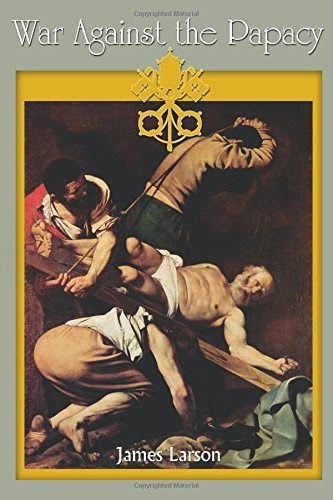
Two Reviews: War Against the Papacy by James Larson and Rending of Christendom Sourcebook

When we launched the Unam Sanctam Catholicam website back in 2012, we originally featured a little store to sell our self-published books and other merchandise. 

Last month, I revamped the USC web-store and hosted it at a separate site called Cruachan Hill Press. Cruachan Hill is the name I self-published my earliest books under; I have retained the name for all subsequent works. We now have 8 books published under the Cruachan Hill name, along with 1 eBook and the always popular "Free Constantinople" T-shirt.

We are kicking off the new Cruachan Hill web store by offering a series of new books. First, the Rending of Christendom Primary Document Catholic Study Guide and Answer Key. These books are designed for home schoolers studying the history of the Protestant Revolt who wish to use primary sources.

From ancient Greece until the early 20th century, the study of history consisted in reading primary sources: documents written first-hand by persons involved in historical events. This reliance on primary sources was abandoned at the dawn of the 20th century by educational ‘reformers’ who pushed learning by textbook instead - with the result that most students now have no contact with the great documents of the past.

Featuring biographies, theological treatises, papal bulls and polemics from the towering figures of the 16th and 17th centuries, The Rending of Christendom sourcebook puts students in direct contact with the past by immersing them in the controversies of the period to learn its history first hand from those who were there. Catholic writings such as those Bellarmine, Borromeo, and the martyrdom of Thomas More, but also Protestant sources like Luther's 95 Theses and excerpts from the ecclesiastical ordinances of Calvin come together to give students a firsthand look at the religious landscape of the tumultuous period.

The book was originally designed to supplement one of my courses I teach through Homeschool Connections, but it can stand alone and includes a recommended reading schedule for semester long course to help parents pace the course accordingly. And - if you are not the sort of parent that likes grading essays, there is an answer key (sold separately) to help you along with this.  Click here for a review of the Rending of Christendom sourcebook from Mary Ellen Barrett's website.

Contains readings and study questions intended for ages 14–18, 110 pages, paperback. For more information, please visit the Cruachan Hill webstore here

Our second book is War Against the Papacy by author James Larson. James Larson is one of the best traditional Catholic authors out there. Many of you may have visited his website, War Against Being, where his voluminous articles advocate a return to God using the golden wisdom of St. Thomas Aquinas. I have always appreciated Mr. Larson's essays; not your typical traditionalist, Mr. Larson does not harp on Vatican II or the 1960's as the source of our troubles but takes us way back to the 14th century, showing how our troubles all began when Catholics started to abandon Thomistic metaphysics. If you have never frequented Mr. Larson's site, I strongly recommend it.

"Thou art Peter, and upon this rock I will build my Church" (Matt. 16:18). It was to St. Peter that our Lord entrusted the Keys of the Kingdom and vowed that his faith would never fail. For centuries the Petrine office has been the bulwark of truth against heresies and ideologies which threaten the integrity of the Church's faith. In War Against the Papacy, James Larson explains why the apparent auto-demolition of the papacy under the post-conciliar popes has not changed this fundamental reality - and why attacks against the papacy, even in the name of tradition, betray a lack of trust in Christ's promise to St. Peter.

Larson presents a much needed balance in contemporary discussions of the papacy. While not denying the troubling and often scandalous actions of the modern popes, he nevertheless argues convincingly that no pope has lost the faith, and why full and formal union with Rome remains a Catholic's only option. Liberal errors about a new ecclesiology in the spirit of Vatican II are refuted, but Larson is equally harsh with Sedevacantists, as well as the arguments put forward by certain traditionalists, whom Larson critiques from a traditionalist standpoint. Those looking for balance in a traditionalist approach to the papacy will appreciate Larson's studious, patient, and deeply spiritual examination of the papal office.

War Against the Papacy is 160 pages, paperback, $16.49 + shipping. Please click here to purchase War Against the Papacy from the Cruachan Hill product page.

Sunday, February 08, 2015

Book Review: "On The Marks of the Church"


Many of you are aware of Ryan Grant's Bellarmine Translation Project, which is the most prominent literary endeavor of Mediatrix Press, the publishing arm of the Athanasius Contra Mundum blog apostolate. If you are unfamiliar with this project, you can listen to Ryan's podcast here explaining the rationale for this mammoth undertaking.

But, to sum it up, St. Robert Bellarmine, S.J. (1542-1621) was a pillar of the Counter-Reformation and one of the greatest theological luminaries in the Church's history. Along with the work of other great saints of the era like Philip Neri and Charles Borromeo, Cardinal Bellarmine's theology helped establish the direction of the post-Tridentine Church, especially vis-a-vis its engagement with the deficient theologies presented by Protestantism.

Like St. Paul, we may say of Bellarmine that though his bodily presence was weak, his writings were voluminous and powerful. Though Bellarmine was not the most innovative or profound theologian ever, the sheer universality of his knowledge and scope of his writing makes him unique among Catholic authors - perhaps occupying a plane with St. Augustine and a few others. Bellarmine not only knew every aspect of Catholic theology exhaustively, but also had read and understood all the arguments of the heretics as well, often demonstrating an astonishing ability to cut through the polemic and isolate the most fundamental characteristics of each heresy.

His pivotal work was De controversiis, a encyclopedic synopsis of all the heresiarchs of the Reformers and their doctrines, along with refutations of their errors. St. John Fisher had undertaken a similar work against Luther; Bellarmine picks up where Fisher left off, making invaluable new contributions along the way - for example, in being the first Catholic theologian to undertake a systematic refutation of Calvin. Thus De controversiis is a work of astounding breadth and great importance, both as a work of theology and as a historical cross-section of the state of the Protestant movement in the first generation after Trent.

Given this, it is very odd that this important work of Bellarmine was never translated into English. There are various reasons for this; but our dear friend Ryan Grant at Athanasius Contra Mundum has undertaken to rectify that with the Bellarmine Translation Project, an effort to make the great works of Robert Bellarmine available to an English audience for the first time.

The first project in this undertaking has just been released: On the Marks of the Church. This work was originally a sub-section of De controversiis, but it may be considered one of the most important portions. In On the Marks of the Church, Bellarmine evaluates the teachings of various reformers on the characteristics of the Church. He refutes them and responds by identifying the true marks of the Catholic Church.

There is a great introduction by Ryan introducing the work and explaining what the nota or "marks" of the Church are - in the words of Bellarmine, "testimonies or signs which discern her from every false religion of the Pagans, Jews, and Heretics", those characteristics or aspects of the Church which "cause it to be evidently believable." Of course, we profess four marks of the Church every week in the Nicene Creed (One, Holy, Catholic, Apostolic); but those familiar with only these four may be surprised that Bellarmine identifies not four but fifteen marks.

Latin translation is always a tricky thing, especially with medieval and early modern Latin, which tends to be overly wordy with a lot of subordinate clauses ("therefore"..."furthermore"..."moreover", etc) and any translator runs the risk of producing a translation that, while being slavishly literal, is not very readable. If you want to know what I mean, check out our very literal rendering of the bull Dum Diversas of Pope Nicholas V (1452). Ryan, an erudite Latinist and experienced Latin teacher, avoids these dangers and gives us a translation that is faithful to the Latin but is eminently readable.

I highly recommend not only this particular work, but your support of the Bellarmine Translation Project in general. You can donate to the project at Ryan's Go Fund Me Page. He has raised over $5,000 so far and will need much more to plough through the remaining works of the great Bellarmine.

Below are the links where you can read about and purchase On the Marks of the Church:

Click here for the product page at Mediatrix Press.

Click here to purchase on Amazon ($15.99 USD)

Friday, January 02, 2015

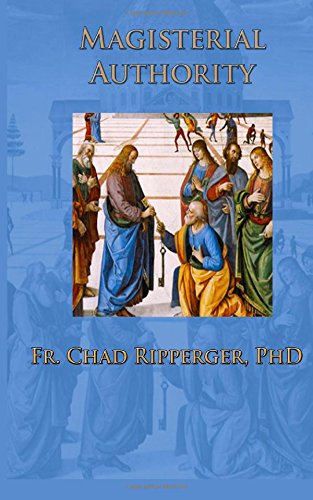
Book Review: Magisterial Authority

There is a gap today in many peoples understanding of the Holy Catholic Faith. What is the Magisterium? What authority does magisterial teaching have, and what degrees of intellectual assent are we required to yield to magisterial teaching? In this short and understandable work, Magisterial Authority by Father Chad Ripperger, the author does a solid job explaining the above in a way that most people who have reached the age of maturity will understand.

This book has already been reviewed here at Rorate Caeli by our friend Ryan Grant of Mediatrix Press. While I enjoyed the book and think Ryan did a great job with his review, I had some different thoughts on the work.

There has been some discussion in the press that the Pope will be publishing an encyclical in the near future throwing his support behind the theory that man is causing global climate fluctuations. Fr. Ripperger's helpful book examines the Pope's authority on matters of science or on other topics outside of faith and morals. If the Pope declares that the science behind man made climate change to be true, does that bind on the conscience of the faithful to accept it as well, or else risk becoming a dissident if one does not?

For being so short, the work is fairly comprehensive; I cannot think of an aspect of magisterial teaching that Father Chad did not at least briefly cover, and there was one particularly time I wished he had covered it more in depth in this short work. In the second essay ‘Various Organs of Infallibility’. The author cites Tuas Libenter, of Pope Pius IX, to say that the universal and constant consensus of Catholic theologians are to be considered infallible, but he limits those to the scholastic schools from between 1100 to 1750:
“When the term Theologians is used, it should not be confused with the generic theologians. The term “Theologians” refers to a specific group of men, viz. those theologians of the various scholastic schools from the twelfth century until the middle of the eighteenth century (roughly during the years of 1100 and 1750). Pius IX in Tuas Libenter says that we are to hold those teachings as pertaining to the Faith not only found in the decrees of the councils but also in the universal and constant consensus of the Catholic Theologians.” pg 30

He cites Scanelli, who observes the following:

“Although the assistance of the Holy Ghost is not directly promised to theologians, nevertheless the assistance promised to the Church requires that He should prevent them as a body from falling into error; otherwise the faithful who follow them would all be led astray.” pg 30-31

In my mind this raised some further questions which perhaps someone can explain for me.
  1. Why is the cut off date 1750 if the Church stills needs their assistance, according to Scannelli?
  2. Why is it limited to the Scholastics?
  3. Is this idea advanced by Pope Pius IX based on previous teaching on the same topic, or is this just one thought in his magisterial teaching?
  4. Is this statement asserting the infallibility of a consensus of theologians itself infallible? From what I understand from Fr. Chads book,  not every statement in an encyclical is infallible.
  5. Who determines if there is a consensus? Reading all the works of the scholastic presents a practical problem to everyone (even Bishops) except other theologians.

One would have to rely a great deal on the integrity of the theologians to point out when there is a lack of a consensus, (which many of them did, like St. Alphonsus, who would routinely cite people who disagreed with his opinion and then state why the thought they were wrong). This could lead to assuming a false consensus when none exists, a sort of “hyper-infallibility” every time someone reads a few theologians in agreement with each other from that era.

In the fourth essay ‘The Proper Response to an Erring Magisterial Member’ Father Ripperger provides some very sound and practical advice that can be very helpful to maintaining peace in ones soul in these tumultuous times. I thought the advice to pray and do penance when one encounters such a thing to be most excellent. It reminded me of a similar exhortation in the Ladder of Divine Ascent by St. John Climacus, that before reproofing one’s brother one should pray and do penance in secret for him.

I would like to add a few thoughts to the last point in the essay: to examine ones conscience, asking “what have I done to deserve better leaders?”.

My desire to elaborate comes in part from the use of the quote from St. John Eudes in the text used in Fathers exhortation, the quote that is ubiquitous in traditional catholic circles from Catholic sites, blogs, forum signatures, memes, and has become a traditional Catholic cliche. The reliance on this singular quotation is curious, since there are many other works on calamity and why bad things happen written by greater authorities that appear to be neglected such as: St. John Cassian’s conference on the Slaughter of Holy Men, and even more modern works like Reparation to the Sacred Heart of Jesus by Father Raoul Plus (A slightly abridged version on Audiobook here).

I wish to draw from that well of knowledge of St. John Cassian, not in opposition to examination of ourselves, or that bad leaders are not sometimes a divine chastisement . Rather that bad leaders in and of themselves are an indifferent kind of thing.

St. John Cassian, in conference 6 talks about the three kinds of things in this world: the good, the bad, and the indifferent. The only thing bad is sin, the only thing good is Godliness and the practice of virtue and the indifferent are

“But those things are indifferent which can be appropriated to either side according to the fancy or wish of their owner, as for instance riches, power, honor, bodily strength, good health, beauty, life itself, and death, poverty, bodily infirmities, injuries, and other things of the same sort, which can contribute either to good or to evil as the character and fancy of their owner directs.” ~On the Slaughter of Some Holy Men, St. John Cassian.

Evil, that is sin we are responsible for can never be forced on us, even if our bodies were possessed by a devil, we are only guilty in so far as we cooperate with evil at the level of our will.

Is our anger at bad leaders because we wish to avoid suffering? If our examination of conscience returns us to compunction and a willingness to suffer then it is good, but we should be cautious as to think that even if we and the majority of Christians should show perfect fidelity to grace for the rest of our lives that we would avoid suffering the scourge of bad leaders.

Bad leaders, whether they are chastisements for the wicked, and/or trials for the just, are to bring out a greater good. Father Chad says “We must make sure that our conscience is clear by making sure that we do prayer and penance to make sure that we have priests and bishops who love and teach the Orthodox Catholic Faith”.pg 58

Can man ever make sure, even by prayer and penance? When our ability to say pleasing prayer and make righteous penance comes from the movement of Grace? When our Lord was in agony, He asked that the cup pass from him, was not His Prayer most perfect? Yet, He said “Thy Will be Done”, and we must pray similarly - when we ask God to send us good and holy priests, it must be within the greater context of His Adorable Will, understanding that He may send us good or bad for His own reasons. God allowed the betrayal of Judas to bring a greater good out of it.  God can allow bad leaders for the same reason, and that He will give the grace to resist the temptations to sin that arise both from their bad example and leadership, and  I cannot conclude otherwise. We cannot make sure why we have bad leaders at any given time, and so we should rather seek to unite ourselves with the will of the Father whether He gives us good leaders, or he allows bad ones for our sanctification. 

Even though I found certain parts I disagreed with, I still found this work is still most necessary, and I feel that it will become even more important in the coming year. I would encourage you to read, buy and distribute this to your friends and family. In my opinion, its presentation is solid and should appeal to more than just traditional Catholics. I certainly plan on passing around my copy.